Best Master's in Machine Learning Programs in Illinois
Compare 5 accredited Machine Learning programs in Illinois, with graduate earnings, cost, debt, and completion data from IPEDS and the U.S. College Scorecard.

Illinois posted 122,609 tech openings over the year ending January 2026, with Chicago finance, logistics, and healthcare employers competing against downstate research universities for machine learning talent.
The ranked schools here pair Evanston, Urbana-Champaign, and Chicago across campus and online formats. GRE policies and pricing vary, but the split is between a dedicated MS in Machine Learning and Data Science, an ML specialization in electrical and computer engineering, and online MEng in AI and machine learning.
Graduate earnings and debt vary enough that the format and specialization you choose should follow your job target.
Key Points
- UIC's online MEng in AI and ML lists $896 per credit across 36 credits.
- Illinois has 328,158 net tech jobs, per CompTIA's 2026 workforce report.
- Confirm each program's GRE rule on its admissions page before applying for 2027.
Top-Ranked Machine Learning Master's Programs in Illinois
Three Illinois options stand out, covering a dedicated ML degree, an electrical and computer engineering master's with an ML specialization, and a fully online engineering master's. Tuition shown is published graduate tuition, net price is an institution-wide average after aid, and graduation rate is school-wide, not specific to the program.
Northwestern University
#1Evanston, IL · ~$55,000/yr (est.)
Best for: Full-time students wanting a tight cohort
Northwestern offers a dedicated ML degree: the Master of Science in Machine Learning and Data Science, a 15-month, full-time campus program in Evanston. It uses a small cohort model with a summer internship, practicum and capstone tied to industry partners. Graduate tuition is $53,452 for in-state and out-of-state students alike, the institution-wide average net price after aid is $29,167, and the school-wide graduation rate is about 95%. Accreditation: Higher Learning Commission, next review 2034-35.
- Dedicated ML and data science degree, not a concentration
- 15-month full-time program on the Evanston campus
- Fall start with a cohort of 55-60 students
- Capstone required, plus a summer internship
- Covers predictive, descriptive and prescriptive analytics
- Minimum 3.0 GPA and three recommendation letters
- Scholarship priority deadline December 1, 2026; regular deadline January 15, 2027
University of Illinois Urbana-Champaign
#2Champaign, IL · ~$19,000/yr (est.)
Best for: Engineers specializing in AI within ECE
UIUC does not offer a standalone ML degree. Its M.S. in Electrical and Computer Engineering includes a field of specialization in Machine Learning, AI and Data Science, so it suits engineers who want depth in hardware, signals or systems alongside ML. Graduate tuition is $15,986 in-state and $31,114 out-of-state, institution-wide average net price after aid is $14,355, and the school-wide graduation rate is about 85%. Accreditation: Higher Learning Commission, next review 2029-30.
- Concentration within an ECE master's, not a dedicated ML degree
- Campus program; one of ten ECE fields of specialization
- Fall application deadline January 15
- Spring application deadline September 1
- Fellowship consideration deadline December 15
- Admission decisions typically announced by April 2
- Applicants submit a research interests preference form
University of Illinois Chicago
#3Chicago, IL · ~$18,000/yr (est.)
Best for: Working engineers needing online flexibility
UIC offers an online Master of Engineering with a focus in Artificial Intelligence and Machine Learning, an engineering master's with an ML concentration rather than a dedicated ML degree. It is a professional, project-based format that blends AI and ML training with leadership preparation. Graduate tuition is $14,390 in-state and $24,588 out-of-state, the program lists $896 per credit, and institution-wide average net price after aid is $10,974. The school-wide graduation rate is about 62%. We did not verify UIC's institutional accreditation for this page, so confirm it directly with the university.
- Concentration within an engineering master's, not a dedicated ML degree
- 100% online, with accelerated 8-week terms
- 36 credit hours across 9 courses
- Completion in as few as 12 months, full-time or part-time
- Non-thesis format with no capstone required
- Covers computer vision, NLP and AI ethics and fairness
- Listed at $896 per credit
Cost & outcomes by school
Federal data for the highest-earning Machine Learning programs, independent of the ranking above. Earnings are this field's master's graduates four years after completing, where the Scorecard reports them.
| School | Earnings | Tuition / yr | Debt | Grads/yr | Format |
|---|---|---|---|---|---|
| Northern Illinois University IL | — | $9,176 | $24,300 | 144 | Campus |
| Chicago State University IL | — | $10,294 | — | — | Campus |
| University of Illinois Chicago IL | — | $17,550 | — | 7 | Online |
| University of Illinois Urbana-Champaign IL | — | $19,278 | — | — | Campus |
| Northwestern University IL | — | $54,655 | — | 35 | Campus |
Sources: U.S. Department of Education. Tuition and graduates: IPEDS. Earnings and debt: College Scorecard, this field's master's graduates; a dash means no figure is reported.
Online and Hybrid Master's in Machine Learning Options in Illinois
The first real decision is whether you need fully online delivery or a campus lab seat, and online master's programs in Illinois divide cleanly on that point.
What's online and what isn't
UIC's Master of Engineering with a focus area in artificial intelligence and machine learning is delivered entirely online, built on accelerated eight-week terms across 36 credit hours, with no thesis or capstone. Full-time students can finish in roughly 12 months; part-time students take one eight-week course at a time and move at their own pace. Northwestern's Master's in Machine Learning and Data Science and UIUC's machine learning, AI and data science track through electrical and computer engineering are campus-based.
UIUC also runs online master's options in computer science, including a data science variant, each requiring 32 credits with an optional AI specialization. Lectures and assignments are asynchronous with occasional live sessions, and students can finish in as little as 12 months full time or stretch enrollment up to five years.
A practical tip
If you want research access, faculty advising, and a lab affiliation, pay the campus premium. If you already hold an engineering or analytics job and need credentials without relocating, the asynchronous route protects your income and lets you slow down during heavy work quarters.
Which Illinois Master's in Machine Learning Programs Waive or Make the GRE Optional?
GRE policies change from one admissions cycle to the next, so treat this table as a starting point and confirm the current rule on each program's admissions page before you apply. The entries below reflect 2026 admissions pages. Where we could not confirm a published policy, the table says so instead of guessing.
| Program | GRE Policy | Waiver Criteria / Notes |
|---|---|---|
| University of Illinois Urbana-Champaign, Siebel School of Computing and Data Science graduate programs | Recommended, not required | General and subject-test scores may be submitted as supporting information. No waiver is needed because the test is not required. |
| University of Illinois Urbana-Champaign, MS in Computer Science / Master of Computer Science | Not required | Applicants may submit scores if they prefer. No waiver process is described. |
| Northwestern University, MS in Computer Science | Not required | GRE scores are not required for the master's application. No waiver process is described. |
| Northwestern University, Master of Science in Machine Learning and Data Science | Not required | Neither GRE nor GMAT scores are required. No waiver process is described. |
| University of Illinois Chicago, machine learning and related master's programs | No policy confirmed | We did not find a published GRE policy in the admissions material reviewed. Check the program's admissions page directly. |
Related Articles
What Does an Illinois Machine Learning Master's Cost, and Do You Need a License?
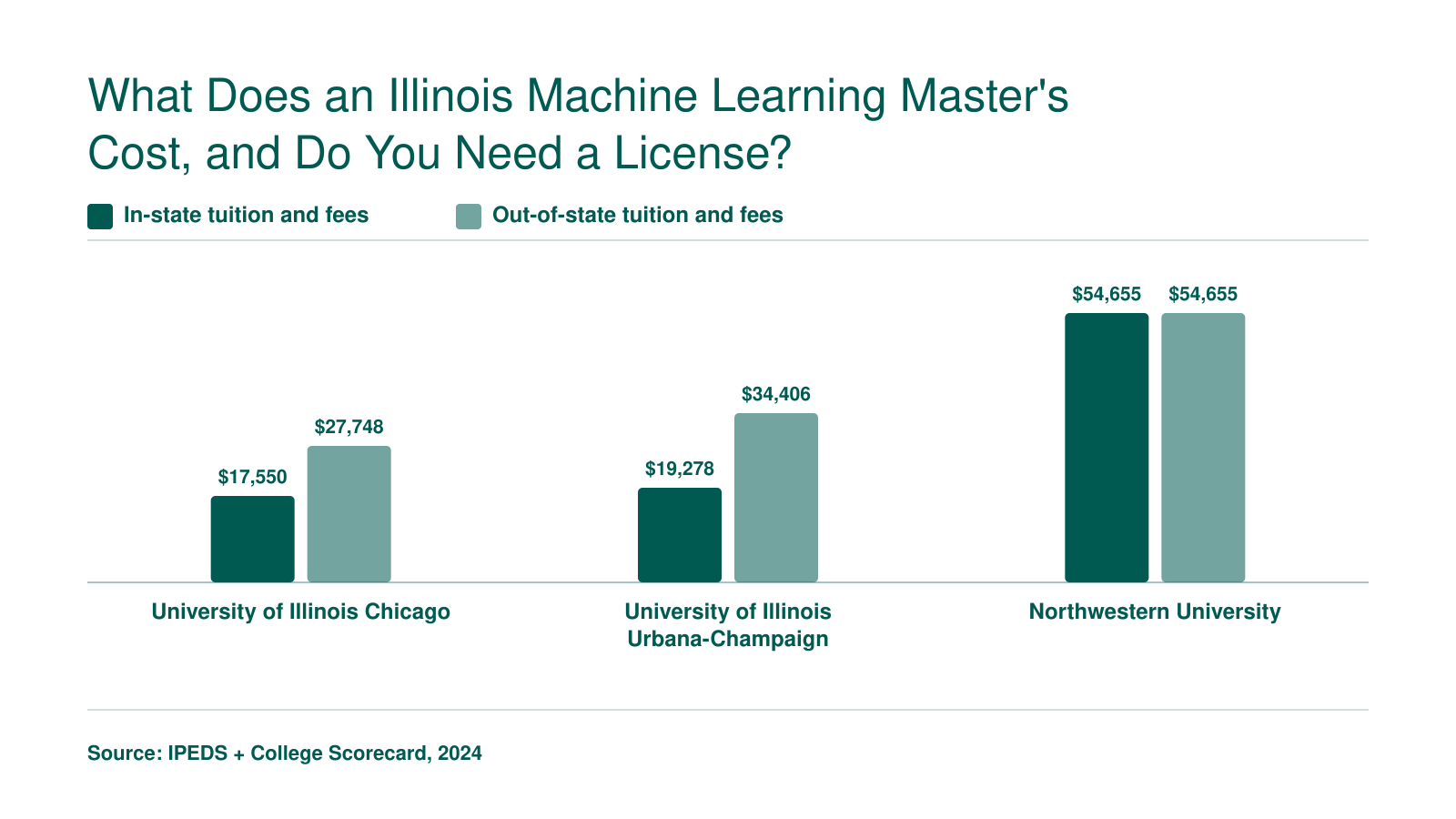
UIC's online MEng in AI and ML lists $896 per credit across 36 credits, which works out to roughly $32,256 before any fees. Northwestern's private-school tuition is the same for in-state and out-of-state students, while the two public universities charge nonresidents noticeably more. Net price is an institution-wide average across all students, not a figure for this specific program. Treat it as a rough guide only. Per-credit rates and total costs for the other two programs were not reliably published, so confirm them with each bursar. Illinois has no state license specific to machine learning practitioners, as far as our research found. Licensure matters only if your work falls under a regulated field such as engineering or finance. Employers commonly recognize voluntary cloud certifications, including AWS and Google Cloud machine learning credentials. These are optional, and no Illinois law requires them.
Career and Salary Outcomes for Machine Learning Master's Graduates in Illinois
Machine learning master's graduates in Illinois enter a market where Chicago's trading firms, health systems, and manufacturers compete for applied machine learning talent. For the specific programs here, the clearest published financial comparators are median federal graduate debt and the return-on-investment signal, not broad institutional salary averages. Median federal graduate debt at completion is $15,000 at Northwestern, $19,500 at Illinois Urbana-Champaign, and $16,704 at Illinois Chicago. Northwestern also leads on return on investment at 5.96, followed by Illinois Urbana-Champaign at 4.16 and Illinois Chicago at 4.12. Those debt levels are modest relative to common six-figure machine learning roles in the region.
Common Illinois job paths include machine learning engineer, data scientist, quantitative analyst, and applied research scientist. Chicago financial services and proprietary trading firms hire heavily for quant and ML roles, while hospital systems, manufacturers, and logistics companies add data science and analytics positions. Some graduates move into applied research scientist roles in corporate R&D or national labs, and students who keep borrowing near the published medians often find repayment manageable.
CompTIA's State of the Tech Workforce 2026 puts Illinois at 328,158 net tech jobs, with employers posting 122,609 openings for tech occupations between January 2025 and January 2026. That hiring volume is the backdrop for any machine learning master's you weigh here.
Admissions and Prerequisites for Machine Learning Master's Programs in Illinois
Requirements vary by department and degree, so confirm details on each admissions page before you apply.
- Degree and GPAA four-year bachelor's is the baseline. UIUC's MS in Computer Science lists 3.20/4.00 for consideration, and its Professional MCS recommends 3.2 but does not treat it as absolute. UIC asks for 3.0 overall or 3.5 over roughly the last two years.
- Math and programmingUIUC's Professional MCS expects object-oriented programming, data structures, algorithms, linear algebra, and statistics or probability. UIC lists specific CS foundation courses.
- Application materialsExpect a statement of purpose, recommendation letters, and English proficiency scores for international applicants. UIC generally requires the GRE for international MS applicants, while UIUC's Professional MCS requires no exam.
- Non-CS majorsUIUC asks non-CS applicants to show the prerequisite courses above. UIC occasionally admits very strong applicants from other fields as non-degree students to complete foundation CS coursework first.
- SelectivityPublished GPA figures are thresholds for consideration, not guarantees of admission. Strong math and programming preparation matters as much as the GPA.
How We Rank Illinois Machine Learning Master's Programs
A useful Illinois machine learning ranking has to weigh price and payoff side by side. We compare graduate tuition, net price, delivery format, and institution-wide graduation rates, then pair those with College Scorecard program-level earnings and debt where published. A school-wide figure for graduation rate or net price describes the institution as a whole, while earnings and debt figures belong to the machine learning program itself when that data is available. We count a program as a dedicated ML degree only when the curriculum centers on machine learning, not when it is a general computer science, AI, or data science master's with a few related electives. Because tuition and GRE policies change between admissions cycles, confirm the current numbers and testing requirements directly with each school before applying.
Compare Machine Learning programs on the data that matters
Explore more Computers & IT specializations or browse every graduate field.
All Computers & IT programs