Most Affordable Master's Programs
Ranked lists re-ordered by graduate tuition, lowest first, so the cheapest way into each field is at the top. Earnings and debt still show on every card.
A master's program advertised at $450 per credit can cost more than one listed at $700. The difference hides in mandatory fees, extra credit requirements, out-of-state surcharges, and a degree that never pays back what it took to earn. Per-credit tuition is the number marketing pages lead with, even in lists of affordable MBA programs, and it is rarely the number that lands on your bill.
Start with the field and specialization links above. From there, any program's affordability claim should pass four tests: total cost, accreditation, outcomes (debt against likely salary), and format and residency pricing. A verification checklist closes the page.
A low sticker price is easy to publish. A low net price paired with solid graduate earnings is much harder to fake.
Key Points
- Employer assistance under IRS Section 127 can exclude up to $5,250 per year.
- Public universities often charge nonresidents over 300 percent of the resident rate.
- Confirm accreditation first, then compare total cost against College Scorecard earnings and debt.
Business & Management
Education & Teaching
Nursing
Healthcare
Communications & Media
Psychology
Social Work & Social Sciences
Counseling
Computers & IT
Science & Engineering
Religion & Theology
Arts & Design
Criminal Justice & Law
What Does 'Affordable' Actually Mean for a Master's Degree?
Affordable is not a single figure; it is four different numbers that admissions pages often blur together. The sticker price you see advertised is usually a per-credit tuition rate. A published cost of attendance adds books, supplies, room, board, transportation, and loan fees for one academic year. Net price subtracts the grant and scholarship aid a student actually receives. Total degree cost multiplies the required credits by the per-credit price and adds every mandatory fee across the whole program.
Four Numbers That Get Confused
- Sticker tuition: The per-credit rate or annual tuition before any aid.
- Published cost of attendance: Sticker plus estimated living and indirect expenses for one year.
- Net price after aid: What remains after grants and scholarships, though graduate aid is usually much smaller than undergraduate aid.
- Total degree cost: Required credits times per-credit price plus program, clinical, technology, and graduation fees.
At the master's level, grants are scarce. Most graduate aid is federal loans, not free money, so a school's "net price" looks less like a discount and more like a borrowing plan. Because the sticker-to-net gap is smaller, the total degree cost is the number that should anchor your comparison.
Affordability Is Relative to What the Degree Buys
A $15,000 degree is not affordable if it cannot meet a state's licensure requirements or does not change your earnings. A $40,000 degree can be a better value if it raises your salary by twice that amount within a few years. Cost alone tells you nothing without accreditation, licensure readiness, and post-graduate earnings attached to it.
Always Multiply by Required Credits
Per-credit pricing hides total cost. A 30-credit program at $600 per credit costs $18,000 before fees. A 48-credit program at $450 per credit costs $21,600 before fees. The lower per-credit rate is the more expensive degree. Before comparing any program, find the required credit total and multiply.
The remaining sections evaluate affordability in that order: cost, accreditation, outcomes, and format.
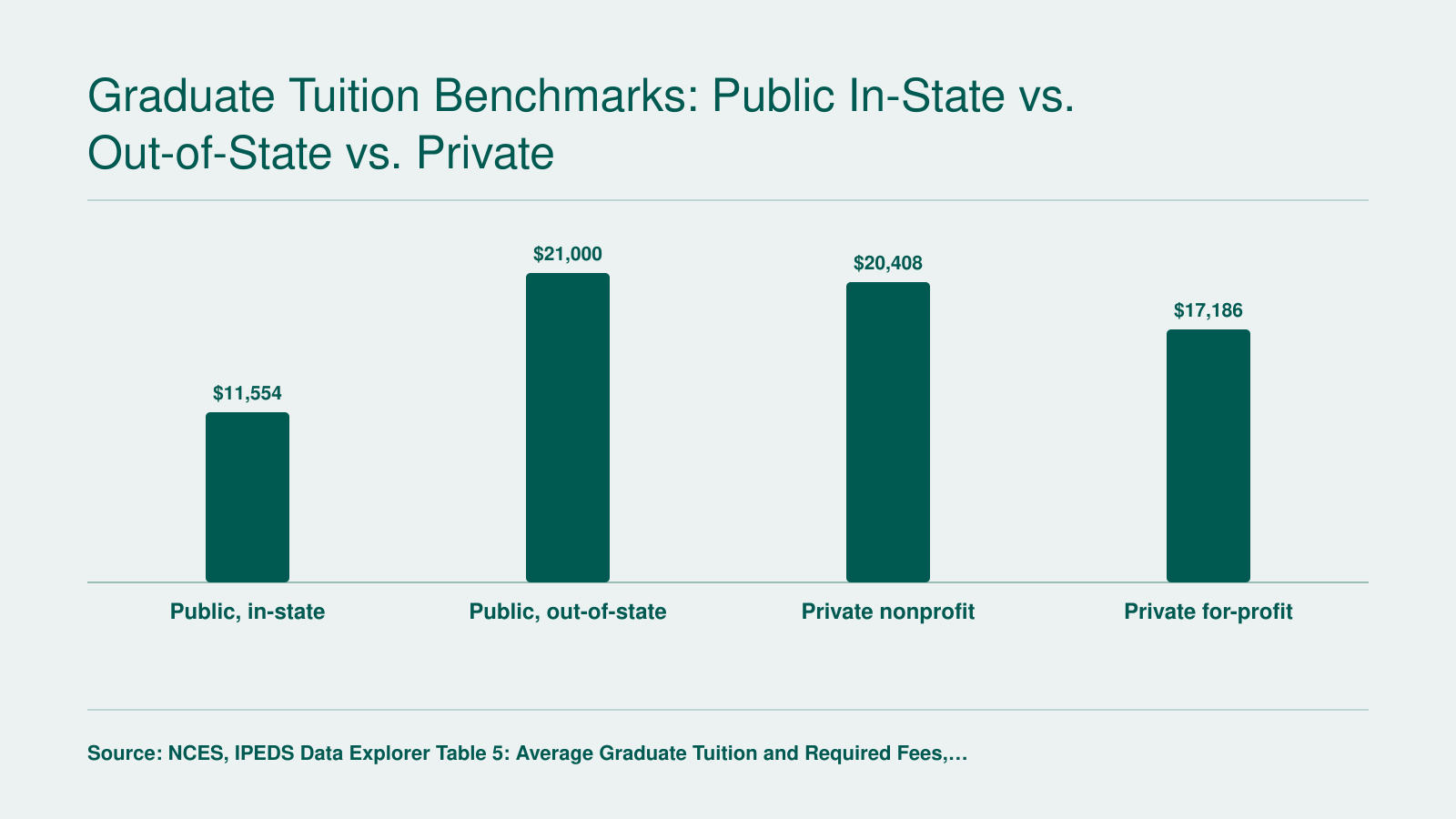
Graduate Tuition Benchmarks: Public In-State vs. Out-of-State vs. Private
Use these national averages as a yardstick, not a price quote. A program well below the public in-state average is genuinely low-cost, while one priced near the private nonprofit average is not affordable, whatever its marketing says. The figures are average annual graduate tuition and required fees for 2022-23, the most recent national breakdown available from NCES IPEDS. They are sticker prices before grants or scholarships and exclude doctoral professional-practice programs.
How to Calculate the Total Cost of a Master's Degree (Not Just Tuition)
The tuition figure on a program's homepage is the smallest honest number published, and the real total cost of a master's degree almost always runs higher.
The Formula
Total cost = (per-credit tuition × total required credits) + (per-term mandatory fees × number of terms) + one-time fees (application, matriculation, graduation) + books and materials + technology or online-delivery fees.
Each piece usually sits on a different page of the bursar's site, which is why so many students underestimate. There is no national standard for graduate fees. Schools set them individually, and they shift with enrollment status and delivery mode. A few 2026 examples show the spread:
- Distance fees: University of Kentucky adds $10 per credit for distance courses.1 University of Cincinnati Online charges $22 per credit part-time.2 UT Knoxville's fully online programs carry a $100-per-credit online support fee.3
- Per-term fees: Full-time Kentucky graduate students with any in-person class pay $731.50 per term in mandatory fees, versus $282.50 for exclusively distance students.1
- Exit fees: UT Knoxville's master's graduation application is $30.3 The University of St. Thomas in Minnesota lists a $210 graduation fee.4
- Books and supplies: The Urban Institute puts typical budgets around $1,300 a year for master's and doctoral students and about $1,700 for professional-degree students.5
A Worked Example
These round numbers are illustrative, not drawn from any one school. A 30-credit program at $400 per credit advertises $12,000. Now add the rest:
- Per-term fees: $500 × 5 terms (one more than planned) = $2,500
- Online-delivery fee: $25 × 30 credits = $750
- One-time fees: about $225 for application and graduation
- Books and materials: roughly $1,000
- Thesis continuation: 3 extra credits = $1,200
The "$12,000 program" now costs about $17,700, nearly 50 percent more than the sticker.
Design Choices That Quietly Add Cost
Read the curriculum, not just the price sheet. Watch for thesis continuation fees charged each term until you defend, practicum or internship terms that still bill full tuition even though you are working off-site, required on-campus residencies that mean flights and hotels for an "online" degree, and prerequisite or leveling courses that add credits if your undergraduate background doesn't match.
Why Slower Pacing Costs More
Part-time study is often the right call for working adults, but it isn't free. Every extra term triggers another round of per-term fees, and tuition rates typically rise from one academic year to the next, so credits taken in year three may cost more than the same credits in year one. When you compare programs, price the pace you will actually keep, then build in one buffer term. If the program still fits your budget under that scenario, it is genuinely affordable.
Cost Line Items to Find on Every Program's Tuition Page
Program marketing pages often show only a headline tuition figure, while the full fee schedule lives on the university's bursar or student accounts site. Use this table as a lookup while you browse, and fill in every row for each program before you compare prices. A program that looks cheaper on its own page can cost more once the missing lines are added.
| Cost Item | How It's Usually Charged | Where to Find It | Why It Changes Your Total |
|---|---|---|---|
| Per-credit tuition | Flat rate per credit hour, often with separate resident, nonresident, and online rates | Bursar or student accounts tuition page; program admissions page | This is the base rate. Confirm which residency or online rate applies to you before multiplying. |
| Total required credits | Fixed number of credit hours to graduate, including any prerequisites or bridge courses | Program curriculum page; graduate catalog; program handbook | Credits multiplied by the per-credit rate gives your true tuition. A higher rate on a shorter degree can still cost less. |
| Mandatory per-term fees | Flat charge each semester or quarter, sometimes tied to enrollment level | Bursar fee schedule, often a PDF listed by term | These repeat every term, so a longer or part-time path pays them more times. |
| Online or distance learning fee | Per credit or per course for online sections, sometimes on top of tuition | Bursar fee schedule; online program cost page | Can erase the savings of an online format, or replace the on-campus fees you would otherwise pay. |
| Technology fee | Per credit, per term, or per year | Bursar fee schedule; general student fees page | Small per-credit amounts add up over a full degree. |
| Program-specific or differential tuition | Higher per-credit rate for certain programs, such as business, engineering, or nursing | Bursar page listing rates by college or program; program handbook | The university's general graduate rate may not apply to your program. Check the rate for your exact degree. |
| Practicum, clinical, or residency costs | Course fees, supervision fees, background checks, travel, or required on-campus sessions | Program handbook; practicum or field placement page; ask the admissions office | These are rarely in the tuition figure but can be significant, especially for required in-person components. |
| Application fee | One-time charge per application | Graduate admissions application page | Applying to several programs multiplies this cost. Ask about fee waivers. |
| Graduation or degree conferral fee | One-time charge in your final term | Bursar fee schedule; registrar graduation page | Easy to miss, and charged even if you finish with no other balance due. |
Accreditation: Why It Must Come Before Any Cost Comparison
The Council for Higher Education Accreditation (CHEA) directory lists more than 8,200 accredited institutions as of September 2026, so a legitimate accreditor is easy to find for any real school.1 A program that cannot point to one has no business on a list of affordable options, however low its tuition.
Two Kinds of Accreditation
Institutional accreditation evaluates the whole school: governance, finances, faculty, student services, and outcomes. Programmatic accreditation reviews a specific professional or specialized program.2 CACREP, for example, accredits counseling programs3, and AACSB, CCNE, CSWE, and ABET cover business, nursing, social work, and engineering. A master's program can hold the first without the second, and the second never replaces the first. For licensure-track fields, you need to confirm both.
How to Verify It
Do not trust a logo or the word "accredited" on a marketing page. Work through these steps:
- DAPIP: Search the school in the Department of Education's database by name, state, city, or OPE ID.4 Match the exact campus, since similar names and renamed schools can carry different status.
- CHEA directory: Check the institution there too. The two databases are complementary, and a mismatch is a reason to ask questions, not an automatic disqualifier.
- The accreditor's own site: Confirm the school or program is listed, with the right campus, delivery format, and dates.
- Record the details: Note the accreditor, status, review dates, and any adverse actions. If sources disagree, ask the accreditor for a written explanation.
What Skipping This Costs
An unaccredited or wrongly accredited degree can mean no federal aid eligibility, credits that will not transfer, ineligibility for licensure, and a credential that employers and doctoral programs decline to recognize. Nothing suggests that accreditation earned after you enroll retroactively validates a degree you have already finished.
Red Flags in Very Cheap Programs
- An accreditor that is not recognized by the Department of Education or CHEA, or one whose name closely resembles a recognized agency.5
- "Membership," "approval," or "international accreditation" offered in place of recognized accreditation, a pattern common with accreditation mills.5
- Per-degree pricing, a classic diploma mill sign.6
- "Candidacy" status, which is not full accreditation.
- An accredited institution whose specific program has no programmatic accreditation, when your field or state licensing board requires it.
Salary Outcomes and Graduate Debt: The Real ROI Test
The federal College Scorecard now surfaces median earnings for master's completers at one, four, and five years after finishing, giving prospective students a longer window than the old three-year lookback but still demanding cautious reading.1
Read the Scorecard by field and credential level
On the College Scorecard field-of-study pages, as the field-of-study data documentation explains, select a school and master's credential to see median cumulative federal debt and median earnings for completers in that field.2 The debt figure includes federal loans from any prior school, not only the program shown.3 Earnings represent completers who are working and not enrolled during the measurement year, reported from W-2 wages and self-employment income, as the College Scorecard Glossary notes, so they do not reflect everyone who finished the master's.2
Run the first-year salary test
A practical rule many advisors use: keep total borrowing at or below expected first-year salary. For example, a program where median cumulative debt is around $55,000 and median early earnings are about $55,000 sits at a 1.0 debt-to-earnings ratio. If debt is $70,000 and the same field pays $50,000, the ratio is 1.4, a warning sign. The exact threshold varies by field, but the direction is simple: below 1.0 is easier to manage, above about 1.25 gets uncomfortable.1 The national median for workers with a master's is about $1,574 per week versus $1,432 for a bachelor's, roughly a $7,400 annual premium before field differences.1
Know what the Scorecard cannot tell you
Scorecard debt covers only federal borrowers, not all graduates, and some small programs suppress medians for privacy.4 Early-career earnings understate fields with long training, licensure, or promotion ladders, so a low first-year number in mental health counseling or nursing does not mean the degree lacks value. The right comparison is the same field at other schools, not one field against another.
Avoid the low-cost trap
A cheap program is not automatically good ROI. In education and humanities, the master's wage premium over a bachelor's is often only $2,000 to $5,000 per year, while health, computer science, and engineering see $15,000 to $30,000.1 If a low-tuition humanities master's adds only a few thousand dollars in annual pay and leaves $40,000 in debt, the arithmetic is worse than a pricier engineering program that doubles earnings.
The Master's Degree Earnings Premium
Median usual weekly earnings for full-time workers with a master's degree
Online, Hybrid, and On-Campus: Residency Pricing and Licensure Catches
Public universities typically charge nonresidents more than 300 percent of the resident rate,1 so the first question for any online program is whether that gap follows you onto the screen. Sometimes it does not. Many public universities price online master's programs at one flat rate for every student. Others keep in-state and out-of-state tiers, or add an e-tuition surcharge. No national standard exists2, so confirm the exact rate on the school's bursar page rather than relying on a program brochure.
Check the Fine Print on a Flat Rate
A published online rate can still hide distinctions. Confirm whether it is charged per credit or per term, whether it applies to all credits, which mandatory fees are added, and whether summer terms or cohort programs are priced differently. Professional programs in business, nursing, and education, including special education master's degree online options, often cost more than the standard graduate rate.
Regional Reciprocity Can Lower Out-of-State Costs
If you live in the West, WICHE's Western Regional Graduate Program lets residents of WICHE's 16 member states and territories (including American Samoa, CNMI, and Guam) enroll in selected out-of-state public graduate certificate, master's, and doctoral programs at up to 150 percent of the resident rate.3 Most institutions charge plain resident tuition.1 Eligibility is program-specific, so check WICHE's Savings Finder for your target program.4 Midwest and Southern regions run similar exchanges, but terms differ, so verify each one directly.
State Authorization and Licensure
A school must be authorized to enroll online students in your state, often through NC-SARA reciprocity.5 That authorization does not approve a program for licensure. State licensing boards make that call.5 For counseling, nursing, teaching degrees, or affordable MSW programs, find the school's professional licensure disclosure and look for your state by name. Schools must state whether the curriculum meets each state's requirements, tell you before enrollment if it does not or has not been determined, and notify enrolled students within 14 calendar days if that status changes.6
Count the Costs Beyond Tuition
On-campus study adds housing, relocation, and often lost wages, which can outweigh any tuition difference. Online formats usually let you keep working. Also weigh degree structure: a thesis, capstone, or required internship can extend time to degree, and every extra term adds tuition, fees, and forgone income. Ask each program how long students typically take to finish, not just how long the catalog says it takes.
Ways to Cut the Price Further: Employer Aid, Assistantships, and Transfer Credit
Sticker price is only the starting point, and several levers can shrink what you actually pay. The biggest ones sit outside the tuition page.
Employer Tuition Assistance
Under IRS Section 127, an employee can exclude up to $5,250 per calendar year of employer educational assistance from taxable income (the 2025-2026 limit).1 It covers tuition, fees, books, supplies, equipment, and certain student loan payments, for undergraduate or graduate study.2 It does not cover meals, lodging, or transportation.3 The employer must have a written plan,5 and unused amounts do not carry forward.2 Anything above $5,250 is generally taxable wages unless another provision applies.4
Before you enroll, ask HR for the plan in writing and look for repayment or retention clauses. Many employers require you to repay the benefit if you leave within a set period.
Graduate Assistantships
Assistantships typically pair a tuition waiver with a stipend, and some add health insurance or help with mandatory fees.2 Terms vary widely by university, department, and appointment: work hours, duration limits, and academic-progress requirements all differ, and a stipend rarely covers full living costs. These positions are more common in on-campus, research-oriented programs than in online professional degrees, so do not count on one if you are comparing online options. Assistantship waivers are also separate from Section 127 aid, so ask how each is taxed.
Transfer Credit and Speed
Many programs accept a limited number of graduate credits from accredited schools.6 Six semester credits is a common cap, some allow nine or twelve, and others cap transfers near 25 percent of the degree (about 7.5 credits in a 30-credit program, usually rounded to 6 or 9).6 Typical conditions include:
- Level: The credits must be graduate-level and relevant.
- Grade: A minimum of B is common.
- Recency: Older coursework may not qualify.
- Approval: The program or graduate school must sign off.
Some schools also award credit for completed graduate certificates. Ask for the transfer policy in writing before you apply.
Shortening time to degree cuts cost too. Accelerated terms or competency-based formats can help experienced students finish sooner, but confirm accreditation first.
File the FAFSA
Graduate students are treated as independent, so parental income does not count. Filing the FAFSA opens federal loans and some institutional aid, and many schools use it to award their own funds.
Affordability is not the lowest tuition you can find; it is the total price you pay after aid measured against the salary the degree actually helps you earn.
Your Admissions-Page Verification Checklist
Before you trust any "affordable" label, run each program through these six checks. Most take a few minutes and can save you thousands of dollars.
- Confirm accreditationLook up the institution in the Department of Education's DAPIP database or on CHEA. If your field requires programmatic accreditation, such as for counseling, nursing, or business, verify that separately.
- Multiply credits by per-credit tuitionFind the total required credits and the per-credit rate for your residency status and format, then multiply. Don't rely on a single advertised figure.
- Download the fee scheduleAdd per-term, online, technology, and graduation fees to the tuition number. These often sit on a separate page from tuition.
- Check the licensure disclosureIf the degree leads to a license, read the program's professional licensure disclosure for your state. A cheap program that doesn't qualify you in your state costs more than it saves.
- Look up debt and earningsSearch the program on College Scorecard for median debt and earnings. If program-level figures aren't published, say so in your notes and treat the comparison with caution.
- Ask admissions in writingRequest written answers on transfer credit, typical time to completion, and any thesis, practicum, or residency costs. Written answers give you something to point to later.
Affordable Master's Programs: Common Questions
These answers cover the questions prospective students ask most often when comparing low-cost options. Costs and requirements vary by school, so confirm every figure on the admitting program's own pages.