Most Affordable Master's in Psychology Programs
Compare 200+ accredited most affordable General Psychology programs at 190+ schools, with graduate earnings, cost, debt, and completion data from IPEDS and the U.S. College Scorecard.

Per-credit rates are the most misleading number in graduate admissions, and health psychology master's programs cost comparisons can hide the same problem. A program advertised at a few hundred dollars a credit can cost far more once out-of-state surcharges, term fees, and required campus trips are added, so the cheapest-looking option often isn't.
The schools ranked here are sorted by real cost signals: net price, graduate tuition, median debt, and earnings, not prestige. Several California State campuses, CUNY Queens College, and American Public University all appear on that basis.
One caution applies throughout. A general psychology master's, like most of these and many social psychology master's programs, prepares students for research roles or doctoral study. It does not lead to a counseling license, which requires a separate, licensure-track degree.
Key Points
- 2027 rankings weigh real graduate earnings and net price, not prestige.
- Louisiana Monroe charges online students the same rate regardless of residency.
- Confirm programmatic accreditation before paying tuition; your license may depend on it.
The 10 Most Affordable Master's in Psychology Programs for 2027
These ten schools pair lower sticker prices with meaningful graduation and aid data. We highlight what makes each program distinctive, from research intensity to clinical hours, so you can compare the real fit beyond the published fee.
California State University-Los Angeles
#1Los Angeles, CA · ~$9,000/yr (est.)
Best for: Doctoral-oriented students valuing research mentorship
Cal State LA offers a research-oriented master's in psychology built around a thesis and close faculty mentoring. The program prepares students for doctoral study or research careers, with a prerequisite path for applicants who did not major in psychology.
- Research-focused curriculum with thesis requirement
- Requires 31-32 units total
- 2.8 GPA minimum for admission
- Prerequisite courses required for non-psychology majors
- Close faculty mentoring relationship
California State University-San Bernardino
#2San Bernardino, CA · ~$10,000/yr (est.)
Best for: Neuro-curious learners wanting hands-on research
Cal State San Bernardino's master's in psychological science emphasizes active research under faculty guidance. It offers two concentrations, including a General track and a Behavioral and Cognitive Neuroscience track, making it a fit for students considering doctoral work in multiple subfields.
- Two concentrations: General and Behavioral/Cognitive Neuroscience
- Active research with program faculty
- Courses across basic psychology areas
- Prepares for doctoral programs in psychology
California State University-Fresno
#3Fresno, CA · ~$9,000/yr (est.)
Best for: First-generation scholars pursuing data analysis
Fresno State's General/Experimental psychology master's uses a mentorship model with small cohorts of two to three students per faculty member. The curriculum emphasizes experimental design, advanced statistics, and a thesis, and graduates often pursue doctoral study or roles in research analysis and program evaluation.
- Mentorship model with small cohorts of 2-3 students
- Thesis required with experimental design
- Curriculum includes advanced statistics and research methods
- Prepares for doctoral programs and analysis roles
CUNY Queens College
#4Queens, NY · ~$12,000/yr (est.)
CUNY Queens College offers a flexible general master's in psychology with either a thesis or comprehensive exam capstone. Students can choose 30 credits with thesis or 36 credits without, and the program draws electives from cognition, neuroscience, developmental psychology, and psychometrics.
- 30 credits with thesis or 36 credits without thesis
- Elective options across cognition, neuroscience, developmental, psychometrics
- 3.0 GPA minimum for admission
- Comprehensive exam or thesis capstone
California State University-Dominguez Hills
#5Carson, CA · $9,000 – $19,000/yr (est.)
Cal State Dominguez Hills provides a master's in psychology with clinical and health tracks. The clinical option includes 550 supervised practicum hours, while the health option requires a thesis. The degree also maps toward an LPCC path with additional units and clinical hours.
- Clinical track: 33 units and 550 supervised practicum hours
- Health track: 36 units with thesis
- LPCC path requires 63 units including 280 face-to-face clinical hours
- Test optional; no entrance exam required
California State University-Fullerton
#6Fullerton, CA · $9,000 – $19,000/yr (est.)
Cal State Fullerton's master's in psychology is a 36-unit academic program with a thesis, designed more for research and doctoral preparation than for clinical or counseling practice. Admission is competitive, with GRE scores and three letters of recommendation required.
- 36 units: 18 core, 12-15 content courses, thesis research
- GRE required; fall intake only
- 3.0 GPA and 3 letters of recommendation required
- Not a clinical or counseling path; designed for research or doctoral prep
American Public University System
#7Charles Town, WV · $5,000 – $10,000/yr (est.)
American Public University's online master's in psychology is designed for working adults who want breadth. The General Concentration pairs a 21-credit core with four electives chosen from about 15 courses, and the program does not lead to licensure or professional certification.
- 39 credit hours, fully online
- General concentration: 21 core hours plus four electives from about 15 courses
- Does not lead to licensure or professional certification
- Thesis sequence; focuses on applied roles and further study
California State University-Northridge
#8Northridge, CA · ~$9,000/yr (est.)
CSUN's master's in psychology blends research training with clinical assessment exposure. Students choose either a Clinical Research track with a thesis or a Clinical Fieldwork track with a comprehensive exam, and on-campus clinics provide supervised practical experience.
- Two options: Clinical Research thesis or Clinical Fieldwork exam
- On-campus clinics include Child/Adolescent Diagnostic Assessment and Anxiety/Mood Disorders
- Teaching Intern Program offers monthly stipend
- Prepares for Ph.D. or Psy.D., not independent private practice
California State University-Long Beach
#9Long Beach, CA · $9,000 – $19,000/yr (est.)
Cal State Long Beach offers a 30-unit master's in psychological research over four semesters. Cohorts are capped at 15 or fewer students, and the program emphasizes core seminars across psychology subfields with a thesis defense.
- No GRE required; 30 units over four semesters
- Cohorts of 15 or fewer students; thesis defense required
- 2.5 GPA minimum; January 15 deadline
- Core seminars in cognition, learning, social, personality, health, clinical, developmental, quantitative methods
University of West Florida
#10Pensacola, FL · $5,000 – $10,000/yr (est.)
University of West Florida's master's in psychology offers two concentrations: Counseling Psychology leading toward Licensed Mental Health Counselor and Industrial-Organizational Psychology. The degree requires 42-60 credits, and students complete either an internship or a thesis.
- 42-60 semester hours depending on concentration
- Concentrations: Counseling Psychology (LMHC) and Industrial-Organizational Psychology
- 3.0 GPA and 2 letters of recommendation required
- 6-credit internship or thesis; up to 10 transfer credits accepted
Cost & outcomes by school
Federal data for the highest-earning General Psychology programs, independent of the ranking above. Earnings are this field's master's graduates four years after completing, where the Scorecard reports them.
| School | Earnings | Tuition / yr | Debt | Grads/yr | Format |
|---|---|---|---|---|---|
| San Diego State University CA | $111,549 | $10,252 | $30,710 | 26 | Campus |
| California State University-Fresno CA | $90,681 | $8,865 | — | 9 | Campus |
| Fairleigh Dickinson University-Metropolitan Campus NJ | $86,294 | $19,068 | — | 12 | Campus |
| California State Polytechnic University-Humboldt CA | $79,429 | $9,921 | $38,684 | 30 | Campus |
| Missouri State University MO | $76,762 | $8,204 | — | — | Campus |
| California State University-Chico CA | $75,000 | $9,996 | $34,125 | 25 | Campus |
| Stony Brook University NY | $71,005 | $14,222 | $22,014 | 21 | Campus |
| University of Houston-Clear Lake TX | $70,718 | $9,762 | $29,222 | 16 | Campus |
| Touro University Worldwide CA | $65,760 | $9,000 | $27,075 | — | Online |
| Arizona State University AZ | $63,039 | $10,843 | $34,643 | 414 | Online |
| Southern New Hampshire University NH | $58,824 | $21,387 | $40,872 | 956 | Online |
| Cameron University OK | — | $5,022 | — | — | Online |
Sources: U.S. Department of Education. Tuition and graduates: IPEDS. Earnings and debt: College Scorecard, this field's master's graduates; a dash means no figure is reported.
Cost, debt & payoff
Median earnings of this field's master's graduates (4 yrs after completing) vs. their median federal loan debt · U.S. College Scorecard
Across these programs the median graduate earns about $63,039 and finishes with roughly $37,184 in debt — a ratio that clears a common rule of thumb (keep debt below first-year salary). Tuition and debt vary widely school to school, so check the per-school figures in the table above before you shortlist.
How We Ranked These Programs: Real Costs, Not Sticker Prices
Prestige matters here only when graduates' finances back it up. The question we asked of every school was simple: What does a student actually pay, and what do they walk away earning? The ranking order reflects the tradeoff between real cost and early career income.
What Gets the Most Weight
Net price after grant and scholarship aid carries the heaviest weight because it is the closest public figure to what students actually pay. Financial aid indicators come next, followed by published graduate tuition and required fees for in-state and out-of-state students. We then fold in program-level median debt and first-year earnings from the College Scorecard where available.
Where the Data Has Limits
Net price and graduation rate are institution-wide averages, not psychology-program-specific, and net price is an average rather than a personal aid offer. Use it to compare schools, not to predict your exact bill.
What We Ignored on Purpose
We did not reward reputation surveys, advertising relationships, or selectivity for its own sake. A selective brand that leaves graduates with more debt and no earnings advantage does not earn a top spot here. A lower position on the list is not a punishment for small enrollments or newer programs; it simply reflects weaker cost or earnings signals. That focus keeps the ranking useful for students comparing master's in psychology programs by cost and career outcomes.
What a Master's in Psychology Really Costs Once Fees and Time Are Added
The real price of a psychology master's is the per-credit tuition multiplied by 30 to 36 credits, plus every fee that repeats each term, plus any extra semesters you pay for if you stretch the degree out. The tuition figures in the ranking above are the starting point, and the gap between the cheapest public options and typical private online programs is wide. Fees narrow that gap less than most students expect. The University of Oregon, for example, puts its estimated Fall 2026 program cost at about $38,100.
Add-Ons That Are Easy to Miss
- Technology and online fees: Public online psychology master's degrees typically charge about $500 to $1,500 a year in mandatory fees. American Public University charges $85 per course, while Oregon adds $25 per credit for online courses.
- Per-term charges: Oregon also lists technology ($68), building ($45), and incidental ($80.63) fees each term, plus a one-time matriculation fee of $569.89.
- Practicum costs: Where a placement is required, liability insurance often runs $100 to $200, and background checks may apply.
- Books and software: Estimates conflict, from $300 to $600 a year to $1,000 to $2,500 for the whole program. American Public University leans on open educational resources, which keeps this line small.
- Graduation, proctoring, and residency travel: Amounts vary by school, so check each bursar's fee schedule and ask about on-campus requirements before you enroll.
How Time to Degree Changes the Total
Full-time students typically finish a 30 to 36 credit program in 18 to 24 months, and some 30-credit accelerated psychology master's programs run 12 to 18 months. Part-time study usually takes 36 to 48 months, sometimes longer. Every additional term repeats the per-term fees, and a thesis, practicum, or internship can push the timeline out further.
A Simple Way to Compare
Multiply the per-credit rate by total credits, then add every per-term fee times the number of terms you expect to be enrolled. Finish with one-time fees, books, and practicum costs. Run that math for each school on your shortlist.
In-State vs. Out-of-State Tuition: Where Online Students Pay Less
Public universities do not all price online psychology master's programs the same way. The University of Louisiana Monroe is cited in 2026 sources as charging the same per-credit rate to online students regardless of residency, while East Texas A&M lists a higher nonresident rate for its fully online Psychology MS at 9 credit hours. Eligible Western-state students may receive reduced WRGP pricing at Arizona State University, but Boise State notes fully online programs are not WRGP-eligible, so students should confirm residency pricing before enrolling.
| School | State | Format | In-State Tuition & Fees | Out-of-State Tuition & Fees | Gap |
|---|---|---|---|---|---|
| California State University-Los Angeles | CA | Campus | $8,688 | $18,768 | $10,080 |
| CUNY Queens College | NY | Campus | $11,612 | $21,042 | $9,430 |
| California State University-San Bernardino | CA | Campus | $9,612 | $19,692 | $10,080 |
| Purdue University Northwest | IN | Campus | $6,638 | $11,960 | $5,322 |
| California State University-Fullerton | CA | Campus | $8,994 | $19,074 | $10,080 |
| California State University-Fresno | CA | Campus | $8,865 | $18,945 | $10,080 |
| California State University-Northridge | CA | Campus | $8,982 | $19,062 | $10,080 |
| Fayetteville State University | NC | Online | $6,791 | $17,856 | $11,065 |
| California State University-Dominguez Hills | CA | Campus | $8,978 | $19,058 | $10,080 |
| University of West Florida | FL | Campus | $9,062 | $24,894 | $15,832 |
Cheapest Online Psychology Master's Programs With No Campus Visits Required
Which online psychology master's programs truly require no campus visits? Start with a strict definition: "no residency" means zero on-campus intensives. That is a separate question from synchronous delivery, where you must log in for live sessions at set times. A program can be residency-free and still expect you online at a fixed hour each week.
Fully Online Options
- Ohio University: 100% online and asynchronous, with no synchronous attendance required.4
- Walden University: no residency, student-chosen scheduling, and $610 per quarter credit plus a quarterly program fee.6
- Capella University: 100% online General Psychology. FlexPath estimates run from $9,225 (8 months) to $24,600 (20 months), effective July 13, 2026 and subject to change.1
- Grand Canyon University: $610 per credit across 36 credits ($21,960 base), eight-week terms, and no field experience course.3
- University of West Alabama: fully online at $429 per credit plus a $120 semester technology fee.2
- Nova Southeastern University: 100% online, 30 credits.5
Published pages for most of these schools do not settle the synchronous question, so confirm it directly. Programs with weekend or summer residencies add flights, lodging, and unpaid time off for every visit. We have no verified travel figure, so price those trips yourself before comparing tuition.
Practicum and State Restrictions
Many general psychology master's degrees are non-licensure, and GCU notes that career and licensure requirements vary by state.3 If a program includes a practicum or internship, ask whether you arrange a local site or the school does. Some online schools also limit enrollment by state of residence, so check yours before applying.
Questions to Ask Admissions
- Residency: Are there any on-campus intensives, now or in a later course?
- Synchronous hours: Are live sessions required, and at what times?
- Placement support: Is a practicum required, and who secures the site?
- State rules: Can the school enroll students in your state?
- Total cost: Do the quoted figures include fees, resource kits, and travel?
Related Articles
General Psychology vs. Counseling vs. Social Work: Which Master's Fits Your Goal
A general psychology master's builds research and assessment skills. A counseling or social work master's builds a route to a state license. Which one you pick largely decides the jobs you can hold afterward.
How the three paths compare
- General or applied psychology: No single national credit standard exists. Programs usually emphasize research, assessment, or a specialty rather than state-regulated psychotherapy. The degree alone typically does not lead to independent clinical licensure, and psychologist licensure generally requires a doctorate.
- Clinical mental health counseling (CACREP): Commonly 60 semester credits. Recent examples require 100 practicum hours and a 600-hour internship, then the NCE and post-degree supervision. Nationally that supervision runs roughly 2,000 to 4,000 hours, with 3,000 for the Texas LPC and 4,500 for the New Jersey LAC pathway.
- Social work (CSWE-accredited MSW): Credit totals vary by program. Regular-standing programs commonly include about 900 supervised field hours. The clinical license (LCSW) requires further supervised experience and the ASWB Clinical Exam, with hours varying widely by state.
Accreditation supports eligibility but does not grant a license. Check your state board's rules on degree title, coursework, and hours before enrolling.
Specialized tracks and non-clinical careers
Forensic, health, industrial-organizational, social psychology, and sports psychology tracks generally point toward work outside therapy. Common destinations include research support, human resources, program evaluation, case management, and community college teaching. Requirements for these roles vary by employer and state, so confirm them for the specific job you want.
If your goal is to counsel clients, choose one of the most affordable master's in counseling psychology programs or an MSW program. If you want research, workplace, or applied roles, a general psychology master's is often the cheaper, better-fitting option.
Accreditation and Licensure: What to Confirm Before You Pay Tuition
A cheap degree that cannot lead to the credential you want is the most expensive mistake in this category. Start with the baseline: every school ranked here should hold regional institutional accreditation6. Then look at programmatic accreditation, which is where students get confused.
What the Accreditors Cover
The American Psychological Association accredits doctoral programs, internships, and postdoctoral training, not master's degrees. For master's programs, two bodies matter. CACREP accredits counseling programs only1, and its master's programs require at least 60 semester credits plus practicum and internship2. MPCAC accredits both psychology and counseling master's programs3, which makes it the main option for psychology degrees CACREP cannot review. Both are CHEA-recognized14. Accreditation is programmatic: it does not issue a license or replace a state board's exam and supervised-hour rules.
Master's-Level Licensure Varies by State
A few states license master's-level psychology practitioners under titles such as licensed psychological associate. Texas and Kentucky are commonly cited examples, handled through their psychology examining boards, but rules on coursework, exams, supervision, and independent practice differ, and we could not verify current requirements for every state. Confirm directly with the board. Counselor licensure is a separate track, typically requiring 48 to 60 graduate credits, a national exam, and 2,000 to 4,000 supervised hours5. Ohio, Kentucky, North Carolina, and Florida (from July 1, 2025) require CACREP for professional counselor licensure5.
Check Portability and the Disclosure Page
MPCAC states that licensure across state lines is not guaranteed for any graduate, whatever the accreditation4. Before enrolling, find the program's professional licensure disclosure page and look for a statement, state by state, of whether the curriculum meets, does not meet, or has not been determined to meet that state's requirements.
Most general psychology master's degrees are not built for licensure. A counseling or clinical track with practicum is the usual route to a license, so ask the admissions office to confirm in writing which track you are enrolling in.
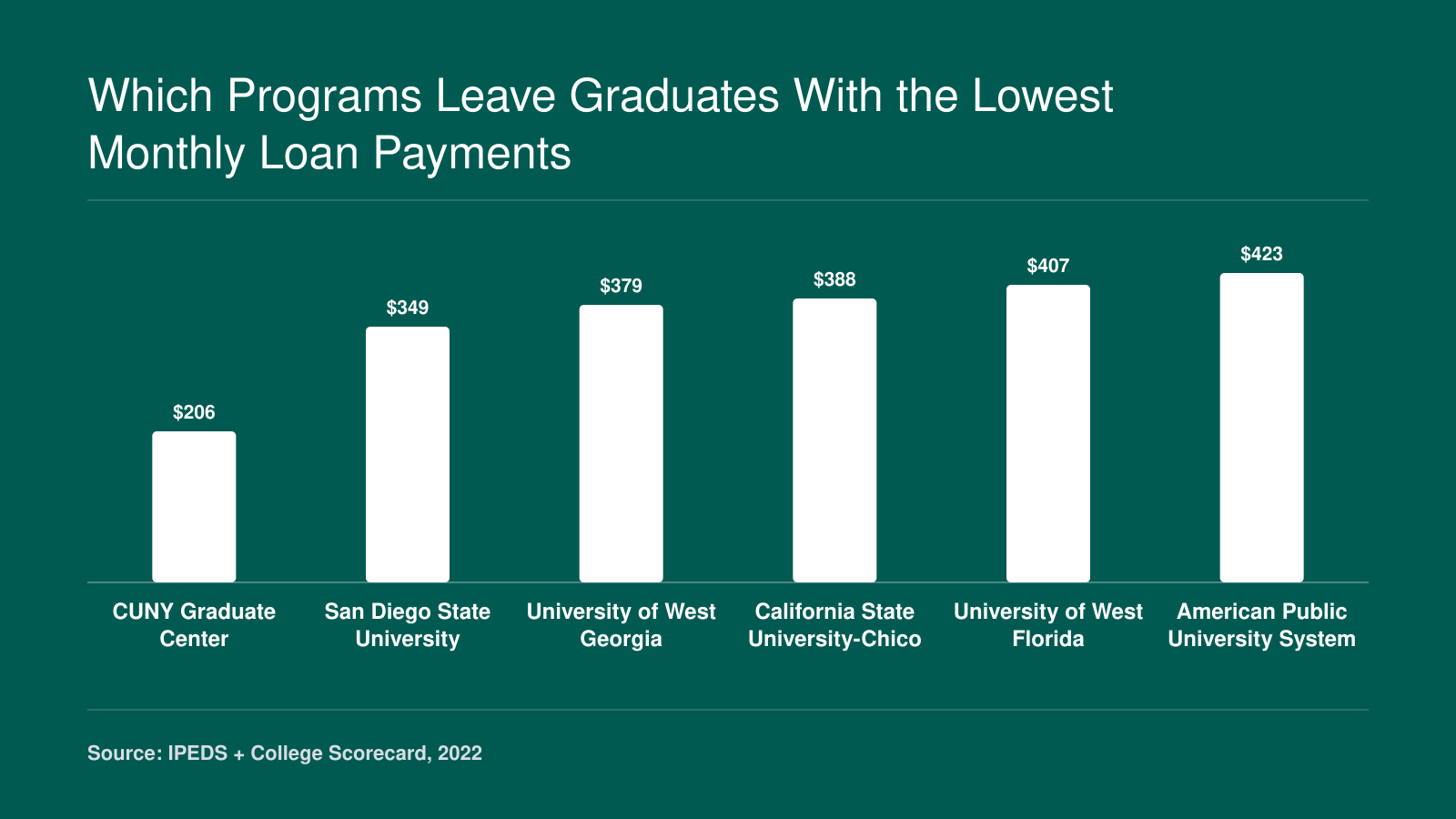
Which Programs Leave Graduates With the Lowest Monthly Loan Payments
Low tuition alone does not guarantee a small monthly bill. The chart below shows each program's median 10-year monthly loan payment for federal borrowers, using program-level College Scorecard data, so the post-graduation debt load is easier to compare side by side.
Top First-Year Earnings Among Affordable Psychology Master's Programs
Applying Without a Psychology Bachelor's: Prerequisites and Transfer Credits
A non-psychology bachelor's degree doesn't close off these programs, but requirements vary.
- Bachelor's fieldCUNY SPS, Arizona State University Online, and Florida International University accept any accredited bachelor's field; others expect psychology or equivalent coursework.
- Prerequisite courseworkExpect introductory psychology, statistics, and research methods. FIU requires four prerequisites at C or better; CUNY SPS requires three at B or better and may admit conditionally; Capella may allow them before or during enrollment.
- GPA and GRE policiesReported minimums range from 2.7 at Capella to 3.0 at several schools. Franklin, NYU, Pepperdine, and Penn State Behrend do not require the GRE; Fresno State does.
- Transfer credit limitsWhere transfer credit is accepted, caps often run 6 to 12 credits. CUNY SPS allows up to 6, Franklin implies up to 12, and FIU accepts none.
- Supporting documentsPrepare a statement of purpose, recommendations, and a resume with relevant experience.
General Psychology programs by state
Frequently Asked Questions About Affordable Psychology Master's Programs
What is the cheapest master's in psychology?
How much does it cost to get a master's in psychology online?
Can you earn a psychology master's online without ever visiting campus?
Which psychology master's degrees qualify you for a professional license?
What's the difference between a general psychology master's and a counseling master's?
Can online psychology grad students get assistantships or federal financial aid?
Is a master's in psychology worth the cost if you don't plan to become a therapist?
Will credits from a psychology master's transfer into a doctoral program?
Compare General Psychology programs on the data that matters
Explore more Psychology specializations or browse every graduate field.
All Psychology programs