Most Affordable Health Psychology Master's Programs
Compare 10 accredited most affordable Health Psychology programs, with graduate earnings, cost, debt, and completion data from IPEDS and the U.S. College Scorecard.
Advertised tuition for a health psychology master's rarely matches the final bill. Across the ranked schools, program tuition runs from $8,368 to $17,126, while net price after aid spans $9,492 to $22,878, and fees or prerequisite courses can widen the gap.
Set expectations early: most of these degrees are nonclinical. They prepare graduates for health promotion, research, or doctoral study, not for independent licensure as a psychologist or counselor.
Key Points
- North Carolina A&T State University posts the lowest in-state tuition at $6,813.
- University of Michigan-Dearborn has the lowest net price after aid at $9,492.
- Walden lists a $925 program fee beyond per-credit tuition.
Health Psychology Master's Programs Ranked by Affordability
North Carolina A&T State University posts the lowest published in-state graduate tuition and fees on this list at $6,813, while University of Michigan-Dearborn has the lowest net price after aid at $9,492. Out-of-state learners should compare carefully: NCAT charges $20,673 out of state, and UM-Dearborn charges $32,896. The ranked entries below pair tuition, net price, delivery format, and completion time for each health psychology master's program.
North Carolina A & T State University
#1Greensboro, NC · ~$8,000/yr (est.)
Best for: In-state students prioritizing low published tuition
North Carolina A&T State University pairs one of the lowest published in-state graduate tuition rates in this list with a strong graduation profile: the school graduates about 57% of students. The Health Psychology MS offers thesis and practicum options, a curriculum centered on wellness and health disparities, and day and evening classes. For North Carolina residents or students comfortable with a mix of on-campus and online work, it is a hard-to-beat value.
- 36 credit hours with thesis or practicum pathway
- Focus on wellness, health promotion, and health disparities
- Day and evening in-person classes
- Not designed as a licensure or counseling pathway
- Career paths include health educator and behavioral health technician
Touro University Worldwide
#2Los Alamitos, CA · ~$9,000/yr (est.)
Best for: Working adults seeking online accelerated path
Touro University Worldwide delivers its Health Psychology concentration fully online with no residency and six start dates per year. The MA in Psychology can be completed in as few as 12 months through 8-week courses, and no GRE is required. The school graduates about 29% of students, and its $500-per-credit rate can drop to $300 for military-affiliated learners.
- No GRE required; test optional
- Complete in as few as 12 months
- 100% online with no residency
- 8-week courses and 6 start dates per year
- Curriculum: smoking cessation, nutrition, eating disorders
- Career paths: hospitals, universities, government
University of Michigan-Dearborn
#3Dearborn, MI · ~$17,000/yr (est.)
Best for: Michigan residents seeking licensure-focused clinical training
University of Michigan-Dearborn's Clinical Health Psychology MS is an online program built for students who want clinical preparation, with 48 credits over two years and two terms of practicum. The school graduates about 58% of students, and the program notes that graduates meet course requirements for the Michigan Limited License. Its $9,492 net price is the lowest in this ranking after aid.
- No GRE required
- 48 total credit hours
- Two years, starts fall only
- 3.2 minimum GPA and prerequisite courses
- Thesis or capstone option
- Practicum in community clinical settings
- Prepares for Michigan Limited License
- Application deadline March 15
University of Wisconsin-Milwaukee
#4Milwaukee, WI · $13,000 – $26,000/yr (est.)
University of Wisconsin-Milwaukee offers a campus-based MS in Psychology with a Health Psychology specialization that emphasizes research competence and optional field placement. Students can complete the 36-credit program in two to three years, with part-time options and assistantships available. The school graduates about 49% of students.
- 36 total credit hours
- Full-time and part-time options
- Optional field placement in health psychology
- Research in lab and clinical settings
- Interdisciplinary training with Medical College of Wisconsin
- Complete in two to three years
- Application deadline December 1
Central Connecticut State University
#5New Britain, CT · ~$15,000/yr (est.)
Central Connecticut State University's MA in Psychology with a Health Psychology specialization is an on-campus program with evening classes and part-time or full-time enrollment. The curriculum covers mind-body connections, biofeedback, behavioral interventions, and health promotion, and the school graduates about 48% of students.
- Full-time and part-time options
- Evening classes offered
- Focus on mind-body connection and prevention
- Biofeedback and behavioral intervention topics
- Preparation for further doctoral study
National University
#6San Diego, CA · ~$16,000/yr (est.)
National University's MS in Health Psychology is a fully online, asynchronous program with 8-week courses and rolling starts. The 30-credit degree can be finished in about 16 months, accepts up to 12 transfer credits, and offers a FastForward pathway into the PhD. The school graduates about 43% of students.
- No GRE required and rolling admissions
- 30 total credit hours, 10 courses
- Complete in about 16 months
- 8-week courses, starts every Monday
- Asynchronous online classes
- Up to 12 transfer credits accepted
- FastForward pathway to PhD
- Optional internship at program's end
Cost & outcomes by school
Federal data for the highest-earning Health Psychology programs, independent of the ranking above. Earnings are this field's master's graduates four years after completing, where the Scorecard reports them.
| School | Earnings | Tuition / yr | Debt | Grads/yr | Format |
|---|---|---|---|---|---|
| Touro University Worldwide CA | $89,314 | $9,000 | $27,075 | 115 | Online |
| National University CA | $78,497 | $16,416 | $28,854 | 1,098 | Online |
| University of Wisconsin-Milwaukee WI | $66,931 | $12,728 | $41,000 | 52 | Campus |
| Central Connecticut State University CT | $61,035 | $14,562 | $53,260 | — | Campus |
| Walden University MN | $56,934 | $10,885 | $41,000 | 270 | Online |
| Northcentral University CA | $52,083 | $17,998 | $30,160 | 153 | Online |
| North Carolina A & T State University NC | — | $8,368 | — | 12 | Campus |
| Grand Canyon University AZ | — | $10,015 | — | — | Online or campus |
| Carroll University WI | — | $14,424 | — | — | Campus |
| University of Michigan-Dearborn MI | — | $17,126 | — | 15 | Online |
Sources: U.S. Department of Education. Tuition and graduates: IPEDS. Earnings and debt: College Scorecard, this field's master's graduates; a dash means no figure is reported.
Cost, debt & payoff
Median earnings of this field's master's graduates (4 yrs after completing) vs. their median federal loan debt · U.S. College Scorecard
Across these programs the median graduate earns about $63,983 and finishes with roughly $35,580 in debt — a ratio that clears a common rule of thumb (keep debt below first-year salary). Tuition and debt vary widely school to school, so check the per-school figures in the table above before you shortlist.
How We Weighed Price, Aid, and Outcomes to Build This List
Which health psychology master's programs cost the least once financial aid is counted? That question drives the list, so net price after aid and graduate tuition carry the most weight, as they do across most affordable master's in psychology programs. Institution-wide graduation rate plays a supporting role, a check on whether students at a school tend to finish.
Two caveats matter. The net prices shown are institution-wide averages, not personal quotes; your own cost depends on your aid package, residency, and enrollment status. Graduation rates describe the whole school, not the health psychology program, so read them as a rough signal only.
Where possible, we checked published tuition against current university pages. Some schools bill by quarter credit or publish rates without an academic year, so confirm the current rate before you budget.
What These Programs Really Cost: Tuition, Fees, and Leveling Courses
Tuition is not the final bill. The table below compares in-state tuition, out-of-state tuition, and net price after aid using federal data for the schools ranked here. Beyond these figures, published fee schedules vary: Walden lists a $925 program fee and estimates $2,500 to $3,500 for books and materials, while National University charges a $0 application fee but may require prerequisite psychology coursework for applicants without a background. Grand Canyon lists PSY-520 as a prerequisite; such leveling courses raise total cost, and accepted transfer credits can reduce it.
| School | In-State Tuition & Fees | Out-of-State Tuition & Fees | Net Price (After Aid) |
|---|---|---|---|
| University of Michigan-Dearborn | $15,640 | $32,896 | $9,492 |
| North Carolina A & T State University | $6,813 | $20,673 | $10,846 |
| University of Wisconsin-Milwaukee | $10,398 | $22,398 | $15,014 |
| Central Connecticut State University | $13,050 | $16,550 | $16,857 |
| Touro University Worldwide | $14,600 | $14,600 | $19,058 |
| National University | $13,284 | $13,284 | $22,878 |
Related Articles
Accreditation, Licensure, and What This Degree Qualifies You to Do
The American Psychological Association accredits doctoral programs, not master's programs, so for accredited health psychology master's programs the relevant standard is institutional accreditation. Confirm each U.S. school's regional accreditation on its website or through the U.S. Department of Education's database before you apply. Online health psychology master's programs carry the same institutional accreditation as the campus programs at the same school. The UK programs (King's College London, Portsmouth, Edge Hill) hold British Psychological Society Stage 1 accreditation, which does not translate into U.S. licensure.234
Licensure: Mostly Nonclinical
Most health psychology master's degrees are nonclinical and do not lead to counseling licensure, including the ones at the University of Wisconsin-Milwaukee1 and National University. Counseling-oriented options are different. Anna Maria College points toward Massachusetts LMHC licensure, and the University of Michigan-Dearborn's clinical track aligns with a Michigan Limited License. State rules vary, so check them before enrolling.
Career Paths
Nonclinical graduates typically work as:
- Health educators
- Wellness program coordinators
- Research coordinators
- Public health program staff
Several programs, including Walden, Portsmouth, Edge Hill, and Leiden, also position the degree as preparation for doctoral study.
Practicum Hours and How Long the Degree Takes
Timelines swing more than you would expect. Tulane's coursework-only behavioral health track averages nine months; its thesis route, with three independent study credits and three thesis credits, averages twelve. National University's 30-credit health psychology degree runs about 16 months in eight-week terms. Most 30- to 48-credit programs land near 18 to 24 months full time, with part-time study commonly stretching to 30 to 48 months depending on credit load.
Capstone, Thesis, or Supervised Hours
The final requirement drives both. National University caps its degree with a three-credit capstone and requires no clinical hours; an internship is optional. Clinically oriented degrees are heavier, a theme we also track in the most affordable master's in clinical psychology programs: William Paterson's MA requires two practicum courses and 600 documented supervised hours, and Carroll University's 60-credit behavioral health psychology degree requires roughly 700 clinical hours across 24 months.
What Fieldwork Costs You
Supervised hours are usually unpaid, so budget for lost income, commuting, and sometimes liability insurance. Online students should confirm whether the program places you or expects you to secure a site near home, and whether your state is approved.
Before You Apply: GRE, Prerequisites, and Transfer Credit
- Degree and GPAPrograms below generally expect a regionally accredited bachelor's degree with published minimum GPAs around 2.8–3.0; San Diego State lists 2.85 overall and 3.0 in psychology.
- GRE and prerequisitesSeveral schools here waive the GRE, but North Carolina A&T requires it. Common prerequisites are introductory psychology, statistics, and research methods; gaps may be handled through provisional admission or additional coursework.
- Transfer creditWhere published, transfer caps range from 6 to 12 graduate credits. Touro generally requires a B- or higher; St. Thomas requires a B or higher within five years.
- Supporting documentsHave a statement of purpose, recommendation letters, and a current resume ready.
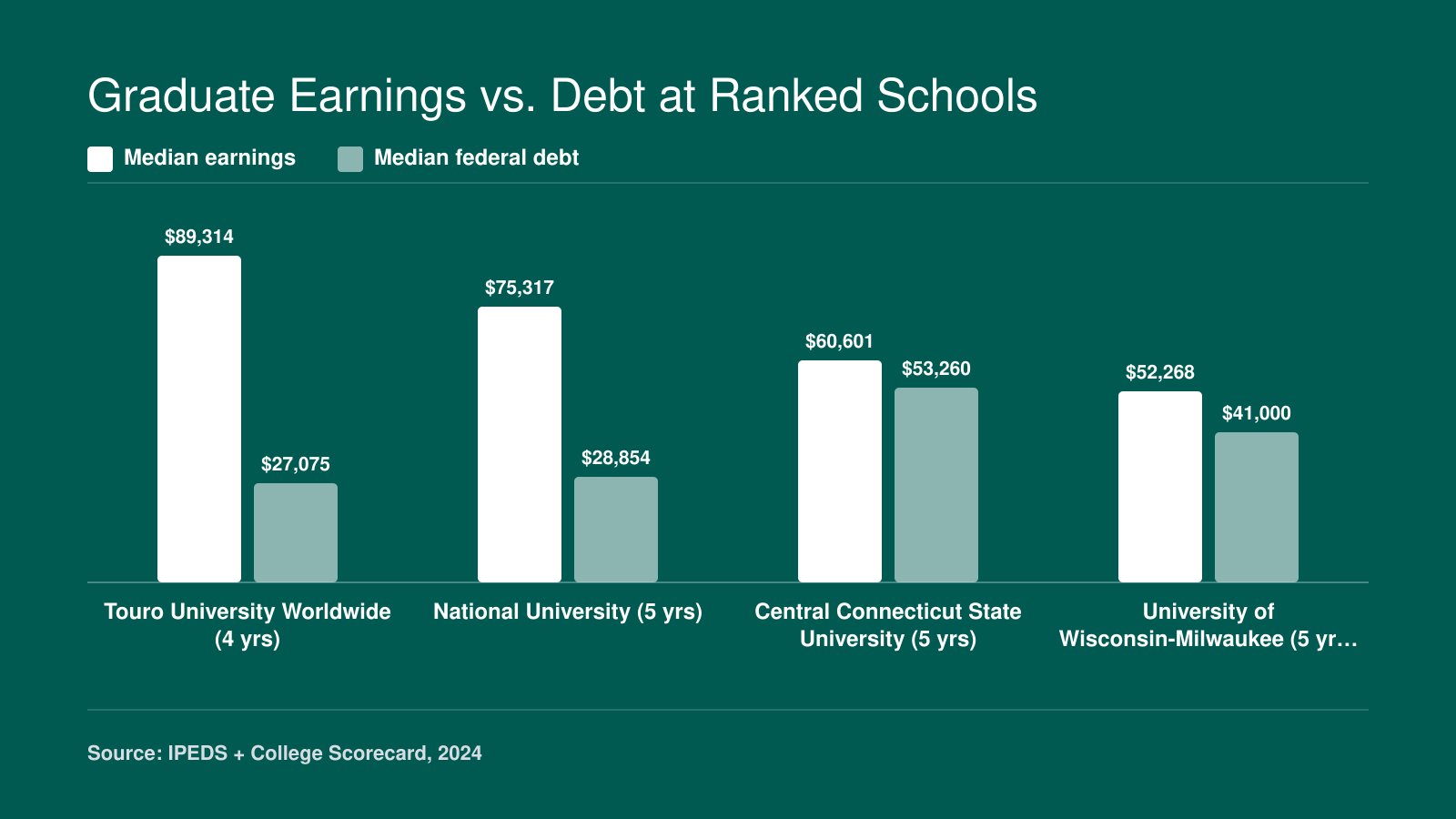
Graduate Earnings vs. Debt at Ranked Schools
The chart compares published program-level median earnings after completion with median federal debt. Earnings windows vary by reporting schedule; the bar labels note four-year or five-year figures.
Is a Health Psychology Master's Worth the Cost?
Monthly loan payments tell you more than tuition does. Graduates of Touro University Worldwide's health psychology track carry median debt of $27,075, about $308 a month on a 10-year plan. National University's graduates are close behind at $28,854, or $328 a month. At Central Connecticut State, median debt reaches $53,260 and $606 a month; at UW-Milwaukee it's $41,000 and $466.
Set those against first-year earnings and the gap widens. Touro and National graduates earn roughly twice what they owe in their first year out ($61,331 and $57,834). Central Connecticut graduates earn about what they borrowed. The lowest-cost online programs, built for nonclinical health roles in hospitals, universities, and government, tend to deliver the strongest return among affordable master's programs.
That math changes if you want licensure or a doctorate. UM-Dearborn's clinical health psychology MS prepares students for Michigan's limited license, and North Carolina A&T positions its MS as a step toward a Ph.D. A cheap nonclinical degree that doesn't move you toward either goal isn't a bargain.
Your next step: shortlist two or three programs from the ranking and request full cost-of-attendance quotes from each.
Health Psychology programs by state
Compare Health Psychology programs on the data that matters
Explore more Psychology specializations or browse every graduate field.
All Psychology programs