Best Master's in School Psychology Programs
Compare 130+ accredited School Psychology programs at 120+ schools, with graduate earnings, cost, debt, and completion data from IPEDS and the U.S. College Scorecard.

Most school psychologist openings require specialist-level training, not a standalone master's, regardless of the degree label a program advertises. The 15 programs in this comparison carry average net prices from about $11,300 at Florida State to roughly $48,100 at Fairfield.
The practical tension is licensure, not degree title. A 30-credit M.A. can fall short of the 60-plus credits and 1,200-hour internship that state education agencies require before a graduate can practice. The number that matters is the total sequence a program can verify, because a lower-cost route that does not meet state practice rules is not a route at all.
Key Points
- A standalone master's often stops short of school practice; the EdS is the working credential.
- Program-level debt is unpublished for the three lowest-borrowing picks, so net price guides the comparison.
- Confirm NASP approval and state certification rules before applying for the 2027 cycle.
10 Top Master's in School Psychology Programs Ranked by Outcomes
We ranked these master's in school psychology programs using U.S. Department of Education data on graduate earnings, graduation rate, and net price. The list below shows each school's overall graduation rate and typical costs so you can compare value, not just reputation. Program accreditation status changes; confirm each program on the NASP approved program list before applying.
Columbia University in the City of New York
#1New York, NY · ~$58,000/yr (est.)
Best for: Aspiring school psychologists seeking urban clinical immersion
Columbia University's Teachers College offers a School Psychology Ed.M. that blends psychological theory with hands-on practice across schools, clinics, and hospitals. The 69-credit program prepares students for New York State certification and includes optional bilingual extension and BCBA certification tracks.
- 69 total credit hours
- Prepares for New York State school psychologist certification
- BCBA/LBA certification eligible and bilingual extension available
- Clinical experience in first year through university clinic
- Financial aid available
- Practica and internship experiences
The University of Texas at Austin
#2Austin, TX · ~$12,000/yr (est.)
Best for: Texas residents wanting LSSP licensure and fellowships
UT Austin's M.A. SSP program trains scientist-practitioners with three semesters of school-based practicum and a 1,200-hour internship. The small cohort, no GRE requirement, and TRACCS fellowship make it a strong public option for Texas licensure as a Licensed Specialist in School Psychology.
- No GRE required
- 65 total credit hours
- Full-time enrollment with fall or summer start
- 1,200 clinical internship hours
- TRACCS fellowship with tuition coverage
- Prepares for Texas LSSP licensure and Praxis
Tufts University
#3Medford, MA · ~$51,000/yr (est.)
Best for: Social-justice-oriented students wanting Massachusetts placements
Tufts University's MA/EdS in School Psychology integrates social justice with evidence-based practice, with field experiences beginning in year one. The three-year program reports 100% job placement and prepares graduates for Massachusetts state and national certification. Its cohort includes 33% underrepresented students.
- 3-year program with 12 total courses
- Field experiences begin first year
- PREPaRE crisis training required
- 100% job placement rate
- 75% of graduates work in Massachusetts K-12 schools
- 33% underrepresented students in cohort
Northeastern University
#4Boston, MA · ~$29,000/yr (est.)
Northeastern's School Psychology MS/CAGS is a three-year Boston campus program with an early childhood emphasis and urban, culturally diverse field placements. Students complete 525 practicum hours and a 1,200-hour internship, and the program reports a 100% licensure pass rate.
- 3-year program with 62 total credit hours
- Early childhood emphasis with urban placements
- 525 practicum hours and 1,200-hour internship
- 100% licensure pass rate
- No entrance exam required
- Cohort-based structure
William & Mary
#5Williamsburg, VA · $15,000 – $20,000/yr (est.)
William & Mary's School Psychology program is a three-year campus pathway with small, multidisciplinary classes and fieldwork starting the first semester. Graduates complete 1,200 internship hours and report a 95% employment rate.
- 3-year program starting in fall
- Fieldwork begins in first semester
- 1,200 clinical internship hours
- 95% job placement rate
- Small, multidisciplinary classes
Florida State University
#6Tallahassee, FL · ~$11,000/yr (est.)
Florida State's M.S./Ed.S. in School Psychology is a full-time, three-year program with no GRE requirement and a fall-only start. Students progress from foundational coursework through a practicum year to a full-time internship, and the program prepares graduates for Florida school psychologist certification.
- 3-year full-time program with fall-only admission
- No GRE required
- 73 total credit hours
- 3.2 GPA minimum
- Full-time internship in final year
University of Minnesota-Twin Cities
#7Minneapolis, MN · ~$22,000/yr (est.)
The University of Minnesota offers a Master of Arts with an Education Specialist certificate, combining two years of coursework with a year-long internship. Students can participate in Project SPARK assistantships in Minneapolis Public Schools, and the program reports a 100% job placement rate.
- 3-year program with a year-long internship
- Project SPARK assistantships available
- 100% job placement rate
- 85% of students publish or present research
- Leads to state and national school psychologist credential
University of Connecticut
#8Storrs, CT · ~$23,000/yr (est.)
UConn's Master's/Sixth-Year Program in School Psychology prepares students for Connecticut's 070 School Psychologist credential through a three-year sequence that includes 400 practicum hours and a 1,500-hour internship. The program requires the Praxis exam for admission.
- 3-year full-time program with fall start
- 66 total credit hours
- 400 practicum hours and 1,500-hour internship
- Praxis exam required for admission
- Prepares for Connecticut 070 certification
San Diego State University
#9San Diego, CA · ~$10,000/yr (est.)
San Diego State's Master of Science in Counseling with a School Psychology concentration emphasizes multicultural competence and social justice. The program prepares graduates for the California Pupil Personnel Services Credential and reports that 85% of graduates work as school psychologists.
- Emphasis on multicultural competence and social justice
- 70% students of color since 1990
- 85% of graduates work as school psychologists
- Prepares for California Pupil Personnel Services Credential
University of Massachusetts-Amherst
#10Amherst, MA · $15,000 – $20,000/yr (est.)
UMass Amherst offers a combined MEd/EdS in School Psychology structured around seven core domains, with supervised practica and a full-year internship. The program requires a related bachelor's degree and relevant work or research experience, and admits only for fall entry.
- 69 total graduate credits
- Seven core curriculum domains
- Full-year internship required
- Fall entry only with January 4, 2027 deadline
- Requires related bachelor's degree and relevant experience
Cost & outcomes by school
Federal data for the highest-earning School Psychology programs, independent of the ranking above. Earnings are this field's master's graduates four years after completing, where the Scorecard reports them.
| School | Earnings | Tuition / yr | Debt | Grads/yr | Format |
|---|---|---|---|---|---|
| Chapman University CA | $107,808 | $39,868 | — | 26 | Campus |
| Loyola Marymount University CA | $100,264 | $23,172 | — | 33 | Online |
| Minnesota State University-Mankato MN | $99,934 | $10,449 | — | 24 | Campus |
| San Francisco State University CA | $96,854 | $9,370 | — | 6 | Campus |
| Seattle University WA | $93,491 | $24,216 | $63,958 | 22 | Campus |
| Alliant International University-San Diego CA | $86,459 | $19,690 | $61,500 | 121 | Hybrid |
| CUNY Queens College NY | $86,240 | $11,612 | $33,941 | 57 | Campus |
| CUNY Brooklyn College NY | $84,744 | $11,524 | $24,750 | 45 | Campus |
| California State University-Northridge CA | $83,681 | $8,982 | $41,000 | 22 | Campus |
| Fairleigh Dickinson University-Metropolitan Campus NJ | $80,630 | $19,068 | $42,425 | 22 | Campus |
| University of Utah UT | $80,164 | $8,724 | $26,100 | 71 | Campus |
| National University CA | $78,497 | $16,416 | $28,854 | 1,098 | Online |
Sources: U.S. Department of Education. Tuition and graduates: IPEDS. Earnings and debt: College Scorecard, this field's master's graduates; a dash means no figure is reported.
Cost, debt & payoff
Median earnings of this field's master's graduates (4 yrs after completing) vs. their median federal loan debt · U.S. College Scorecard
Across these programs the median graduate earns about $69,658 and finishes with roughly $41,971 in debt — a ratio that clears a common rule of thumb (keep debt below first-year salary). Tuition and debt vary widely school to school, so check the per-school figures in the table above before you shortlist.
Master's or Eds in School Psychology: Which Credential Gets You Hired?
A standalone master's and a specialist-level degree can look similar on a brochure, but they lead to different places. One often ends short of school practice; the other is built around it.
Can You Practice With Only a Master's?
Usually not with a conventional 30-36 credit master's in general psychology. The National Association of School Psychologists sets its minimum standard at specialist-level preparation: at least 60 graduate semester hours, sequenced supervised practica, and a supervised internship of at least 1,200 clock hours, with at least 600 in a school setting. A typical master's falls short on credits and often lacks that internship. Some programs titled "master's" do run 60 or more credits and meet the standard, so what counts is the content, not the label.
How the Three Levels Compare
- Conventional master's (MA/MS/MEd): Often under 60 credits, commonly around three years when part of a longer pathway, and generally not enough on its own for state school psychologist certification or the NCSP.
- Specialist (EdS/SSP): About 60 credits (roughly 54 excluding internship), typically three to four years, a 1,200-hour internship, and eligibility for state certification and the NCSP when the program meets NASP standards.
- Doctorate (PhD/PsyD): Usually five to seven years, with a longer internship and broader practice and research options.
Completion time shifts with enrollment status, prerequisites, and internship structure, so treat these as typical ranges.
Why You Often Earn Both
Many programs award an MA or MS partway through, then the EdS at completion. The master's is a checkpoint, not the finish line. If you leave after it, you may hold a graduate degree but not the credential districts hire for.
Check Your State Before You Enroll
States set the credential level, and the wording varies. Florida says "master's or higher" but requires 60 semester hours, practica, and a 1,200-hour internship1 with 600 school hours2. Texas requires a graduate psychology degree plus at least 60 graduate credits. Idaho points to an approved 60-credit specialist program and a 1,200-hour internship under a credentialed school psychologist. Different labels, much the same preparation. Confirm your target state's rule first, then choose a program that satisfies it.
Does Your Program Need NASP Approval? Licensure Rules Explained
NASP program approval is a stamp of quality specific to school psychology training, awarded by the National Association of School Psychologists to programs that meet its standards for coursework, field experience, and credits. It is not the same thing as APA accreditation, which applies only to doctoral programs in psychology, nor is it the regional institutional accreditation that every legitimate university carries. All three can appear in a program's marketing, so it helps to know which one actually affects your ability to work.
NASP Approval and the NCSP Credential
Graduating from a NASP-approved program matters most if you want the Nationally Certified School Psychologist (NCSP) credential. The NCSP requires a specialist or doctoral degree built on at least 60 semester hours, a 1,200-hour internship, and a passing score of 147 on the Praxis School Psychologist exam (5402). Graduates of NASP-approved programs follow a streamlined application: their training is already verified against the standard. Graduates of other programs can still earn the NCSP, but they must submit a full portfolio review documenting that their coursework and hours measure up.
State Certification Is What Actually Licenses You
You do not need the NCSP, or even a NASP-approved program, to become a school psychologist in most states. Certification comes from your state education department, not from NASP. Many states accept any program, NASP-approved or not, that meets their own credit and field-experience standards.
A typical state path looks like this:
- Complete a state-approved program: often 60 semester hours at the specialist level.
- Finish a supervised internship: commonly 1,200 hours.
- Pass the Praxis School Psychologist exam (5402): required in most states.
Some states lean on NASP directly, accepting the NCSP as a route to certification. Maryland, for example, recognizes NASP-approved training alongside its own Department of Education standards and requires the same 1,200 internship hours and Praxis exam.
Check Both Before You Apply
Before committing to any program, look it up in NASP's approved program directory and read your state education department's certification requirements side by side. If you plan to practice in a state that requires NASP approval or the NCSP, that narrows your list considerably. If your state sets its own standards, you have more freedom, but you still need to confirm the program clears them.
What a School Psychology Degree Really Costs, Beyond Tuition
Students comparing school psychology with clinical psychology master's programs often anchor on per-credit tuition, but school psychology's credential path usually runs through the EdS and a 1,200-hour internship. The number you should plan around is the total for the entire sequence, not a single year.
Why the Specialist Sequence Changes the Math
Published rates show how differently programs price the full sequence. American Public University lists $855 per unit across a 66 to 89 unit range, putting its published total between roughly $56,000 and $76,000 before fees. Capella lists $540 per quarter credit for 59 credits, about $31,860, over 24 to 30 months. General online EdS estimates land from $20,000 to more than $60,000. A master's-level course sequence alone rarely qualifies for practice; most states require the EdS, which can run three years including internship, so one year of tuition understates the bill. Those published ranges may exclude fees, books, or travel, so confirm required credits and total with the school.
Hidden Costs Beyond the Credit Hour
Sticker tuition leaves out several regular expenses: - Assessment kits and testing materials: Practicum and internship often require access to cognitive and achievement tests, which can be costly. - Exam and screening fees: Background checks, fingerprinting, and the Praxis School Psychologist exam add to the total; ETS currently lists $156 as of October 2026. - Resource fees: Capella, for example, lists a $175 per quarter resource kit during coursework. - Travel and internship time: Practicum sites may be distant, and the 1,200-hour internship may be unpaid or low paid in many placements.
How Students Reduce the Real Cost
Graduate assistantships can include tuition remission, but waiver amounts and appointment terms vary by program and year. Paid internships exist in some states but are not guaranteed. Federal or state shortage-area grants and loan forgiveness programs can offset the full specialist sequence. Public net price figures are institution-wide averages for graduate students, not personalized quotes for this program, so treat them as a rough reference rather than a final cost.
Three Programs Where Graduates Borrow the Least
These three schools report the lowest median federal debt among borrowers on this page. Because federal debt is reported at the institution level, each figure below is school-level context, not a program-specific result. Low debt often aligns with the funding options covered in the previous section, especially in-state public tuition and smaller borrowing.
| Program | Institution-wide median federal debt (borrowers) | Estimated 10-year monthly payment |
|---|---|---|
| University of Wisconsin-La Crosse | $20,272 | $231 |
| William & Mary | $20,500 | $233 |
| CUNY Brooklyn College | $24,750 | $282 |
What Practicing School Psychologists Earn
Typical pay for the profession nationally
Related Articles
From Coursework to Certification: The Training Timeline
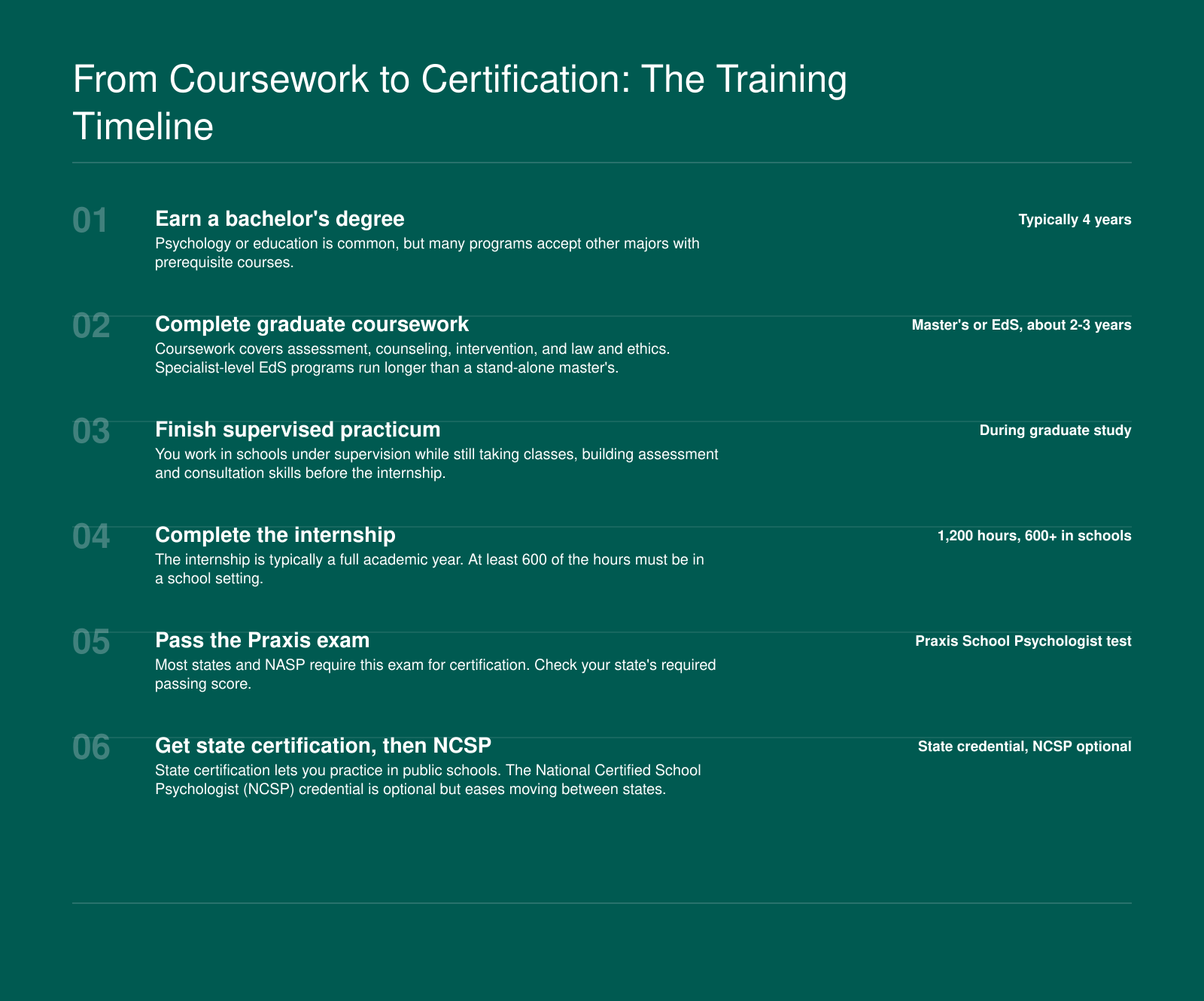
Becoming a school psychologist follows a fixed order, and skipping ahead is not possible. Each stage must be finished before the next begins, and the internship is the longest single commitment. Durations below are typical and vary by program and state.
Application Checklist for School Psychology Graduate Programs
Requirements vary by program, so confirm each school's current rules before you apply. These are the items most programs ask for.
- Bachelor's degree and GPAA 3.0 is a common benchmark, but it is often a screening threshold rather than a guarantee. San Diego State lists 2.8, Southern Maine 2.5, and Indiana State may provisionally admit applicants with a 2.7–3.0 major GPA based on other materials. Some programs accept any major, while others, like Fort Hays State, want psychology or education plus 12 psychology credits.
- Prerequisite courseworkTypical expectations include introductory psychology, statistics or research methods, child development, and abnormal psychology. There is no universal list, so check each program.
- GRE statusPolicies differ. Arizona (Fall 2026) and Temple do not require it, Fort Hays requires a recent GRE General unless you hold a related master's, and Seattle University asks for the GRE or GMAT only when the bachelor's degree is non-graded. Don't assume a blanket waiver.
- Letters, statement, and resumePlan on two or three recommendation letters. Arizona asks for three, and Temple and Southern Maine ask for two. Experience with children, schools, or families is often preferred and can strengthen your application, though it is rarely an absolute requirement.
- Interviews and deadlinesSome programs interview shortlisted applicants, including Michigan State and the University of Washington. Fall deadlines often fall between December and February, such as Florida and Southern Maine on December 1, Michigan State on January 15, and Temple on February 1. Indiana State reviews on a rolling basis. Confirm whether a date is a priority or final deadline.
The specialist-level credential, not the master's label, is what actually determines whether you can practice as a school psychologist.
School Psychology programs by state
Quick Answers for Prospective School Psychology Students
Can you become a school psychologist with only a master's degree?
If I earn certification in one state, can I work as a school psychologist in another?
Is the NCSP the same as a state license?
Compare School Psychology programs on the data that matters
Explore more Psychology specializations or browse every graduate field.
All Psychology programs