Best Master's in School Psychology Programs in North Carolina
Compare 4 accredited School Psychology programs in North Carolina, with graduate earnings, cost, debt, and completion data from IPEDS and the U.S. College Scorecard.

East Carolina University admits about 10 school psychology students a year, and in-state graduate tuition across the schools here runs from $7,658 to $12,101. North Carolina has only a handful of graduate programs, so one missed deadline or one weak prerequisite record can close off a cycle entirely.
Campus, hybrid, and online formats sit together here. Every route still ends in a supervised school-based internship, which no format can shortcut.
Key Points
- The 1,200-hour supervised internship happens in schools, even in online and hybrid programs.
- East Carolina University has the lowest listed in-state tuition at $7,658.
- UNC Chapel Hill makes the GRE optional, and NC State does not consider it.
Ranked: Best Master's in School Psychology Programs in North Carolina
Four North Carolina school psychology programs are ranked below. Each card shows the school's overall graduation rate, not a program-level rate, and published program outcomes such as Praxis results or job placement are noted only where a school reports them. Program-level graduate earnings are not yet available for these programs, and outcome definitions and reporting years differ by school, so treat the figures as context rather than a like-for-like comparison.
Appalachian State University
#1Boone, NC · $9,000 – $25,000/yr (est.)
Best for: Full-time students wanting in-person training
Appalachian State's Master of Arts and Specialist in School Psychology is a full-time, in-person program on the Boone campus, built on the scientist-practitioner model. School-based experiences start early and lead to a full-year internship that includes an applied research project. The program reports a 100% job-placement rate for graduates seeking school psychologist positions, though it does not specify the reporting year, cohort size, or employment window. It also offers graduate assistantships to eligible students.
- NASP-approved, delivered 100% in person on the Boone campus
- Full-time enrollment required
- About 67 graduate credit hours
- 2025-26 first-year cohort of 10 students
- Comprehensive third-year internship with an applied research project
- SSP-only route for applicants with a closely related graduate degree
- Graduate assistantships available to eligible students
- Reports 100% job placement for graduates seeking school psychologist roles
East Carolina University
#2Greenville, NC · ~$8,000/yr (est.)
Best for: Licensed NC educators studying part-time online
East Carolina's MA/SSP is a three-year, full-time program with two years of on-campus coursework followed by a school-based internship. It admits about 10 students a year, does not require an entrance exam, and reports 100% job placement. ECU also lists a separate part-time online pathway for North Carolina-licensed educators with at least two years of K-12 experience. That route lists an estimated total cost near $25,000 and takes at least four years part-time from a bachelor's degree.
- Three-year, full-time program; years 1 and 2 on campus
- Internship in year 3
- 70 total credit hours, fall start
- No entrance exam required; test optional
- 3.0 GPA minimum and prerequisite coursework required
- Admits about 10 students per year from a competitive pool
- Optional pathway to Board Certified Behavior Analyst certification
- Leads to NC educational licensure and eligibility for national certification
Western Carolina University
#3Cullowhee, NC · ~$8,000/yr (est.)
Best for: Applicants targeting the specialist degree route
Western Carolina offers an M.A. in Psychology with a School Psychology concentration, open only to students admitted to its Specialist in School Psychology program. Students earn the master's en route to the specialist degree and cannot apply to it directly. WCU reports a 100% Praxis pass rate every year, but its outcome page covers both the 5402 and 5403 exams without a separate 5403 figure or cohort size. It says graduates find work in North Carolina public schools within one to three years but does not publish the underlying percentages.
- Open only to students in the Specialist in School Psychology program
- Completed en route to the S.S.P. degree; no direct application
- Two concentration options in the M.A. in Psychology: Clinical and School
- Thesis required
- Maximum of 16 credit hours per term, with the course load limit waived
- Reports 100% Praxis pass rate each year (exam versions not separated)
North Carolina State University at Raleigh
#4Raleigh, NC · $12,000 – $33,000/yr (est.)
NC State's M.S. in School Psychology with a Certificate of Advanced Studies is a three-year, full-time program in Raleigh. Training starts in an on-campus Psychoeducational Clinic and moves through four school practica to a full-year internship. The program has been NASP-approved since 2022, requires no thesis, and does not consider GRE scores. The sources we reviewed publish no placement or Praxis figures for it.
- NASP-approved since 2022
- Three-year, full-time program with a fall start
- Scientist-practitioner model with a small cohort
- On-campus Psychoeducational Clinic plus four required practica
- One-year internship in the third year
- No thesis or capstone required
- No entrance exam required; GRE scores not considered
- Application deadline December 1
Cost & outcomes by school
Federal data for the highest-earning School Psychology programs, independent of the ranking above. Earnings are this field's master's graduates four years after completing, where the Scorecard reports them.
| School | Earnings | Tuition / yr | Debt | Grads/yr | Format |
|---|---|---|---|---|---|
| Appalachian State University NC | $72,547 | $8,570 | — | 32 | Campus |
| East Carolina University NC | $66,394 | $7,658 | — | 9 | Campus |
| North Carolina State University at Raleigh NC | — | $12,101 | — | — | Campus |
| Western Carolina University NC | — | $7,876 | — | 6 | Campus |
Sources: U.S. Department of Education. Tuition and graduates: IPEDS. Earnings and debt: College Scorecard, this field's master's graduates; a dash means no figure is reported.
How We Rank North Carolina School Psychology Programs
How do you compare school psychology programs in North Carolina when most rankings never show their reasoning? We start with numbers you can check yourself, drawn from federal IPEDS and College Scorecard data rather than reputation surveys or paid placements.
We look at four things for each program:
- Cost: Published graduate tuition and the average net price students actually pay after aid.
- Completion: The university's overall graduation rate.
- Flexibility: Whether the program is offered on campus, online, or in a hybrid format.
- Outcomes: College Scorecard earnings and debt for graduates, where the program reports them.
These inputs have limits. Net price and graduation rate describe masters programs in North Carolina across the university, not the school psychology program alone. Many specialist-level programs enroll small cohorts, so program-level earnings are often not published. When outcome data is missing, we leave it blank instead of estimating.
Online and Hybrid Master's in School Psychology Programs in North Carolina
Flexibility in online coursework is helpful, but no school psychology program is fully remote. The practicum sequence and the 1,200-hour internship happen in schools, and that is true even for the online and hybrid options below.
East Carolina University offers an online, part-time M.A./S.S.P. designed for working educators. Coursework mixes live synchronous classes with asynchronous work, and the program does not require a separate on-campus residency. Students complete two practicum courses and two internship courses in a home district or another North Carolina public school, ending in a paid internship under a provisional license.
UNC Chapel Hill uses Hyflex delivery for some courses, combining synchronous in-person or remote attendance with asynchronous work. Traditional-calendar courses often run in the late afternoon and evening, which may help working students. Practicum and externship hours occur in school and clinical placements; the full-time internship falls in year four or five.
If you are balancing a job, confirm evening synchronous times before enrolling.
Related Articles
GRE Policies at Ranked North Carolina Master's Programs
Most of the programs here do not require GRE scores, and UNC Chapel Hill treats them as optional. North Carolina State University does not consider GRE scores at all, so a strong GPA and prerequisite record carry more weight there. Deadlines change by cycle, so confirm them on each school's admissions page before you apply.
| School | GRE Policy | Application Deadline | Key Prerequisites |
|---|---|---|---|
| University of North Carolina at Chapel Hill, School Psychology | Optional. Official scores may be submitted and must be valid within the last 5 years. | December 15, 2026, 11:59 PM (Fall 2027 admission) | Bachelor's in psychology or at least 18 credit hours in psychology, or a master's in psychology, education, or a related field. Transcripts, three letters of recommendation, statement of purpose, and résumé/CV. |
| North Carolina Central University, Psychology M.A. | Not Required | Fall only: July 1 (U.S. citizens and permanent residents); April 1 (international applicants) | At least 30 semester hours in psychology. Two letters of recommendation, official transcripts, statement of purpose, $50 non-refundable fee. |
| Western Carolina University, Psychology M.A. | Not Required. Applicants may submit scores if they think scores represent their ability better than their GPA. | March 1 (Fall only) | Psychology degree not required. Without one, at least 18 hours of undergraduate psychology, including general psychology, 6 hours of statistics and/or research methods, and abnormal psychology. |
| East Carolina University, School Psychology MA/SSP | Not Required | February 1 (Specialist in School Psychology program) | Bachelor's in psychology, education, or a related field, with introductory psychology, statistics, and research methods. A 3.0 or higher GPA is strongly preferred. Recommendations and personal statement. |
| North Carolina State University, School Psychology M.S./CAS | Not Required (scores are not considered) | December 1 (Fall only) | Degree from an accredited institution. The program requires 60 credit hours, a summer practicum, and a third-year full-time internship. |
Online coursework never replaces the supervised in-school internship, and for most students a strong funding offer matters more than the sticker price.
Cost, Financial Aid, and North Carolina Licensure
What will a master's in school psychology in North Carolina actually cost? For in-state students, listed graduate tuition starts at $7,658 at East Carolina University, rises to $7,876 at Western Carolina University and $8,570 at Appalachian State University, and reaches $12,101 at NC State University. Out-of-state rates climb faster, from $18,595 at Western Carolina to $32,874 at NC State. The net price figures for each school are school-wide averages across all students, not a quote for this program.
Estimating total cost
Full program totals are hard to pin down. Only ECU's online MA/SSP publishes one: $407 per credit across 64 semester hours, about $25,000 total, with a paid final-year internship. ECU's on-campus program requires 70 hours, and Western Carolina's requires 71. Neither posts a current total. Fees come on top of tuition everywhere.
Funding
ECU's on-campus program advertises departmental assistantships, but without amounts. NC State's MS/CAS points students mainly to state education assistance. Its PhD offers two teaching assistantships, and UNC Chapel Hill's PhD says some assistantships carry tuition waivers and others do not. Western Carolina and Appalachian State do not establish program-specific assistantships.
Licensure and time to salary
Graduates need an NCDPI school psychologist license, so internship structure and Praxis preparation shape when your paycheck starts. A third-year internship that is paid shortens the unpaid stretch.
One tip: ask each program what share of students actually receive assistantship funding.
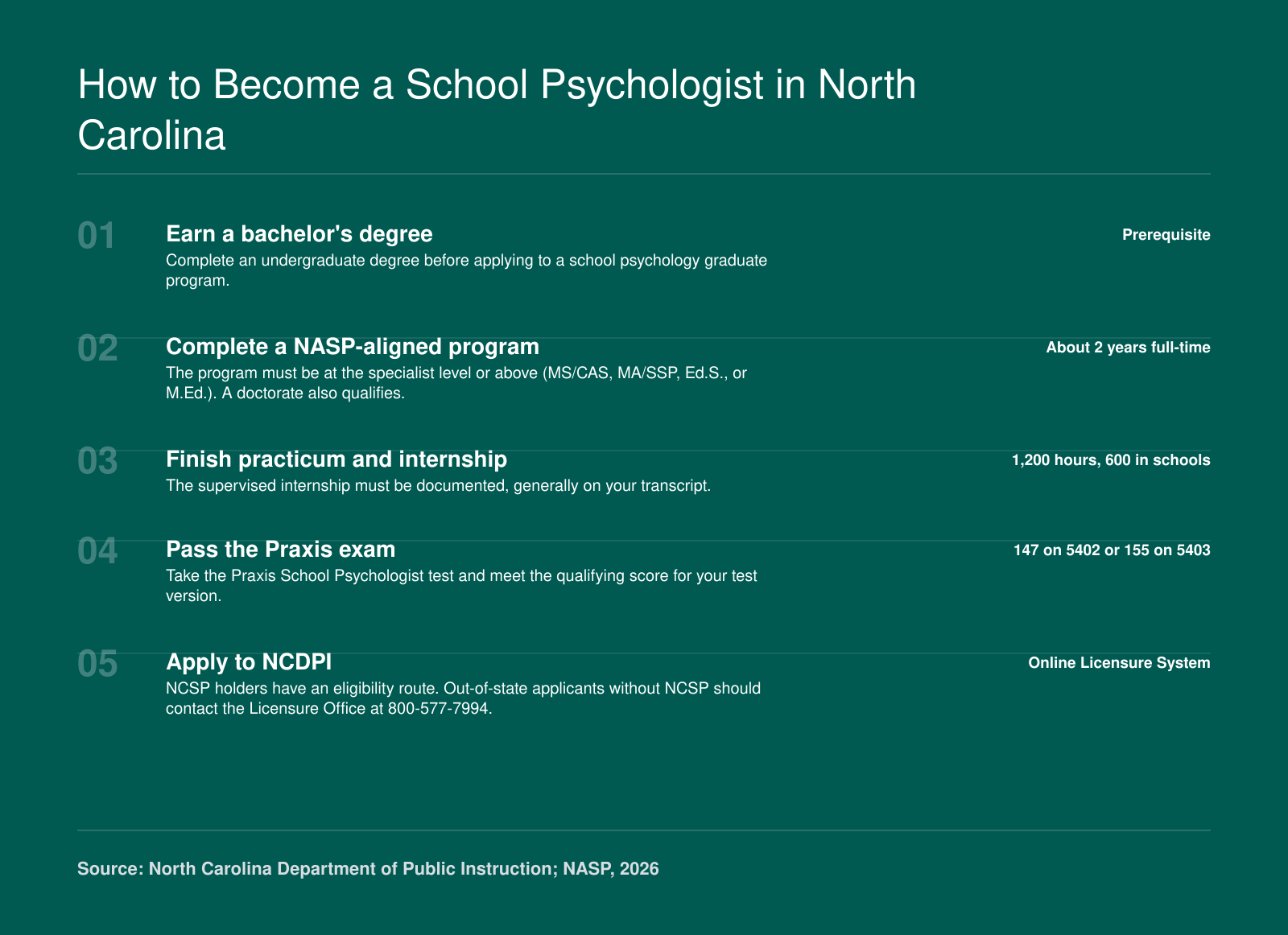
How to Become a School Psychologist in North Carolina
North Carolina has no lateral-entry route, so the path runs through an approved graduate program. Compare the ranked programs above to find one that fits your schedule and budget.
NASP Accreditation and Credential Differences: MA/SSP vs MS/CAS
Credential names in school psychology still vary campus to campus, even though NASP applies one specialist-level standard behind them1. Appalachian State holds full NASP approval dating to 1991 and awards an MA plus SSP (or the SSP alone for applicants who already hold a closely related graduate degree), with the specialist sequence running 67 credit hours2. East Carolina's program reports NASP accreditation along with state approval and confers the MA/SSP1. NC State earned NASP approval in 2022 and awards the MS/CAS over roughly three years1. At UNC-Chapel Hill, the NASP-approved pathway is the APA-accredited doctorate, not a specialist degree3. Western Carolina's current NASP status could not be verified, so ask the department directly.
SSP (Specialist in School Psychology) and CAS (Certificate of Advanced Study) both pair a master's with specialist-level preparation; an EdS designation does the same work. When the program carries NASP approval, the licensure outcome is comparable1. Confirm the total credit load clears NASP's 60-semester-hour threshold plus the 1,200-hour internship4, since graduates of approved programs get a streamlined NCSP route within ten years4.
Frequently Asked Questions About NC School Psychology Master's Programs
Do North Carolina school psychology programs require the GRE?
Which school psychology programs in North Carolina are NASP accredited?
How much do school psychologists earn in North Carolina?
Can I work while completing the internship year?
Compare School Psychology programs on the data that matters
Explore more Psychology specializations or browse every graduate field.
All Psychology programs