Best Master's in Educational Psychology Programs
Compare 250+ accredited Educational Psychology programs at 170+ schools, with graduate earnings, cost, debt, and completion data from IPEDS and the U.S. College Scorecard.

A master's in educational psychology is usually not, on its own, a school psychology license, and the credit counts show the gap. Research-oriented degrees here, similar to many best master's in psychology programs, run 30 to 36 credits. NASP-aligned school psychology programs run 65 to 69 credits over three years, with supervised internships. The licensure section explains the difference.
The programs ranked here span online, hybrid, and campus formats, and the career paths diverge just as sharply: research, instructional design, assessment, or school-based practice, often with a child psychology focus. Institution-wide average net price runs from about $1,300 to nearly $40,000 a year.
Several licensure-track programs are full-time only, so lost income belongs in the cost math.
Key Points
- NASP reports roughly 1 school psychologist per 1,065 students in 2023-2024, about double the 1:500 benchmark.
- Graduation rates describe whole universities, so check program-level outcomes and net price before you apply to any ranked school.
- Choose your track first: a research master's is non-licensed, while school psychology tracks lead to school-based licensure.
The 10 Best Master's in Educational Psychology Programs for 2027
These master's in educational psychology programs stand out for balancing affordability, completion outcomes, and format flexibility across online, campus, and blended options. The cards below highlight what each school offers, from research-focused applied developmental science to NASP-aligned school psychology pathways.
Texas A&M University-Central Texas
#1Killeen, TX · $5,000 – $10,000/yr (est.)
Best for: Military-connected adult learners
Texas A&M University-Central Texas offers a Master of Science in Applied Psychology with a concentration in Educational Psychology and a Teaching Emphasis. The 36-credit program combines core psychology foundations with coursework in instructional design, assessment, and research-based teaching practices, and is particularly relevant to military-connected and adult learners in the Fort Cavazos and Killeen area.
- 36 total credit hours
- 4 concentration options
- 3 start dates per year
- Thesis required
- Applied thesis experience
- Financial aid available
- Prepares for doctoral programs
- Instructional design and assessment focus
- Faculty advisors with subject matter expertise
- Multiple annual start dates
- Prepares for psychology-related careers
Columbia University in the City of New York
#2New York, NY · ~$58,000/yr (est.)
Best for: Future school psychologists in urban districts
Teachers College, Columbia University offers a NASP-accredited Master of Education in School Psychology that combines assessment, intervention, and consultation training with fieldwork in New York City schools and clinics. The 69-credit program runs full-time across three years, with practica, field placements, and a culminating internship, plus optional pathways for BCBA certification or a bilingual extension.
- NASP accredited
- 69 total credit hours
- 3 years of full-time study
- Apply by 2026-01-15
- Starts fall
- 2 letters of recommendation minimum
- $75 application fee
- Optional ABA certificate for BCBA licensure
University of Virginia
#3Charlottesville, VA · ~$24,000/yr (est.)
Best for: Research-minded students wanting applied work
The University of Virginia's M.Ed. in Educational Psychology: Applied Developmental Science blends developmental science with hands-on research and practice. Students choose between applied research and applied professional tracks, complete a 200-hour internship, and work closely with faculty at centers such as CASTL and Youth-Nex.
- 33 total credit hours
- 2 concentration options
- 200-hour internship experience
- Departmental funds up to $4,000
- Full-time and part-time options
- Starts summer
- 2 letters of recommendation minimum
- Research at CASTL and Youth-Nex
University of Maryland-College Park
#4College Park, MD · ~$18,000/yr (est.)
University of Maryland's Master of Arts in School Psychology is a 30-credit program designed largely for students planning to continue into the PhD in School Psychology. The curriculum includes foundational regression analysis and 18 credits of doctoral-level school psychology courses, with a choice of thesis or non-thesis options. Small cohorts and close faculty mentorship prepare students for leadership roles in school psychology.
- 30 total credit hours
- Thesis or non-thesis option
- Includes regression analysis courses
- Designed for PhD track students
- 18 credits of school psychology doctoral courses
- Small cohorts and faculty mentorship
University of Illinois Urbana-Champaign
#5Champaign, IL · ~$19,000/yr (est.)
University of Illinois Urbana-Champaign's Master of Science in Educational Psychology is a customizable, research-driven program with concentrations in Bilingual-Bicultural Education, Digital Learning, and African American Studies. Students complete a thesis, work closely with faculty advisers, and access research centers such as the Beckman Institute. GRE scores are optional, and assistantships, scholarships, and tuition waivers are available.
- 32 total credit hours
- 3.0 GPA minimum
- 3 letters of recommendation minimum
- Thesis required
- No entrance exam required
- Financial aid available
- Faculty advisor assigned
- No separate financial aid application
- Bilingual-Bicultural Education concentration
- Research centers: Beckman Institute, CREA, TIER-ED
- Bureau of Educational Research assists with funding
- 12 credit hours of 500-level courses required
- Advisor assigned to each student
- Digital Learning concentration
- Faculty research at Beckman Institute and TIER-ED
- Application requires statement of purpose and resume
- International students need English proficiency
- Preference for applicants with research experience
The University of Texas at Austin
#6Austin, TX · ~$12,000/yr (est.)
The University of Texas at Austin's School Psychology master's program prepares graduates for Texas LSSP licensure and national certification. The scientist-practitioner curriculum includes 65 credit hours, three semesters of school-based practicum, and a 1200-hour internship, with a small cohort of 4-10 students and 94% receiving funding.
- NASP accredited
- No entrance exam required
- 65 total credit hours
- Full-time enrollment
- 3 semesters school-based practicum
- 1200-hour internship
- TRACCS fellowship with tuition and stipend
- 94% of students receive funding
University of Georgia
#7Athens, GA · ~$11,000/yr (est.)
University of Georgia's MA in Educational Psychology with a concentration in Applied Cognition and Development examines how cognitive and developmental processes shape teaching and learning. Students work alongside faculty known for creativity research and gain hands-on experience through the department's affiliated research centers.
- Applied Cognition and Development concentration
- 4 concentration options
- Careers: professors, school psychologists, researchers
- Ranked among top 20 graduate programs
- Faculty awarded millions in research funding
- Gifted and Creative Education concentration
- Houses Torrance Center for Creativity
- Prepares educators of gifted and creative
- Practical experience with research centers
- Quantitative Methodology concentration
- Four areas of emphasis
- Prepares for research and academic careers
- Affiliated research centers and clinics
Tufts University
#8Medford, MA · ~$51,000/yr (est.)
Tufts University's MA/EdS in School Psychology program trains culturally responsive school psychologists through three years of coursework and progressively intensive field experience. The program emphasizes equity, includes PREPaRE crisis training, and reports nearly all graduates secure employment as school psychologists within three months.
- NASP accredited
- 3-Year program
- 100% job placement rate
- Meets NCSP and MA licensure requirements
- Field experience begins in first year
- Required PREPaRE crisis training
- Social justice and equity focus
University of Wisconsin-Madison
#9Madison, WI · ~$12,000/yr (est.)
University of Wisconsin-Madison offers multiple educational psychology master's options, including a research-focused MS with pathways in human development, learning sciences, and quantitative methods, and a Learning Analytics MS focused on data visualization. Research MS students train alongside faculty using the Wisconsin Center for Education Research and the Waisman Center. A separate School Psychology MS is also available.
- 36 total credit hours
- 3 specialization pathways
- Starts fall
- 3.0 GPA minimum
- 3 letters of recommendation minimum
- Thesis or capstone option
- Access to WCER and Waisman Center
- 30 total credit hours
- 8 total courses
- 24-month program
- $1,000 per credit
- Up to $12,000 scholarships available
- Professional portfolio of work
- Zero-textbook cost (Z-degree)
- Offers MS, EdS, and PhD in school psychology
William & Mary
#10Williamsburg, VA · $15,000 – $20,000/yr (est.)
William & Mary's School Psychology program is a three-year sequence that awards a master's degree after the first year and an Education Specialist upon completion. Small, practicum-infused classes and multidisciplinary coursework prepare graduates for school, agency, and hospital settings, with an employment rate above 95%.
- 3-Year program
- Starts fall
- 1200 clinical hours
- Over 95% employment rate
- Small classes with practicum
- Multidisciplinary classes
- Full-time internship in final year
- Work in schools, agencies, hospitals
Cost & outcomes by school
Federal data for the highest-earning Educational Psychology programs, independent of the ranking above. Earnings are this field's master's graduates four years after completing, where the Scorecard reports them.
| School | Earnings | Tuition / yr | Debt | Grads/yr | Format |
|---|---|---|---|---|---|
| Chapman University CA | $107,808 | $39,868 | — | 26 | Campus |
| California State University-Long Beach CA | $100,315 | $8,898 | $25,500 | 54 | Campus |
| Loyola Marymount University CA | $100,264 | $23,172 | — | 33 | Hybrid |
| Minnesota State University-Mankato MN | $99,934 | $10,449 | — | 24 | Campus |
| San Francisco State University CA | $96,854 | $9,370 | — | 6 | Campus |
| Touro University Worldwide CA | $89,314 | $9,000 | $27,075 | 115 | Online |
| Alliant International University-San Diego CA | $86,459 | $19,690 | $61,500 | 121 | Hybrid |
| CUNY Queens College NY | $86,240 | $11,612 | $33,941 | 57 | Campus |
| CUNY Brooklyn College NY | $84,744 | $11,524 | $24,750 | 45 | Campus |
| California State University-Northridge CA | $83,681 | $8,982 | $41,000 | 22 | Campus |
| University of Georgia GA | $83,010 | $11,002 | $41,000 | 81 | Campus |
| Fairleigh Dickinson University-Metropolitan Campus NJ | $80,630 | $19,068 | $42,425 | 22 | Campus |
Sources: U.S. Department of Education. Tuition and graduates: IPEDS. Earnings and debt: College Scorecard, this field's master's graduates; a dash means no figure is reported.
Cost, debt & payoff
Median earnings of this field's master's graduates (4 yrs after completing) vs. their median federal loan debt · U.S. College Scorecard
Across these programs the median graduate earns about $69,715 and finishes with roughly $41,000 in debt — a ratio that clears a common rule of thumb (keep debt below first-year salary). Tuition and debt vary widely school to school, so check the per-school figures in the table above before you shortlist.
Behind the List: The Data and Weighting That Shaped Our Rankings
A ranking is only as good as the numbers underneath it, so this one starts with the figures every college is legally required to report to the federal government, not with reputation surveys or a panel of deans voting on which names sound impressive.
What We Measured
Five kinds of information shaped the order of the list:
- Cost after aid: The average net price students actually pay once grants and scholarships are subtracted, alongside the published graduate tuition rate.
- Earnings after graduation: Federal figures on what people who finished the educational psychology program were earning in the years following completion.
- Borrowing: The typical federal loan balance carried by graduates of that specific program.
- Completion: The institution's overall graduation rate.
- Format: Whether the degree is offered online, in a hybrid arrangement, or on campus only.
How the Pieces Were Balanced
The logic is simple, whether for clinical psychology master's programs, counseling psychology master's programs, or this educational psychology list, a program earns its place by keeping cost and debt low relative to what its graduates go on to earn. A $70,000 degree that leads to $48,000 salaries scores worse than a $22,000 degree leading to the same salaries. Flexible delivery and solid completion rates add to a program's standing but do not rescue a weak cost-to-earnings picture.
Where the Data Falls Short
Net price is an institution-wide average, so it blends undergraduates and graduate students together. Graduation rates describe the whole school, not the educational psychology department. Some smaller programs enroll too few students for earnings to be published at all, which means a genuinely strong option can look thinner on paper than it is.
Treat this list as a shortlist, not a verdict. Confirm current tuition, assistantship availability, and accreditation status directly with each school before you apply.
Educational Psychology Master's Degree Cost: Where Net Price Runs Lowest
The table below shows the programs with the lowest net price in this comparison. Published graduate tuition is the sticker price before aid, while average net price reflects what students actually pay after grants and scholarships. That gap between in-state and out-of-state rates matters most for on-campus students who cannot get a residency waiver. Where federal debt figures are reported, median debt at completion and the corresponding 10-year monthly payment are also shown.
| School | In-State Graduate Tuition | Out-of-State Graduate Tuition | Average Net Price | Median Federal Debt at Completion | 10-Year Monthly Payment |
|---|---|---|---|---|---|
| Texas A&M University-Central Texas | 6242 | 13586 | 1300 | 17750 | N/A |
| California State University-Long Beach | 8898 | 18978 | 10440 | 14289 | 290 |
| Florida State University | 10553 | 26707 | 11297 | 18000 | N/A |
Online, Hybrid, or on Campus: How Delivery Formats Stack Up
In the rankings, a "Both" label means a school offers more than one format, such as an online option alongside a campus-based one. Formats can differ by concentration, so confirm which one your chosen track actually uses before you apply. Online students should also ask each program about technology requirements and proctored-exam rules, since the sources reviewed here do not spell those out.
| Format | Example program | Course delivery | In-person requirements | Practicum handling | Best fit |
|---|---|---|---|---|---|
| Fully online, flexible pacing | University of Tennessee, Knoxville, Online MS in Educational Psychology | Mixed asynchronous and synchronous instruction | No required on-campus residency specified in the program's materials | Not detailed in the sources reviewed | Students balancing study with work and life commitments |
| Online with scheduled meetings | Texas Tech University, School Psychology Track | Most courses online with scheduled synchronous meeting times; a few include face-to-face components | Periodic travel to the Lubbock campus for some face-to-face courses | Second year: 14 hours per week in a school district under a supervising school psychologist, plus a 3-credit practicum course that meets virtually | Students who can commit to set meeting times and occasional campus trips |
| Hybrid with a short residency | University of British Columbia, M.Ed. in School and Applied Child Psychology | Most coursework online from home; online courses may be synchronous | Short residency at the Vancouver campus; the listed practicum includes in-person attendance August 11 to 25, 2028 | Online and in-person assessment practicum, in-person school practicum with online group supervision, and a fully in-person internship with monthly online meetings | Working professionals, including those in rural and remote communities, who can travel for a short residency |
| Blended online and clinical | University of Massachusetts Global, MA in Educational School Psychology with PPSP Credential | Online coursework combined with in-person clinical practice | In-person clinical practice built into the program | 450 hours of practicum, then 1,200 hours of supervised PK to 12 internship | Students wanting online flexibility on the path to California's school psychology credential |
Accreditation and Licensure: Research Track vs. School Psychology Track
The biggest fork in choosing an educational psychology graduate program is not geography or tuition; it is the choice between a non-licensed master's in research and learning science and a practice credential that leads directly to school-based licensure. Understanding that split early will save you years and thousands of dollars.
Institutional vs. Specialized Accreditation
Every reputable program should sit inside a regionally accredited university. You can confirm that through the U.S. Department of Education or the Council for Higher Education Accreditation (CHEA) database. Beyond that, specialized approval depends on what you intend to do. NASP approves school psychology specialist programs, and CAEP reviews educator preparation programs. APA accredits doctoral programs in clinical, counseling, and school psychology only; it does not accredit master's programs in educational psychology.
Research Track vs. School Psychology Track
A master's in educational psychology typically leads to roles in research support, assessment, instructional design, or further doctoral study, and it does not by itself make you eligible for school psychologist certification. The school psychology route is a different beast: most states require a specialist-level credential, usually an EdS or SSP of at least 60 graduate semester credits, including a supervised internship. A handful of states still accept a standalone master's, but most do not. Michigan, for example, requires at least 60 graduate credits and a 1,200-hour supervised internship; a master's alone will not qualify.
The NCSP Credential at a Glance
The National Certified School Psychologist (NCSP) is a national certification, not a state license. To be eligible, your graduate program must be officially titled "School Psychology" and include at least 60 semester credits, with at least 54 credits outside the supervised internship. Clinical experience must total 1,200 hours, including at least 600 in a school setting. NASP-approved programs in 2026 vary from 60 to 69 semester credits, so verify the exact credit total. If you graduated from a NASP-approved program, you generally have 10 years to apply for the NCSP. A non-school-psychology master's does not establish NCSP eligibility.
A 3-Step Verification Process
- Check the accreditor: Search the school's institutional accreditor in the U.S. Department of Education or CHEA database.
- Check NASP approval: If school-based work is the goal, review NASP's approved-program list for the specific degree and format.
- Confirm state rules: Contact your intended state's education department to verify certification requirements, credit minimums, internship hours, and exam requirements before enrolling.
Related Articles
The National Association of School Psychologists recommends one school psychologist for every 500 to 700 students. For the 2023-2024 school year, NASP reports a national average of about 1 for every 1,065 students, roughly double the 1:500 benchmark at the low end of its range.
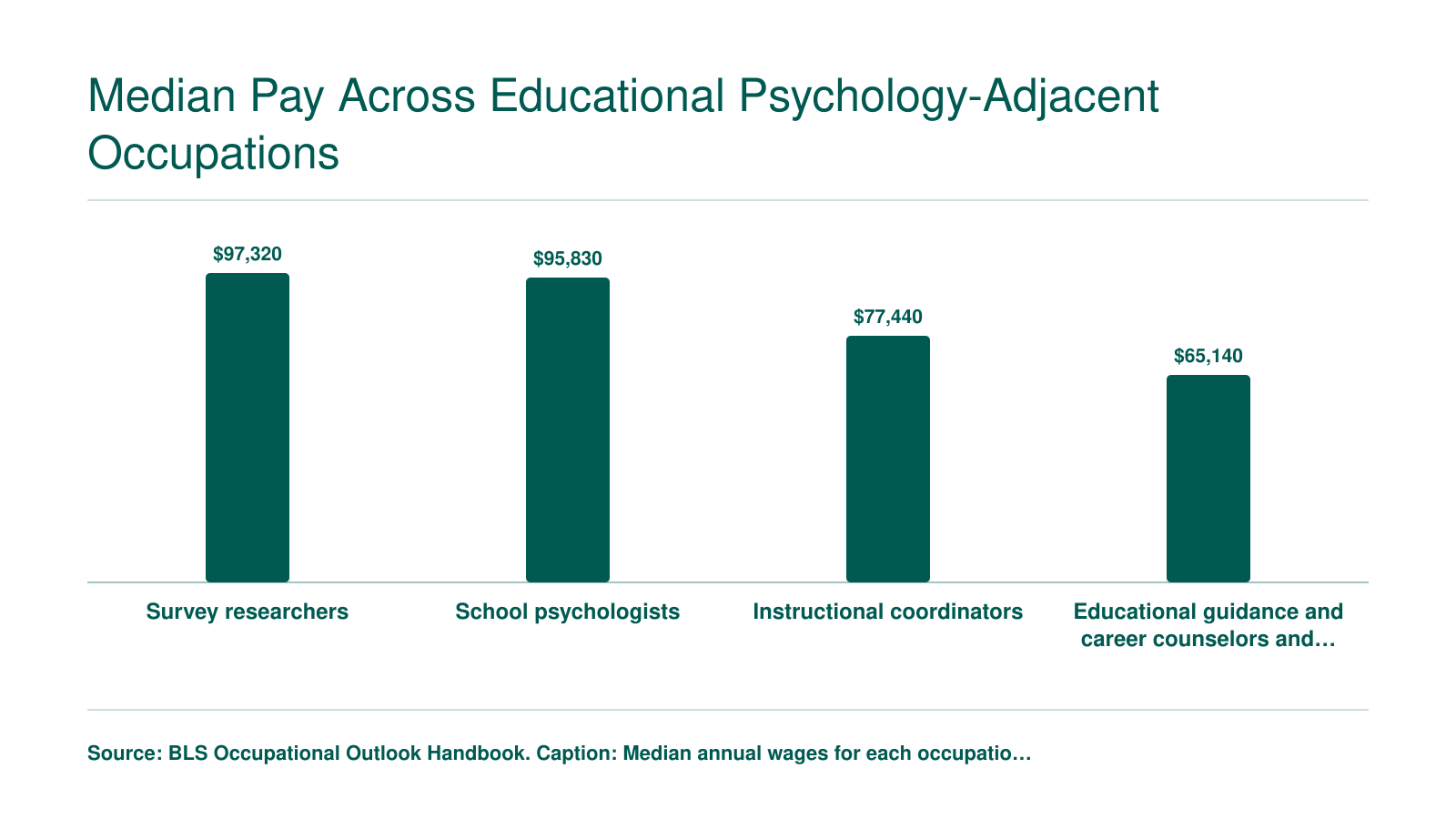
Median Pay Across Educational Psychology-Adjacent Occupations
A master's in educational psychology can lead into several related fields, and pay varies widely among them. This chart compares national median annual wages for four occupations that graduates commonly consider. These are occupation-wide figures, not earnings of graduates from the ranked programs, and school psychologist roles typically require the school psychology track discussed above.
Getting in: GRE Policies, Prerequisites, and Deadlines at Leading Programs
Requirements vary by program, not just by university, so confirm details with the specific program before you apply. The examples below come from each program's published admissions pages.
- Degree and GPAA bachelor's degree is the baseline; Northern Colorado and Florida State specify an accredited or regionally accredited one. Stated minimum GPAs are usually 3.0: Wisconsin–Madison's Research M.S. (last 60 semester hours), Illinois (preferred), Memphis, Texas A&M (recommended), and Florida State (upper-division coursework). Northern Colorado asks for 3.00. Kent State's M.Ed. lists 2.750. Memphis notes admitted M.S. students typically hold 3.30 or higher.
- GRE statusWisconsin–Madison requires the GRE for the ed-psych areas and the Research M.S. Illinois's M.S. makes it optional, and Northern Colorado's M.A. does not require it. Texas A&M has suspended it for several programs; where it is still required, scores must be under five years old.
- Prerequisite courseworkMost programs here publish no prerequisite list. Wisconsin–Madison's Research M.S. requires no particular major but prefers about 18 credits of educational psychology foundations. Teacher certification is not required there. Kent State's optional Gifted Education concentration does require an Ohio teaching license.
- Application materialsWisconsin–Madison, Illinois, and Memphis list three recommendation letters; Kent State lists two. Illinois weighs the statement of purpose alongside GPA and letters. The sources reviewed do not say how much research experience counts for thesis tracks, so ask the program directly.
- Fall deadlinesWisconsin–Madison lists December 1, 2026. Georgia State is February 1. Florida State has a February 15 priority date and a July 1 final deadline. Memphis is March 1. Texas A&M's research-methods cycle closes October 15, and its other listed cycles run August 1 to March 22. The sources do not say whether any date is the funding-priority deadline, so verify that before assuming it.
Educational Psychology programs by state
Compare Educational Psychology programs on the data that matters
Explore more Psychology specializations or browse every graduate field.
All Psychology programs