Best Master's in Educational Psychology Programs in Michigan
Compare 9 accredited Educational Psychology programs in Michigan at 6 schools, with graduate earnings, cost, debt, and completion data from IPEDS and the U.S. College Scorecard.

Michigan's Preliminary School Psychologist Certificate requires an approved program of at least 45 semester credits and a 600-hour practicum, while a master's in educational psychology alone does not qualify. That is the core split: one degree studies learning, the other licenses school-based practice.
Most programs on this list are campus-based, with Andrews University offering online and evening coursework, and GRE policies range from No GRE Required to required. Cost, format, and credential path matter more than the degree title.
Key Points
- In-state graduate tuition runs from $15,937 to $28,056 a year.
- Michigan school psychologist certification requires a specialist-level program, not this master's alone.
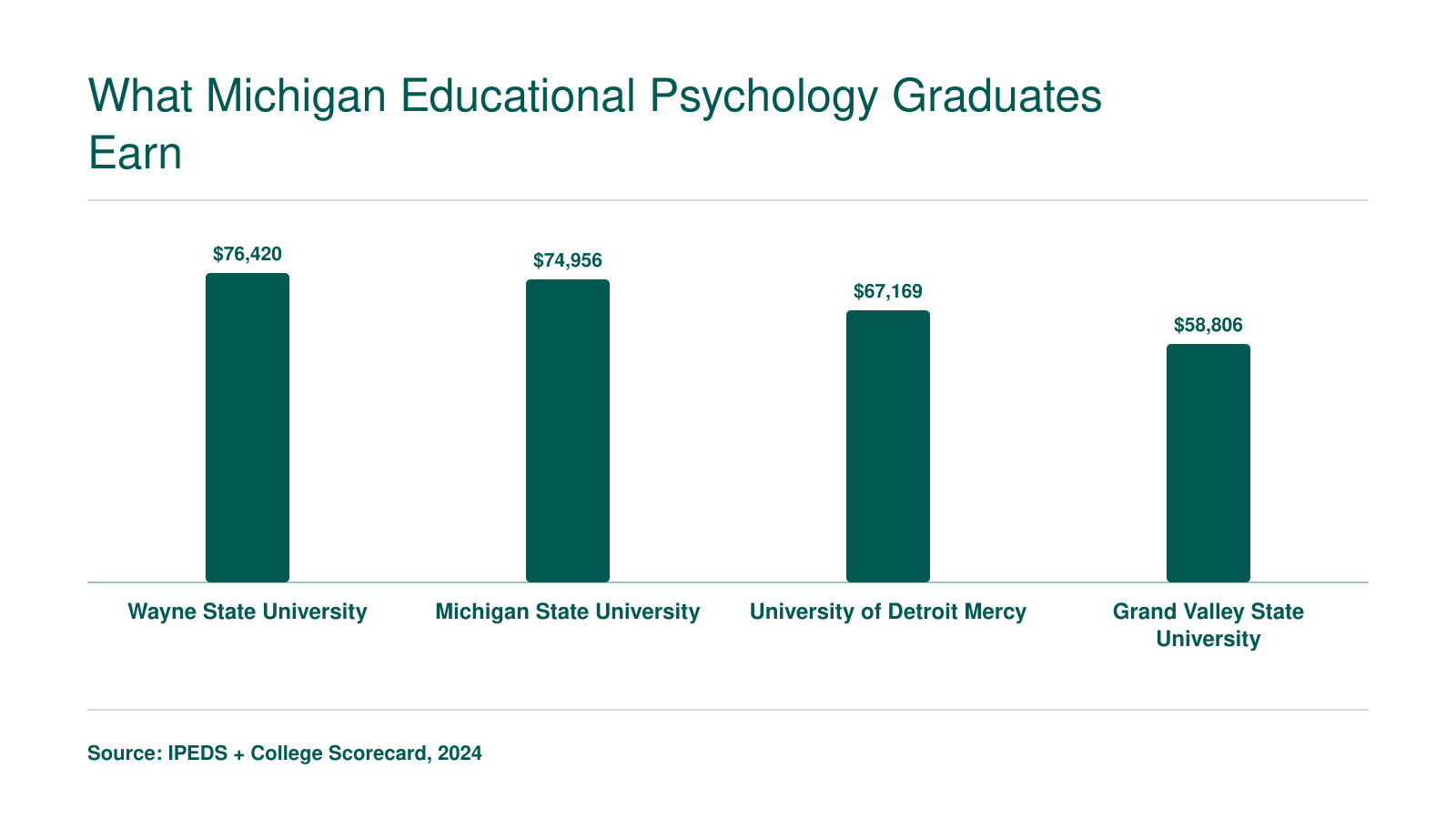
- Median earnings four years after graduating range from $58,806 to $76,420.
Ranked Michigan Schools for a Master's in Educational Psychology
We ranked six Michigan schools, with in-state graduate tuition running from $15,937 to $28,056 a year at the published rates. Most programs are campus-based. Andrews University offers online and evening courses for its educational psychology master's, and Michigan State's school psychology pathway is described as hybrid. Several of the strongest options are school psychology programs, so read each card for the credential it actually leads to.
Michigan State University
#1East Lansing, MI · $22,000 – $42,000/yr (est.)
Best for: Aspiring school psychologists seeking district apprenticeships
Michigan State University has the strongest institution-wide graduation rate of the six, at about 81%. Its school psychology master's is not a standalone degree. It is built into the Ed.S. or Ph.D. pathway, which has NASP accreditation and Michigan Department of Education approval. Graduate tuition is $21,432 in-state and $41,508 out-of-state. District-funded apprenticeships in the first two years offset some of that cost. Program-level earnings are published for a small group of nine completers, at about $74,956 four years out.
- 30 credit hours, Plan B without a thesis
- Final examination required
- Part of the Ed.S. or Ph.D. program
- No terminal master's degree offered
- Curriculum includes child development
- Housed in the College of Education
University of Detroit Mercy
#2Detroit, MI · ~$23,000/yr (est.)
Best for: Applicants who want to skip the GRE
University of Detroit Mercy pairs a NASP-accredited school psychology master's with a clear route to Michigan certification. It is test optional and does not require the GRE, and practicum placements can be paid. Graduate tuition is $22,544 for in-state and out-of-state students alike, at $978 per credit. Program completers show median earnings of about $67,169 four years out, and the institution-wide graduation rate is about 67%.
- 30 credits, first year of the three-year Specialist program
- NASP accredited through 2029
- GRE not required, test optional
- 2.7 GPA minimum and three recommendation letters
- Prerequisite courses and an on-campus interview required
- Prepares for Praxis II in School Psychology
- Full-time only, fall start
- Paid practicum placements available
Andrews University
#3Berrien Springs, MI · $25,000 – $30,000/yr (est.)
Best for: Working professionals needing evening or online courses
Andrews University is the only school here offering a true educational psychology master's built for working professionals, with online and evening courses and three start terms a year. The 33-credit degree focuses on research, program evaluation and curriculum design, within a Christian worldview. Graduate tuition is $28,056 for all students, though the university advertises a discount for full-time students. Institution-wide graduation is about 72%. Program-level earnings and debt are not published.
- 33 credit hours, one-year program
- Starts fall, spring or summer
- Online and evening courses
- 2.6 GPA minimum, two recommendation letters
- No entrance exam required
- Christian philosophy of learning
- Curriculum development and evaluation focus
- Developmental psychology concentration
- Pathway to the PhD program
- Interview with the program coordinator
- Transfer credit up to 20%
- 500-word statement of purpose
- Scholarship based on GRE and GPA
- Instructional psychology concentration
- GRE not required for admission
- Three start dates per year
- Graduate scholarship based on GRE
- PhD in Educational Psychology pathway
Wayne State University
#4Detroit, MI · ~$18,000/yr (est.)
Wayne State University offers the lowest in-state graduate tuition in the field, $15,937, against $34,519 out-of-state. It is also the only school here with a general M.Ed. in Educational Psychology, which can include an Applied Behavior Analysis certificate. Program completers report median earnings of about $76,420 four years out, the highest published. Its separate school and community psychology master's currently has an admissions moratorium and requires the GRE. Institution-wide graduation is about 58%.
- On campus in Detroit
- 3.0 GPA minimum
- ABA certificate can be part of the M.Ed.
- Applies psychology in schools, mental health and business
- GRE required for admission
- Admissions moratorium currently in effect
- Cohort with a fixed course sequence, fall start only
- Three recommendation letters and a personal interview
- 15 credits of psychology prerequisites
- Practicum, internship and capstone included
Grand Valley State University
#5Allendale, MI · $20,000 – $25,000/yr (est.)
Grand Valley State University offers a three-year, full-time cohort that awards both an M.S. and a Specialist in School Psychology. Graduate tuition is $20,030 for all students. It suits applicants committed to school-based practice, since the 63-credit sequence ends in a year-long internship. Program-level earnings are about $58,806 four years out, and the institution-wide graduation rate is about 67%.
- 63 credit hours over three years
- Dual M.S. and Psy.S. degrees
- Cohort model, one cohort per year, fall start
- Full-time enrollment only
- Year-long internship required
- Ethics and diversity course, special education law
Central Michigan University
#6Mount Pleasant, MI · ~$17,000/yr (est.)
Central Michigan University runs a small, NASP-approved school psychology specialist program, admitting only 12 students a year. Graduate tuition is $16,737 for all students, second lowest in the field. Graduates are eligible for Michigan certification and national NASP certification. Institution-wide graduation is about 59%, and program-level earnings are not published.
- 64 credit hours over three years, full-time
- Earns both an M.A. and an S.Psy.S.
- NASP accredited
- Eligible for Michigan certification and NASP national certification
- Full-time internship in the third year
- Faculty expertise in autism and behavior analysis
Cost & outcomes by school
Federal data for the highest-earning Educational Psychology programs, independent of the ranking above. Earnings are this field's master's graduates four years after completing, where the Scorecard reports them.
| School | Earnings | Tuition / yr | Debt | Grads/yr | Format |
|---|---|---|---|---|---|
| Wayne State University MI | $76,420 | $17,960 | $40,245 | 46 | Campus |
| Michigan State University MI | $74,956 | $21,772 | — | 22 | Campus |
| University of Detroit Mercy MI | $67,169 | $22,544 | $57,763 | 41 | Campus |
| Grand Valley State University MI | $58,806 | $20,030 | $45,696 | 9 | Campus |
| Central Michigan University MI | — | $17,187 | — | 9 | Campus |
| Andrews University MI | — | $29,156 | — | 3 | Hybrid |
Sources: U.S. Department of Education. Tuition and graduates: IPEDS. Earnings and debt: College Scorecard, this field's master's graduates; a dash means no figure is reported.
Cost, debt & payoff
Median earnings of this field's master's graduates (4 yrs after completing) vs. their median federal loan debt · U.S. College Scorecard
Across these programs the median graduate earns about $74,956 and finishes with roughly $42,971 in debt — a ratio that clears a common rule of thumb (keep debt below first-year salary). Tuition and debt vary widely school to school, so check the per-school figures in the table above before you shortlist.
Online and Hybrid Educational Psychology Master's Options in Michigan
Most Master's Programs in Michigan ranked here are campus-based, so plan on regular time in Michigan classrooms. Flexibility comes from scheduling rather than fully remote study.
- Andrews University: The Educational Psychology master's offers online and evening courses, the most workable fit here for someone keeping a day job.
- Michigan State University: The School Psychology track sits inside the Ed.S. rather than standing alone as a master's. It is hybrid, with about half of coursework online and half on campus, and classes almost always meet on Tuesdays. It typically takes three years, including the internship.
- Detroit Mercy, Grand Valley State and Central Michigan: These school psychology programs require full-time enrollment. Grand Valley and Central Michigan also require a year-long internship.
- Wayne State University: The M.Ed. in Educational Psychology is campus-based. Ask the department about part-time study.
Field experience is the main limit on remote study. Practica and internships take place in schools, during the school day.
For working teachers: ask each program which weekday classes meet and when field hours must be completed. A fixed evening or single-day schedule is manageable. Daytime placements usually mean taking leave.
Which Michigan Master's Programs Waive or Make the GRE Optional?
GRE policies for a master's in educational psychology in Michigan range from required to not needed at all, and some schools publish nothing. None of the published policies below tie a waiver to a GPA threshold or a prior graduate degree. Policies change by admissions cycle, so confirm the current rule with the admissions office before you apply, and ask whether any waiver or alternative route applies to your record.
| School | GRE Policy | Conditions or Notes |
|---|---|---|
| Andrews University (M.A. Educational Psychology) | Not required | GRE is not an admission requirement. Qualifying students may submit scores for a Graduate Scholarship, and scores must be under 5 years old at admission. The Psychology Subject Test is not required. |
| Michigan State University (Graduate Certificate in Educational Psychology) | Optional | Submission is optional but encouraged. Scores may help show quantitative aptitude or offset gaps in an academic record. This policy is for the certificate, not a master's degree. |
| Wayne State University (M.A. School and Community Psychology) | Required | Verbal and quantitative sections are required for admission consideration. The program has an admissions moratorium, and the catalog lists at least 15 credits in psychology or educational psychology as a prerequisite. |
| University of Detroit Mercy | No published policy | We found no GRE statement in the admissions sources reviewed. Ask the admissions office directly. |
| Grand Valley State University | No published policy | We found no GRE statement in the admissions sources reviewed. Ask the admissions office directly. |
| Central Michigan University | No published policy | We found no GRE statement in the admissions sources reviewed. Ask the admissions office directly. |
Related Articles
Cost of a Master's in Educational Psychology in Michigan and Licensure Pathways
Among the Michigan schools ranked here, Central Michigan University posts the lowest published graduate tuition, at the same rate for in-state and out-of-state students, making it the most affordable option on this list, consistent with the Most Affordable Master's in Educational Psychology Programs ranking. Public universities draw the sharpest resident-versus-nonresident line: Michigan State and Wayne State both roughly double their sticker price for out-of-state students, while Andrews University and University of Detroit Mercy, as private institutions, charge one rate regardless of residency.
Fees, Credits, and Aid
Published per-credit figures vary by program and reporting year, so treat them cautiously. Wayne State lists Fall 2026 College of Education graduate rates near $866 per credit in-state and about $1,876 out-of-state,1 though its specific Educational Psychology track, fee schedule, and total cost are not spelled out. University of Detroit Mercy publishes roughly $978 per credit across 30 credit hours and notes financial aid availability; Central Michigan and Grand Valley both advertise scholarships and assistantships for their specialist cohorts. Confirm mandatory fees and current rates with each admissions office before budgeting. The net price reported for each school is an institution-wide average after aid, not a quote for this program.
Licensure Split
Most educational psychology master's degrees are non-licensure and prepare graduates for research, evaluation, and applied roles. Michigan school psychologist certification instead requires a NASP-approved specialist-level program, which is a separate, longer track than the school psychology master's programs Michigan.
Michigan School Psychologist Certification at a Glance
Educational Psychology vs. School Psychology Master's in Michigan
No. A master's in educational psychology on its own does not lead to Michigan school psychologist certification. That credential comes through a school psychology program at the specialist level, and NASP approval is the benchmark. Michigan State University, Andrews University, Central Michigan University, University of Detroit Mercy and Wayne State University hold full NASP approval at that level. Grand Valley State University's specialist program holds conditional accreditation. Michigan State also holds full NASP approval at the doctoral level.
| Factor | Educational Psychology Master's | School Psychology (Specialist) |
|---|---|---|
| Focus | Learning, development, motivation, assessment and research methods | Applied practice: assessment, counseling, intervention and consultation in schools |
| Typical degree level | Master's (M.A. at Michigan State) | Specialist level; Michigan State also offers a doctoral track |
| Licensure outcome | Generally non-licensure; does not lead to school psychologist certification on its own | Prepares graduates for school psychologist certification |
| Accreditation | Educator preparation accreditation (CAEP) and regional accreditation; the degree is not NASP-reviewed | NASP approval: full at Andrews, Central Michigan, Detroit Mercy, Wayne State and Michigan State; conditional at Grand Valley State |
| Typical careers | Instructional design, assessment, research, curriculum support, doctoral preparation | School psychologist in K-12 districts |
| Typical length | Commonly one to two years | Longer, usually about three years including a supervised internship |
What Michigan Educational Psychology Graduates Earn
Program-level median earnings four years after finishing run from $58,806 to $76,420 among the schools below that publish them. For ROI context, median program debt is $40,245 at Wayne State University, $45,696 at Grand Valley State University and $57,763 at the University of Detroit Mercy. Graduates commonly move into roles such as instructional designer, learning specialist, assessment coordinator and research analyst.
Admissions Checklist for Michigan Educational Psychology Master's Programs
Requirements differ by school, so confirm each point on the program's own admissions page before applying.
- Bachelor's degree and GPAAndrews University requires a bachelor's degree and sets a 2.60 minimum GPA, though applicants below it may still be reviewed on their overall profile. Michigan State University's M.A. in Education page lists a 3.0 overall GPA, with possible exceptions when other materials show strong promise. Wayne State University does not state a minimum undergraduate GPA.
- Prerequisite courseworkWayne State's School and Community Psychology M.A. asks for 15 credits in psychology or educational psychology. Andrews does not specify prerequisite courses. Check the others directly.
- Application materialsAndrews asks for official transcripts, two recommendations, a résumé and a 500-word statement of purpose, plus TOEFL, IELTS or PTE Academic if English was not your language of instruction. Wayne State requires three recommendations, GRE verbal and quantitative scores, and an interview. Andrews does not require the GRE, and Michigan State treats it as optional supporting material.
- DeadlinesWayne State's window runs September 1 to February 1. Andrews lists July 15, November 15, April 1, May 1 and June 1 by term, and recommends starting in January or February. Michigan State reviews on a rolling basis with term-specific due dates. Confirm 2026–27 dates with each school.
Compare Educational Psychology programs on the data that matters
Explore more Psychology specializations or browse every graduate field.
All Psychology programs