Best Master's in Forensic Psychology Programs
Compare 60+ accredited Forensic Psychology programs at 50+ schools, with graduate earnings, cost, debt, and completion data from IPEDS and the U.S. College Scorecard.

Will a master's in forensic psychology qualify you to practice as a psychologist? Usually not, and the program title rarely says which ones do. Some degrees prepare graduates for supervised clinical roles, while others, including those at John Jay, Saint Mary's, and Touro, state outright that they are not license-eligible.
Cost spreads just as widely: among the ranked schools that report net price, it runs from roughly $3,200 at John Jay to about $36,600 at George Washington. Graduate earnings vary too.
Independent licensure and the "forensic psychologist" title generally sit at the doctoral level, so the master's has to match the job you actually want.
Key Points
- University of California-Irvine leads our ranking with $80,735 median earnings after completion.
- APA accreditation covers doctoral programs only, so no master's degree can claim it.
- BLS projects 2 percent growth for forensic psychologists from 2025 to 2035, a small niche.
The 10 Top Forensic Psychology Master's Programs for 2027
Each school earned its spot based on what graduates leave with: earnings, debt, and the bill they paid to get there. The list below spans online, in-person, and hybrid forensic psychology master's paths, so you can compare format, price, and career focus side by side. Use the cards to weigh clinical preparation against research-oriented legal study before you apply.
University of California-Irvine
#1Irvine, CA · ~$15,000/yr (est.)
Best for: Interdisciplinary learners focused on law and policy
UC Irvine's Master of Legal and Forensic Psychology draws on both the psychology and criminology, law and society departments, so legal systems and behavioral science are taught together. The online program includes a required in-residence week before the first fall quarter, and the school's posted program materials emphasize rolling admissions. Four years after finishing, median program earnings were $68,705.
- Apply by 2026-03-01
- Rolling admissions
- Starts fall
- Intersection of psychology and legal issues
- Career opportunities in research and policy institutes
- Online informational sessions available
- Interdisciplinary psychology and criminology departments
Palo Alto University
#2Palo Alto, CA · ~$50,000/yr (est.)
Best for: Working professionals needing synchronous online evening classes
Palo Alto University's MS in Psychology offers a forensic psychology concentration online with synchronous evening classes, a structure built for working professionals. The 36-unit curriculum is completed over six quarters and includes two forensic-focused specialty courses plus risk-assessment grounding. Four years after finishing, median program earnings were $85,224.
- Synchronous online evening classes
- 36 credits over six quarters
- No GRE or application fee required
- Two forensic-focused specialty courses
- Faculty advisor and success coach assigned
- Part-time available
George Washington University
#3Washington, DC · ~$36,000/yr (est.)
Best for: Students seeking hands-on externship training
George Washington University's MA in Forensic Psychology is a campus-based program that offers applied forensics and applied psychology tracks, with daytime, evening, and weekend classes for working students. The curriculum covers criminal profiling, threat assessment, and expert testimony, and a practicum or externship adds real justice-system exposure. Four years after finishing, median program earnings were $82,024.
- 37 total credits
- Full-time and part-time options
- Comprehensive examination required
- Day, evening, and weekend classes
- Applied forensics concentration
- Externship training opportunities
- Careers in law enforcement and corrections
- Training in psychopathology assessment
- Applied psychology concentration
- Victimology and investigative interviewing coursework
- Expert testimony training
- Psychological profiling coursework
CUNY John Jay College of Criminal Justice
#4New York, NY · ~$12,000/yr (est.)
CUNY John Jay College of Criminal Justice brings a criminal-justice specialist identity to a hybrid 42-credit MA in Forensic Psychology. The curriculum blends psychological development, psychopathology, and assessment with multicultural awareness and the tensions between psychology and law. The program is not license-eligible but prepares students for doctoral study or roles such as advocate, research assistant, case manager, and court liaison. Four years after finishing, median program earnings were $68,820.
- 42 total credits
- Thesis or capstone option
- Multicultural awareness emphasized
- Prepares for doctoral study
- Career paths include advocate or research assistant
- Not license-eligible
California State University-Los Angeles
#5Los Angeles, CA · ~$9,000/yr (est.)
Cal State LA's MS in Forensic Psychology runs as a fall-start cohort, so students move through the 33- to 34-unit sequence together and receive close faculty mentoring. A nine-month practicum places students in forensic settings such as rape crisis centers, dependency courts, prisons, and probation departments.
- Fall start, cohort-based structure
- 33 to 34 units
- Thesis required
- 9-month practicum in forensic settings
- Close faculty mentoring
- Prepares for doctoral study or practice
Touro University
#6New York, NY · ~$15,000/yr (est.)
Touro University's fully online MS in Forensic Psychology keeps the price point straightforward at $500 per credit, with 36 credits across 12 courses. The curriculum covers criminal behavior, psychological assessment, and legal procedures, and the program does not lead to licensure but supports research, corrections, victim advocacy, or doctoral study. Four years after finishing, median program earnings were $86,288.
- $500 per credit
- 36 total credits, 12 courses
- 2.5 GPA minimum
- Scholarships and financial aid available
- Fully online
- Does not lead to licensure
Montclair State University
#7Montclair, NJ · ~$16,000/yr (est.)
Montclair State University's forensic psychology concentration sits within an in-person, STEM-designated MA in Clinical Psychology. The scientist-practitioner curriculum emphasizes domestic violence, child abuse, and juvenile offender rehabilitation, with supervised roles in drug courts and child advocacy organizations. Four years after finishing, median program earnings were $81,192.
- No GRE required
- Test optional
- Rolling admissions
- 3.0 GPA minimum
- Prerequisite courses required
- Training in domestic violence, child abuse, and juvenile offender
- STEM-designated
- Small cohorts and close mentorship
Saint Mary's College of California
#8Moraga, CA · ~$39,000/yr (est.)
Saint Mary's College of California frames its campus-based MA in Forensic Psychology around restorative justice, with evening and Saturday classes for a cohort of working students. The 14-course, 39-unit program does not lead to licensure but prepares graduates for roles such as crime analyst, probation officer, or police consultant. Field placement gives students real experience in corrections and community advocacy settings.
- 39 total credits, 14 courses
- Apply by 2026-05-01
- Cohort-based evening classes
- Restorative justice philosophy
- Field placement experience
- Career path as crime analyst or probation officer
- Not license eligible
University of Denver
#9Denver, CO · ~$42,000/yr (est.)
University of Denver's two-year, 90-credit MA in Forensic Psychology combines clinical training with legal analysis and places students in practicum settings across adult and juvenile justice, victim assistance, and specialty courts. Denver FIRST serves as a research and service hub, giving students access to grant-funded projects and low-cost clinical work. Four years after finishing, median program earnings were $68,815.
- 2-year, 90-credit program
- Practicum in adult and juvenile justice
- Denver FIRST forensic research hub
- Focus on social justice and anti-racism
- Quarter system academic calendar
- Faculty involved in legislative policy
Fairleigh Dickinson University
#10Madison, NJ · ~$26,000/yr (est.)
Fairleigh Dickinson University's MA in Forensic Psychology is a hybrid, 18-month, 45-credit program that includes a 300-hour externship at sites such as prisons, courts, and mental health facilities. Classes are small, with a 10:1 student-to-faculty ratio, and the program includes an automatic interview for FDU's Clinical Psychology PhD. Four years after finishing, median program earnings were $80,630.
- 18-month program
- 45 total credits
- 300 clinical hours
- No GRE, test optional
- $0 application fee
- Study abroad option in England
- Small class sizes, 10:1 ratio
- Automatic interview for PhD program
Cost & outcomes by school
Federal data for the highest-earning Forensic Psychology programs, independent of the ranking above. Earnings are this field's master's graduates four years after completing, where the Scorecard reports them.
| School | Earnings | Tuition / yr | Debt | Grads/yr | Format |
|---|---|---|---|---|---|
| Teachers College at Columbia University NY | $91,522 | $37,918 | $81,639 | 237 | Campus |
| Touro University Worldwide CA | $89,314 | $9,000 | $27,075 | 115 | Online |
| Alliant International University-San Diego CA | $86,459 | $19,690 | $61,500 | 121 | Hybrid |
| Touro University NY | $86,288 | $14,979 | $37,615 | 45 | Online |
| Palo Alto University CA | $85,224 | $50,166 | $99,711 | 58 | Online |
| George Washington University DC | $82,024 | $36,414 | $49,750 | 76 | Campus |
| Montclair State University NJ | $81,192 | $16,056 | $36,500 | 19 | Campus |
| Fairleigh Dickinson University-Metropolitan Campus NJ | $80,630 | $19,068 | $42,425 | 22 | Hybrid |
| Fairleigh Dickinson University NJ | $80,630 | $25,628 | $42,425 | 100 | Hybrid |
| National University CA | $78,497 | $16,416 | $28,854 | 1,098 | Online |
| Marymount University VA | $77,172 | $23,446 | $54,818 | 96 | Campus |
| The Chicago School at Chicago IL | $73,751 | $35,328 | $82,748 | 249 | Online |
Sources: U.S. Department of Education. Tuition and graduates: IPEDS. Earnings and debt: College Scorecard, this field's master's graduates; a dash means no figure is reported.
Cost, debt & payoff
Median earnings of this field's master's graduates (4 yrs after completing) vs. their median federal loan debt · U.S. College Scorecard
Across these programs the median graduate earns about $73,751 and finishes with roughly $50,331 in debt — a ratio that clears a common rule of thumb (keep debt below first-year salary). Tuition and debt vary widely school to school, so check the per-school figures in the table above before you shortlist.
How We Built This Ranking: Outcomes Before Prestige
Our top-ranked program, University of California-Irvine, reports median earnings of $80,735 after completion. That number matters more to a terminal master's buyer than a glossy campus or a faculty celebrity. We weight each program by outcomes: program-level median earnings after completion, median federal debt, net price, and graduation rate. A higher salary paired with lower debt and a realistic net price beats a prestige brand built on reputation surveys or research output, which tells you little about whether your specific degree will pay for itself. For example, UC Irvine's in-state net price is $14,251, while CUNY John Jay reports $3,203.
We are direct about the limits. Graduation rate and net price are institution-wide averages, not the forensic psychology cohort alone. Earnings figures are medians for completers only, so they do not include students who left without a degree. Delivery format is not penalized: online, hybrid, and campus programs compete on the same outcome measures, because remote learners should face the same financial and career standards. A fully online program like Oklahoma State's sits beside campus programs with no format-based handicap.
Clinical or Nonclinical? How Each Track Shapes Your Licensure Options
Most forensic psychology master's degrees fall into one of two buckets: clinical psychology master's programs or counseling-track programs built around supervised client contact, and nonclinical programs built for corrections, advocacy, and research roles.
Two Different Degrees, Two Different Endpoints
Licensure-oriented counseling programs generally require 48 to 60 semester hours and a supervised practicum with direct client contact. In contrast, nonclinical forensic psychology programs often run 30 to 40 credits and skip the practicum. That is why John Jay College of Criminal Justice describes its MA in Forensic Psychology as not license-eligible, and why Oklahoma State University's 32-credit online MS in Forensic Sciences with a forensic psychology concentration is explicitly nonclinical. National University's program is also nonclinical. Montclair State's clinical forensic concentration emphasizes supervised roles and doctoral preparation, though licensure eligibility still depends on state rules. The Chicago School includes 700 clinical hours and weekly individual supervision, but state boards still decide whether that coursework and fieldwork satisfies local licensure rules. Programs like the University of Denver's 90-credit MA include extensive practicum work, but that alone does not confer psychologist status. A nonclinical degree can still support roles as a victim advocate, probation officer, or research coordinator without a license.
What "Psychologist" Actually Requires
In nearly every state, the title psychologist requires a doctorate. A master's in forensic psychology, even a clinical one, does not make you a licensed psychologist. Texas is one of the few states with a master's-level pathway: the Licensed Psychological Associate, or LPA, requires 60 semester credits, at least 6 practicum credits, passage of the EPPP and Texas Jurisprudence Exam, and 3,000 post-graduate supervised hours completed within 24 to 48 months across no more than three placements. Not every state offers a master's-level psychology license, and rules vary widely.
The Realistic Route
If you want to practice now, the practical path is to earn a license as a Licensed Professional Counselor or Licensed Mental Health Counselor through clinical mental health counseling programs, or pursue Texas LPA status if you qualify. Then, if the psychologist title matters later, use that foundation to enter a doctoral program. The master's becomes a stepping stone, not the final credential.
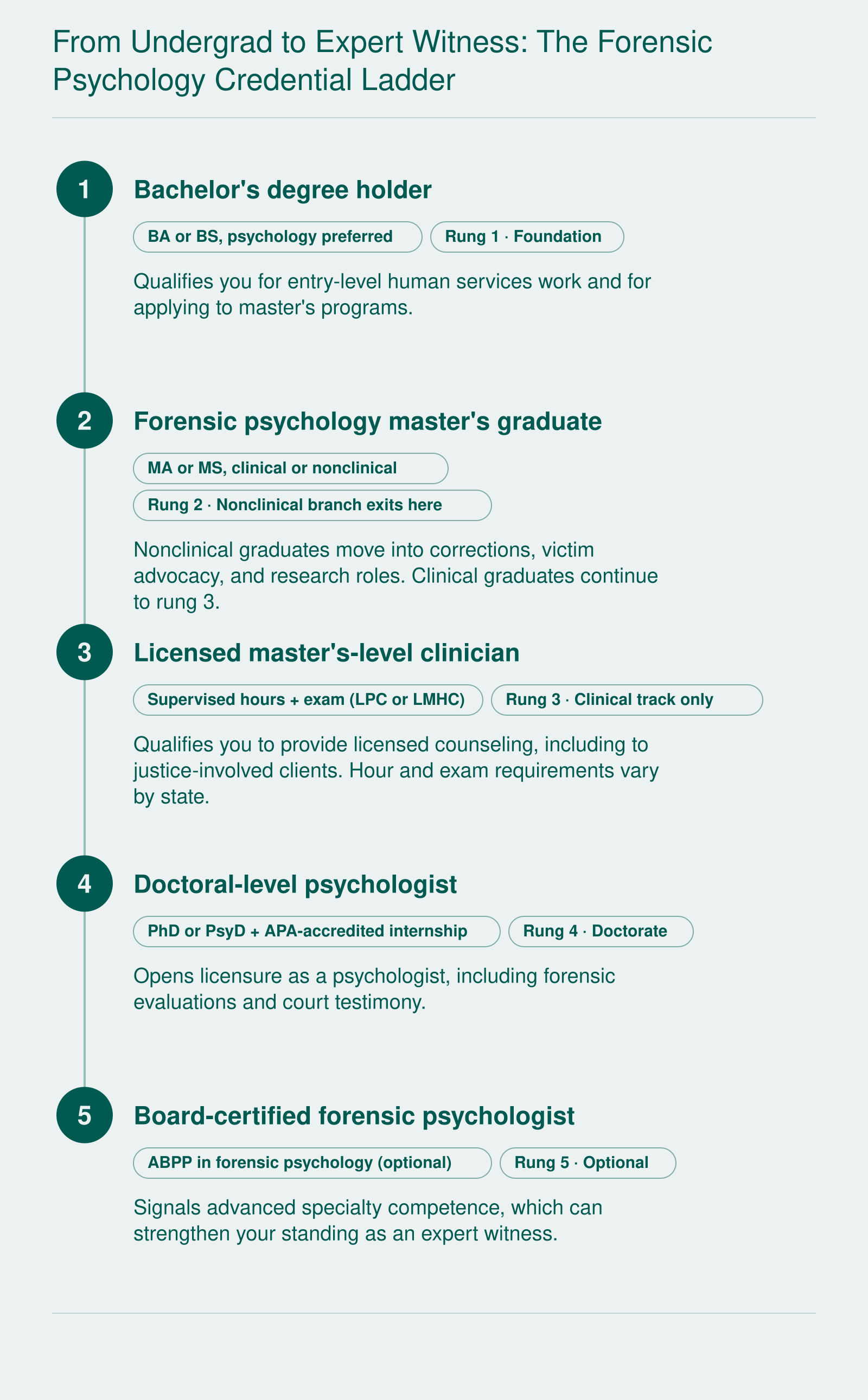
From Undergrad to Expert Witness: The Forensic Psychology Credential Ladder
Each rung unlocks a different scope of work. The nonclinical master's track exits the ladder after rung 2, while the clinical track continues toward licensure and doctoral training.
APA Accreditation and Forensic Psychology Master's Degrees: The Fine Print
The phrase "APA-accredited forensic psychology programs" appears in many search queries, but it describes a category that does not exist at the master's level.
What APA Actually Accredits
The American Psychological Association's Commission on Accreditation (APA-CoA) reviews doctoral graduate programs in clinical, counseling, school psychology, and approved combinations. It also accredits doctoral internships and postdoctoral residencies in health service psychology. Accreditation is program-specific, not institutional. One accredited doctoral program does not give master's programs in the same department APA recognition, and no forensic psychology master's degree is APA-accredited.
Accreditation That Applies to a Master's
At the master's level, look for regional institutional accreditation first. For accredited master's in psychology programs and counseling psychology master's programs, the Master's in Psychology and Counseling Accreditation Council (MPCAC) and the Council for Accreditation of Counseling and Related Educational Programs (CACREP) are the relevant specialized accreditors. The research for this ranking could not confirm which of the 10 ranked programs currently hold MPCAC or CACREP accreditation, so verify directly with the program before you apply.
Why This Matters
Licensure boards often require a degree from a recognized accreditation pathway, and doctoral admissions committees may favor applicants from accredited master's programs. Treat any "APA accredited" language in a master's brochure as a cue to ask which program, exactly, holds that status.
Related Articles
The Bureau of Labor Statistics projects employment for "psychologists, all other" (the category that includes forensic psychologists) will grow 2 percent from 2025 to 2035, rising from about 60,000 jobs to 61,400. That's a smaller, specialized niche than the broader psychology field.
Application Checklist: GRE, Prerequisites, and Experience
Requirements vary widely across forensic psychology master's programs, and several policies change year to year. Confirm each item with the program before you apply.
- Bachelor's degreeEvery program requires an accredited bachelor's. Walden accepts any bachelor's or higher, while Arizona State prefers psychology, criminal justice, social science, or a closely related field.
- Minimum GPADenver lists 2.5, Arizona State 3.00 (last 60 hours), and John Jay 3.0. Fairleigh Dickinson sets no minimum but says competitive applicants typically hold 3.5 or higher.
- GRE policyArizona State, Walden, and SNHU list no GRE requirement. John Jay has listed a combined 297 but offered a waiver for Fall 2025, so check the current cycle. Denver accepts a Psychology Subject score of 660+ in place of coursework.
- Prerequisite coursesExpect statistics, research methods, and an introductory or abnormal psychology course. Fairleigh Dickinson requires Introductory Psychology, Statistics, and Psychopathology. John Jay wants 12 psychology credits with B or better in key courses.
- Work or volunteer experienceExperience in corrections, victim services, courts, or research strengthens an application. Our research did not find it formally required at the programs above.
- Recommendations and personal statementFairleigh Dickinson asks for a CV, a personal statement, transcripts, and two letters, ideally from professors. Walden requires no essay.
Forensic Psychology programs by state
Forensic Psychology Master's Programs: Your Questions Answered
These answers cover the questions applicants ask most often. Policies vary by school and change often, so confirm details with each program before you apply.
How is a master's in forensic psychology different from a clinical psychology master's?
Does a forensic psychology master's qualify you to practice as a licensed psychologist?
How many years does a part-time forensic psychology master's usually take?
Can you apply with a bachelor's in criminal justice instead of psychology?
Will master's credits transfer into a PsyD or PhD program later?
Do forensic psychology master's programs require a thesis or capstone?
Compare Forensic Psychology programs on the data that matters
Explore more Psychology specializations or browse every graduate field.
All Psychology programs