Best Master's in Counseling Psychology Programs
Compare 380+ accredited Counseling Psychology programs at 260+ schools, with graduate earnings, cost, debt, and completion data from IPEDS and the U.S. College Scorecard.

A counseling psychology master's only pays off if your state board will license the graduate who holds it. Virginia requires 4,000 post-degree supervised hours; Florida requires 1,500. The accreditor on your transcript, CACREP or MPCAC, often decides which boards count your coursework at all.
Cost spreads just as wide. Published in-state graduate tuition among the ranked programs runs from roughly $8,900 at Fresno State to about $67,600 at Boston University, with 60 credit hours a common requirement at either end.
Employers hire on the license, not the diploma. That credential is issued by a state, and states disagree.
Key Points
- Supervised hours after the degree run from 1,500 in Florida to 4,000 in Virginia.
- BLS projects 18 percent job growth for mental health counselors from 2025 to 2035.
- CACREP has the broadest licensure recognition, so confirm your state board's accreditor rules first.
Best Master's in Counseling Psychology Programs: 2027 Rankings
These 10 master's programs in counseling psychology and clinical mental health counseling stand out for accreditation, clinical training, and licensure preparation. We compare in-person and online formats, tuition and net price, and the concentrations that shape your career path. Use the rankings to weigh which program fits your state's licensure requirements and your budget.
William & Mary
#1Williamsburg, VA · $15,000 – $20,000/yr (est.)
Best for: Virginia school and mental health counseling students
William & Mary offers CACREP-accredited counseling master's programs with school and clinical mental health counseling concentrations. Students can choose a campus experience in Williamsburg or a fully online option with three start dates per year. The school counseling path prepares K-12 counselors and meets Virginia licensure requirements, while the clinical mental health track includes 700 supervised clinical hours and prepares students for the NCE or NCMHCE. Program graduates report median earnings of about $64,700 four years after finishing, with median debt around $20,500.
- CACREP accredited
- 60 graduate credit hours required for licensure
- 4,000-hour post-master's residency
- First aid, CPR, AED training required
- Prepares for Virginia Professional Counselor licensure
- Campus-based with online option available
- M.Ed. degree program
- CACREP accredited
- 2-year, 60 credit hour program
- 700 supervised clinical hours
- Prepares for NCE or NCMHCE
- Small cohorts with faculty mentorship
- Clinical placements across diverse settings
- Financial aid and scholarships available
- CACREP accredited
- Fully online with three start dates per year
- 100% licensure pass rate
- Electives in addictions and transpersonal counseling
- Supervised practicum and internship courses
- Social justice and cultural responsiveness focus
- Personalized faculty mentoring
Ohio State University
#2Columbus, OH · ~$14,000/yr (est.)
Best for: Ohio counselor education students
Ohio State's Counselor Education program trains students for clinical mental health counseling and professional school counseling careers. The campus-based master's pairs counseling theory with supervised practice, and faculty emphasize self-reflection and evidence-based care. Students study in Columbus, near clinical partners and a large alumni network across Ohio.
- Two concentration options: clinical mental health and school counseling
- Accredited counselor education program
- Prepares professionals for community, private, and hospital settings
- Emphasizes ethical, self-reflective practice
- Combines theory with supervised practice
- Top-rated counselor education program
Gonzaga University
#3Spokane, WA · ~$22,000/yr (est.)
Best for: Washington clinical mental health counseling students
Gonzaga's CACREP-accredited Master of Arts in Clinical Mental Health Counseling is a two-year, campus-based program in Spokane. The program reports a 100% licensure pass rate and 100% job placement rate, with supervised internships throughout the community. Small cohorts and faculty mentorship help students develop an individualized counseling theory and prepare for the NCE.
- CACREP accredited
- 2-year program
- 100% licensure pass rate
- 100% job placement rate
- Supervised internships in the community
- Develop an individualized counseling theory
- Small cohorts with committed faculty
- Prepares for NCE
University of Oklahoma – Hudson College of Public Health
#4Norman, OK · ~$9,000/yr (est.)
The University of Oklahoma's Professional Counseling master's program offers a School Counseling concentration with CACREP accreditation in clinical mental health. Students complete 60 credit hours in a cohort model, with a state-of-the-art counseling lab and faculty advising. The program prepares graduates for Oklahoma LPC licensure and certified school counselor roles.
- CACREP accredited
- Three concentration options
- Complete in 2 or 3 years
- 60 total credit hours
- Cohort-based structure
- Prepares for Oklahoma LPC licensure
- Prepares Certified School Counselors in Oklahoma
- State-of-the-art counseling training lab
University of Wisconsin-Madison
#5Madison, WI · ~$12,000/yr (est.)
UW-Madison's MPCAC-accredited Master of Science in Counseling is a selective, campus-based program admitting just 10 to 12 students per year. The 60-credit curriculum includes supervised practica and a capstone clinical case conceptualization, and it meets licensure requirements in 12 states including Wisconsin. Program graduates report median earnings of about $55,600 one year after finishing and $71,100 four years after finishing, with median debt around $25,900.
- MPCAC accredited
- No entrance exam required
- 2-year, 60 total credit hours
- Full-time and part-time options
- Capstone clinical case conceptualization
- Prepares graduates for Wisconsin LPC licensure
- Meets licensure requirements in 12 states
- Highly competitive: 10 to 12 students enrolled yearly
California State University-Stanislaus
#6Turlock, CA · ~$10,000/yr (est.)
California State University-Stanislaus offers multiple counseling-related master's paths, including a psychology M.S. with a counseling track, a counseling M.A. with a Pupil Personnel Services credential, and a counseling M.A. with a professional clinical counselor option. Programs emphasize multicultural competence and meet California BBS and school counseling requirements. The campus is in Turlock, with evening courses for working students.
- 60 total credit hours
- 3.0 GPA minimum
- Three letters of recommendation
- Thesis required
- Prepares for California MFT licensure
- Curriculum meets California BBS requirements
- Focus on counseling theories and skills
- California Commission on Teacher Credentialing accredited
- Complete in 2-3 years
- 58 total credit hours
- 800 clinical hours
- Evening classes for working students
- Prepares for K-12 school counseling
- Qualifies for PPS credential and M.A.
- 32 total credit hours
- Cohort-based structure
- 3.0 GPA minimum
- Two letters of recommendation
- Thesis or capstone option
- Courses scheduled late afternoon and evening
- Leads to LPCC licensure in California
University of South Carolina
#7Columbia, SC · ~$14,000/yr (est.)
USC's Counseling and Rehabilitation master's program offers career counseling, clinical addiction counseling, and clinical rehabilitation counseling concentrations. The 60-credit program is housed in the medical school and emphasizes supporting clients with disabilities and diverse needs. Graduates qualify for South Carolina LPC-A licensure and can pursue multiple national counseling credentials.
- 60 total credit hours
- Two letters of recommendation
- Prepares for LPC-A or LAC-A licensure
- Credential prep: CRC, NCC, MAC, CCC
- Supports clients with disabilities
- Faculty-student collaboration emphasized
- Fall and spring admission terms
- 60 total credit hours
- Starts fall/spring
- Licensure as Licensed Professional Associate
- Master Addiction Counselor (MAC) certification
- National Certified Counselor (NCC) certification
- Supports people with disabilities
- Faculty-student collaboration emphasized
- 60 total credit hours
- Two letters of recommendation
- Supports people with disabilities
- Prepares for LPC-A licensure
- CRC and NCC certification prep
- Faculty-student collaboration emphasized
- Welcomes varied student backgrounds
Boston University
#8Boston, MA · $65,000 – $70,000/yr (est.)
Boston University's EdM in Counseling includes concentrations in child and adolescent mental health, school counseling, and sport/performance psychology. The two-year, in-person program requires at least 700 supervised clinical hours and meets Massachusetts licensure academic requirements. Program graduates report median earnings of about $52,000 one year after finishing and $70,800 four years after finishing, with median debt around $80,000.
- Three concentration options
- 2-year program
- 700 clinical hours
- Clinical practicum and internship
- Prepares for Massachusetts licensure
- CMPC certification eligibility
- Path to APA-accredited doctoral programs
- Strong mental health focus
New York University
#9New York, NY · ~$43,000/yr (est.)
NYU Steinhardt's Counseling for Mental Health and Wellness master's prepares students for licensed mental health counselor roles. The on-campus program offers a clinical curriculum with supervised fieldwork, while the fully online option is MPCAC-accredited and includes a 100-hour practicum and 600-hour internship. Students can focus on areas such as substance-related disorders, marriage and family counseling, and LGBTQ+ health.
- 21-month program
- Fully online option available
- Prepares for licensure and employment
- Clinical training for licensed counselor
- LGBTQ+ health and social services focus
- On-campus and online degree options
- MPCAC accredited
- Five concentration options
- No entrance exam required
- 60 total credit hours
- 100-hour practicum in mental health setting
- 600-hour internship at approved clinical site
- Small, interactive live online classes
- One-on-one faculty office hours
California State University-Fresno
#10Fresno, CA · ~$9,000/yr (est.)
California State University-Fresno offers a clinical mental health counseling master's and a separate CACREP-accredited marriage, family, and child counseling master's. The clinical mental health path is 60 units with supervised practicum and internship, preparing students for Licensed Professional Clinical Counselor eligibility. The program is nationally ranked and emphasizes serving diverse clients across the lifespan.
- Two concentration options
- 60 total credit hours
- 3.0 GPA minimum
- Three letters of recommendation
- National Certified Rehabilitation Counselor Exam prep
- Prepares for Licensed Professional Clinical Counselor
- Top rankings by U.S. News and World Report
- Interview by program faculty required
- CACREP accredited
- 60 total credit hours
- 3.0 GPA minimum
- Three letters of recommendation
- Prepares for National Counselor Exam
- Fulfills California MFT licensure coursework
- LPCC licensure coursework available
- Practicum requires grade of B or better
Cost & outcomes by school
Federal data for the highest-earning Counseling Psychology programs, independent of the ranking above. Earnings are this field's master's graduates four years after completing, where the Scorecard reports them.
| School | Earnings | Tuition / yr | Debt | Grads/yr | Format |
|---|---|---|---|---|---|
| Chapman University CA | $107,808 | $39,868 | — | 26 | Campus |
| California State University-Long Beach CA | $100,315 | $8,898 | $25,500 | 54 | Campus |
| San Francisco State University CA | $96,854 | $9,370 | — | 6 | Campus |
| Golden Gate University CA | $95,577 | $17,070 | — | 65 | Campus |
| Seattle University WA | $93,491 | $24,216 | $63,958 | 22 | Hybrid |
| St. Mary's University TX | $92,592 | $21,726 | $52,375 | 6 | Campus |
| CUNY Queens College NY | $86,240 | $11,612 | $33,941 | 57 | Campus |
| Fairleigh Dickinson University-Metropolitan Campus NJ | $80,630 | $19,068 | $42,425 | 22 | Online |
| National University CA | $78,497 | $16,416 | $28,854 | 1,098 | Online |
| Bay Path University MA | $76,036 | $15,162 | $38,712 | 110 | Online |
| University of North Texas TX | $75,626 | $9,091 | $32,709 | 133 | Campus |
| Southeast Missouri State University MO | $71,839 | $7,702 | $30,189 | 21 | Campus |
Sources: U.S. Department of Education. Tuition and graduates: IPEDS. Earnings and debt: College Scorecard, this field's master's graduates; a dash means no figure is reported.
Cost, debt & payoff
Median earnings of this field's master's graduates (4 yrs after completing) vs. their median federal loan debt · U.S. College Scorecard
Across these programs the median graduate earns about $66,014 and finishes with roughly $51,250 in debt — a ratio that clears a common rule of thumb (keep debt below first-year salary). Tuition and debt vary widely school to school, so check the per-school figures in the table above before you shortlist.
What Earned a Spot on This List
How do you tell whether a counseling psychology master's is worth what it costs? A good program should leave you licensable, employable, and not buried in debt, so those three outcomes drove every pick on this list.
The Numbers Behind the Picks
We started with College Scorecard program-level earnings and debt for graduates. We then paired those figures with each institution's net price, published graduate tuition, and graduation rate. Together they show what a student pays, what a completer borrows, and what that graduate earns afterward.
Where the Data Falls Short
Two limits matter. Graduation rate and net price describe the whole institution, not the counseling program itself, so treat them as context rather than a promise. Earnings come from program completers and cover a specific time window after graduation, which means they reflect past cohorts, not a guarantee for yours. When a program's figures are unpublished, we leave the slot empty rather than guessing.
What Federal Data Can't Tell You
Federal data does not track accreditation or delivery format, so we checked both separately against school and accreditor information. Both matter. Accreditation (MPCAC or CACREP) can determine whether your degree satisfies your state's licensure rules, and format shapes how you complete practicum hours. Programs change both over time, so confirm them directly with each school's admissions office and with your state licensing board before you apply.
MPCAC vs. CACREP: Which Accreditation Fits Your Licensure Goal
Neither accreditation is universally better. CACREP has the broadest state and federal recognition for professional counselor (LPC) licensure, while MPCAC suits psychology-science-oriented programs and states that accept it. Match the accreditor to your state board's rules before you apply, because MPCAC accreditation alone does not make you a CACREP program graduate.
| Feature | MPCAC (Counseling Psychology) | CACREP (Clinical Mental Health Counseling) |
|---|---|---|
| Accrediting scope | Accredits master's programs in the Psychology and Counseling professions | Accredits master's and doctoral programs solely in the Counseling profession |
| Minimum credit hours | Set by MPCAC standards and varies by program; confirm the total against your state board's requirement | 60 semester credits is the standard benchmark for clinical mental health counseling programs |
| Supervised practicum and internship | Varies by program; confirm that hours meet your state's supervised-experience rules | 100 practicum hours over a full term of at least 8 weeks (2024 standards), followed by a longer supervised internship |
| Typical degree titles | Counseling Psychology (core areas often include psychopathology, multicultural counseling, research methods, group counseling, and ethics) | Clinical Mental Health Counseling or Mental Health Counseling |
| State licensure recognition | Depends on each state's educational requirements; accepted in some states, not a guarantee of LPC eligibility | Meets educational requirements in most states with expedited review; required in Ohio, Kentucky, North Carolina, and Florida (since July 1, 2025) |
| Federal and VA employment recognition | Not the basis for VA or TRICARE counselor recognition; confirm with the employer | VA recognizes CACREP-graduate LPMHCs as mental-health specialists; a CACREP degree is required for the TRICARE Certified Mental Health Counselor credential |
| Doctoral pathway fit | Fits research-oriented counseling psychology doctoral study and psychology-science career tracks | Fits counselor education and supervision doctorates, which CACREP also accredits |
| Licensure eligibility by degree | A counseling psychology master's can lead to licensure, but only if the state's educational requirements are met | A CACREP clinical mental health counseling degree aligns directly with CACREP-based LPC requirements |
Related Articles
Counseling Psychology Licensure Requirements by State: Credits, Hours, and Exams
Post-degree supervised hours range from 1,500 in Florida to 4,000 in Virginia, so the same master's degree can lead to very different timelines depending on where you practice. Illinois and Massachusetts (3,360 hours each) sit above the 3,000-hour norm in most states listed. "Member" in the Counseling Compact column means a state has enacted the compact, not that it is live. Ohio and Georgia are operational in 2026, while Pennsylvania (enacted July 2026), Florida, North Carolina, Virginia, and Washington are not yet issuing privileges. If you might relocate, a compact state can eventually let you practice across member states without a new license, but non-members like California, Texas, New York, Illinois, and Massachusetts may require a separate application or endorsement. This table is a baseline: credit hours and exam rules are not confirmed for every state, so verify with your state licensing board, because rules change.
| State | License Title | Graduate Credits Required | Post-Degree Supervised Hours | Required Exam | Counseling Compact Member |
|---|---|---|---|---|---|
| California | LPCC | N/A | 3,000 | N/A | No |
| Texas | LPC | N/A | 3,000 | N/A | No |
| New York | LMHC | 60 semester hours | 3,000 (includes 600-hour internship) | NCMHCE | No |
| Florida | LMHC | N/A | 1,500 | NCMHCE | Yes (enacted, not yet operational) |
| Illinois | LCPC | 48 or 60, depending on route | 3,360 | NCMHCE | No |
| Pennsylvania | LPC | N/A | 3,000 | NCE, NCMHCE | Yes (enacted July 2026, not yet operational) |
| Ohio | LPCC | N/A | 3,000 | N/A | Yes (operational since January 2026) |
| Georgia | LPC | N/A | 3,000 | NCE, NCMHCE | Yes (operational since June 2026) |
| North Carolina | LCMHC | 60 semester hours | 3,000 (2,000 direct client) | NCE, NCMHCE, CRCE | Yes (not yet operational) |
| Virginia | LPC | N/A | 4,000 (2,000 direct client) | NCE, NCMHCE | Yes (not yet operational) |
| Washington | LMHC | N/A | 3,000 | NCE, NCMHCE | Yes (not yet operational) |
| Massachusetts | LMHC | N/A | 3,360 | NCMHCE | No |
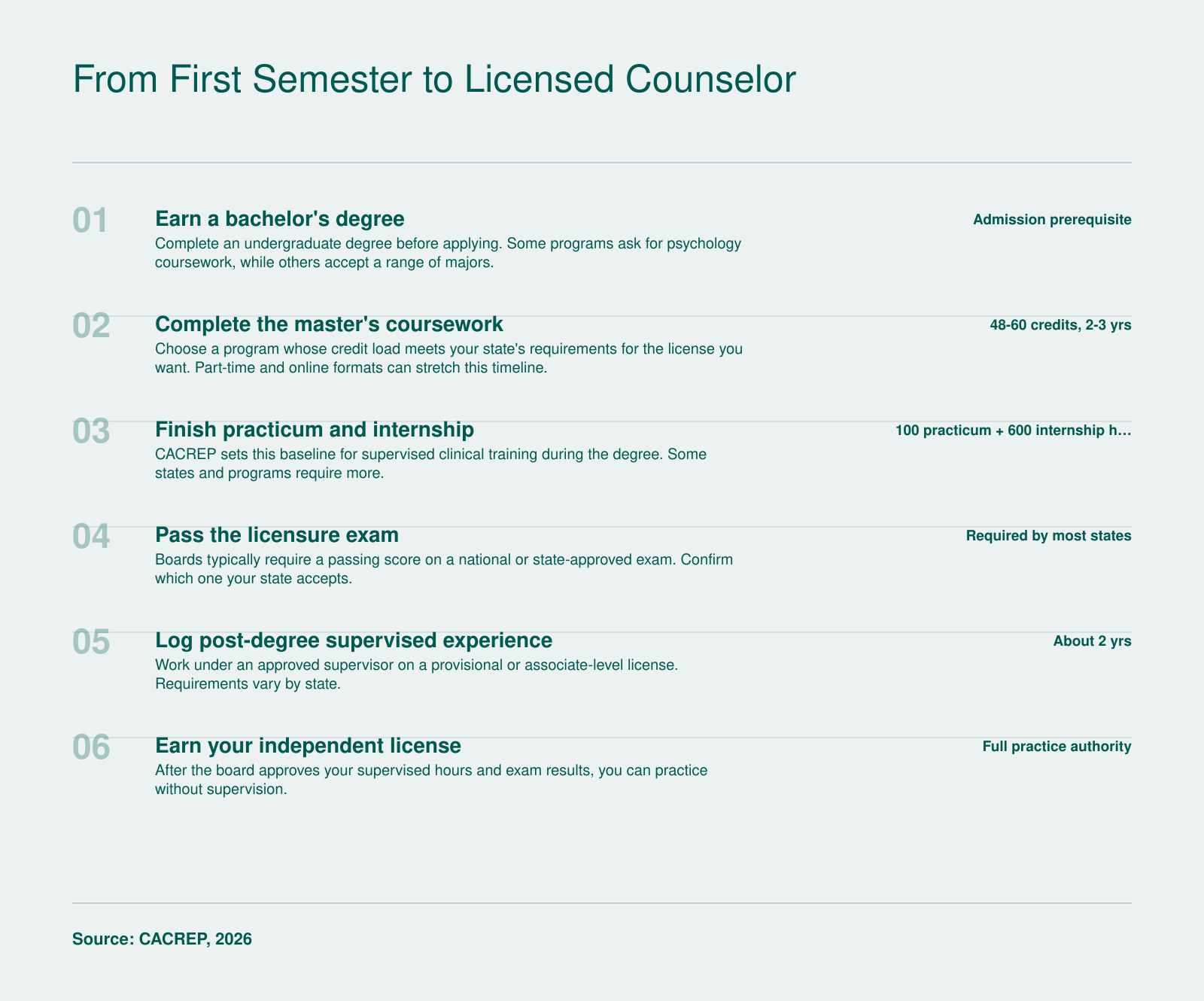
From First Semester to Licensed Counselor
How long does it take? Most students spend 2-3 years on the master's degree, then about 2 more years in supervised practice before they can hold a full independent license. Exact hours and timelines vary by state, so check your licensing board before you enroll.
Online, Hybrid, or on Campus: How Format Affects Your Practicum
The Ranked List Leans Heavily Campus-Based
All 13 programs in this ranking are delivered primarily on campus, which tells you something about where counseling psychology and clinical psychology master's programs still live. Two of them, William & Mary and NYU, advertise a fully online pathway alongside the in-person version. Outside the ranking, flexible options are more common: Merrimack College runs its program online, on campus, or as a hybrid, and schools like Old Dominion, Walden, Capella, Keiser, and Sacred Heart build their degrees around distance delivery.
Asynchronous Does Not Mean Never Showing Up
Synchronous coursework meets at a set time, live, with classmates. Asynchronous means you watch lectures and post discussion work on your own schedule. Most "online" counseling programs mix both, and almost all of them add required campus time. Seattle University's hybrid format includes two four-day residencies. The University of Oklahoma pairs live online sessions with two weeklong residencies. Keiser requires two on-campus residencies before you start practicum. Sacred Heart builds two weeklong residencies into its 60-credit degree, and Capella requires two as well. Walden layers synchronous skills labs on top of in-person fieldwork. If you are shopping for a program you can complete from your couch, assume residencies until the program tells you otherwise.
Who Secures Your Clinical Site?
This is the question that derails more students than tuition. Online delivery does not shrink your fieldwork. For clinical mental health counseling programs, CACREP's floor is roughly 700 hours, 100 practicum plus 600 internship, and those hours happen in person at approved sites. The Chicago School, for example, reports 100 practicum hours and 300 hours in its first internship course. Most programs do not publicly state whether they place you or expect you to find your own site. Merrimack mentions an internship coordinator who works with students, but stops short of guaranteeing a placement. Ask admissions directly, in writing, before you deposit.
Yes, an Online Degree Can Lead to Licensure
It can, provided the program satisfies your state's accreditation, credit-hour, and supervised-hour rules. The complication is state authorization, which is separate from licensure. Schools must be authorized to enroll students who live in a given state, and some states also regulate where clinical placements can occur. The California Institute of Integral Studies publishes its authorization status state by state, noting it can apply to both enrollment and clinical placement. Confirm your state is covered before applying, not after.
According to the BLS Occupational Outlook Handbook, employment of substance abuse, behavioral disorder, and mental health counselors is projected to grow 18 percent between 2025 and 2035, much faster than the 4 percent average for all occupations over the same period.
What Licensed Mental Health Counselors Earn Nationally
Nationally, counselors in this occupation earn a median annual wage of
Counseling Psychology programs by state
Counseling Psychology Master's Programs: Your Questions Answered
These answers cover the timing, admissions, credit transfer, and title questions applicants ask most. Policies vary by school and state, so confirm specifics with each program and your state licensing board before you apply.
How long does a master's in counseling psychology usually take full-time vs. part-time?
Do counseling psychology master's programs still require the GRE, and when are application deadlines?
Can I transfer graduate credits from another program into a counseling psychology master's?
Can I use the title "psychologist" with only a master's in counseling psychology?
Compare Counseling Psychology programs on the data that matters
Explore more Psychology specializations or browse every graduate field.
All Psychology programs