Best Master's in Counseling Psychology Programs in North Carolina
Compare 10 accredited Counseling Psychology programs in North Carolina at 6 schools, with graduate earnings, cost, debt, and completion data from IPEDS and the U.S. College Scorecard.

A master's in counseling psychology in North Carolina is a graduate degree, often 60 credit hours, that pairs coursework with supervised practicum and internship hours. It leads to the LCMHC-A credential or school counselor licensure, depending on the program you pick, so accreditation and clinical training matter more than prestige.
The tension is cost against format. Public universities such as UNC Charlotte and UNC Greensboro cost far less in-state than private options such as Wingate, and hybrid or online delivery trades campus access for flexibility. Not every program here holds the same accreditation status.
Key Points
- East Carolina University offers the lowest in-state path here: $290 per credit for 62 credits.
- UNC Pembroke's hybrid clinical mental health program is one of few flexible-format options, and clinical work stays in person.
- Check CACREP accreditation first, then apply without the GRE at most schools here.
Best Master's in Counseling Psychology Programs in North Carolina, Ranked
North Carolina counseling master's programs vary widely in format, concentration, and accreditation status, and those differences matter for licensure. The six schools below mix campus, hybrid, and fully online options. CACREP status is described as verified only where the directory research confirms it. Otherwise we note what the school itself reports, and you should check the CACREP directory before you apply.
University of North Carolina at Charlotte
#1Charlotte, NC · $5,000 – $10,000/yr (est.)
Best for: Career changers needing part-time flexibility
UNC Charlotte offers a 60-credit Master of Arts in Counseling with Clinical Mental Health, School Counseling, and Addictions Counseling concentrations. The CACREP directory lists all three as accredited through October 31, 2034. Instruction is in person, with full-time and part-time tracks, video labs, a play therapy room, and clinical placements across the Charlotte region. Admission is competitive: applications are reviewed once a year, and the department reports admitting roughly 17% to 35% of applicants between 2020 and 2025.
- Concentrations: Clinical Mental Health, School Counseling, Addictions Counseling
- 60 total credit hours, full-time and part-time options
- In person in Charlotte; summer or fall starts
- Application deadline October 15; group interviews typically in January
- On-campus counseling video labs and a dedicated play therapy room
- CACREP directory lists all three concentrations as accredited through Oct. 31, 2034
- Any undergraduate major accepted if graduate admission requirements are met
- Four addiction courses required, with internships at addiction facilities
- 750 clinical hours across the 60-credit program
- About 20 courses planned semester by semester
- Optional gerontology certificate
- Scholarships and financial aid available
North Carolina A & T State University
#2Greensboro, NC · ~$8,000/yr (est.)
Best for: Aspiring LCMHCs targeting in-person clinical training
North Carolina A&T's Master of Science in Mental Health Counseling (clinical concentration) is a 60-credit, fully in-person program built around supervised field experience. Coursework is aligned with North Carolina's clinical mental health counselor requirements. The program page lists CACREP accreditation, though it was not independently confirmed in the directory research, so verify it before applying. Students can add certificates or pursue a double major across two counseling tracks.
- 60 total credit hours, delivered fully in person
- Multiple supervised field experiences
- Aligned with North Carolina clinical licensure requirements
- Double major available across two counseling tracks
- Add-on certificates for specialization
- Program page lists CACREP accreditation; confirm in the CACREP directory
- Doctoral counseling program also offered at the university
University of North Carolina at Greensboro
#3Greensboro, NC · ~$9,000/yr (est.)
Best for: Full-time students wanting early hands-on clinic work
UNC Greensboro's Master of Science in Counseling places students in the on-campus Vacc Clinic in the first semester, before a 600-hour internship in hospitals, community agencies, or private practice. The university describes its Clinical Mental Health Counseling concentration as CACREP-accredited. In the directory, its Marriage, Couple and Family Counseling and School Counseling programs are listed, but the School Counseling entry showed a March 31, 2026 expiration, so confirm its current status. Cohorts are small, classes meet during the day, and admission is for fall only.
- 600 clinical hours, with an internship after first-semester clinic work
- On-campus counselor training clinic where students counsel real clients under supervision
- Cohorts of roughly 32 to 38 students
- Daytime classes, 9 a.m. to 5 p.m.; fall start only
- No entrance exam required; two letters of recommendation minimum
- University describes the concentration as CACREP-accredited
- Training includes Dialectical Behavior Therapy and motivational interviewing
- Scholarships and financial aid available
University of North Carolina at Pembroke
#4Pembroke, NC · ~$7,000/yr (est.)
UNC Pembroke offers hybrid Master of Arts in Education degrees in Clinical Mental Health Counseling and Professional School Counseling. Classes meet on campus about every other week in the evenings, which suits working adults. The program pages report CACREP accreditation (reaccredited in 2021 for the clinical track), but confirm this in the CACREP directory. Both tracks are 60 credit hours with rolling admissions and a Wilmington option.
- 60 credit hours over about three years
- Hybrid format with evening classes, 5:30 to 8:30 p.m.
- 100-hour practicum plus two 300-hour internships
- Prepares for the National Counselor Exam and LCMHCA licensure
- Minimum 2.8 GPA and three letters of recommendation
- Summer or fall starts with rolling admissions
- School reports CACREP reaccreditation in 2021
- 60 credit hours; hybrid with evening and summer classes
- Two 300-hour internships
- Prepares for the Praxis II exam
- Minimum 2.7 GPA and three letters of recommendation
- Provisional license possible after 24 credits
- Graduate assistantships available
- Career path: K-12 school counselor
Wingate University
#5Wingate, NC · $10,000 – $15,000/yr (est.)
Wingate University's Master of Science in Clinical Mental Health Counseling is a campus-based program with an emphasis on trauma-informed care, cultural competence, and experiential learning. The university reports that the program is in CACREP candidacy, not full accreditation. Applicants who need a CACREP-accredited degree for licensure planning should confirm current status directly. Wingate is a private university, so expect tuition to differ from the UNC system schools.
- Campus-based program in Wingate, North Carolina
- In CACREP candidacy per the university; not yet listed as fully accredited
- Trauma-informed care and cultural competence emphasis
- Coursework in career and group counseling, assessment, and diagnostic and treatment planning
- Training covers clients across the lifespan
- Focus on advocacy for marginalized populations
Methodist University
#6Fayetteville, NC · $45,000 – $50,000/yr (est.)
Methodist University in Fayetteville offers the only fully online option in this group: an asynchronous Master of Science in Clinical Mental Health Counseling. The program is working toward CACREP accreditation, and its inaugural cohort finished in 2025. It is not yet verified as accredited, which matters for licensure planning. Tuition is listed at about $545 per credit hour, military benefits are accepted, and the school reports that most students receive financial aid.
- Fully online, asynchronous coursework
- Listed at $545 per credit, about $32,700 total program tuition
- CACREP initial accreditation in progress; not yet verified as accredited
- Prepares for the National Counselor Examination
- Military and veteran education benefits accepted
- Core topics: life span development, counseling theories, ethical and legal issues
- Scholarships and financial aid available
Cost & outcomes by school
Federal data for the highest-earning Counseling Psychology programs, independent of the ranking above. Earnings are this field's master's graduates four years after completing, where the Scorecard reports them.
| School | Earnings | Tuition / yr | Debt | Grads/yr | Format |
|---|---|---|---|---|---|
| University of North Carolina at Pembroke NC | — | $6,928 | — | — | Hybrid |
| University of North Carolina at Greensboro NC | — | $8,614 | — | — | Campus |
| Wingate University NC | — | $11,864 | — | — | Campus |
| North Carolina A & T State University NC | — | $8,368 | — | 12 | Campus |
| University of North Carolina at Charlotte NC | — | $8,037 | — | 1 | Campus |
| Methodist University NC | — | $47,895 | — | — | Online |
Sources: U.S. Department of Education. Tuition and graduates: IPEDS. Earnings and debt: College Scorecard, this field's master's graduates; a dash means no figure is reported.
Online and Hybrid Master's Options at Ranked North Carolina Programs
No counseling master's in North Carolina is fully remote, because every program requires in-person clinical work. Two ranked programs offer flexible delivery: UNC Pembroke and Methodist University.
UNC Pembroke's Clinical Mental Health Counseling program is hybrid. Classes meet in the evening and are split between campus and online, and a Wilmington option at Cape Fear is available. Clinical work totals 700 hours: a 100-hour practicum plus two 300-hour internships, all in person. The field placement coordinator shares a list of approved sites, but students must contact those sites, or others, and secure their own placement. Apply the semester before you plan to start.
Methodist University's Master of Science in Clinical Mental Health Counseling has a fully online, asynchronous option. Its CACREP accreditation is listed as initial and in progress, so confirm current status before enrolling. I could not verify its hour totals or placement policy. The CACREP standard is 100 practicum hours and 600 internship hours, so ask Methodist directly whether it finds sites or expects you to.
Practical tip: before applying, ask any program offering an online master's in clinical mental health counseling in writing whether it can place you at a site in North Carolina if you plan to license here.
For North Carolina licensure, start with CACREP accreditation or a board-approved curriculum; it is the first filter before supervised hours count.
GRE Policies at Ranked North Carolina Master's Programs
Most of the ranked counseling psychology master's programs here have dropped the GRE and are master's programs with no GRE required, leaving your transcript, essays, and recommendations to carry the weight. Here is where each school stands.
- UNC Greensboro (Clinical Mental Health and School Counseling): No entrance exam required. Applicants with an undergraduate GPA of 2.75 or below must submit a statement explaining earlier academic performance and readiness for graduate study.
- UNC Charlotte (Counseling, M.A.): No GRE or MAT required. The published standard is a 3.0 overall GPA, with occasional exceptions.
- NC State (M.Ed. in School Counseling): No longer requires the GRE or MAT; applicants are expected to hold a 3.0 GPA or higher.
- Wake Forest (Counseling): No GRE required. The Graduate School reviews transcripts holistically and lists a 3.0 minimum GPA.
- Western Carolina (Clinical Mental Health and School Counseling): GRE required (150 Verbal, 150 Quantitative, 4.0 Analytical) unless waived. A conferred bachelor's with a 3.0 GPA, a conferred master's, or two years of K-12 employment (School Counseling only) qualifies you to request a waiver.
- UNC Pembroke (Clinical Mental Health Counseling): The 2026 admissions page lists a 2.8 minimum GPA but publishes no GRE requirement or waiver policy, so the position is unclear from available sources.
Related Articles
Cost of a Counseling Master's in North Carolina and Licensure Preparation
State residency, not program reputation, often drives the biggest tuition swing in graduate counseling education. East Carolina University has the lowest in-state tuition path on the list at $290 per credit for 62 credits, roughly $17,980. Appalachian State, North Carolina Central University, UNC Charlotte, and UNC Greensboro follow at $299 per credit for 60 credits. UNC-Chapel Hill is the most expensive resident option at $1,034 per credit.
The Out-of-State Gap and Private Alternatives
Nonresident rates widen the gap sharply. UNC-Chapel Hill and North Carolina A&T list the highest public nonresident rates, $2,071 and $2,010 per credit, pushing a 60-credit program above $120,000. The lowest public nonresident sticker is East Carolina University at $1,020 per credit for its 62-credit program. Private schools often simplify this: Campbell University charges $575 per credit and Catawba College $599 per credit, or about $34,500 and $35,940 for 60 credits.
Licensure Preparation
A clinical mental health track is the route to the LCMHC-A credential, and a school counseling track leads to NC DPI school counselor licensure, paths that differ from marriage and family therapy master's programs. School counselors need an approved master's program and must pass the ETS Praxis Professional School Counselor exam, with a commonly cited passing score of 156. Current federal data does not publish program-level median debt or 10-year repayment for every program, so any net price figure is best treated as an institution-wide estimate.
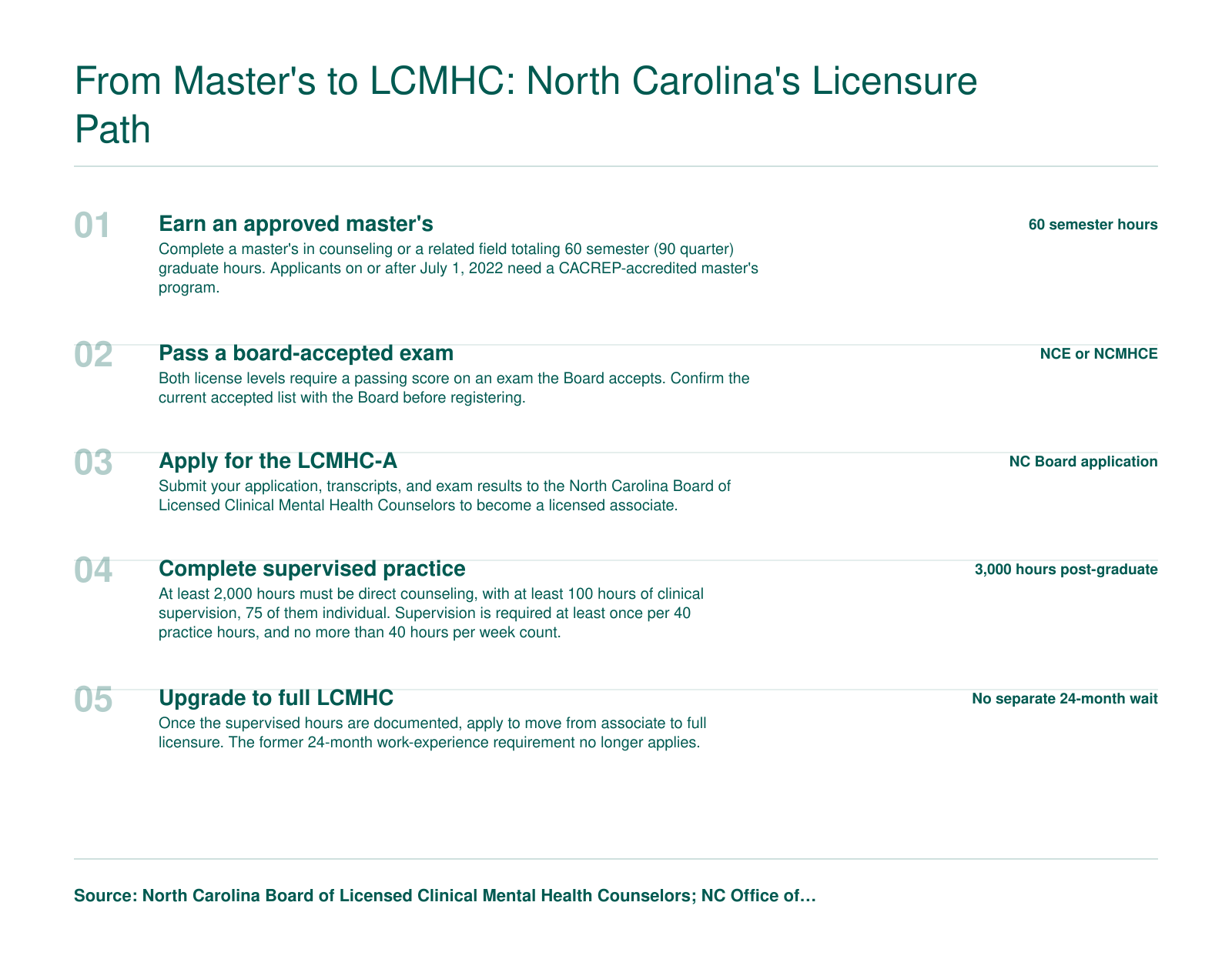
From Master's to LCMHC: North Carolina's Licensure Path
North Carolina licenses clinical mental health counselors in two stages. You practice under supervision as an associate first, then upgrade to the full license. Hours and supervision figures below come from the state board's published requirements.
Career Outcomes and Choosing Your North Carolina Program
Career outcomes mean two concrete things: whether you can get licensed in the role you want, and what that role pays once you are working. For counseling master's programs in North Carolina, verified earnings figures tied to individual programs are not published for every program, so the honest way to compare is by track, placement network, and licensure fit rather than by a salary number attached to a school name.
Start with the credential you are after. If your goal is the LCMHC, choose a clinical mental health counseling track, since its 60-credit structure and clinical practicum hours map to what the state board reviews. If you want to work in K-12 schools, the school counseling track leads to state school counselor licensure instead, and the two are not interchangeable.
Format should be the last filter, not the first. Pick an online or hybrid program only after confirming the school places students near where you actually live.
FAQs About Master's in Counseling Psychology Programs in North Carolina
These answers cover the questions prospective students ask most about program structure, timelines, accreditation, and licensure portability. Licensing rules change, so confirm current details with the North Carolina Board of Licensed Clinical Mental Health Counselors before you commit.
What is the difference between counseling psychology and clinical mental health counseling?
How long does it take to complete a master's in counseling psychology in North Carolina?
Can you become a licensed counselor in North Carolina with a degree from a non-CACREP program?
Can I transfer a North Carolina counseling license to another state?
Compare Counseling Psychology programs on the data that matters
Explore more Psychology specializations or browse every graduate field.
All Psychology programs