Best MSW Programs
Compare 1,100+ accredited Social Work (MSW) programs at 420+ schools, with graduate earnings, cost, debt, and completion data from IPEDS and the U.S. College Scorecard.

Published tuition for an MSW runs from roughly $8,900 for in-state public residents to more than $68,000 at private schools like the University of Chicago, and graduate debt at the ranked programs spans $13,000 to $37,000. That spread, not accreditation, is what separates these options. More than 300 schools hold CSWE accreditation, so the credential itself clears early.
The real tension sits between price and payoff: a bigger name does not reliably mean lower debt or higher post-graduation earnings. We examined 29 schools and narrowed the field to 10 that balance cost against what graduates actually earn.
Licensure adds another constraint. Every program, online or on campus, routes you toward state-specific LCSW requirements that outlast your tuition bill.
Key Points
- Published graduate tuition runs from $8,872 at UCF to $68,652 at Chicago.
- Our ranking weighs earnings against debt, so a famous name doesn't automatically win.
- Online MSW students still complete supervised field hours in person, and 35 states had joined the licensure compact by July 2026.
The 10 Best MSW Programs for 2027, Ranked
Each school below earned its spot on what graduates actually take home and owe, not on reputation. The strongest MSW programs combine a CSWE-accredited curriculum with clear career payoff.
University of California-Berkeley
#1Berkeley, CA · ~$16,000/yr (est.) · ASWB pass rate 93% (3-yr weighted avg)
Best for: Bay Area students seeking anti-oppressive clinical training
Berkeley's Master of Social Welfare is a two-year, full-time program with CSWE accreditation dating to 1928. The curriculum emphasizes evidence-informed, anti-oppressive practice, and a School Social Work concentration prepares students for the California Pupil Personnel Services credential. Median earnings four years after finishing are about $92,446.
- Two-year full-time program
- CSWE accredited since 1928
- Equivalent to Master of Social Work
- Prepares for professional licensure
- Funding options and info sessions offered
- 45 semester units and 1,000-hour practicum
- 450 hours in school settings
- Prepares for California PPSC credential
- Requires Certificate of Clearance and basic skills
- Child Welfare and Attendance add-on option
University of Chicago
#2Chicago, IL · ~$69,000/yr (est.) · ASWB pass rate 90.4% (3-yr weighted avg)
Best for: Policy-minded macro practice candidates
UChicago's master's in social work, social policy, and social administration carries CSWE accreditation continuous since 1919. It offers clinical and social administration concentrations alongside the broad foundation. Median earnings four years after finishing are about $71,980.
- Equivalent to an MSW
- Combines direct practice, policy, research, and theory
- Program pathway options and certificates available
- In-person delivery at Crown Family School
- Clinical concentration
- Field education component
- Global learning opportunities
- Social administration concentration
- Combines practice and policy
- Interdisciplinary research foundation
University of Michigan
#3Ann Arbor, MI · $29,000 – $58,000/yr (est.) · ASWB pass rate 87.2% (3-yr weighted avg)
Best for: Working professionals needing flexible online pathways
Michigan's MSW offers eight specialized pathways, including integrated health, mental health, substance abuse, and child and family welfare. Advanced standing cuts the credit load to 45 for BSW graduates. Median earnings four years after finishing are about $64,788.
- 60-credit MSW with eight specialized pathways
- Full-time or part-time options
- Field education included
- Dual degree opportunities
- CSWE-accredited
- Focus on integrated health, mental health, and substance abuse
- 12 credits in chosen pathway
- Online and on-campus formats
- Advanced standing available with 45 credits
- Children, Youth and Families pathway
- Evidence-based interventions focus
- Generalist foundation curriculum
- 45 total credit hours
- Requires CSWE-accredited BSW degree
- Full-time and part-time options
- 3.5 GPA minimum
- Prepares for LCSW licensure
University of Washington-Seattle Campus
#4Seattle, WA · ~$19,000/yr (est.) · ASWB pass rate 84.5% (3-yr weighted avg)
UW Seattle's MSW is a two-year full-time program with a three-year part-time option and a one-year advanced-standing track. Concentrations include clinical social work, administrative and policy practice, and community-centered integrative practice. Median earnings four years after finishing are about $77,163.
- Two-year full-time, three-year part-time, or advanced standing
- Clinical Social Work, Administrative and Policy, and Community-Centered concentrations
- 48-75 credits depending on track
- Field practicum placements included
- Council on Social Work Education accredited
- One-year advanced standing option
- 48 total credit hours
- Requires BSW from CSWE-accredited program
- Prepares for advanced practice in public social services
- Integrated field practicum
Washington University in St Louis
#5St. Louis, MO · ~$65,000/yr (est.) · ASWB pass rate 91.7% (3-yr weighted avg)
WashU's MSW blends theory, policy, and hands-on experience, with full-time, part-time, advanced standing, and dual degree options. It requires two practicum experiences totaling 960 hours and offers concentrations in children, youth, and families and mental health. Median earnings four years after finishing are about $63,805.
- Full-time, part-time, advanced standing, and dual degree options
- Two practicum experiences totaling 960 hours
- Foundation practicum 360 hours; concentration practicum 600 hours
- Concentration in children, youth, and families
- Over 400 practicum affiliations
- Holistic advising and career engagement support
- Mental health concentration
- Micro, mezzo, and macro practice covered
- Elective credits for specializations
Rutgers University
#6New Brunswick, NJ · ~$23,000/yr (est.) · ASWB pass rate 75.7% (3-yr weighted avg)
Rutgers' Advanced Standing MSW is an accelerated 39-credit path for BSW graduates, available in traditional, online, and intensive weekend formats. The program requires 500 hours of practicum learning. Median earnings four years after finishing are about $66,438.
- 39 total credit hours
- Complete in one to two years
- 500 clinical hours
- Traditional, online, and intensive weekend formats
- Designed for BSW graduates
- CSWE-accredited
University of Wisconsin-Madison
#7Madison, WI · ~$12,000/yr (est.) · ASWB pass rate 91.3% (3-yr weighted avg)
UW-Madison's full-time MSW centers on an advanced generalist specialization with optional focuses in aging, child and family welfare, health, and mental health. BSW holders can complete an advanced standing track in about one year. Median earnings four years after finishing are about $62,101.
- Two-year curriculum for non-BSW students
- Advanced generalist specialization with optional focuses
- Field education at over 100 agencies
- CSWE-accredited
- Dual or double degree options
- Complete in one year
- 30 total credit hours
- Requires CSWE-accredited BSW degree
- 5-year BSW degree recency requirement
- Exemption from most foundation courses
Boston University
#8Boston, MA · $65,000 – $70,000/yr (est.) · ASWB pass rate 89.9% (3-yr weighted avg)
BU's online MSW Advanced Standing is a six-semester, part-time program for BSW graduates, with Clinical Practice or Macro Practice majors and specializations like behavioral health or trauma. The program includes a 1,000-hour field internship and cites a licensure pass rate above 90 percent. Median earnings four years after finishing are about $72,136.
- Six-semester fully online program
- 43 total credit hours
- Clinical Practice or Macro Practice majors
- Single 1,000-hour field internship
- Synchronous and asynchronous coursework
- Small class sizes of 15-25 students
- CSWE-accredited
Binghamton University
#9Vestal, NY · $10,000 – $15,000/yr (est.) · ASWB pass rate 85.1% (3-yr weighted avg)
Binghamton's MSW is an advanced generalist program with more than 1,000 field placement hours across 200+ partner organizations. It offers full-time, part-time, online, and advanced standing formats, with residency rules for online versus in-person study. Median earnings four years after finishing are about $63,907.
- Full-time and part-time options
- Over 1,000 field placement hours
- 200+ field placement partners
- Advanced generalist curriculum
- CSWE-accredited
- Online and campus delivery
- Up to 29 credits waived with BSW
- Requires BSW earned within 5 years
- Requires B or better in major courses
- Full-time and part-time options
- Online or on-campus options
San Jose State University
#10San Jose, CA · ~$10,000/yr (est.) · ASWB pass rate 73.5% (3-yr weighted avg)
SJSU's Advanced Standing MSW is a 12-month, 37-unit hybrid program for BSW graduates, blending online coursework with in-person field internships. It prepares students for LCSW licensure and the California Pupil Personnel Services credential, with field placements at major health networks and county agencies.
- 12-month, 37-unit program
- Hybrid format blending online and in-person field internships
- CSWE accredited since 1973
- Prepares for LCSW credentialing and PPS credential
- 400+ hours of field experience
- California residents only
- Requires 3.5 GPA minimum
Cost & outcomes by school
Federal data for the highest-earning Social Work (MSW) programs, independent of the ranking above. Earnings are this field's master's graduates four years after completing, where the Scorecard reports them.
| School | Earnings | Tuition / yr | Debt | Grads/yr | Format |
|---|---|---|---|---|---|
| Grand Canyon University AZ | — | $10,015 | — | 24,308 | Online |
| Liberty University VA | — | $8,730 | — | 19,236 | Campus |
| Walden University MN | — | $10,885 | — | 16,946 | Online |
| Arizona State University AZ | — | $10,843 | — | 14,144 | Online |
| Capella University MN | — | $15,092 | — | 14,818 | Online |
| University of North Texas TX | — | $9,091 | — | 9,932 | Campus |
| The University of Texas at Arlington TX | — | $11,249 | — | 9,724 | Hybrid |
| Arizona State University AZ | — | $13,587 | — | 10,636 | Campus |
| University of Illinois Urbana-Champaign IL | — | $19,278 | — | 12,978 | Campus |
| University of Maryland Global Campus MD | — | $9,882 | — | 7,086 | Online |
| Chamberlain University-Illinois IL | — | $15,300 | — | 9,626 | Online |
| New York University NY | — | $42,726 | — | 21,902 | Campus |
Sources: U.S. Department of Education. Tuition and graduates: IPEDS. Earnings and debt: College Scorecard, this field's master's graduates; a dash means no figure is reported.
What Moved a School up This List: Our Data and Weighting
A famous name is not the same as a strong payoff, and this ranking leans toward the payoff. Two federal sources supply the evidence. The U.S. Department of Education's College Scorecard provides program-level earnings and debt for MSW completers. IPEDS provides tuition, net price, and graduation rates.
What Carried the Most Influence
Earnings after graduation and median federal debt at completion carried the most weight, since together they show whether the degree pays for itself. Three other factors followed:
- Net price: what students actually pay after grants, not the published tuition.
- Completions volume: a program that graduates many MSW students has a sturdier track record than a tiny one.
- Format availability: online, hybrid, and campus options all count, because flexibility changes who can enroll.
We did not publish fixed percentage weights, and we won't pretend the blend is more precise than the data allows.
Limits Worth Knowing
Graduation rate and net price are institution-wide figures. They reflect a whole university, including undergraduates, not just the social work school. Some programs also lack published Scorecard earnings because their graduating cohorts are too small to report. Those schools are judged on the measures that do exist.
Why Reputation Was Left Out
Reputation surveys and faculty prestige did not factor in. They are hard to verify and say little about what a graduate earns or owes. A career-switcher who is paying for a license and a new salary gets more from outcome data than from a brand impression.
What You Should Verify Yourself
Before applying, confirm three things directly:
- CSWE status: the program's current accreditation.
- State authorization: whether an online program can enroll students in your state.
- Field placement support: whether the school finds your placement site or leaves that to you.
How Much Do MSW Programs Cost? Sticker Price vs. What Students Pay
Why does published graduate tuition run from $8,872 at the University of Central Florida to $68,652 at the University of Chicago? Sector and residency explain most of it. Among the ranked schools, public in-state rates cluster between roughly $8,900 and $19,000, while private tuition is several times higher.
In-State vs. Out-of-State
Residency can double a public bill. The University of Michigan lists $28,886 in-state and $57,776 out-of-state. UCF goes from $8,872 to $28,657, and Hunter College from $11,398 to $20,828.
Some online programs skip the split. Cleveland State's online advanced standing track charges $655.90 per credit in-state and $656.90 out-of-state, effectively one rate.
Sticker Price vs. Net Price
Average net price is the institution-wide figure after grants and scholarships, and it blends all students, not just MSW candidates. It still shows how far aid can pull a bill down. Hunter's is $2,984 against $11,398 in tuition, and Chicago's is $14,860 against $68,652. Treat it as a directional signal, not a quote for your program.
Per-Credit Rates and Program Totals
- Online, traditional: Eastern charges $480 per credit ($28,800 total). Syracuse is $1,226 per credit ($73,560 for 60 credits), Denver is $1,200 ($97,200 for 81 credits), and USC is $2,322 (above $111,000).
- Advanced standing: Eastern totals $14,400, Saint Mary's $18,750 (30 credits at $625), Aurora $19,500, and Cleveland State about $19,700. Syracuse's is $44,136 and Denver's $64,800.
- On campus: Current per-credit and total figures for most of these schools weren't available, so compare using each school's own published rate.
Funding Beyond Loans
- Title IV-E child welfare stipends: Typically tied to an 18 to 24 month public child welfare work commitment. A national survey puts typical awards near $5,954 to $6,744 a year, though some schools advertise far more, up to $25,000 a year plus tuition. Terms vary by state.
- Behavioral health workforce stipends: Up to $10,000 a year, linked to a 12-month rural or underserved placement. Eligibility isn't universal.
- Graduate assistantships: Typically 10 to 20 hours a week. Reported tuition remission runs $15,000 to $30,000 a year, with stipends of $9,000 to $18,000. These aren't guaranteed for MSW students.
- School scholarships: No common amount. Awards depend on merit, need, and donor rules.
One Practical Tip
Ask every program for its total cost per credit including fees, not just base tuition. Denver's rate excludes an $8 per credit technology fee, and Eastern adds a $30 per credit program fee. Across 60 credits, those add up.
Cost, Debt, and Earnings: The MSW Schools With the Strongest Payoff
These three MSW programs show the strongest payoff under a proxy that divides institution-wide 10-year earnings by median graduate debt, so treat that column as school context rather than the MSW program's own result. The pattern is clear: low debt does more to lift return on investment than a high salary because social work pay bands stay relatively compressed. Where federal data is missing for a specific program, the cell is left blank rather than estimated.
| School | Net price | Median program debt at completion | Median monthly payment on a 10-year plan | Median earnings 4 years after graduation | Working 1 year after completion | Above poverty line | ROI proxy (institution-wide) |
|---|---|---|---|---|---|---|---|
| UC Berkeley | $13,481 | N/A | N/A | N/A | N/A | N/A | 7.1 |
| University of Chicago | $14,860 | $75,691 | $861 | $71,980 | 97% | 94% | 6.1 |
| University of Maryland, Baltimore | N/A | $51,234 | $583 | $70,051 | 98% | 96% | 5.9 |
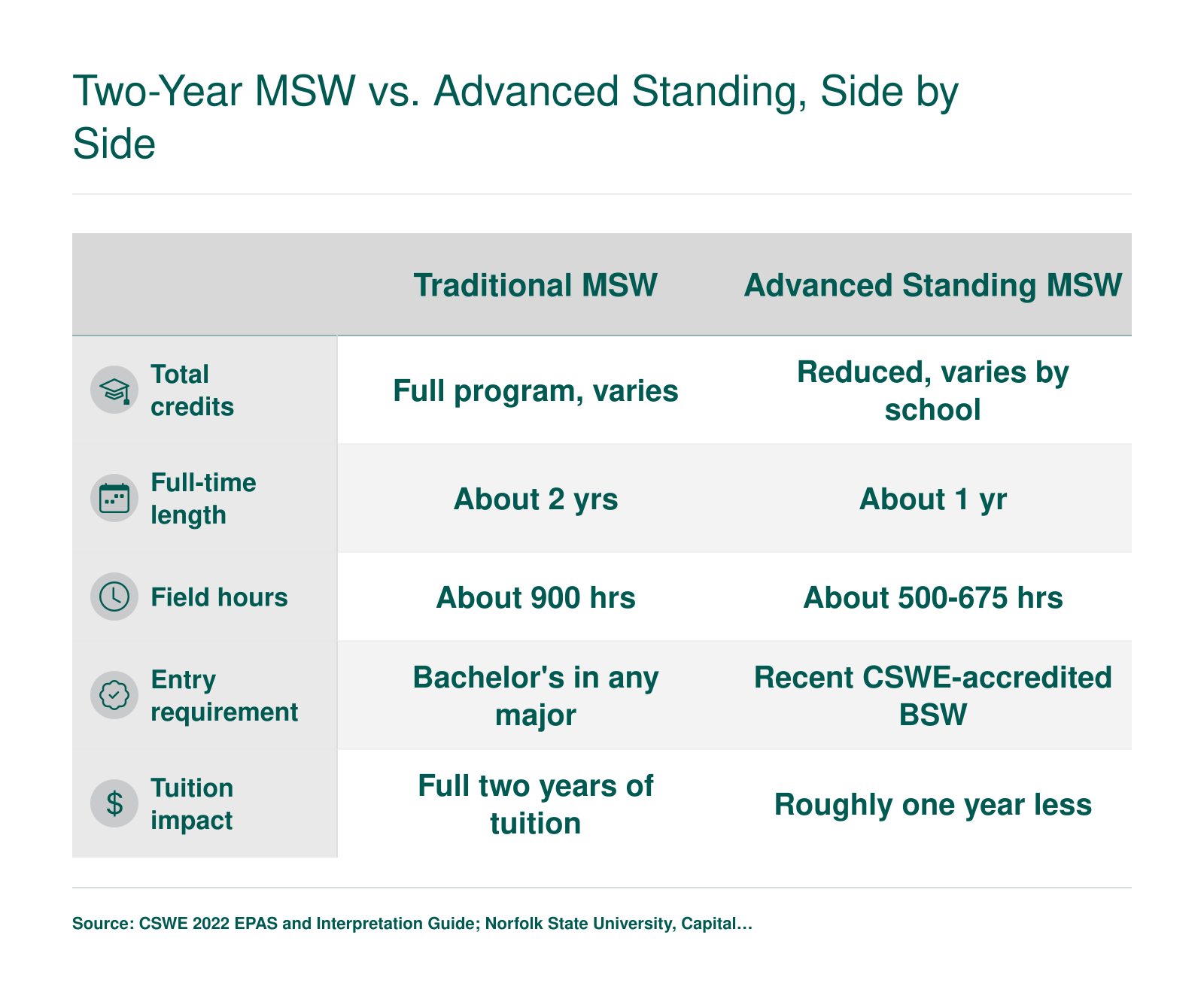
Two-Year MSW vs. Advanced Standing, Side by Side
CSWE's 2022 standards set a 900-hour field education minimum for MSW programs overall. Advanced standing does not get its own lower national minimum, so schools credit prior BSW field work and assign the remaining hours. Exact credits and hours vary by school.
Related Articles
As of July 2026, 35 states have enacted the Social Work Licensure Compact, which will eventually let licensed social workers practice across member states without seeking full licensure in each one. The catch: multistate privileges are not yet available. The compact estimates roughly 18 to 24 months of implementation work before applications open.
MSW Admissions at a Glance: GRE Policies, Acceptance Rates, and Deadlines
Requirements vary by school, format, and track, so confirm details on each program's page. These are the patterns we see most often across 2026 application materials.
- Bachelor's degree and GPAPrograms expect a bachelor's degree from an accredited institution. Published GPA minimums commonly fall between 2.5 and 3.0. Illinois looks at the last 60 or 90 credit hours with a 3.0 benchmark, while Denver lists 2.5 for advanced standing. One program we reviewed will consider applicants below 3.0, and highly selective programs often admit students with higher averages.
- GRE policyMost MSW programs no longer require the GRE. UC Berkeley and Colorado State both list it as not required. Not every top program has dropped it, so check each school separately.
- Essay, references, and experienceNearly every CSWE-accredited program asks for a personal statement. Denver, for example, uses two prompts totaling under 1,500 words. Plan on two to three references. Some programs ask for one academic and one professional. A resume showing human services or volunteer work is commonly weighed, but paid social work employment is not universally required. Advanced standing generally requires a qualifying BSW.
- Deadlines for fall entryPriority deadlines often fall between December and March, and final deadlines between March and August. Examples: Denver, December 18, 2025 for Fall 2026; Michigan, March 1, 2026 for Fall 2026; Colorado State, December 1, 2026 for Fall 2027; Eastern Washington, October 1, 2026 for Fall 2027. Applying by the priority date can matter, since Eastern Washington reviews priority applicants first. Confirm whether an online program offers rolling admission or multiple start dates.
- Acceptance ratesFew schools publish an MSW-specific rate. Berkeley reports an average of 424 applicants and a 33% average admit rate for 2021–2025, which is an average rather than a yearly guarantee. Do not substitute a university's undergraduate admission rate for MSW selectivity.
Social Work (MSW) programs by state
MSW Program Questions Readers Ask Most
These answers cover the questions we hear most often from readers comparing MSW options on mastersprograms.com. Where outcome data is thin, we say so rather than guess.
Which online MSW programs are CSWE-accredited?
Do online MSW programs qualify for social work licensure?
Which MSW programs have the best employment outcomes?
Is a part-time MSW a smart choice if I already work in human services?
Compare Social Work (MSW) programs on the data that matters
Explore more MSW specializations or browse every graduate field.
All MSW programs