Best MSW Programs in California
Compare 88 accredited Social Work (MSW) programs in California at 32 schools, with graduate earnings, cost, debt, and completion data from IPEDS and the U.S. College Scorecard.

A California MSW runs 60 credit hours for most applicants, or about 30 for those with a recent CSWE-accredited BSW entering advanced standing. Every program here holds CSWE accreditation, the credential the Board of Behavioral Sciences requires before you can sit for ASW registration on the LCSW path.
The real decision sits between price and payoff. Public CSU tuition starts near $8,700 a year; graduate pay varies widely, and the salary spread, not the school name, determines whether the degree pays for itself. Both campus and online formats appear below, so program structure shapes that math as much as sticker price does.
Key Points
- Published CSU in-state tuition runs from about $8,700 at Cal State LA to $9,800 at Stanislaus.
- Cal State Northridge's online MSW needs no campus visits but requires a weekly live practicum class.
- Most ranked schools no longer require the GRE, though UC Berkeley concurrent-degree applicants should check partner rules.
California's Top 10 Master's in Social Work Programs for 2027
This list is outcome-driven, not prestige-driven: it favors programs where graduates can show what they earn and owe. Program-level earnings and debt appear only where they are published, with the time window stated. Net price is always an institution-wide average after aid, and graduation rates are institution-wide.
University of California-Berkeley
#1Berkeley, CA · ~$16,000/yr (est.) · ASWB pass rate 93% (3-yr weighted avg)
Best for: Aspiring California school social workers
UC Berkeley's two-year, full-time Master of Social Welfare is CSWE accredited, equivalent to an MSW, and built around multi-level practice with an anti-oppressive, evidence-informed lens. Campus options include a School Social Work track leading to the California PPS credential, concurrent degrees with public health and public policy, and a part-time Flexible MSW. Listed tuition and fees run about $16,347 in state and $50,547 out of state, the institution-wide average net price after aid is about $13,481, and the school's institution-wide graduation rate is 93%. Program-level earnings are not yet published for this program.
- Two-year, full-time campus program
- CSWE accredited since 1928
- Multi-level practitioner training
- Anti-oppressive, evidence-informed practice focus
- Concurrent degrees with Public Health and Public Policy
- Flexible MSW: part-time, extended or one-year advanced standing
- 45 semester units required
- 1,000-hour practicum, 450 hours in school settings
- Leads to California PPS credential recommendation
- Optional Child Welfare and Attendance add-on
- Basic Skills Requirement and Certificate of Clearance needed
University of California-Los Angeles
#2Los Angeles, CA · ~$14,000/yr (est.) · ASWB pass rate 85.5% (3-yr weighted avg)
Best for: Aspiring Los Angeles child welfare practitioners
UCLA Luskin's Master of Social Welfare offers concentrations in Child and Family Well-Being, Health and Mental Health, and Social and Economic Justice, with a cohort of about 150 and 400+ Los Angeles agency partners for practicum. Graduates earned a median of about $65,100 one year after finishing, and median program debt is about $53,600. Listed tuition and fees are about $15,203 in state and $49,403 out of state, institution-wide net price after aid averages about $12,548, and the institution-wide graduation rate is 93%.
- Two-year full-time, part-time, and three-year Child and Family Well-Being options
- Three concentrations chosen in spring of year one
- Over 1,000 practicum hours with 400+ agency partners
- Research capstone required
- Fall start, cohort of about 150
- LA County child welfare stipend pathway for qualifying students
San Diego State University
#3San Diego, CA · ~$10,000/yr (est.) · ASWB pass rate 87.5% (3-yr weighted avg)
Best for: BSW holders seeking one-year advanced standing
San Diego State offers a CSWE-accredited MSW with a Direct Practice/Clinical focus, plus an administration track, an MSW/MPH, and a one-year advanced standing option, with completion plans from one to four years. Graduates earned a median of about $62,000 one year after finishing, with median program debt near $22,400. Listed tuition and fees are about $8,728 in state and $21,328 out of state, institution-wide net price after aid averages about $15,364, and the institution-wide graduation rate is 76%.
- Evidence-based interventions with individuals, families, and groups
- Qualifying exam after 31 units
- Thesis or comprehensive exam option
- Training in CBT, DBT, and Motivational Interviewing
- One- to four-year completion plans
- Second-year specialization in administration and community work
- Administration and community development internships
- Imperial Valley campus option
- Civic engagement course
- Three-year, 93-unit dual degree
- Fall admission only, full-time
- Requires SOPHAS application
- Thesis completion required
- One-year, 38-credit program starting summer
- BSW within five years required
- 3.0 GPA minimum
- Summer bridge courses required
- Thesis or capstone option
California State University-Fullerton
#4Fullerton, CA · $9,000 – $19,000/yr (est.) · ASWB pass rate 82.9% (3-yr weighted avg)
Cal State Fullerton states it is the only public university MSW in Orange County, with an Aging concentration, a part-time hybrid Flex program in Community Mental Health, and advanced standing. The GRE is optional. Graduates earned a median of about $64,200 one year after finishing, with median program debt near $31,100. Listed tuition and fees are about $7,470 in state and $20,070 out of state, institution-wide net price after aid averages about $6,555, and the institution-wide graduation rate is 70%.
- 60 units, two- or three-year course of study
- GRE optional, no entrance exam required
- 3.0 GPA in last 60 semester units
- One year of human service experience required
- 6-unit master's project
- Hybrid, part-time, three-year cohort
- Evening classes for working professionals
- 576 clinical hours
- Starts fall, spring, or summer
- 30 credits, 3.5 GPA minimum
- BSW within five years
- No-credit summer bridge program
- Prepares for psychiatric hospital and clinic settings
- 30 credits, capstone required
- BSW or BASW within past five years
- Three concentration options
- Interview and two applications required
- TOEFL 575 for international applicants
California State University-San Marcos
#5San Marcos, CA · ~$10,000/yr (est.) · ASWB pass rate 82.2% (3-yr weighted avg)
Cal State San Marcos offers a one-year, 30-credit MSW Advanced Standing option for BSW holders, delivered in a hybrid format with select in-person weeks on campus. Graduates earned a median of about $62,700 one year after finishing, with median program debt near $41,000. Listed tuition and fees are about $8,082 in state and $20,682 out of state, institution-wide net price after aid averages about $10,229, and the institution-wide graduation rate is 55%.
- One-year, 30-credit hybrid program
- Skips first-year generalist courses
- BSW within five years, 3.5 GPA required
- Statistics course with a C or better
- 500 hours of social service experience
- Clinical assessment, trauma, and addiction coursework
San Francisco State University
#6San Francisco, CA · $5,000 – $10,000/yr (est.) · ASWB pass rate 80.8% (3-yr weighted avg)
San Francisco State's 60-unit MSW includes 1,100 internship hours, an Individuals, Families, and Groups emphasis, and an anti-racism and cultural humility curriculum. Graduates earned a median of about $93,000 one year after finishing, based on a small graduating group, with median program debt near $23,700. Listed tuition and fees are about $7,950 in state and $20,550 out of state, institution-wide net price after aid averages about $12,278, and the institution-wide graduation rate is 50%.
- 60 units minimum, 1,100 internship hours
- 3.0 GPA, two-step application
- Pupil Personnel Services Credential option
- Behavioral Health stipend program
- Professional practice project or thesis
- Full-time hybrid schedule, in person and Zoom
- $25,000 annual stipend with two-year work commitment
- No GRE required
- Priority to county employees
- Four semesters of internship
California State University-Chico
#7Chico, CA · ~$10,000/yr (est.) · ASWB pass rate 77.9% (3-yr weighted avg)
Cal State Chico offers an advanced generalist MSW with hybrid distributed learning: asynchronous coursework, Zoom sessions, and two on-campus weekends each semester. Options include a one-year advanced standing track and a two-year track. Graduates earned a median of about $62,700 one year after finishing, with median program debt near $19,000. Listed tuition and fees are about $8,472 in state and $21,072 out of state, institution-wide net price after aid averages about $14,480, and the institution-wide graduation rate is 63%.
- Two-year track: 62 units, up to 1,200 practicum hours
- Hybrid distributed learning, one-year or three-year pace
- Fall start only, January 15 deadline
- Title IV-E and Behavioral Health stipend support
- Thesis or capstone option
- 36 units, up to 720 practicum hours
- CSWE-accredited BASW within five years
- Four concentration options
- Title IV-E support up to $25,000
California State University-San Bernardino
#8San Bernardino, CA · ~$10,000/yr (est.) · ASWB pass rate 76.7% (3-yr weighted avg)
Cal State San Bernardino delivers advanced generalist MSW practice across multiple formats: a 35-unit advanced standing track, 60-unit two-year and three-year programs, an MSW/MPA option, and both online and in-person delivery at San Bernardino and Palm Desert. Graduates earned a median of about $67,500 one year after finishing, with median program debt near $37,400. Listed tuition and fees are about $8,093 in state and $20,693 out of state, institution-wide net price after aid averages about $4,564, and the institution-wide graduation rate is 55%.
- 60-unit two-year and three-year options
- 35-unit advanced standing track
- San Bernardino and Palm Desert campuses
- Online distance education available
- Competency-based curriculum with concurrent practicum
- Concurrent dual-degree option
- 60-unit MSW curriculum
- Online and campus formats
- 35 credits, starts summer
- Full-time and part-time options
- One- or two-year completion
- Field practicum included
California State University-Sacramento
#9Sacramento, CA · $10,000 – $20,000/yr (est.) · ASWB pass rate 76.3% (3-yr weighted avg)
Sacramento State's 60-unit MSW offers Behavioral Health, Child, Adolescent and Family, and Health and Aging concentrations, with full-time two-year, part-time three-year, and weekend cohort options. Graduates earned a median of about $66,000 one year after finishing, with median program debt near $33,600. Listed tuition and fees are about $8,018 in state and $20,618 out of state, institution-wide net price after aid averages about $9,338, and the institution-wide graduation rate is 56%.
- 60 units: 28 foundation, 32 specialization
- Two-year full-time or three-year part-time
- Weekend cohort and some evening sections
- Field placement two days weekly, 2.8 GPA minimum
- Second-year field placement three days weekly
- Statistics and human biology prerequisites
- Culminating experience required
- 32 concentration units
- Weekend cohort program offered
- Valid driver's license and auto insurance required
- One-year program, BSW within five years
- 3.5 GPA minimum, 768 clinical hours
- Classes Thursdays and Fridays
- Title IV-E and Public Behavioral Health stipend programs
San Jose State University
#10San Jose, CA · ~$10,000/yr (est.) · ASWB pass rate 73.5% (3-yr weighted avg)
San Jose State's MSW is a hybrid, cohort-based program with synchronous online classes and in-person field placements in local communities. It accepts California residents only and does not require the GRE. Graduates earned a median of about $102,200 five years after finishing. Listed tuition and fees are about $8,410 in state and $21,010 out of state, institution-wide net price after aid averages about $13,760, and the institution-wide graduation rate is 69%.
- Two-year, 60-unit hybrid program
- 1,200 field hours
- GRE not required, 2.5 GPA minimum
- Prepares for LCSW and PPS school social work credentials
- California residents only, fall start
- One-year, 37-unit hybrid program
- 3.5 GPA minimum, work experience required
- Skips the foundational graduate year
- Prepares for LCSW credentialing
Cost & outcomes by school
Federal data for the highest-earning Social Work (MSW) programs, independent of the ranking above. Earnings are this field's master's graduates four years after completing, where the Scorecard reports them.
| School | Earnings | Tuition / yr | Debt | Grads/yr | Format |
|---|---|---|---|---|---|
| San Jose State University CA | — | $9,934 | — | 6,562 | Hybrid |
| University of California-Los Angeles CA | — | $14,476 | — | 7,688 | Campus |
| University of California-Berkeley CA | — | $15,866 | — | 7,796 | Campus |
| National University CA | — | $16,416 | — | 7,768 | Online |
| California State University-Long Beach CA | — | $8,898 | — | 3,888 | Campus |
| California State University-Fullerton CA | — | $8,994 | — | 3,386 | Campus |
| San Diego State University CA | — | $10,252 | — | 3,844 | Campus |
| California State University-Northridge CA | — | $8,982 | — | 3,002 | Campus |
| California State University-Los Angeles CA | — | $8,688 | — | 2,408 | Hybrid |
| California State University-East Bay CA | — | $9,107 | — | 2,082 | Hybrid |
| California State University-Sacramento CA | — | $9,542 | — | 2,350 | Campus |
| San Francisco State University CA | — | $9,370 | — | 2,130 | Campus |
Sources: U.S. Department of Education. Tuition and graduates: IPEDS. Earnings and debt: College Scorecard, this field's master's graduates; a dash means no figure is reported.
Behind the List: The Earnings, Debt, and Cost Signals We Weighed
A program earns its spot in the Best MSW Programs list by what it does for graduates' bank accounts, not its brochure. Four signals shape the order below, and they are deliberately boring ones.
- What graduates earn: Median pay for social work master's completers, measured after they leave the program, drawn from federal College Scorecard reporting at the program level where it has been published.
- What they owe: Median federal loan debt at graduation, translated into an estimated monthly payment on a standard 10-year repayment schedule, so the number means something on a real budget.
- What it costs up front: Average net price after grants and scholarships, the signal for affordable MSW programs, which is reported for the institution as a whole rather than for the social work program alone.
- Whether students finish: Institution-wide graduation rate, used as context on completion risk.
Earnings and debt carry the most weight. Cost and completion refine the order rather than set it.
Highest Program-Level Earnings Among Ranked Schools
Online and Hybrid Master's in Social Work Formats Among the Ranked Schools
Cal State Northridge's online MSW runs four semesters with no campus visits, yet it still requires a one-hour live practicum class every week. Coursework is otherwise asynchronous. Requirements vary by school:
- USC: MSW@USC is described as completely online, with no residency stated. Fieldwork must be completed in your state of residence. Whether live sessions are required is not clear from its page.
- San Jose State: Classes include synchronous online sessions, and internships are in person locally. Only California residents are accepted.
- Cal State San Bernardino: Its distance option uses live online sessions and is open to California residents who are U.S. citizens. Confirm whether that applies to every pathway.
- Chico and San Marcos: Both are hybrid. San Marcos mixes in-person and online classes. Chico offers synchronous and asynchronous options, and its campus-visit expectations should be confirmed directly.
In-person residency requirements vary: some programs have none, many require live online sessions, and a few may require campus visits. Every program requires fieldwork in person in your own community, so ask each admissions office for current terms.
Related Articles
Ranked California MSW Programs With No GRE Requirement
Standardized testing has largely faded from California social work admissions, though policies still shift from one cycle to the next among master's programs with no GRE required. UC Berkeley treats the GRE as optional, but concurrent-degree applicants should check the partner program's rules. UCLA does not require it and will not consider submitted scores, though its admissions page says Fall 2027 requirements may change. USC requires no GRE for its Traditional Online and Advanced Standing Online MSW tracks. CSU Long Beach (Fall 2027) and San Jose State (2026 cycle) both list the exam as not required. CSU Fullerton makes it optional for Fall 2026, recommended mainly for applicants below the 3.0 GPA minimum. Sacramento State waives it for Fall 2027 but reserves the right to bring it back.
The other schools here do not publish a current GRE policy we could confirm, so check their admissions pages directly rather than assume.
Where scores are absent, committees lean on the personal statement, relevant field or volunteer experience, GPA, and recommendation letters.
Paying for a California MSW: Tuition, Net Price, and Debt Load
Public CSU pricing sets the cost floor for a California MSW, and the CSU programs here sit close together, a pattern repeated across master's programs in California. Private schools such as USC price well above that, so request a current bill before comparing.
Annual figures understate the full degree. Cal State LA lists a total program cost of $17,325. Cal State Long Beach reports $14,962 for residents as of June 2026, excluding books and living costs. Cal State Fullerton's MSW Program Tuition page lists $525 per unit, with textbooks, parking, and fees billed separately. Trustees can change all of these.
Debt looks manageable against pay. Cal State LA graduates carry median program-level debt near $30,000, roughly $341 a month over ten years, against median earnings near $64,900 one year out. Fullerton is similar: about $31,100 and $354 a month.
CalSWEC Title IV-E stipends are the main funding lever, generally $25,000 a year (up to $50,000) in exchange for two years of California public child-welfare work.1 Cal State LA's Title IV-E page lists $18,500 per year for its two-year program, so confirm your campus's amount.
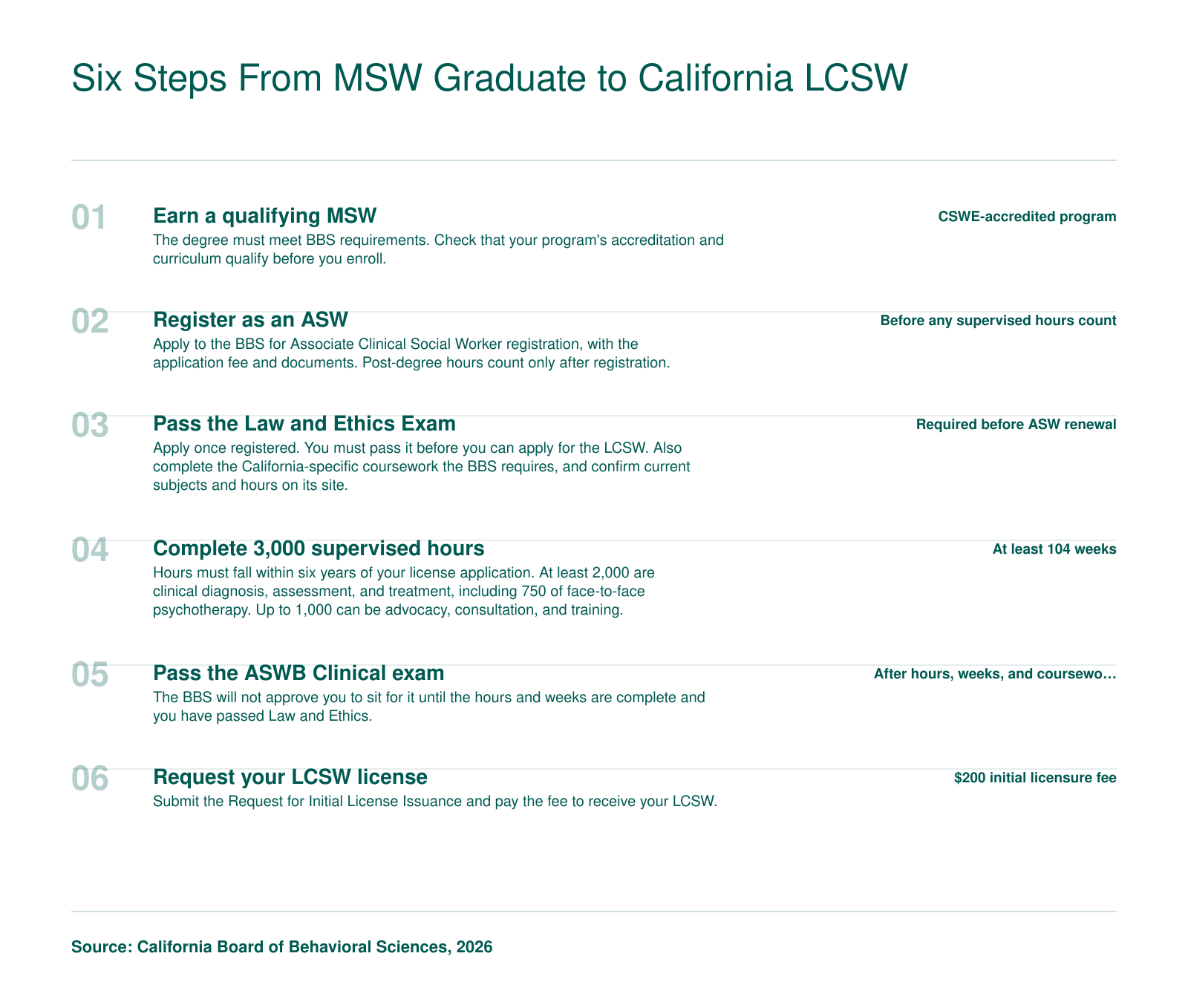
Six Steps From MSW Graduate to California LCSW
Tuition is only the first bill. The California Board of Behavioral Sciences (BBS) path to the LCSW also costs you time, exam fees, and years of supervised work. The usual timeline runs well past graduation, so plan for it before you compare programs.
Clinical Focus, Advanced Standing, or Part-Time: Matching a Program to Your Path
A one-year advanced standing MSW and a traditional two-year degree serve different applicants, and your undergraduate degree usually decides which you qualify for.
Advanced standing requires a CSWE-accredited BSW, typically earned within five years (seven at SJSU). GPA floors run 3.5 at Sacramento State, Cal State Fullerton, Cal Poly Humboldt, and SJSU, and 3.0 at Cal State LA. Cal State LA finishes in 11 months, while SDSU and Sacramento State run about a year and Humboldt offers a two-year part-time option.
Field hours shrink accordingly. Traditional programs generally require at least 900; among advanced standings here, the range runs from 600 at SDSU to 768 at Sacramento State, with Cal State LA at 720. Cal State LA places students across Los Angeles County; confirm placement support with other schools.
For clinical emphasis, look at SDSU's Direct Practice/Clinical concentration, Sacramento State's Behavioral Health track, and UCLA's clinical and macro training. Part-time paths at CSU programs commonly stretch three to four years.
Compare Social Work (MSW) programs on the data that matters
Explore more MSW specializations or browse every graduate field.
All MSW programs