Master's Programs in Illinois
Every master's program reported by a school in Illinois: 1,350+ programs at 70+ graduate schools, with the online options, costs and outcomes behind each one.

Test-optional admissions have made applying to Illinois master's programs easier, but not cheaper or simpler. The state pairs large public flagships at Urbana-Champaign and Chicago with regional public universities and expensive private research universities in Chicago, so two students earning the same degree can face very different bills.
Requirements, deadlines, online master's programs, and assistantship eligibility are set program by program. Licensed fields such as counseling psychology add another layer: since July 2026, Illinois counselor licensure requires a degree of at least 60 semester hours.
For most applicants, the deciding figure is the master's in strategic communication cost after funding, set against what the credential actually earns.
Key Points
- Illinois LCSW licensure requires 3,000 supervised hours after an MSW from a CSWE-accredited program.
- Since July 1, 2026, Illinois counselor degrees must include at least 60 semester hours.
- Admissions rules and deadlines are set by program, so confirm each one before applying for 2026.
Popular degrees in Illinois
Master's programs in Illinois by field
Business & Management
- Management41 programs
- Accounting36 programs
- Finance36 programs
- Marketing32 programs
- General Business30 programs
- Analytics30 programs
- Healthcare Administration28 programs
- Public Administration25 programs
Education & Teaching
- Teaching46 programs
- Educational Leadership23 programs
- Curriculum & Instruction22 programs
- Special Education21 programs
- STEM Education or Science Education or Mathematics Education18 programs
- Music Education14 programs
- Art Education12 programs
- Elementary Education11 programs
Nursing
- Nursing Education or Nurse Educator19 programs
- Nurse Administrator17 programs
- Family Nurse Practitioner (FNP)16 programs
- RN to MSN12 programs
- Direct Entry MSN (MENP) or (DEMSN)11 programs
- Psychiatric Mental Health Nurse Practitioner10 programs
- Adult Gerontology Primary Care Nurse Practitioner7 programs
- Adult Gerontology Acute Care Nurse Practitioner7 programs
Healthcare
- Public Health18 programs
- Health Administration17 programs
- Speech Pathology15 programs
- Nutrition14 programs
- Exercise Science13 programs
- Health Informatics12 programs
- Health Education3 programs
- Clinical Research Management1 program
Communications & Media
- Communication31 programs
- Speech Pathology21 programs
- Communication Disorders17 programs
- Journalism6 programs
- Media Communication5 programs
- Health Communication4 programs
- Strategic Communication3 programs
- Public Relations1 program
Social Work & Social Sciences
- Social Work32 programs
- Sociology18 programs
- Social Work Advanced Standing18 programs
- Political Science, Government11 programs
- Human Services3 programs
Psychology
- Industrial Organizational Psychology16 programs
- Clinical Psychology12 programs
- Counseling Psychology12 programs
- Educational Psychology or School Psychology7 programs
- Applied Behavior Analysis6 programs
- General Psychology5 programs
- Sports Psychology4 programs
- School Psychology3 programs
Counseling
- Clinical Mental Health Counseling35 programs
- School Counseling14 programs
- Marriage and Family Therapy or Marriage and Family Counseling8 programs
- Christian Counseling2 programs
- Addiction Counseling1 program
Computers & IT
- Cybersecurity18 programs
- Data Analytics15 programs
- Information Security & Assurance13 programs
- Machine Learning5 programs
Religion & Theology
- Divinity16 programs
- Theology13 programs
- Christian Ministry10 programs
- Urban Ministry3 programs
- Youth and Family Ministry2 programs
Arts & Design
- Creative Writing31 programs
- Fine Arts11 programs
Science & Engineering
- Environmental Science19 programs
- Sustainability or Environmental Management13 programs
- Geography7 programs
Criminal Justice & Law
- Public Policy8 programs
- Master of Laws7 programs
- Legal Studies3 programs
- Business Law3 programs
What a Master's Degree Costs in Illinois: Public vs. Private Tuition
Illinois master's tuition is not one number; it varies by institution, residency, and often by the specific program you choose.
Public vs. Private Tuition at a Glance
The table below is a directional guide to 2025-26 graduate tuition signals. Exact rates are set by program, college, and term, so treat these as planning ranges, not quotes.
| Institution | 2025-26 Graduate Tuition Signal |
|---|---|
| UIUC | Public; in-state often $18,000-$23,000 per year, out-of-state $34,000-$40,000; business, engineering, and health programs may be higher |
| UIC | Public; in-state often $17,000-$22,000 per year, out-of-state $32,000-$38,000; health sciences often higher |
| Illinois State | Public regional; in-state commonly $11,000-$14,000 per year, out-of-state $24,000-$28,000 |
| Northern Illinois | Public regional; in-state commonly $11,000-$14,000 per year, out-of-state $24,000-$28,000; rates vary by program |
| SIU Carbondale | Public regional; in-state roughly $15,000-$18,000 per year, out-of-state $30,000-$35,000 |
| DePaul | Private; roughly $900-$1,100 per credit hour depending on college |
| Loyola Chicago | Private; base graduate $1,070 per credit hour, business $1,760 per credit hour, health sciences $1,295 per credit hour, social work $1,130 per credit hour |
| Northwestern | Private; many graduate programs run $60,000-$70,000 per year |
| UChicago | Private; Crown Family School of Social Work $53,721 per year plus $1,509 fee; other divisions vary |
Differential Tuition Can Change the Math
Public universities such as UIUC and UIC do not charge one graduate rate. Business, engineering, and several health professions carry differential tuition that can be thousands more per term than the base graduate rate. Private schools vary by division too. At Loyola Chicago, the base graduate rate is $1,070 per credit hour1, but the Quinlan School of Business charges $1,760 per credit hour2. A 30-credit general MBA would therefore cost $52,800 in tuition, versus $32,100 at the base rate, a gap of more than $20,000 before fees. Executive MBA total-program prices exceed $100,000 at Loyola2.
Flat-rate online programs can invert that pattern. UIUC's online Master of Computer Science and iMBA often carry a single all-in program rate that undercuts the on-campus engineering or MBA sticker by a wide margin. That makes the format as important as the university when you compare cost.
Total Degree Cost: What to Budget
For a 30-36 credit master's completed in one to two years, public in-state students in Illinois might budget $20,000 to $45,000 for tuition and mandatory fees. Public out-of-state students often face $55,000 to $80,000. Private universities generally run $60,000 to $120,000 or more for the full degree, depending on program. UChicago's Crown Family School of Social Work lists a nine-month 2025-26 tuition of $53,721 plus a $1,509 services fee3, putting a two-year social work master's at one of the best MSW programs well above $110,000 before living costs.
Because a university-wide average can mislead by tens of thousands of dollars, check the specific program's published rate for the 2025-26 academic year before deciding. A low base rate at a private school may not apply to the business or health program you want, and an online flat-rate program may be the cheapest route even at a flagship public.
Online, Hybrid, and On-Campus Master's Formats in Illinois
Fully online master's programs offer the most schedule control, while hybrid and campus formats offer more structure and face-to-face contact. Illinois has strong examples of each, and the right fit depends on your field and how much flexibility you need.
Fully Online Options
The University of Illinois system leads here. UIUC delivers an online Master of Computer Science (32 credits, 100% online)1 and the Gies online MBA (iMBA, 72 credits)2, and Gies also runs an online MS in Management.3 UIC's College of Education offers a fully online MEd in Measurement, Evaluation, Statistics, and Assessment, the only fully online master's in that college.4 UIC also offers an online Master of Engineering in AI and machine learning.5 DePaul's MA in Professional Communication is an accelerated online program. Current fully online inventories at Northern Illinois or Illinois State were not confirmed, so check their program pages directly.
Hybrid and Chicago Working-Professional Formats
Chicago schools tend to build around people who hold full-time jobs. Loyola's 36-hour MA in Pastoral Studies is offered fully online with a Chicago campus option, so you can choose by preference rather than by necessity.6 Before you apply anywhere, confirm whether classes meet synchronously, since evening live sessions can be as restrictive as a daytime schedule.
Where Online Delivery Has Limits
Counseling, nursing, social work, and teaching all require supervised clinical hours or practicum, and those happen in person. Loyola's online MSW is fully online and synchronous, yet it still requires two internships totaling 1,000 hours (600 hours for the Advanced Standing track). At UIC's College of Education, regular licensure master's programs are not all fully online. Expect to arrange a local placement in your own community.
If you live outside Illinois and are considering a licensure-track program, check the school's state authorization status (NC-SARA participation and state-specific disclosures) for your home state. Authorization affects whether the degree leads to licensure where you live.
Typical Completion Times
- Full time: About 12 to 24 months. UIC's MESA4 and online MEng5 can be finished in as few as 12 months, and Loyola's Advanced Standing MSW takes 12 months.
- Part time online: Usually 2 to 3 years. UIC's MESA runs about 24 months part time,4 Loyola's standard MSW about 24 months, and UIC education programs 24 to 36 months.
- Self-paced: UIUC's MCS allows 12 to 60 months1 and the iMBA 24 to 60 months2, so a lighter load stretches the timeline but not the per-credit workload.
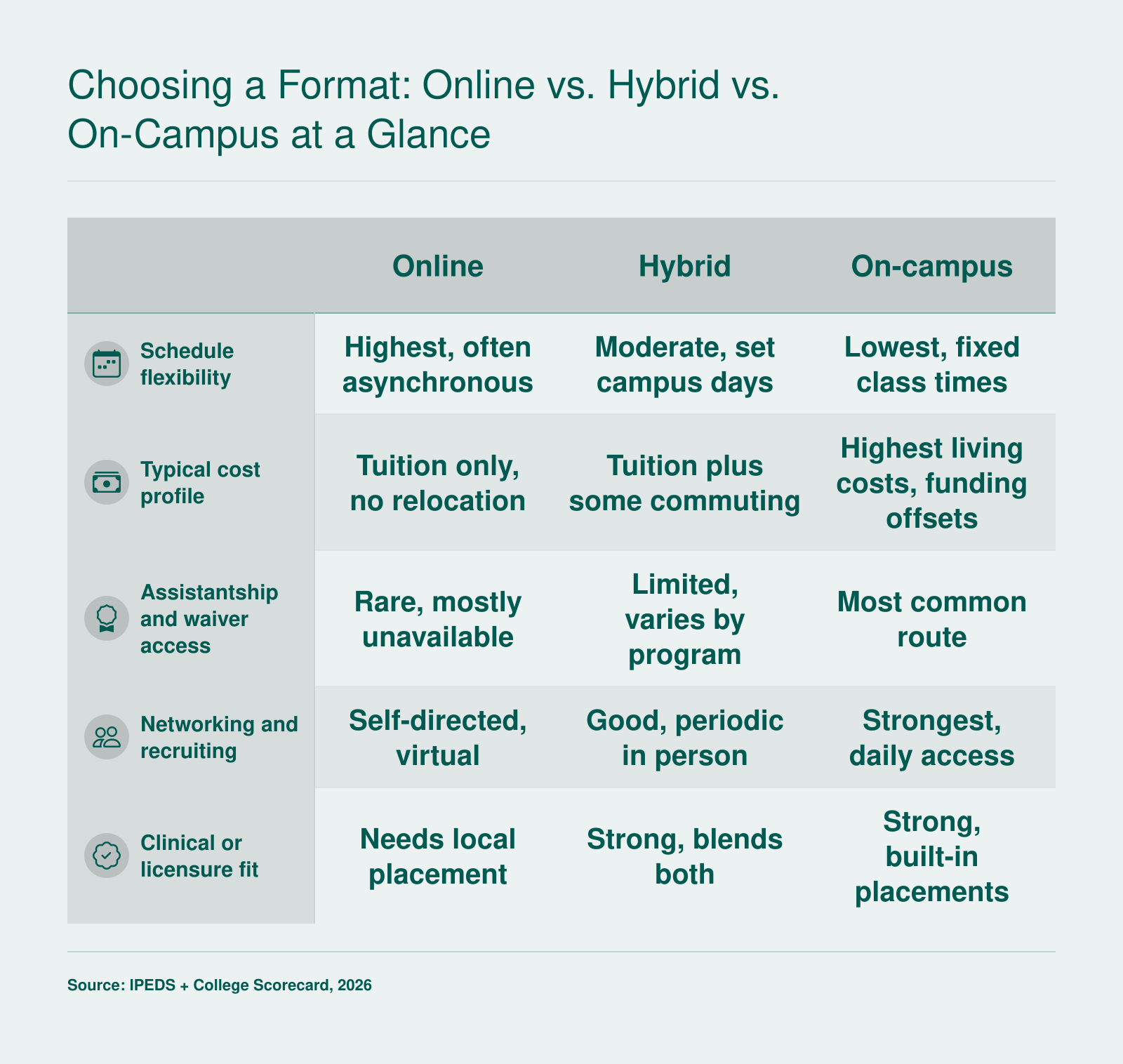
Choosing a Format: Online vs. Hybrid vs. On-Campus at a Glance
Format shapes more than your weekly schedule. It affects what you pay, whether you can win funding, and how easily you can meet clinical requirements. One trade-off is easy to miss: assistantships that come with tuition waivers are mostly tied to on-campus enrollment, so choosing online can mean giving up that route to a lower net price.
Illinois Master's Admissions: GRE Policies and GPA Expectations
Test-optional admissions make applying to master's programs with no GRE required easier, but they also mean there is no single Illinois rule to rely on. Requirements are set program by program, often within the same university, so a policy you read about one department may not apply to the one you want.
Where the GRE Has Loosened
Several Illinois programs have made the exam optional or dropped it:
- UIUC Civil and Environmental Engineering: The GRE is optional for all applicants, and no minimum score applies if you submit one.1 The department still suggests it for some M.S. applicants, such as international students, those seeking funding, or those whose GPA is below the admitted average.1
- UIUC East Asian Languages and Cultures: The GRE is encouraged but not required.2
- DePaul's College of Computing and Digital Media: The GRE and GMAT are not required for its master's programs and MFA.
- Illinois State Mathematics: A GRE is required if your cumulative GPA is below 3.2. A GPA of 3.6 or higher earns an automatic waiver, and applicants between 3.2 and 3.6 can petition for one.
Where Tests Still Appear
UIUC states that graduate programs may require the GRE, and its business programs may require the GMAT. Illinois State likewise says individual programs may ask for the GRE, GMAT, or another exam. Quantitative, economics, and business-school programs are where tests most often remain. Ask any program that lists a test whether waivers exist and what they depend on, whether GPA, work experience, or a prior degree. For UIC, UChicago, Northwestern, and Loyola Chicago, confirm current policy directly with the program, because it can differ by department.
GPA Expectations and Materials
University-wide minimums are only a floor. Illinois State sets 2.8 for the last 60 hours of undergraduate work, and Northern Illinois lists 2.75 on a 4.0 scale.5 Individual departments can ask for more: UIUC's East Asian Languages program expects 3.3 for the last 60 hours and any prior graduate work.2 A 3.0 is a common rough benchmark, but treat it as a guide, not a guarantee. International applicants at Illinois State are evaluated on cumulative GPA instead of the last 60 hours.
Plan on a statement of purpose, recommendation letters (often two or three), a resume, and transcripts. Career changers should check for prerequisite coursework, since some programs expect it before enrollment.
Verify at the Program Level
Before you apply, open the specific program's admissions page, not just the university's general graduate page. Note the test policy, GPA basis (last 60 hours or cumulative), and any waiver petition process, then confirm details with the program coordinator.
Application Deadlines and Checklist for Top Illinois Graduate Schools
Deadlines vary by program, not by university, so confirm each date on the program's own page. The examples below come from recently published UIUC and UIC pages. Fall 2027 dates are not yet uniformly posted, and dates may change from year to year.
- Earliest (priority or funding) deadlineAim for this date if you want funding consideration. UIC's School of Public Health sets a December 1 priority deadline for financial aid on its fall master's programs. UIUC's Geography and GIS research master's closes December 15, 2026 for Fall 2027. Many UIUC and UChicago programs set December to January deadlines for fall entry, so check each program.
- Final deadlineLater dates exist but may limit funding. UIC Computer Science recommends January 15 and closes February 15. UIC's Master of Healthcare Administration closes February 1. UIUC's Special Education master's closes March 1, and UIC's early childhood and youth development MEd programs close March 15.
- Rolling and multi-term admissionOnline and part-time programs often admit for several terms. UIUC's Professional Science Master's in GIS uses rolling admission. UIC's College of Education admits for Spring, Summer, and Fall, and its online public health generalist master's closes August 1 for Fall.
- TranscriptsOrder official transcripts from every institution you attended early, since registrar processing can take weeks. Most applications open months before the deadline; UIC began accepting Fall 2027 applications August 1, 2026.
- Test scores, if requiredPolicies differ by program and change often. Confirm whether the GRE or another test is required, optional, or not considered before you register.
- Recommendations and statementGive recommenders several weeks' notice. Licensure tracks, such as UIUC's early childhood master's with a February 1 deadline, may add materials or program-specific steps.
- International applicant timelineDomestic and international deadlines are often separate at UIC, and the international date is usually earlier. UIC's online public health generalist master's lists May 15 for international applicants versus August 1 overall. Allow extra time for credential evaluations, English proficiency scores, and visa financial documentation.
Funding Your Illinois Master's: Assistantships, Tuition Waivers, and Loans
Assistantships can turn a tuition bill into a paid job; loans can turn the same degree into decades of debt. Illinois publics differ, and not every master's format qualifies for waiver-backed appointments.
How Illinois Graduate Assistantships Work
University of Illinois Chicago publishes the clearest current policy among the state's public research campuses. A UIC graduate assistantship typically pays a monthly stipend and carries a tuition and partial-fee waiver.12 To keep the waiver, appointments generally fall between 25% and 67% full-time equivalent, last at least 91 days in fall or spring (41 in summer), and require enrollment in at least 8 credits in fall or spring and 3 in summer.32 Even with a waiver, students may still owe a service fee, health service fee, CampusCare, and library/IT and facilities assessments. Stipends vary by hiring department; for example, UIC's English MA offered a 50% time nine-month teaching assistantship at $24,200 for 2025-2026 with a tuition and partial-fee waiver.4 Ask the specific department, because UIC does not set one universal master's stipend across all programs. Policy details for Urbana-Champaign, Illinois State, and Northern Illinois are less consistently published, so check each program's graduate college.
Online and Professional Programs May Be Excluded
Waiver-eligible assistantships typically require enrollment in an eligible UIC graduate degree program and an appointment that meets the FTE, duration, and credit thresholds.23 UIC does not categorically bar master's students: the English example shows a teaching assistantship can go to an MA student. But not every professional or online master's program participates; some charge tuition differentials that a waiver may not cover. Before enrolling, ask whether the specific online, professional, or employer-partnered program offers assistantship tuition waivers, or only scholarship and loan funding.
New Federal Loan Limits for 2026
For students borrowing now, the federal landscape changed. Grad PLUS loans ended for new borrowers on July 1, 2026.5 Borrowers who already had a federal Direct Loan before that date and remain continuously enrolled may keep Grad PLUS access until completing the program, changing major or program, or reaching three additional years, whichever comes first. New graduate Direct Unsubsidized borrowing is capped at $20,500 per year, with an aggregate limit of $100,000; professional students may borrow up to $50,000 per year and $200,000 aggregate.5 These limits make waiver-bearing assistantships, employer tuition assistance, and departmental scholarships more important; confirm each in writing, and treat state grant programs with caution, since many Illinois state aid programs target undergraduates and may not apply to graduate study.
Accreditation and Licensure: What Illinois Professional Programs Need
An Illinois Licensed Clinical Social Worker credential requires 3,000 hours of supervised clinical experience after an MSW (2,000 after a DSW), and neither path counts unless the degree came from a CSWE-accredited MSW program.1 That pairing of experience and accreditation is the pattern across Illinois professional licenses. The degree alone rarely qualifies you.
Start With Institutional Accreditation
Every school on your list should hold institutional accreditation, which for Illinois colleges typically means the Higher Learning Commission. That status qualifies a school for federal student aid and makes credit transfer easier. It is a baseline, not a licensure pathway. ISBE, for example, asks administrative license candidates for a degree from a regionally accredited institution and completion of an approved preparation program.3 Those are two separate requirements.
Match the Program to the License
- Social work (LSW/LCSW): IDFPR requires a master's or doctorate in social work from a CSWE-accredited program.1 A related degree in counseling or psychology does not qualify. Since January 1, 2026, candidates gaining experience under the exam alternative must hold an LSW or School Social Worker license.1
- Education (PEL and endorsements): ISBE requires an ISBE-approved program2, and endorsements are tied to specific grade bands and subjects4. Not every master's in education qualifies. Administrative endorsements also require a master's or higher, an internship, Form 80-02, and Illinois content tests for 2026 applications.3
- Counseling (LPC/LCPC): CACREP is the national standard for counseling programs and simplifies licensure in many states, but confirm IDFPR's current education rules before assuming it is the only route.
- Nursing, speech-language pathology, business: Look for CCNE or ACEN for MSN programs, ASHA's CAA for speech-language pathology, and AACSB for business. Verify APRN requirements with IDFPR directly.
Before you enroll, check ISBE's approved-program listings or IDFPR's rules yourself rather than relying on a school's marketing page.
A Warning for Out-of-State Online Students
An Illinois program built to satisfy ISBE or IDFPR may not meet your home state's licensure rules. Ask the program for its state licensure disclosure, then confirm with your own state board before paying a deposit.
Illinois Counselor Licensure Path
Career Outcomes and Earnings for Illinois Master's Graduates
A master's degree pays a measurable earnings premium in Illinois, but how much depends far more on your field than on the credential itself. Statewide, Census data (2020-2024 five-year estimates) puts median earnings for adults 25 and older with a graduate or professional degree at $91,623, compared with $73,326 for those holding only a bachelor's.3 That roughly $18,000 gap is a useful baseline, but note the Census groups all graduate and professional degrees together, so it does not isolate master's holders on their own.
What specific occupations pay in Illinois
Field matters because wages vary widely across careers that require a master's. These are occupational wages for everyone in the role, not graduate-program earnings, but they show where the degree leads:
- Nurse practitioners: median annual wage of $133,457 in Illinois (BLS, May 2024)1, among the highest returns for a clinical master's.
- Mental health and substance abuse counselors: median of $61,189, with entry-level pay near $45,124 and experienced earners around $83,571.2
- Statisticians and data scientists: Illinois statewide figures were not clearly established in the latest release, though national demand for these roles remains strong.
School counselor wages for Illinois were likewise not reliably broken out in the data reviewed, so treat any single figure you see elsewhere with caution.
Check your actual program, then weigh it against cost
Occupational averages tell you where a career tops out; they don't tell you what graduates of a particular program earn. For that, the U.S. Department of Education's College Scorecard now publishes field-of-study earnings for specific degrees at specific Illinois schools. Look up the exact program and field before you enroll, because two programs in the same subject can produce very different outcomes.
Then tie the number back to what you'll pay. A program that costs $35,000 all in and moves you into a role paying $20,000 more per year recovers its cost quickly. One that costs $80,000 for a modest bump may never pay back in real terms. The honest math is total degree cost, including any borrowing, measured against the salary increase you can reasonably expect in your field, not the statewide average. On mastersprograms.com we weigh programs on exactly that tradeoff.
The Master's Earnings Premium in Illinois
Illinois-specific master's earnings are not established in our research, so this is the national benchmark.
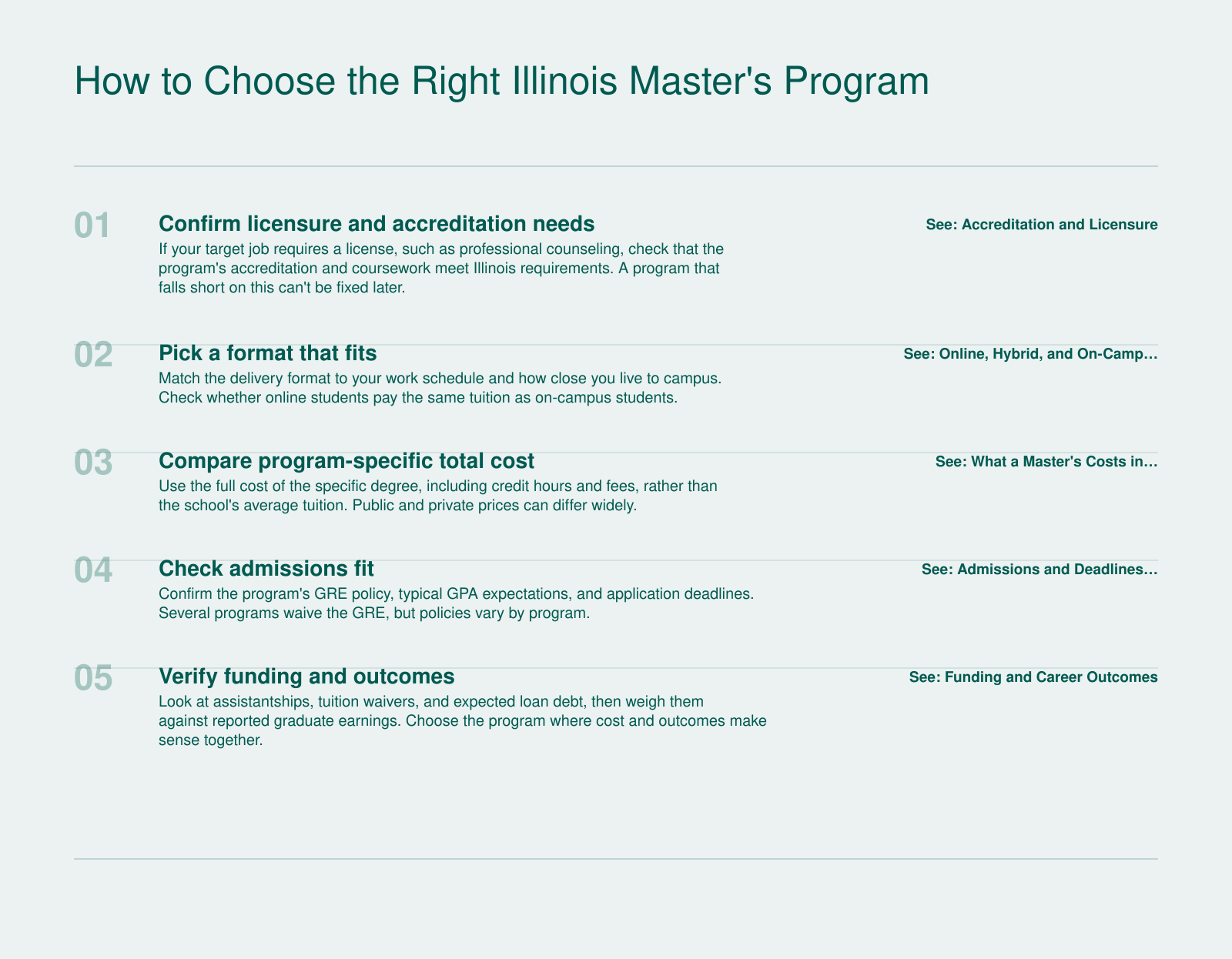
How to Choose the Right Illinois Master's Program
Order matters here. Early steps can rule programs out entirely, so work through them in sequence before you compare finer details. Each step points back to the section of this guide that covers it.
Graduate schools in Illinois with the most master's programs
| School | City | Type | Master's programs | Online | Grad tuition / yr |
|---|---|---|---|---|---|
| DePaul University | Chicago | Private nonprofit | 105 | 55 | $23,358 |
| University of Illinois Urbana-Champaign | Champaign | Public | 67 | 21 | $19,278 |
| Southern Illinois University Edwardsville | Edwardsville | Public | 60 | 36 | $10,488 |
| Southern Illinois University-Carbondale | Carbondale | Public | 60 | 27 | $14,220 |
| Northwestern University | Evanston | Private nonprofit | 58 | 20 | $54,655 |
| Loyola University Chicago | Chicago | Private nonprofit | 54 | 24 | $21,912 |
| University of Illinois Chicago | Chicago | Public | 54 | 18 | $17,550 |
| Northern Illinois University | Dekalb | Public | 48 | 20 | $9,176 |
| University of Illinois Springfield | Springfield | Public | 47 | 39 | $11,938 |
| Lewis University | Romeoville | Private nonprofit | 44 | 20 | $15,800 |
| Eastern Illinois University | Charleston | Public | 42 | 17 | $11,647 |
| Illinois State University | Normal | Public | 38 | 8 | $10,218 |
| Chicago State University | Chicago | Public | 35 | 15 | $10,294 |
| Roosevelt University | Chicago | Private nonprofit | 33 | 19 | $20,935 |
| Bradley University | Peoria | Private nonprofit | 32 | 20 | $20,440 |
Program counts are the verified master's listings in our directory; tuition is the school-wide average for a full-time graduate student (IPEDS).
Frequently Asked Questions About Master's Programs in Illinois
These answers cover the questions prospective students ask most often about timelines, testing, residency and funding. Requirements change by program and entry term, so confirm details on the program's own admissions page before you apply.
How long does it typically take to complete a master's program in Illinois?
Which Illinois master's programs do not require the GRE?
Can I get in-state tuition at an Illinois public university as a graduate student from another state?
Do Illinois master's programs offer assistantships to online students?
Compare programs nationwide
Many Illinois residents study online. Every ranked list above has an online lens, or browse every field.
Online master's programs Browse all fields