Best Direct-Entry MSN Programs in Illinois
Compare 11 accredited Direct Entry MSN (MENP) programs in Illinois, with graduate earnings, cost, debt, and completion data from IPEDS and the U.S. College Scorecard.

Direct-entry MSN programs in Illinois run from 16 months at Loyola University Chicago to 26 months at Millikin University. Each prepares a holder of a non-nursing bachelor's for the NCLEX-RN and a master's, without a second bachelor's.
Formats span campus, hybrid, and online-eligible, with several programs in the Chicago area. The real tension is cost and clinical access: total prices vary widely, and placements always happen in person.
Key Points
- Millikin's 2026-27 rate of $835 per credit across 81 credits totals $67,635 in tuition.
- University of Illinois Chicago posts the lowest average net price among the schools charted.
- No program here is fully online, since clinicals, skills labs, and simulations happen in person.
Top Direct-Entry Master's in Nursing Programs in Illinois, Ranked
Our order rewards schools where career changers pay less, finish more often, and leave with manageable debt. The ten Illinois programs below span Chicago, the suburbs, and downstate cities, and they mix campus, hybrid, and online formats. Compare each school's net price alongside its sticker tuition, since the two can differ by tens of thousands of dollars.
University of Illinois Chicago
#1Chicago, IL · ~$18,000/yr (est.)
Best for: Illinois residents wanting hybrid study
University of Illinois Chicago is a Chicago public university offering a hybrid Master of Science in Nursing for Non-RNs. In-state graduate tuition is $14,338 and out-of-state is $29,884, with an institution-level net price of $10,974, the lowest of any ranked school that reports one. The school's overall graduation rate is 62%, and the most recent reported cohort included 104 completions. Faculty arrange all clinical placements across the Chicago, Rockford, and Urbana campuses, though students must live within commuting distance of their campus.
- Two years, six consecutive semesters including summers
- Hybrid mix of online courses, campus sessions, and lab work
- One fall start per year
- Faculty arrange clinical site placements
- Campuses in Chicago, Rockford, and Urbana
- Students must live within commuting distance of their campus
- Prepares graduates for the NCLEX and RN licensure
Loyola University Chicago
#2Chicago, IL · ~$22,000/yr (est.)
Best for: Career changers seeking a compressed schedule
Loyola University Chicago runs its in-person Master of Nursing at the Health Science Campus in Maywood. Graduate tuition is $53,710 for both in-state and out-of-state students, and the institution-level net price is $36,079. The school's overall graduation rate is 73%, the highest among ranked schools that report one, and its latest cohort had 93 completions. The compressed 16-month format suits career changers who want to reach licensure quickly.
- 66 credit hours over four full-time semesters, about 16 months
- Two start dates per year, fall and spring
- 3.0 GPA minimum and an admissions interview
- 120-hour preceptor-based Professional Role Development experience
- Four prerequisite courses completed within five years
- Classes meet in person at the Maywood health science campus
- Fall 2026 and Spring 2027 cohorts pay $74,500 total program tuition
DePaul University
#3Chicago, IL · ~$23,000/yr (est.)
Best for: Aspiring ICU nurses wanting Chicago clinicals
DePaul University offers its Master's Entry to Nursing Practice on the Lincoln Park campus in Chicago. In-state and out-of-state graduate tuition are both $45,999, and the institution-level net price is $30,902. The school's overall graduation rate is 68%. With 197 recent completions, it has the largest cohort among the ranked programs, and clinicals draw on more than 75 Chicago-area sites with a guaranteed intensive-care rotation.
- Campus-based, 107 quarter hours
- 24-month Accelerated or 36-month Balanced Stride pacing
- Clinicals at over 75 Chicago-area sites
- Guaranteed intensive-care rotation
- Applications through NursingCAS with recommendations and a resume
- Prepares graduates for RN licensure
Elmhurst University
#4Elmhurst, IL · ~$34,000/yr (est.)
Elmhurst University, in the western Chicago suburb of Elmhurst, offers the only fully online-format program in this ranking, with in-person clinicals and a campus residency. Graduate tuition is $42,955 in-state and out-of-state, and the institution-level net price is $24,185. The school's overall graduation rate is 70%, and the program reported 48 recent completions. The Clinical Nurse Leader focus adds a certification option beyond RN licensure.
- 20-month, full-time program with online coursework
- 71 credits and 810 clinical hours
- One on-campus residency plus in-person clinicals
- 3.2 minimum GPA and 22 prerequisite credits in sciences and statistics
- Two start dates per year
- Prepares for NCLEX-RN and CNL certification eligibility
Aurora University
#5Aurora, IL · ~$16,000/yr (est.)
Aurora University is a campus-based option in Aurora with one of the lower net prices outside the public sector. Graduate tuition is $29,170 for in-state and out-of-state students, and the institution-level net price is $18,838. The school's overall graduation rate is 60%. No completions count is reported for the program, so cohort size is unknown. Students train at Chicago-area hospitals and in a high-fidelity simulation lab.
- Two years full-time, including summer terms
- 75 credit hours
- CCNE accredited
- Clinical experiences at Chicago-area hospitals
- High-fidelity simulation lab training
- Leadership and healthcare policy coursework
- Prepares for the NCLEX-RN exam
Rush University
#6Chicago, IL · ~$39,000/yr (est.)
Rush University is a Chicago academic medical center offering a two-year Clinical Nurse Leader pathway for non-nurses. Rush lists tuition at $1,154 per credit hour, and graduate tuition and net price totals are not reported in our federal data. A graduation rate is also not reported. The program reported 167 recent completions, a sizable cohort, and clinicals run at Rush Medical Center and other Chicago hospitals.
- Two-year, full-time program
- Online coursework paired with in-person clinicals
- Over 1,120 clinical hours
- Prerequisites due by the application deadline, lab component recommended
- Clinicals at Rush Medical Center and Chicago hospitals
- Eligible for CNL certification
- Dean's Scholarship Fund available
North Park University
#7Chicago, IL · ~$14,000/yr (est.)
North Park University delivers an on-ground direct-entry MSN in Chicago. Graduate tuition is $36,710 in-state and out-of-state, and the institution-level net price is $16,948. The school's overall graduation rate is 58%. The program reported 42 recent completions, a small cohort. Applicants must be U.S. citizens or permanent residents, and the estimated tuition is $62,900 plus fees.
- 20-month, on-ground program
- 68 credits at $925 per credit
- 595 practicum hours
- 3.0 minimum GPA
- Prerequisites include anatomy and physiology with labs, microbiology, chemistry, and statistics
- Essay, resume, and two references required
- U.S. citizens or permanent residents only
Millikin University
#8Decatur, IL · ~$21,000/yr (est.)
Millikin University in Decatur gives downstate students a campus-based pre-licensure MSN, and describes it as one of only a handful of accredited entry-level programs of its type in Illinois. Graduate tuition is $26,892 in-state and out-of-state, and the institution-level net price is $21,989. The school's overall graduation rate is 55%. A program completions count is not reported, so cohort size is unknown.
- 26-month, campus-based, accelerated full-time schedule
- 81 credit hours
- 500+ clinical hours across med-surg, pediatric, mental health, and public health
- 3.0 GPA requirement, with GRE scores considered for lower GPAs
- Specific science prerequisites
- Applications through NursingCAS
- Nurse Educator concentration
Trinity College of Nursing & Health Sciences
#9Rock Island, IL · ~$37,000/yr (est.)
Trinity College of Nursing & Health Sciences in Rock Island serves the Quad Cities area with a hybrid, five-semester direct-entry MSN. Graduate tuition is $21,579 in-state and out-of-state, with no institution-level net price or overall graduation rate reported. The program is small, with 14 recent completions. Students should confirm the details of clinical placement with the college.
- Five semesters, full-time, fall start
- 3.0 minimum GPA
- Prerequisite courses required with a grade of C or better
- Personal essay required
- $50 application fee
- Non-nursing bachelor's degree required
- CCNE accredited
Methodist College
#10Peoria, IL · ~$16,000/yr (est.)
Methodist College in Peoria offers a hybrid MSN Prelicensure that mixes online theory with weekend labs and clinicals in Peoria, Bloomington, and Champaign. Graduate tuition is $18,008 in-state and out-of-state, but the institution-level net price is $41,787, so published tuition understates what many students pay. The school's overall graduation rate is 20%, the lowest among ranked schools, and the program reported 16 recent completions. Full-time and part-time options are available.
- 70 credits over five full-time semesters, with a part-time option
- Includes 20 foundational master's credits
- Weekend face-to-face labs and clinicals
- Clinical sites in Peoria, Bloomington, and Champaign
- Some evening synchronous online meetings required
- Eligible to sit for the NCLEX
- No fully online option
Cost & outcomes by school
Federal data for the highest-earning Direct Entry MSN (MENP) programs, independent of the ranking above. Earnings are this field's master's graduates four years after completing, where the Scorecard reports them.
| School | Earnings | Tuition / yr | Debt | Grads/yr | Format |
|---|---|---|---|---|---|
| Rosalind Franklin University of Medicine and Science IL | $218,719 | $36,769 | — | — | Campus |
| Loyola University Chicago IL | $118,017 | $21,912 | $59,750 | 41 | Campus |
| North Park University IL | $115,101 | $14,417 | $26,500 | 25 | Campus |
| Elmhurst University IL | $107,924 | $34,460 | $41,000 | 104 | Online |
| University of Illinois Chicago IL | $96,323 | $17,550 | $97,999 | 98 | Hybrid |
| DePaul University IL | $91,098 | $23,358 | $101,373 | 153 | Campus |
| Rush University IL | $91,030 | $38,755 | $90,484 | 148 | Campus |
| Methodist College IL | — | $15,762 | — | 5 | Hybrid |
| Aurora University IL | — | $16,463 | — | — | Campus |
| Millikin University IL | — | $21,333 | — | — | Campus |
| Trinity College of Nursing & Health Sciences IL | — | $37,188 | — | 12 | Hybrid |
Sources: U.S. Department of Education. Tuition and graduates: IPEDS. Earnings and debt: College Scorecard, this field's master's graduates; a dash means no figure is reported.
Cost, debt & payoff
Median earnings of this field's master's graduates (4 yrs after completing) vs. their median federal loan debt · U.S. College Scorecard
Across these programs the median graduate earns about $107,924 and finishes with roughly $75,117 in debt — a ratio that clears a common rule of thumb (keep debt below first-year salary). Tuition and debt vary widely school to school, so check the per-school figures in the table above before you shortlist.
Which Illinois Direct-Entry Master's Programs Waive or Drop the GRE?
Do you need the GRE for a direct-entry MSN in Illinois? Often not, but the rules differ by school, as with No-GRE master's programs.
- No GRE: Rush lists no GRE for 2026-2027, though some partnership pathways may request scores if your GPA is under 3.0. UIC is reported as GRE-free for the same cycle, so confirm on its own admissions page.1
- Conditional: Millikin requires the GRE only when your undergraduate GPA falls below 3.0.
- No published policy found: The admissions material we reviewed for Loyola Chicago, DePaul, Elmhurst, Aurora, North Park, Trinity, Methodist College and Rosalind Franklin did not state a GRE rule. Ask directly, and ask whether a nursing entrance exam such as the TEAS applies.
Expect a 3.0 GPA bar plus anatomy and physiology, microbiology, chemistry and statistics.1 Millikin adds lifespan development and lab chemistry, and UIC wants a 2.50 science GPA. Ask each school about course recency limits. Millikin's cycle closes May 1, 2027 for a July 2027 cohort. UIC has historically used November 1, January 15 and April 1 deadlines, which shift year to year.1
Online and Hybrid Direct-Entry MSN Options in Illinois: What You Can Do Remotely
Online coursework is the flexible half of a direct-entry master's in nursing. The hands-on half is where you have to show up. No program here is fully online, because pre-licensure clinicals, skills labs, and simulations happen in person.
Theory classes are what move online. Labs, simulations, and clinical rotations stay on campus or at partner sites, and some schools add proctored exams or orientations.
- Rush University: a hybrid six-semester program with more than half of courses online, though the school sets which ones. Classes and clinicals run weekdays, with placements in metro Chicago.
- Methodist College: blended delivery with weekday-evening online meetings and required weekend labs in Peoria, Bloomington, and Champaign.
- Elmhurst University: online didactic courses, clinicals near home in eligible states, and one on-campus residency for simulation skills.
- North Park, Millikin, and UIC: mostly on-ground or mixed formats, with online elements that are not itemized.
Most schools do not publish how many campus visits you will make, so ask admissions for a written schedule.
Related Articles
Clinical Hours, Placements, and NCLEX Pass Rates by School
How many clinical hours will you actually log, who finds your placements, and do graduates pass the NCLEX? Those three questions separate a program you can trust from one you cannot.
Clinical Hours and Who Secures Placements
Illinois sets a licensure floor, and the strongest programs clear it comfortably. Rush publishes more than 1,120 clinical hours, including a 200-hour immersion aligned to your interests, and the school arranges every placement itself, mostly at Rush University Medical Center and sometimes other Chicago-area facilities. That takes the hardest part off your plate. North Park reports 612 practicum and clinical hours across 68 credits and five semesters, using its simulation center and partner sites; whether it guarantees, assigns, or only coordinates off-campus placements is not clearly published, so ask directly.
NCLEX-RN First-Time Pass Rates
Rush reported a 100% first-time rate for the first quarter of 2024. North Park reports 93% for its Direct Entry MSN graduates in 2025, though independent confirmation that this covers only first-time writers is thin. For context, Illinois candidates passed at 85% in 2025 against 87% nationally, with 75% the minimum for good standing. Where a school does not publish a direct-entry-specific rate, request it before you commit.
Total Cost of a Direct-Entry MSN in Illinois and the Path to RN Licensure
Comparing a per-credit rate with an all-in budget is the difference between a headline number and what you actually pay. Millikin's 2026-27 rate shows how quickly costs build: $835 per credit across 81 credits totals $67,635 in tuition. Add the $20 per-credit comprehensive fee ($1,620) and the $200 registration deposit, and the figure reaches $69,455 before books, uniforms, background checks, clinical travel, and any prerequisite courses. Prerequisites taken beforehand at an Illinois community college add another layer, since lab and technology fees vary by district. Rush publishes a $1,154 per-credit rate but no complete all-in total, so call the nursing office for total credits and clinical costs. UIC's MSN for non-RNs lists base tuition, a nursing differential, and fees, so compare those components before assuming a single sticker total. The net price shown is an institution-wide average, not a direct-entry MSN quote. Graduate students can borrow Direct Unsubsidized and Grad PLUS loans. After completing the program, graduates may sit for the NCLEX-RN; budget separately for the IDFPR application and NCLEX registration fees, which change.
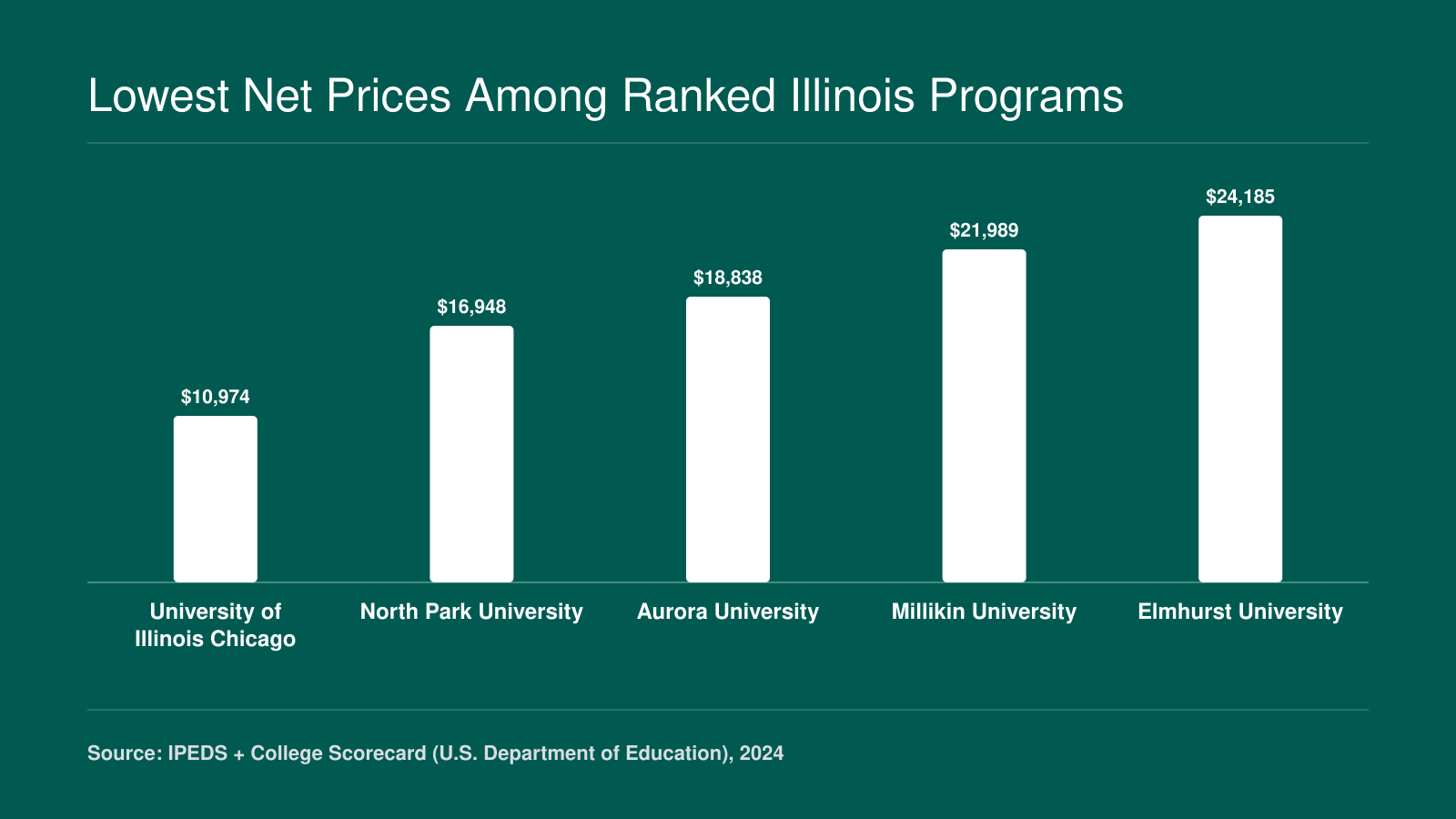
Lowest Net Prices Among Ranked Illinois Programs
Net price is what students pay on average after grants and scholarships, and it often sits well below the sticker tuition. University of Illinois Chicago has the lowest figure here, while Elmhurst University is the highest of the group charted. These are institution-wide averages after aid, not a guaranteed quote for any direct-entry MSN program, so confirm your own cost with each school's financial aid office.
Illinois RN Licensure at a Glance
Where Illinois Direct-Entry MSN Graduates Report the Highest Earnings
These are the five highest median earnings among the schools ranked here, drawn from federal College Scorecard data. Each figure is the median for master's graduates in nursing at that school, measured five years after finishing, so it may include graduates of other nursing master's tracks and not only the direct-entry route. Rosalind Franklin sits well above the rest, so read that gap with caution and compare it with each school's debt.
| School | Median earnings | Measured | Median program debt |
|---|---|---|---|
| Rosalind Franklin University of Medicine and Science | $226,223 | Five years after finishing | Not reported |
| Loyola University Chicago | $124,591 | Five years after finishing | $59,750 |
| University of Illinois Chicago | $116,791 | Five years after finishing | $97,999 |
| North Park University | $116,050 | Five years after finishing | $26,500 |
| Elmhurst University | $99,646 | Five years after finishing | $41,000 |
Quick Answers for Career Changers Weighing a Direct-Entry MSN
These answers cover the questions career changers ask most often. Details vary by school and year, so confirm current policies on each admissions page before you apply.
What does an Illinois direct-entry MSN actually cost from start to finish?
Which Illinois direct-entry MSN programs admit applicants who haven't finished their science prerequisites?
Do Illinois direct-entry MSN schools arrange clinical placements, or do students find their own?
How do direct-entry MSN graduates in Illinois perform on the NCLEX-RN?
Is part-time study possible while working full time?
Which direct-entry MSN options exist in Chicago versus downstate Illinois?
Compare Direct Entry MSN (MENP) programs on the data that matters
Explore more Nursing specializations or browse every graduate field.
All Nursing programs