Master's Programs in Maryland
Every master's program reported by a school in Maryland: 600+ programs at 20+ graduate schools, with the online options, costs and outcomes behind each one.

UMGC's military rate of $250 per credit and Johns Hopkins' private-school pricing sit in the same state, and the gap between them is the central cost question for anyone pursuing a master's in Maryland. The options include University System of Maryland publics such as UMD College Park, UMBC and Towson, private institutions led by Johns Hopkins and Loyola, and large online providers like UMGC. All of them sit close to the federal agencies, biotech firms and hospital systems of the Baltimore-Washington corridor.
The program lists on this page show what is offered. What they leave out is what it costs, which formats exist, how selective admission is, how students fund it, which degrees lead to licensure, clinical mental health counseling programs included, and what graduates earn. Cheapest options, fully online degrees, GRE policies and deadlines follow.
Proximity to employers helps, but it does not guarantee a return on tuition.
Key Points
- UMGC has the lowest published rate: $250 per credit for military students.
- Maryland has no blanket GRE rule, so each program sets its own.
- Check each program's 2026 deadline, since UMD, UMBC and Towson let departments choose.
Popular degrees in Maryland
Master's programs in Maryland by field
Business & Management
- Management20 programs
- Accounting19 programs
- Analytics18 programs
- Healthcare Administration11 programs
- Marketing10 programs
- Healthcare Management9 programs
- General Business9 programs
- Public Administration9 programs
Education & Teaching
- Teaching39 programs
- STEM Education or Science Education or Mathematics Education12 programs
- Special Education11 programs
- Secondary Education11 programs
- Educational Leadership9 programs
- Art Education9 programs
- Elementary Education8 programs
- Reading & Literacy8 programs
Nursing
- Nursing Education or Nurse Educator12 programs
- Family Nurse Practitioner (FNP)8 programs
- RN to MSN7 programs
- Nurse Administrator4 programs
- Direct Entry MSN (MENP) or (DEMSN)3 programs
- MSN/MBA2 programs
- Nurse Educator2 programs
- Public Health2 programs
Communications & Media
- Communication12 programs
- Public Relations7 programs
- Speech Pathology5 programs
- Journalism4 programs
- Communication Disorders3 programs
- Media Communication1 program
- Strategic Communication1 program
- Health Communication1 program
Healthcare
- Health Administration9 programs
- Health Informatics6 programs
- Health Education6 programs
- Speech Pathology5 programs
- Public Health4 programs
- Nutrition2 programs
- Exercise Science1 program
- Clinical Research Management1 program
Computers & IT
- Cybersecurity10 programs
- Data Analytics10 programs
- Information Security & Assurance8 programs
- Machine Learning5 programs
Science & Engineering
- Environmental Science14 programs
- Sustainability or Environmental Management10 programs
- Geography6 programs
Psychology
- Counseling Psychology9 programs
- Industrial Organizational Psychology3 programs
- Educational Psychology or School Psychology3 programs
- Applied Behavior Analysis3 programs
- General Psychology2 programs
- School Psychology2 programs
- Clinical Psychology2 programs
- Developmental Psychology2 programs
Social Work & Social Sciences
- Social Work8 programs
- Human Services5 programs
- Sociology4 programs
- Social Work Advanced Standing4 programs
- Political Science, Government1 program
Counseling
- School Counseling10 programs
- Clinical Mental Health Counseling7 programs
- Marriage and Family Therapy or Marriage and Family Counseling2 programs
- Addiction Counseling1 program
Arts & Design
- Creative Writing14 programs
- Fine Arts4 programs
Criminal Justice & Law
- Public Policy7 programs
- Homeland Security3 programs
- Master of Laws2 programs
- Legal Studies1 program
- Cybercrime1 program
- Business Law1 program
What a Master's Degree Costs at Maryland Universities
Published per-credit rates in Maryland span a wide range, and the gap between public and private options is the biggest cost lever you have. The figures below come from university bursar and tuition pages for 2026-27 unless noted. Totals are our own estimates for a 30-credit degree and exclude fees, books and any program-specific charges.
Public University Rates
- University of Maryland, College Park: $913 per credit in-state and $1,916 out-of-state, or roughly $27,400 and $57,500 over 30 credits.1 The School of Public Health lists higher rates, $1,120 in-state and $2,075 out-of-state.
- Morgan State (Fall 2026 and Spring 2027): $495 in-state and $970 out-of-state, roughly $14,850 and $29,100 over 30 credits.
- Frostburg State (on-campus master's): $496 for Maryland residents and $630 for others, roughly $14,900 and $18,900. The page also lists a separate $525 graduate rate, and we could not tie it to a specific program.
- UMGC: $555 per credit, with no residency split on the pages we reviewed, or about $16,650 for 30 credits. UMGC also displays a $566 rate and a $694 specialty graduate rate, so confirm which applies to your program.
We could not confirm current official rates for UMBC, the University of Maryland, Baltimore, Towson or Salisbury from the sources available. Check each bursar page before you budget.
The Private-School Gap
Loyola University Maryland lists its Professional MBA, one of the MBA programs we compare, at $1,195 per credit, or about $35,850 over 30 credits.2 That is $282 more per credit than UMD's in-state rate, roughly $8,500 over a 30-credit degree, and more than double Morgan State or Frostburg. Loyola's clinical mental health counseling program is listed at $1,175 for Fall 2026 admits, so rates differ by program. Johns Hopkins is private; its university-wide page states that its costs are for 2026-27, but rates vary by division and no single per-credit figure could be confirmed.3 Get a quote from your specific program.
Private schools also don't split rates by residency in the figures we found, so out-of-state students face a smaller penalty there than at UMD. An out-of-state student at UMD pays more per credit than at Loyola's MBA.
Fees and Program Differentials
Fees can shift the comparison. UMD charges flat per-semester graduate fees: $382.50 for 1 to 8 credits and $738 for 9 or more.1 Morgan State adds $81.50 per credit, bringing its in-state total to $576.50 per credit. Frostburg's listed per-credit fees total $133, if all apply to your format. UMGC charges a per-credit technology fee and a $24 per-credit Shady Grove Center fee where applicable.
Expect business, engineering, nursing and public health programs to cost more than the base rate. A typical 30 to 36 credit degree can differ by tens of thousands of dollars depending on school and field. Rates are reset each year, so treat these numbers as a starting point and verify them on the bursar page for your entry term.
The Cheapest Ways to Earn a Master's in Maryland
What is the cheapest master's program in Maryland? Among published 2026-27 rates, University of Maryland Global Campus (UMGC) sits at the bottom. Its military rate is $250 per credit for servicemembers, eligible spouses and dependents, and $336 for eligible military students in the MS in Transformational Leadership. Maryland residents pay $555 per credit in standard UMGC graduate programs, though specialty programs such as cybersecurity master's programs, data analytics, and general MBA programs run $694. Frostburg State is close behind at $496 per credit for residents on campus and $525 for fully online students. By comparison, UMB's online master's rates start at $831.70 for residents. Salisbury and Coppin State are also worth checking, but we could not find published 2026 per-credit graduate rates for them. Fees and program-specific rates can change the comparison, so confirm with each bursar.
How In-State Residency Works
The resident rate is the biggest discount available, and it is not automatic. University System of Maryland schools generally require 12 consecutive months of Maryland residency before the last registration date for the semester you want. That usually means:
- Maintaining your primary home and most personal property in Maryland
- Filing a Maryland resident income tax return
- Holding a Maryland driver's license and vehicle registration for 12 months, with a limited exception for recent movers
- Receiving no public assistance from another state
Moving here for school typically does not qualify you, so plan the timeline before applying.
Levers That Lower the Bill
- Part-time study: Taking one or two courses a term while working spreads cost and keeps your income.
- Employer assistance: Ask HR about tuition benefits before you enroll, since some require approval in advance.
- Transfer credit: Many programs accept a limited number of graduate credits from elsewhere, each one saving a full per-credit charge.
- Program length: A 30-credit degree at $555 per credit costs about $16,650 in tuition, while a 36-credit degree at the same rate costs about $19,980.
Sticker Price Is Not Net Price
Per-credit rates leave out fees, and they leave out funding. A flagship program that offers an assistantship with tuition remission can cost less out of pocket than an unfunded regional program with a lower rate. Compare what you would actually pay after aid, not the posted tuition alone.
Online, Hybrid and Campus Formats Across Maryland
Flexibility costs money in some Maryland online programs and saves it in others, so the format you pick can matter as much as the school. Price varies widely, and the cheapest online option is not always the one that fits a working schedule.
Who Offers Online Master's Degrees
University of Maryland Global Campus (UMGC) is the largest online provider, with a heavy focus on cybersecurity, data analytics, business and leadership. Johns Hopkins delivers online and part-time degrees through Engineering for Professionals and Advanced Academic Programs, mostly in technical, policy and applied fields. Towson, UMBC, UMD College Park and Morgan State also offer online or hybrid options. UMBC's include cybersecurity, data science, health IT, software engineering and TESOL. Morgan State's offerings include online MSW programs and an online MBA. UMD's Smith School runs online degrees in business analytics and management studies. Check each program's own page for delivery details, since formats differ even within one school.
Do Online Students Pay In-State Rates?
It depends on the school. UMGC publishes a standard graduate rate of $555 per credit for Maryland residents and $659 for out-of-state students in Fall 2026, while its specialty programs (cybersecurity, data analytics, MBA) run $694 per credit for everyone. UMD Smith charges $1,631 per credit in-state and $2,072.50 out-of-state for 2026-2027.3 UMBC's online MS in Information Systems is a flat, all-inclusive $962 per credit, textbooks included.2 Morgan State lists $667 per credit for the online MSW and $834 for the online MBA. UMBC also offers a regional rate to eligible students from Washington, D.C., Delaware and select Virginia and Pennsylvania counties, for selected programs.1
Hybrid and Regional Sites
The Universities at Shady Grove, UMBC's Shady Grove presence, Hopkins' centers in Washington and Montgomery County, and the Southern Maryland and Hagerstown higher education centers let students take evening or weekend classes close to home. These sites suit commuters who want in-person contact without driving to a main campus. Confirm which degrees are offered at each location, because course availability changes by term.
Matching Format to Your Life
Working professionals generally do best with part-time evening, weekend or asynchronous online formats, which keep a paycheck coming during the degree. Licensure paths are less flexible. Social work, counseling and teaching programs usually require supervised field placements, practicum or clinical hours in person, even when coursework is online. Ask any online program how it arranges placements in your area before you enroll.
Admissions Requirements: GRE Policies, Prerequisites and Selectivity
A blanket GRE rule would make applying simpler, but Maryland does not have one. Requirements are set program by program, and two programs at the same university can disagree.
Do Maryland master's programs require the GRE?
At UMD College Park, the answer depends on the department. The Civil and Environmental Engineering M.S. requires official GRE scores, with a minimum of 306 combined and 156 on Quantitative.1 In the College of Education, the M.A. asks for scores at or above the 50th percentile on each section, while M.Ed. programs require no GRE. Government and Politics does not require the GRE.2 Public health master's programs also do not require it, placing them among master's programs with no GRE required.
UMBC works differently. Many of its programs list GRE sections, and some name subject tests or other standardized exams.3 The university waived the GRE for all Fall 2026 applications, but the sources do not say whether that waiver overrides every program-specific test requirement.4 Treat the program page as the final word.
For Towson, UMB and Johns Hopkins, there is no verified institution-wide GRE policy to report. Health-professions and biomedical programs at UMB may differ materially from other fields. Check each program individually.
The standard application package
- Transcripts: Official records from every post-secondary institution attended.
- GPA: UMD and UMBC both set a 3.0 floor for full admission, plus any program prerequisites.56
- Statement and letters: Most programs want a goals statement and typically three recommendations. Some add writing samples, a portfolio or an interview.
- English proficiency: International applicants should expect to document it. Confirm accepted tests and scores with the program.
What about the UMD acceptance rate?
No single, reliable acceptance rate exists for UMD's graduate school, and selectivity varies by department. The most useful signal is each program's own GPA language. Government and Politics says competitive applicants tend to land above 3.5, and English uses a 3.5 qualifying GPA for the M.A. but still considers lower applicants.27 Public health notes that a 3.0 may not be competitive. Read the university minimum as a floor, not a target.
Is a one-year master's possible?
Program length is set at the program level, and the sources reviewed here do not verify any specific one-year or accelerated Maryland master's. Look for full-time tracks with a low credit requirement, and ask departments about combined bachelor's/master's pathways. Confirm credit counts and timelines on the program page before planning around a single year.
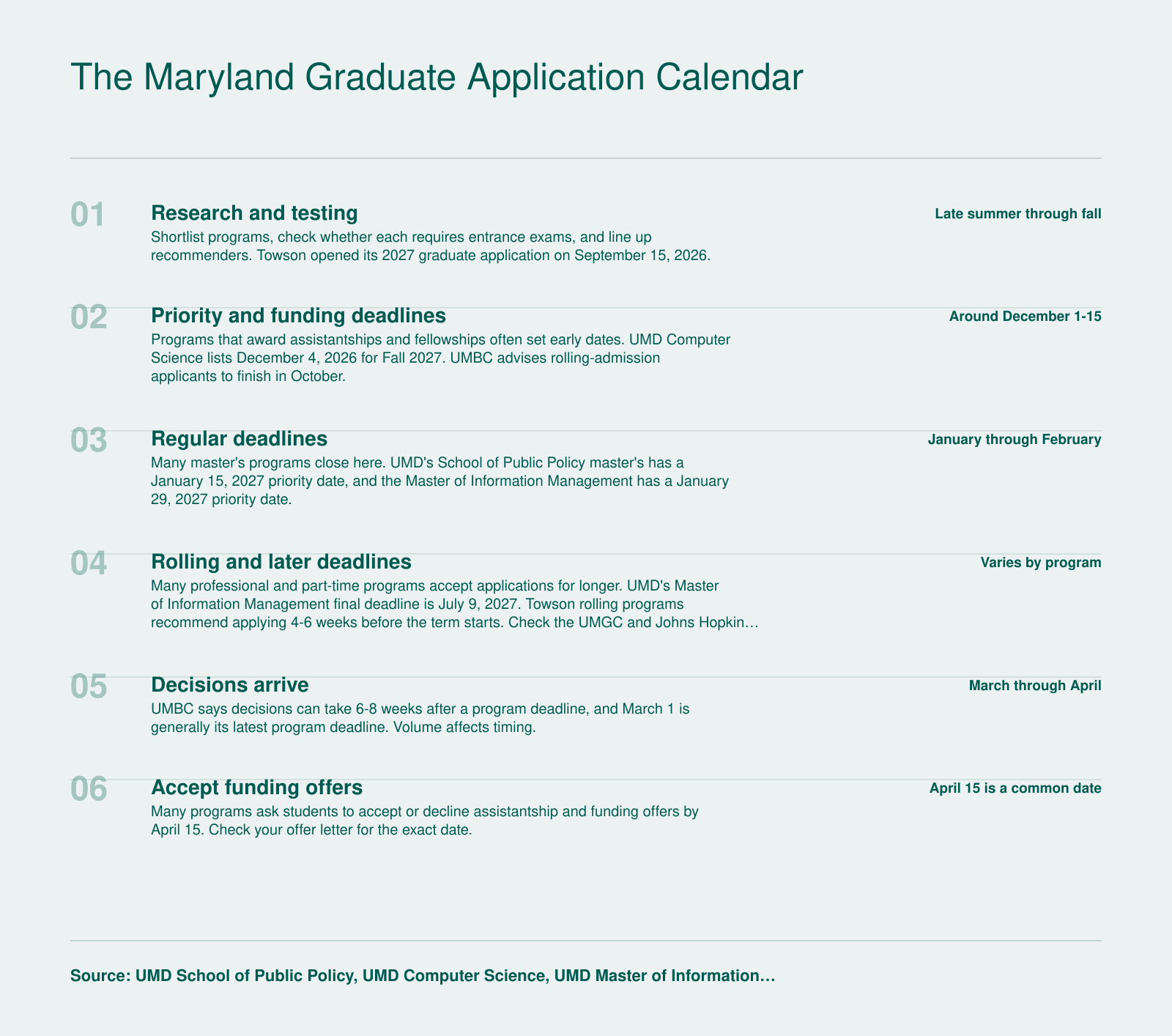
The Maryland Graduate Application Calendar
Maryland has no single graduate deadline. UMD College Park, UMBC and Towson let programs set their own dates, so the sequence below is a typical pattern, not a rule. Deadlines differ by program, so confirm each one on the department page before you plan around it.
Paying for It: Assistantships, Scholarships and Tuition Remission
Can you get a Maryland master's degree paid for? Sometimes, mainly through a graduate assistantship, though most master's students combine several smaller sources.
Graduate Assistantships at UMD and Other USM Schools
UMD College Park sets minimum assistantship stipends by appointment step: about $26,568 to $27,608 for 2025-26 after a 1% cost-of-living increase.1 Departments can pay more. The School of Public Policy lists $28,467 for master's assistants in 2026-27.2 A full assistantship (20 hours a week) generally remits up to 10 credits in fall and spring and 4 in winter.3 A half assistantship (10 hours) covers up to 5 and 2.3 Assistants are billed at the in-state rate, and remission covers only standard in-state tuition.3 Mandatory fees and any higher program-rate differential remain your responsibility.4 Health benefits may be part of the package, depending on the appointment and funding source.
Other USM campuses run their own assistantships, so don't assume UMD's figures apply there. At every school, these positions cluster in research-oriented master's and doctoral programs. They are far less common in professional, executive or online programs.
State and Institutional Aid
The Maryland Higher Education Commission offers two programs open to graduate students in both 2025-26 and 2026-27:
- Graduate and Professional Scholarship: need-based aid for degree-seeking graduate and professional students.5
- Workforce Shortage Student Assistance Grant: for Maryland residents preparing for child care, human services, teaching, nursing, physical and occupational therapy, social work or public service.5
Check MHEC directly for current award amounts, deadlines and any service obligations. Many departments also award their own merit scholarships, often at the point of admission.
Federal Loans and Employer Benefits
Direct Unsubsidized Loans remain the main federal option. Under 2025 federal legislation, Grad PLUS loans close to new borrowers starting July 1, 2026, and new annual and lifetime caps apply. Confirm your limits with the financial aid office before you plan around borrowing.
Working adults should ask HR about tuition assistance before enrolling. Employees of USM institutions may also qualify for employee tuition remission, which can make a part-time master's at a system school far cheaper than the posted price.
Licensure and Accreditation for Career-Focused Degrees
A lower tuition bill or a flexible online format means little if the degree does not lead to a license. Two layers of accreditation decide that.
Two Layers of Accreditation
Institutional accreditation, from the Middle States Commission on Higher Education for Maryland schools, governs federal aid eligibility and whether other schools accept your transfer credits. Programmatic accreditation covers a specific degree: CSWE for social work, CACREP for counseling, CCNE or ACEN for nursing, including MSN programs, and CAEP or an MSDE-approved program for teaching, such as M.Ed. programs. Licensing boards and employers often care most about this second layer.
Maryland Licensure Tracks
- Teaching: MSDE issues educator certification, generally through an approved preparation program.
- Advanced practice nursing: The Maryland Board of Nursing licenses APRNs.
- Social work: The Board of Social Work Examiners oversees the path from LMSW to LCSW-C.
- Counseling: The Board of Professional Counselors and Therapists oversees LGPC, then LCPC. The LGPC requires a master's of at least 60 semester hours from an accredited, Board-approved college, 3 graduate credits in each required subject, and 125 hours of direct client counseling in supervised field work.1 The LCPC adds 3,000 supervised hours over at least three years (2,000 of them after the master's), plus the NCE and the Maryland Law Assessment.2
The Board's counseling materials require an accredited, Board-approved institution but do not name CACREP, so confirm the current rule rather than assuming.3
What to Verify Before Enrolling
Online students at out-of-state or national programs face the most risk. A program can be properly accredited and still miss Maryland's coursework or supervised-practice rules. Before paying a deposit:
- Find the programmatic accreditor on the program's own site, then confirm it in the accreditor's public directory.
- Compare the curriculum with current requirements on the relevant Maryland board's website or in COMAR.
- Ask whether graduates have been licensed in Maryland and whether practicum placements can be arranged in-state.
Maryland Social Work Licensure at a Glance
Career Outcomes: Which Maryland Master's Degrees Pay Off
A six-figure salary can still be a weak return if it arrives with six-figure debt. In Maryland, the more useful test is what a master's degree adds after subtracting loan payments, and the current federal data is uneven enough that students should read every figure with its time horizon attached.
Earnings vs. debt, not salary alone
College Scorecard program-level medians cover only federal aid recipients, and for several Maryland master's programs the earnings or debt fields are not reported. That caveat matters before comparing schools. UMD's master's-level business grouping reports median earnings of $125,159 one year after completion, while Johns Hopkins reports $113,065 for a similar grouping; neither figure has a matching program-level median debt, so neither can be labeled a clean return on investment.
UMBC reports a median salary of $98,786 across 503 cybersecurity master's graduates from 2011 through 2026, but that is a university figure, not a federal Scorecard median, and it comes without median debt. For UMD computer science, the Scorecard-based table shows 873 graduates and $20,000 in median debt, but no earnings figure.
Where licensure changes the math
Nursing and social work illustrate the difference between optional and required master's degrees. UMB's MSN program-level earnings and debt are not reported in the current data, but Johns Hopkins reports five-year median earnings of $114,391 for registered nursing master's graduates, again without matching median debt. Social work MSW outcomes are not yet available at the program level, so prospective MSW students comparing affordable MSW programs should weigh licensure preparation and clinical placement quality instead of a salary-to-debt ratio.
Maryland's job market favors certain fields
The state's demand centers shape these outcomes. Federal agencies and defense contractors draw cybersecurity and computer science graduates across the Baltimore-Washington corridor, while Johns Hopkins Medicine and the I-270 biotech cluster support health-science and biotechnology master's work. Johns Hopkins reports five-year median earnings of $116,723 for biotechnology master's graduates and $102,525 for graduates of its MPH programs, though debt is not reported. Those figures align with Maryland's employer mix, but they are not the full return picture without debt.
Public vs. Private: UMD and UMB Compared With Johns Hopkins and Loyola
Maryland's public University System of Maryland campuses and its private universities differ most in how they price tuition and fund students, less in the outcomes they report. The outcome figures below are institution-level, not master's-specific, so treat them as context rather than a program guarantee. Verdict: publics usually win on value for in-state residents, while privates can justify the price in fields such as public health, professional engineering and international studies when employer reimbursement or strong outcomes offset the cost.
| Factor | Public (UMD, UMB, UMBC, Towson) | Private (Johns Hopkins, Loyola) |
|---|---|---|
| Tuition structure | Separate in-state and out-of-state rates, usually charged per credit | One rate regardless of residency, usually charged per credit or by program |
| In-state discount | Substantial for Maryland residents | None, since residency does not change the price |
| Assistantships and funding | Graduate assistantships with tuition support, concentrated in research-oriented programs | Merit scholarships and some assistantships; employer reimbursement often fills the gap for working students |
| Part-time and online options | Wide range of part-time, hybrid and online formats at lower cost | Large part-time and online catalogs aimed at working professionals |
| Brand and employer network | Strong ties to federal agencies, state government and the health system | National and international brand, with deep reach in public health, engineering and global affairs |
| Typical cohort size | Larger classes, especially at UMD, with reported enrollment of 30,246 | Smaller cohorts, with reported enrollment of 5,617 |
| Reported completion rate | 89% | 95% |
| Reported salary outcomes | $82.9k per year | $87.6k per year |
Graduate schools in Maryland with the most master's programs
| School | City | Type | Master's programs | Online | Grad tuition / yr |
|---|---|---|---|---|---|
| University of Maryland-College Park | College Park | Public | 68 | 11 | $18,276 |
| Johns Hopkins University | Baltimore | Private nonprofit | 64 | 27 | $64,730 |
| Towson University | Towson | Public | 44 | 18 | $12,636 |
| Bowie State University | Bowie | Public | 33 | 5 | $10,854 |
| Salisbury University | Salisbury | Public | 30 | 10 | $10,785 |
| University of Baltimore | Baltimore | Public | 29 | 21 | $16,574 |
| Strayer University-Maryland | Baltimore | Private for-profit | 29 | 29 | $15,135 |
| Loyola University Maryland | Baltimore | Private nonprofit | 28 | 14 | $20,070 |
| Morgan State University | Baltimore | Public | 27 | 9 | $9,981 |
| University of Maryland, Baltimore | Baltimore | Public | 24 | 16 | $17,827 |
| Mount St. Mary's University | Emmitsburg | Private nonprofit | 23 | 19 | $14,351 |
| University of Maryland Global Campus | Adelphi | Public | 23 | 23 | $9,882 |
| Frostburg State University | Frostburg | Public | 22 | 18 | $11,498 |
| McDaniel College | Westminster | Private nonprofit | 21 | 20 | $10,044 |
| University of Maryland-Baltimore County | Baltimore | Public | 20 | 1 | $16,524 |
Program counts are the verified master's listings in our directory; tuition is the school-wide average for a full-time graduate student (IPEDS).
Frequently Asked Questions About Maryland Master's Programs
These answers cover the questions prospective students ask most often about timelines, testing, selectivity, employee benefits and online pricing in Maryland. Policies change by program and by year, so confirm details with the department before you apply.
Can I complete a master's degree in one year in Maryland?
Do Maryland master's programs require the GRE?
What is the UMD graduate school acceptance rate?
Can Maryland state or USM employees get tuition remission for a master's degree?
Do out-of-state students pay more for UMGC or other Maryland online master's programs?
Compare programs nationwide
Many Maryland residents study online. Every ranked list above has an online lens, or browse every field.
Online master's programs Browse all fields