Best Master's in Cybersecurity Programs in Maryland
Compare 10 accredited Cybersecurity programs in Maryland, with graduate earnings, cost, debt, and completion data from IPEDS and the U.S. College Scorecard.

Does a Maryland cybersecurity master's pay off in the hiring market around Fort Meade, home to the NSA and U.S. Cyber Command? Among programs with published outcomes, graduate median earnings five years out run from $75,432 to $111,361.
Campus and online programs share one ranking, since several schools here deliver the degree both ways; some also appear among Master's in Cybersecurity Programs With No GRE Required.
Cost cuts the other way. Average net price ranges from $13,338 to $26,505, and many federal and contractor roles still require a certification such as CompTIA Security+ on top of any degree.
Key Points
- Capitol Technology University tops the list with a fully online M.S. and an NSA/DHS Cyber Defense designation.
- University of Maryland Global Campus graduates report $111,361 median earnings five years out, the highest figure published here.
- Maryland requires no state license for cyber roles, so employers look for Security+, CISSP, or CISM.
Top Master's in Cybersecurity Programs in Maryland for 2027
Capitol Technology University takes the top spot as the best overall pick: a fully online, lab-heavy M.S. in Cybersecurity from a school with a long-standing NSA/DHS Cyber Defense designation and a flat graduate tuition rate. The rest of the list mixes public and private options, campus and online, so you can weigh price, format, and focus. Graduation rates shown are institution-wide figures, not program-specific.
Capitol Technology University
#1Laurel, MD · ~$12,000/yr (est.)
Best for: Working adults studying fully online
Capitol Technology University in Laurel offers a fully online M.S. in Cybersecurity delivered in 8-week asynchronous terms, with hands-on labs in malware analysis and penetration testing. It holds an NSA/DHS CAE-CD (Cyber Defense) designation. Graduate tuition is listed at $11,340 for in-state and out-of-state students alike, and the school's institution-wide graduation rate is 42.7%.
- Fully online, asynchronous classes in 8-week terms
- Hands-on labs in malware analysis and penetration testing
- Capstone required (risk assessment)
- $665 per credit; military rate of $350 per credit
- 20% tuition discount for faculty
- Maps to NSA cyber defense knowledge units
- Small classes taught by working practitioners
University of Maryland Global Campus
#2Adelphi, MD · ~$10,000/yr (est.)
Best for: Career changers from non-technical majors
University of Maryland Global Campus is an online public option with in-state graduate tuition of $9,612 and $11,862 for out-of-state students. Its Cybersecurity Technology master's is approved by the NSA's CAE program office as a designated program of study, and it admits students from any undergraduate major. Institution-wide graduation rate is 33.3%.
- 30 credits, finish in as little as 16 months
- Five concentration options
- Fully online with rolling starts
- 3.0 GPA minimum; no specific undergraduate major required
- Transfer up to 12 credits
- Prepares for CISSP and CEH exams
- Dual MS/MBA option saves up to 9 credits
- Capstone required
Stevenson University
#3Owings Mills, MD · ~$8,000/yr (est.)
Best for: Aspiring digital forensics and incident response analysts
Stevenson University in Owings Mills offers a fully online Master of Cybersecurity and Digital Forensics, pairing incident response and malware detection with forensic analysis. Graduate tuition is $8,460 regardless of residency. Its institution-wide graduation rate of 68.5% is the highest on this list.
- Fully online format for working professionals
- Focus on incident response, malware detection, forensic analysis
- Real-world projects and internships emphasized
- Leadership and management skill development
- Targets roles such as Cybersecurity Consultant and Security Architect
University of Baltimore
#4Baltimore, MD · $17,000 – $23,000/yr (est.)
The University of Baltimore's M.S. in User-Centered Cybersecurity blends security with human-centered design, a distinctive angle on this list. Graduate tuition is $14,760 in-state and $21,654 out-of-state. The institution-wide graduation rate is 38.2%.
- 30 credits, STEM-designated
- Courses on campus and online, with a fully online option
- No entrance exam required
- 3.0 GPA minimum and two recommendation letters
- Diary studies and usability tests; GDPR and CCPA coverage
- $50 application fee
Hood College
#5Frederick, MD · ~$9,000/yr (est.)
Hood College in Frederick offers a 30-credit M.S. in Cybersecurity on campus or fully online. Foundation courses are available for students without a computing background. Graduate tuition is $9,180 for all students, and the institution-wide graduation rate is 56.9%.
- 30 credits; on-campus or fully online
- Foundation courses for applicants without computing experience
- Covers network security, risk management, forensics, ethical hacking
- Capstone project required
- Admission needs transcripts, resume, and statement of purpose
Bowie State University
#6Bowie, MD · ~$11,000/yr (est.)
Bowie State University offers an on-campus M.S. in Information Systems & Sciences with an Information Assurance concentration. The curriculum aligns with CNSS 4011 standards. Graduate tuition is $8,226 in-state and $13,140 out-of-state, with an institution-wide graduation rate of 38.2%.
- Information Assurance concentration
- Curriculum aligned with CNSS 4011 standards
- Courses certified by CNSS
- Covers security analysis, auditing, and management
- Campus-based delivery
University of Maryland Eastern Shore
#7Princess Anne, MD · ~$8,000/yr (est.)
The University of Maryland Eastern Shore in Princess Anne offers an on-campus M.S. in Applied Cybersecurity Engineering through its Computer Science and Engineering Technology department. It carries the lowest graduate tuition on this list: $6,354 in-state and $11,772 out-of-state. The institution-wide graduation rate is 35.3%.
- Applied cybersecurity engineering focus
- Protection, detection, and reaction capabilities
- Covers availability, integrity, authentication, confidentiality, non-repudiation
- Includes restoration of information systems
- Offered by the Computer Science and Engineering Technology department
Strayer University-Maryland
#8Baltimore, MD · ~$15,000/yr (est.)
Strayer University's Maryland campus offers an online M.S. in Cybersecurity, validated by the NSA, with online and hybrid formats. Graduate tuition is $13,920 for all students. The institution-wide graduation rate is 37.5%.
- 45 credits across 10 courses
- 100% online or hybrid formats
- 2.5 GPA minimum
- Validated by the National Security Agency
- Transfer up to four eligible classes
- Employer reimbursement and military benefits accepted
- One-on-one academic coaches and career planning
Cost & outcomes by school
Federal data for the highest-earning Cybersecurity programs, independent of the ranking above. Earnings are this field's master's graduates four years after completing, where the Scorecard reports them.
| School | Earnings | Tuition / yr | Debt | Grads/yr | Format |
|---|---|---|---|---|---|
| University of Maryland Global Campus MD | $106,787 | $9,882 | $39,520 | 109 | Online |
| Stevenson University MD | $86,344 | $8,460 | $41,000 | 112 | Online |
| University of Baltimore MD | $85,028 | $16,574 | $41,175 | 17 | Hybrid |
| Towson University MD | $74,405 | $12,636 | — | 11 | Campus |
| University of Maryland Eastern Shore MD | — | $8,010 | — | — | Campus |
| Hood College MD | — | $9,470 | — | — | Campus |
| Bowie State University MD | — | $10,854 | — | — | Campus |
| Capitol Technology University MD | — | $12,060 | — | — | Online |
| Strayer University-Maryland MD | — | $15,135 | — | — | Online |
| University of Maryland, Baltimore MD | — | $17,827 | — | 14 | Online |
Sources: U.S. Department of Education. Tuition and graduates: IPEDS. Earnings and debt: College Scorecard, this field's master's graduates; a dash means no figure is reported.
Cost, debt & payoff
Median earnings of this field's master's graduates (4 yrs after completing) vs. their median federal loan debt · U.S. College Scorecard
Across these programs the median graduate earns about $85,686 and finishes with roughly $41,000 in debt — a ratio that clears a common rule of thumb (keep debt below first-year salary). Tuition and debt vary widely school to school, so check the per-school figures in the table above before you shortlist.
How This Ranking of Maryland Cybersecurity Master's Programs Was Built
A well-known name is not always a good value, so every school in this ranking of Master's Programs in Maryland earned its place on public federal data, not reputation surveys. The signals are average net price after aid, institution-wide graduation rate, and College Scorecard program-level earnings and debt wherever those figures are published.
Two cautions apply. Graduation rates and net price describe the whole institution, not just a Maryland cybersecurity master's program, so read them as context rather than a verdict on one degree. Program-level earnings and debt are narrower, but they are not published for every school.
Online, hybrid, and campus programs compete on the same scale. Format alone does not move a school up or down.
Online and Hybrid Master's in Cybersecurity Options in Maryland
Yes, you can earn a master's degree in cybersecurity fully online in Maryland; compare fully online formats in the Best Online Master's in Cybersecurity Programs ranking. Capitol Technology University, University of Maryland Global Campus, Stevenson University, and Strayer University-Maryland all list online delivery as their program type. Hood College and the University of Baltimore also mention a fully online option, though their primary listings are campus and hybrid.
Format trade-offs
Capitol Tech is the clearest on structure: asynchronous classes in 8-week terms, with no on-campus residency indicated.12 That suits anyone juggling shifts or a security clearance workload, but you give up live interaction. UMGC offers online courses with select hybrid options, though its published materials don't say whether classes meet live or on a schedule. Check that before enrolling.
Near Fort Meade, D.C., and Baltimore
For Baltimore commuters, the University of Baltimore's hybrid M.S. in User-Centered Cybersecurity is the most practical in-city option. UMGC's Adelphi base serves the D.C. corridor, and Bowie State is campus-based in the same area. Hood College's campus program sits in Frederick. No school here publishes dedicated evening sections, so confirm meeting times with admissions.
CyberSeek (CompTIA/NICE) counted 27,050 cybersecurity job postings in Maryland for May 2024 through April 2025, in its June 2025 release. That figure measures employer postings over 12 months, not vacancies at one moment or the number of people employed.
Related Articles
Master's in Cybersecurity Cost in Maryland: The Most Affordable Programs
The University of Maryland Eastern Shore has the lowest average net price here at $13,338, while University of Maryland Global Campus posts the lowest in-state sticker tuition at $8,136. At the public schools, out-of-state rates run higher than in-state rates because state funding subsidizes residents. At UMES, Bowie State and Baltimore, the nonresident rate is more than double the resident rate. Hood is private and charges one rate to everyone. Net price is an institution-wide average after aid, so treat it as an approximation, not a quote. Employer tuition assistance and military benefits are common among Maryland cyber students, and UMGC lists military benefits as accepted, so check both before you borrow.
| School | In-State Graduate Tuition | Out-of-State Graduate Tuition | Average Net Price | Format |
|---|---|---|---|---|
| University of Maryland Eastern Shore | $9,076 | $20,122 | $13,338 | Campus |
| University of Baltimore | $9,992 | $23,984 | $13,868 | Hybrid (fully online option available) |
| Bowie State University | $9,218 | $19,938 | $19,298 | Campus |
| Hood College | $47,700 | $47,700 | $20,873 | Campus (online format available) |
| University of Maryland Global Campus | $8,136 | $12,336 | $22,063 | Online |
Maryland Licensure and Certification for Cybersecurity Professionals
What Do Maryland Cybersecurity Master's Graduates Earn?
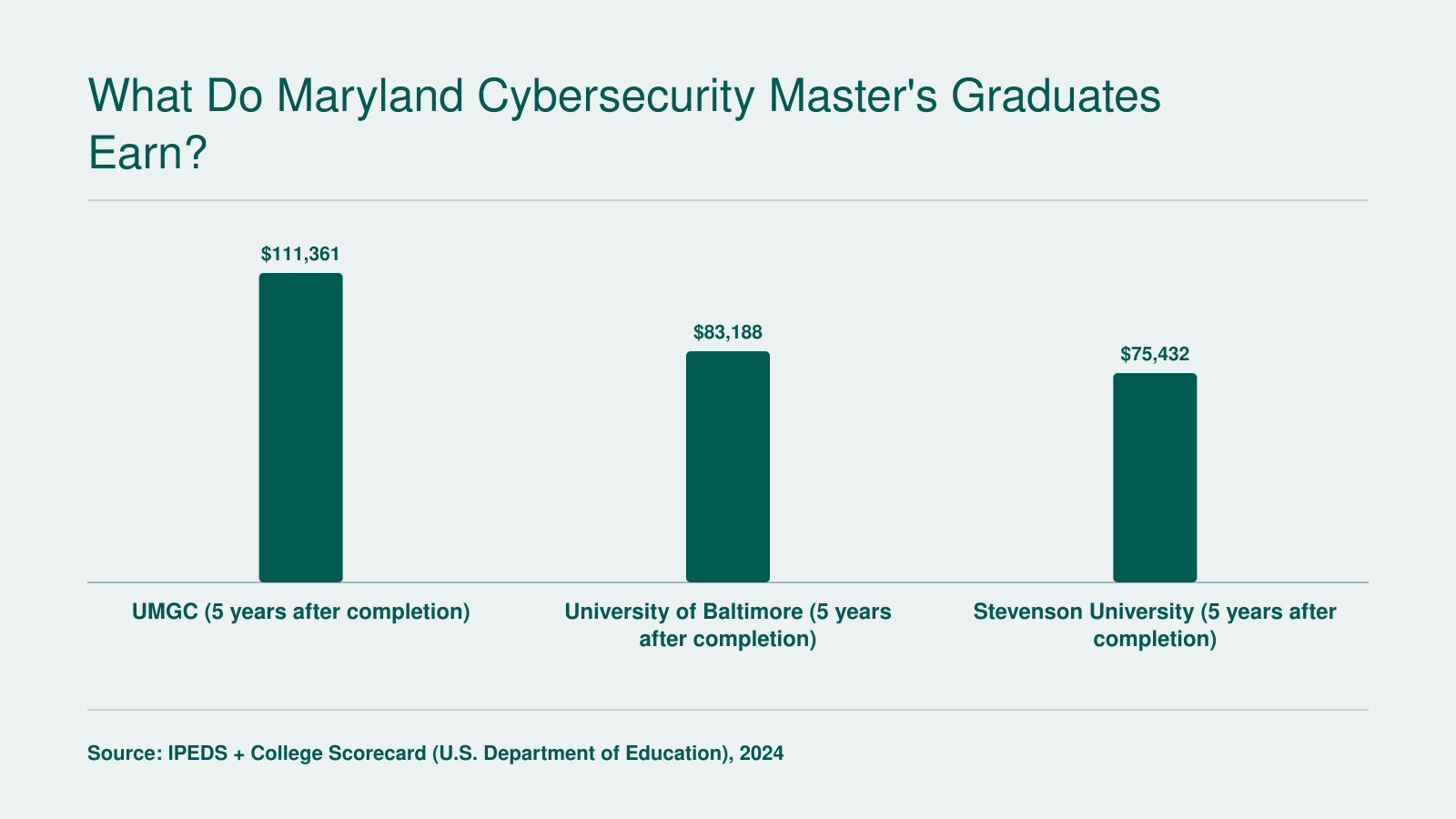
Among the ranked programs with a published program-level figure, median earnings five years after completion run from $75,432 at Stevenson University to $111,361 at University of Maryland Global Campus. University of Baltimore sits between them at $83,188. In plain terms, a typical cybersecurity master's graduate from these programs earns roughly $75,000 to $111,000 about five years out. Capitol Technology University and Hood College do not report a program-level earnings figure, so they are left off the chart.
Quick Answers on Maryland Cybersecurity Master's Programs
Which Maryland cybersecurity master's programs carry an NSA Center of Academic Excellence designation?
What is the most affordable master's in cybersecurity in Maryland?
Can I transfer graduate credits or finish a Maryland cybersecurity master's in under two years?
Compare Cybersecurity programs on the data that matters
Explore more Computers & IT specializations or browse every graduate field.
All Computers & IT programs