Accelerated Master's in Cybersecurity Programs
Compare 440+ accredited fastest Cybersecurity programs at 380+ schools, with graduate earnings, cost, debt, and completion data from IPEDS and the U.S. College Scorecard.

A conventional cybersecurity master's takes two years. The accelerated versions finish in 12 to 18 months, and 4+1 pathways let undergraduates earn both degrees in about five years instead of six.
The tradeoff is intensity. Eight-week terms and heavy course loads suit working professionals and strong undergraduates, but a shorter program is not automatically cheaper once you weigh tuition against earnings.
Employers still screen on certifications and hands-on skill, so speed only pays off when the coursework maps to what hiring managers test.
Key Points
- ISC2's 2024 study counts roughly 504,000 unfilled US cybersecurity positions.
- Bachelor's-to-master's tracks can double-count graduate credits and trim a year.
- Published full-program tuition varies widely, with debt and first-year earnings largely unreported.
The 10 Fastest Accelerated Cybersecurity Master's Programs
The programs below are ordered by how quickly they move a student from first graduate course to credential, with cost and outcome data used to separate programs that finish in similar time. From eight-week terms to accelerated bachelor's-to-master's pathways, the fastest options often share a compressed schedule or allow graduate credits to count toward both degrees.
Saint Louis University
#1Saint Louis, MO · ~$26,000/yr (est.)
Best for: Working adults pursuing online eight-week terms
Saint Louis University runs its accelerated bachelor's-to-master's cybersecurity pathway through the School for Professional Studies, aimed at working professionals. Students can apply up to 12 graduate credits toward both degrees and finish bridge courses with a B or better for automatic graduate admission. Eight-week terms and fully online delivery keep the pace fast.
- Accelerated bachelor's to master's program
- Up to 12 graduate credits count toward both degrees
- Requires 3.00 overall GPA and 3.50 major GPA
- Program director approval needed
- Cybersecurity Principles and Networking Concepts courses
- Eight-week accelerated terms offered
- Automatic graduate matriculation with B or better
- No separate graduate application needed
University at Albany
#2Albany, NY · ~$14,000/yr (est.)
Best for: Career changers exploring five concentrations
The University at Albany offers a 36-credit Master of Science in Digital Forensics and Cybersecurity with five specialized concentrations. Students can complete the intensive program in one year and choose an internship or thesis, preparing for roles across cybersecurity, digital forensics, and risk management.
- Five unique cybersecurity concentration options
- One-year intensive program with internship option
- Collaborative program between Business and Homeland Security colleges
- 36-credit curriculum
- Culminating internship or thesis
- Prepares for roles in cybersecurity, digital forensics, and risk management
University of Rhode Island
#3Kingston, RI · ~$18,000/yr (est.)
Best for: Part-time students needing flexible online pacing
The University of Rhode Island's Professional Science Master's in Cyber Security is delivered online for working professionals, with part-time enrollment and instructor-guided learning. A non-technical bridge program opens entry for career changers, and the curriculum integrates technical courses, workplace skills, and a graduate internship. The program is designated a National Center of Academic Excellence in Cyber Defense.
- Online degree format
- Flexible schedule for professionals
- Part-time enrollment available
- Non-technical background bridge program
- Graduate internship included
- Industry certifications such as A+ and Security+
- Cost is $1,377 per credit
- Center of Academic Excellence in Cyber Defense
George Mason University
#4Fairfax, VA · $15,000 – $20,000/yr (est.)
George Mason's MS in Cyber Security Engineering takes a systems engineering approach to securing cyber-physical systems, from critical infrastructure to autonomous vehicles. The 30-credit program offers concentrations in Secure Advanced Manufacturing, Autonomous Vehicles, and Cyber Secure AI, along with a thesis or capstone. An accelerated BS/MS pathway is available for undergraduates.
- 3 concentration options: Secure Advanced Manufacturing, Autonomous Vehicles, Cyber Secure AI
- 30 total credit hours
- 3.0 GPA minimum
- Thesis or capstone option
- Accelerated BS/MS pathway available
- Systems engineering perspective emphasized
- Capstone integrates system design
University of Arizona
#5Tucson, AZ · ~$15,000/yr (est.)
The University of Arizona delivers an online Master of Science in Cybersecurity through a joint effort of the Eller College of Management and the College of Engineering. The 33-credit program offers Information Systems and Physical Systems tracks, with accelerated seven-week courses for the Information Systems track. Six admission dates per year add flexibility for working professionals.
- 33 credit hours required
- Cost per credit $1,250
- Online delivery format
- Accelerated 7-week courses
- Six admission dates yearly
- Information Systems track option
- Joint program with three departments
- Enterprise Security Certificate option
- Physical Systems track spans 21 units
- 16-week format for Physical Systems
- Hands-on interactive classes
- Technical mastery focus
- Assess, prevent, and manage security risks
- Bachelor's degree required
- Designated Center for Academic Excellence
Pace University
#6New York, NY · $30,000 – $35,000/yr (est.)
Pace University's online MS in Cybersecurity can be completed in as little as one year full-time, with part-time options available. Students choose from Cyber Operations or Cybersecurity Leadership concentrations, or follow a general track, and no GMAT or GRE is required. The STEM-designated program holds National Center of Academic Excellence in Cyber Defense Education designation.
- Cyber Operations concentration
- Includes Cyber Intelligence Analysis and Modeling
- Network Security and Defense coursework
- Business Continuity Planning course
- 30 credit hours required
- Can be completed in as little as 1 year
- Cybersecurity Leadership concentration
- Focus on information security management
- Penetration testing and network defense topics
- STEM-designated program
- No GMAT or GRE required
- Three prerequisite courses required
- General track available
- Hands-on learning with virtual labs
- Prerequisite courses in statistics, coding, and data communications
- National Center of Academic Excellence in Cyber Defense Education
- Also available on campus
- Admission decision in one week
Houston Christian University
#7Houston, TX · ~$12,000/yr (est.)
Houston Christian University offers a fully online Master of Science in Cybersecurity that can be completed in one year, with part-time options and low-residency weekend sessions. The 30-credit program includes a graduate capstone and project-based learning, and admission requires a 3.0 GPA plus 18 credits of computer science or information systems coursework.
- 30 credit hours
- Complete in one year
- Fully online program
- Low-residency option available
- Project-based learning approach
- Graduate capstone project
- 3.0 GPA minimum
- 18 computer science credits prerequisite
- Information Technology track option
- Focus on network administration and security analysis
- System administration topics
- Cloud computing coursework
- Wireless and mobile security
- Applied cryptography courses
- Ethical hacking instruction
University of Maryland Global Campus
#8Adelphi, MD · ~$10,000/yr (est.)
UMGC's online Master of Science in Cybersecurity Technology is a 30-credit program that can be finished in as little as 16 months, with rolling starts and transfer credit accepted. The program prepares students for CISSP and CEH exams and holds National Center of Academic Excellence in Cyber Defense and DC3 Center of Digital Forensics Academic Excellence designations.
- 30 total credit hours
- 16-month program
- $694 per credit, $336 military rate
- Transfer up to 12 credits
- Prepares for CISSP and CEH certification
- 5 concentration options
- NSA and DC3 designated cyber program
- Graduate certificate head start: 12 credits
ECPI University
#9Virginia Beach, VA · ~$14,000/yr (est.)
ECPI University's Master of Science in Cybersecurity with a Cyber Operations specialization can be completed in 15 months through a year-round, pre-scheduled path. Classes are available on campus, live online, or fully online, with small class sizes and hands-on labs. Graduates can pursue roles such as security analyst, incident responder, and network security engineer.
- 15-month program
- 36 total credit hours
- Fully online option available
- Small class sizes
- Transfer up to 6 credits
- Year-round accelerated schedule
- Discounted certification exam vouchers
- SACSCOC accredited
Arizona State University
#10Tempe, AZ · ~$14,000/yr (est.)
Arizona State University offers an online Master of Computer Science with a cybersecurity concentration that requires 30 credit hours, with each of the 10 classes lasting 7.5 weeks. The total program cost is $15,000 with no textbook expense, and admission requires a 3.0 GPA plus programming and math prerequisites. No letters of recommendation are needed.
- 30 total credit hours
- 10 total classes
- 7.5 weeks per class
- Total cost $15,000
- No textbooks required
- Minimum 3.00 GPA required
- Prerequisite programming knowledge needed
- No letters of recommendation
Cost & outcomes by school
Federal data for the highest-earning Cybersecurity programs, independent of the ranking above. Earnings are this field's master's graduates four years after completing, where the Scorecard reports them.
| School | Earnings | Tuition / yr | Debt | Grads/yr | Format |
|---|---|---|---|---|---|
| Champlain College VT | $134,853 | $10,710 | $35,971 | 45 | Online |
| Middle Georgia State University GA | — | $4,534 | — | — | Online |
| University of West Georgia GA | — | $6,046 | — | — | Hybrid |
| Rogers State University OK | — | $6,456 | — | — | Online |
| New Mexico State University NM | — | $6,605 | — | — | Online |
| Longwood University VA | — | $7,758 | — | — | Online |
| University of North Carolina Wilmington NC | — | $8,112 | — | — | Online |
| The University of Texas at Tyler TX | — | $8,480 | — | — | Online |
Sources: U.S. Department of Education. Tuition and graduates: IPEDS. Earnings and debt: College Scorecard, this field's master's graduates; a dash means no figure is reported.
Cost, debt & payoff
Median earnings of this field's master's graduates (4 yrs after completing) vs. their median federal loan debt · U.S. College Scorecard
Across these programs the median graduate earns about $89,165 and finishes with roughly $41,000 in debt — a ratio that clears a common rule of thumb (keep debt below first-year salary). Tuition and debt vary widely school to school, so check the per-school figures in the table above before you shortlist.
Accelerated Pathway or Fast Online Degree? Know Which One You're Getting
The word "accelerated" covers two different products, and they work differently.
Bachelor's-to-master's (4+1)
Undergraduates take approved graduate courses that count toward both degrees, finishing in about five years instead of six. The number of shared credits varies by school. The University of Central Arkansas caps it at 91, while the University of New Hampshire allows up to 122 and Golden Gate University allows up to 123. You generally become a graduate student after the bachelor's is complete, and many schools require a separate graduate application. Central Arkansas warns that 4+1 entry does not guarantee admission to a master's degree in cybersecurity.1 Because these pathways run on credit-sharing, they usually require current enrollment at that university.
Compressed online master's
These programs speed up the calendar, not the credit count. Old Dominion, for example, offers a 30-credit online degree that can be finished in 12 months through 8-week terms.4 Rogers State offers a 30-credit online degree that can also be finished in 12 months.5 Liberty's 36-credit program runs 8-week courses with eight starts a year.6 These are standalone online master's in cybersecurity degrees that accept outside applicants, and no bachelor's credits are double-counted.
Before applying, ask each school which model it uses. Some pages blur the two.
Eligibility Checklist: GPA, Prerequisites, and Shared Credits
Admission expectations vary by school, but these are the thresholds and conditions that show up most often in accelerated cybersecurity tracks.
- Cumulative GPACommon 4+1 thresholds are a 3.0–3.3 overall GPA; some programs also set a 3.3–3.5 major GPA.
- Standing and completed creditsExpect junior or senior standing after roughly 60–90 bachelor's credits, with several programs requiring at least 75.
- Prerequisite courseworkProgramming, data structures, networking, discrete math, or an introductory security course are common prerequisites.
- Credit sharingTypical shared-credit limits run from 6 to 12 graduate credits toward the bachelor's; shared courses often require a B or better.
- Standalone accelerated master'sA completed bachelor's degree is required; GRE requirements vary, and IT work experience or certifications may substitute for some prerequisites.
Related Articles
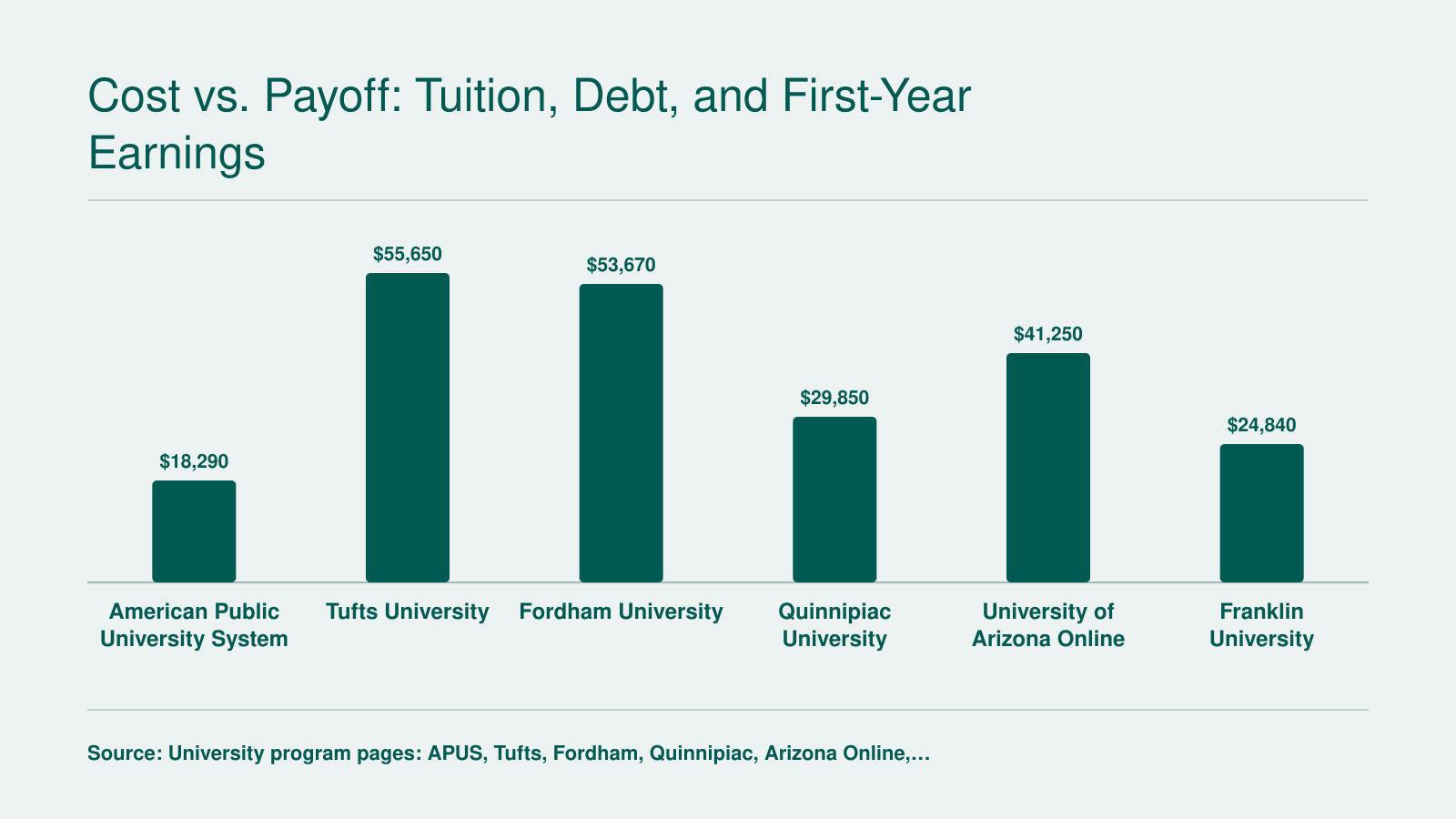
Cost vs. Payoff: Tuition, Debt, and First-Year Earnings
The chart below compares published total graduate tuition for accelerated cybersecurity master's programs that disclose a full program price, so you can see the upfront cost gap. Program-level median debt at completion and first-year earnings are not separately reported for every school in this ranking, so this visual sticks to the cost figures schools do publish. Net price is an institution-wide average, not a program quote, and shared 4+1 credits can lower the bill by reducing graduate credits.
ISC2's 2024 Cybersecurity Workforce Study put the US gap at about 504,000 unfilled positions, with the global shortfall near 4.8 million. Finishing an accelerated master's sooner means entering that stretched market a full year or more ahead.
Specializations That Line up With CISSP, Security+, and Cloud Credentials
Which cybersecurity concentration in accelerated information security and assurance programs actually helps you pass a certification exam? Sort the tracks offered by the programs here into a few families, then match each to the credential it feeds.
- Network defense and operations: Cyber Operations (Pace, ECPI) and Cyber Defense (Mississippi State) build the foundation tested on CompTIA Security+, the usual entry-level credential.
- Digital forensics: Albany's Digital Forensics concentration lines up with forensics credentials such as GCFA or EnCE.
- Cloud and AI security: Houston Christian includes cloud computing coursework, which maps most directly to CCSP. George Mason offers an AI concentration, though no standard AI-security certification exists yet.
- Governance and leadership: Pace's Cybersecurity Leadership track aligns with CISSP domains.
Know the experience rules before you plan around a credential. CISSP requires five years of paid work in at least two of its eight domains. A relevant degree can cover up to one year, and only one waiver applies. CCSP also asks for five years, though an active CISSP waives that experience requirement (the exam still applies).
UMGC says its program prepares students for CISSP and CEH, ECPI offers discounted certification exam vouchers, and URI lists industry certifications among its offerings.
Choose the concentration that fits the role you want, not the one that finishes fastest.
Cybersecurity programs by state
Accelerated Cybersecurity Master's: Your Questions Answered
How long does an accelerated master's in cybersecurity take?
Can you finish an accelerated cybersecurity master's degree entirely online?
What GPA do accelerated cybersecurity master's programs require?
How much does an accelerated cybersecurity master's degree cost in total?
Is an accelerated cybersecurity master's worth it compared with a traditional two-year degree?
When are application deadlines for bachelor's-to-master's cybersecurity pathways?
What happens to my shared credits if I leave an accelerated pathway early?
Do employers treat an accelerated cybersecurity master's differently from a traditional one?
Compare Cybersecurity programs on the data that matters
Explore more Computers & IT specializations or browse every graduate field.
All Computers & IT programs