Best Master's in Cybersecurity Programs in West Virginia
Compare 10 accredited Cybersecurity programs in West Virginia at 7 schools, with graduate earnings, cost, debt, and completion data from IPEDS and the U.S. College Scorecard.

West Virginia's cybersecurity master's options are few, and nearly all are delivered online. Per-credit pricing runs from $470 at American Public University System to $1,063 at West Virginia University's business track, so format, cost, and admissions rules decide more than name recognition.
The rankings combine campus and online programs because West Virginia schools increasingly deliver the same degree through the same channel.
Federal and defense employers in the state tend to care more about NSA-recognized training and certifications like CISSP than about the school's brand.
Key Points
- In 2027, ranked cybersecurity master's programs are online without campus residency.
- In-state graduate tuition ranges from $8,700 to $17,729 across ranked programs.
- WVU graduates report median earnings of $98,517 four years after finishing.
West Virginia's Top Cybersecurity Master's Programs, Ranked
Every program on this list earned its spot through a practical mix of cost, completion, and delivery flexibility, not name recognition. West Virginia's cybersecurity master's options range from public universities with relatively accessible tuition to fully online private providers built around working adults. The strongest choices pair a specialized security degree with hands-on certification paths and state or federal defense connections.
West Virginia University
#1Morgantown, WV · ~$11,000/yr (est.)
Best for: Business-focused online security managers
WVU brings a business-school cybersecurity master's rather than a standard technical M.S., making it a fit for students aiming at security management and CISO roles. The online program uses 8-week terms, requires no GMAT or GRE, and aligns coursework with CISSP preparation, with hands-on labs and projects. WVU Cyber also creates federal and defense connections across the state, including partnerships tied to offensive cyber operations and AI-enabled national security. The school's overall graduation rate is 65 percent.
- 30 credits required
- $1,043 per credit hour
- 8-week terms; can finish in one to two years
- No GMAT or GRE required
- Minimum 2.75 GPA
- Hands-on technical labs and cybersecurity projects
- CISSP certification preparation
- AACSB-accredited John Chambers College of Business
American Public University System
#2Charles Town, WV · $5,000 – $10,000/yr (est.)
Best for: Policy-minded online cybersecurity students
American Public University System's online Master of Science in Cybersecurity Studies takes a policy and intelligence approach, connecting cybersecurity to criminal justice, emergency management, and national security rather than just technical controls. The fully asynchronous 36-credit degree includes a capstone paper or hands-on project and monthly 8- to 16-week terms, which helps working professionals. The school's overall graduation rate is 57 percent.
- 36 credit hours; typically completed in two years
- $470 per credit
- National Center of Academic Excellence in Cyber Defense accredited
- No entrance exam; GRE and GMAT are test optional
- Rolling admissions with 12 start dates per year
- Fully online asynchronous classes
- Transfer up to 15 credits
- Capstone: research paper or hands-on project
Fairmont State University
#3Fairmont, WV · ~$10,000/yr (est.)
Best for: Risk-focused asynchronous online learners
Fairmont State University's online Master of Science in Cybersecurity and Risk Management is an asynchronous 30-hour program built around cyber intelligence, risk management, and security operations. It is offered through the College of Business and Aviation and has no application fee, with a minimum 2.75 undergraduate GPA for admission. The school's overall graduation rate is 44 percent.
- 30-credit asynchronous online program
- Focus on cyber intelligence, risk management, and security operations
- Minimum 2.75 undergraduate GPA
- No application fee
- Offered through College of Business and Aviation
- Model schedules for one- or two-year completion
Marshall University
#4Huntington, WV · $5,000 – $10,000/yr (est.)
Marshall University's fully online M.S. in Cybersecurity gives students three concentration tracks: Cyber Defense, Cyber Forensics, and Cyber Management. The 30-credit program includes core work in cyber threat intelligence and IoT security, with bridge courses available for students from other majors. Marshall's Institute for Cyber Security has a 2026 partnership with TWENTY that creates internship and applied-research pathways in offensive cyber operations and AI, and the school's overall graduation rate is 51 percent.
- 30 credit hours fully online
- Concentrations: Cyber Defense, Cyber Forensics, Cyber Management
- Core courses include cyber threat intelligence and IoT security
- Minimum 2.75 GPA in a related field
- Bridge courses available for other majors
- National Centers of Academic Excellence designation
- 2026 TWENTY partnership for offensive cyber internships and research
University of Charleston
#5Charleston, WV · $15,000 – $20,000/yr (est.)
The University of Charleston offers a compact online M.S. in Cybersecurity with three concentration paths: Cybersecurity Strategy, Cyber Intelligence, and Information Assurance. The program is built around real-world application, requires a 2.0 college GPA for general admission, and can be completed in as few as five terms. The school's overall graduation rate is 46 percent.
- Cybersecurity Strategy concentration
- Courses include Cyber Operations Management and Strategic Cyber Intelligence
- Prepares for Chief Security Officer and Security Program Management roles
- Cyber Intelligence concentration
- Focus on digital threat protection and data integrity
- CYBR 660 capstone course
- STEM OPT eligible
- Information Assurance concentration
- Emphasis on data protection and strategic security implementation
- Analyze system security demands alongside legal concepts
- Transfer up to 9 credits
Salem University
#6Salem, WV · ~$12,000/yr (est.)
Salem University's online Master of Science in Information Technology with a cybersecurity specialization is designed for working IT professionals, using a one-course-a-month schedule and a fully online format. The 30-credit program includes a capstone and aligns its security coursework with CISSP guidelines, supporting roles such as cybersecurity analyst, security engineer, security architect, or CISO. The school's overall graduation rate is 20 percent.
- 30 total credit hours; full-time completion in about 12 months
- Fully online with one-course-a-month schedule
- Cybersecurity track includes intrusion detection and prevention
- Coursework follows CISSP guidelines
- Capstone project required
- Prepares for cybersecurity analyst, engineer, architect, or CISO roles
Strayer University-West Virginia
#7Scott Depot, WV · ~$15,000/yr (est.)
Strayer University's West Virginia program offers an online Master of Science in Cybersecurity built around 45 credits and 10 courses, with 11-week terms and optional hybrid classes at select campuses. The degree covers threat detection, digital forensics, risk assessment, and system defense, and is validated by the National Security Agency. A dedicated Cybersecurity Center and one-on-one academic coaching help tie coursework to current industry trends.
- 45 total credit hours across 10 courses
- 11-week course terms
- Fully online with optional hybrid classes at select campuses
- Validated by the National Security Agency
- Dedicated Cybersecurity Center aligned to industry trends
- Transfer up to four eligible classes
- One-on-one academic coaches and career planning services
Cost & outcomes by school
Federal data for the highest-earning Cybersecurity programs, independent of the ranking above. Earnings are this field's master's graduates four years after completing, where the Scorecard reports them.
| School | Earnings | Tuition / yr | Debt | Grads/yr | Format |
|---|---|---|---|---|---|
| West Virginia University WV | $98,517 | $11,412 | $29,500 | 48 | Online |
| Marshall University WV | $66,450 | $9,510 | — | 16 | Online |
| American Public University System WV | — | $8,700 | — | — | Online |
| Fairmont State University WV | — | $10,036 | — | — | Online |
| Strayer University-West Virginia WV | — | $15,135 | — | — | Online |
| University of Charleston WV | — | $17,729 | — | 21 | Online |
| Salem University WV | — | $12,070 | — | — | Online |
Sources: U.S. Department of Education. Tuition and graduates: IPEDS. Earnings and debt: College Scorecard, this field's master's graduates; a dash means no figure is reported.
What Put These Programs on the List, and Which Hold NSA CAE Status
How do you know a West Virginia cybersecurity master's program is worth the cost before you enroll?
Start with the numbers that show up after graduation. The programs below earn placement based on graduate tuition, average net price, institution-wide graduation rate, delivery format, and College Scorecard outcomes where they are published.
Institutional accreditation is a baseline quality check. The NSA/DHS Center of Academic Excellence (CAE) designation is a separate cybersecurity-specific signal. West Virginia University currently holds CAE-CD through 2027 and CAE-R through 2029. No CAE-CO designation is listed for the state.
WVU Cybersecurity M.S. vs. Business Cybersecurity Management M.S.
West Virginia University houses two distinct cybersecurity master's degrees, and the right fit depends on whether you want to build secure systems or lead cyber risk and governance.
| Attribute | M.S. in Cybersecurity | M.S. in Business Cybersecurity Management |
|---|---|---|
| Home college | Benjamin J. Statler College of Engineering and Mineral Resources, Lane Department of Computer Science and Electrical Engineering | John Chambers College of Business and Economics |
| Delivery | Fully online; first cohort scheduled for Fall 2026 | Online, flexible and location-independent; 12–24 months |
| Total credits | 30 credits: 15 core plus 15 electives | 30 credits: 10 required courses, 3 credits each |
| Required core courses | CPE 530, CPE 553, CYBE 510, CYBE 520, CYBE 660 | CYBR 510, CYBR 515, CYBR 520, CYBR 525, CYBR 530, CYBR 535, CYBR 540, CYBR 545, CYBR 550, CYBR 555 |
| Intended background | Computer science, computer engineering, or related technical fields | Business and organizational focus; no specific prerequisite undergraduate major or technical background published |
| Typical career roles | Security engineering, systems security, defense, analysis, and research in business, industry, research, and government | Cybersecurity management, risk, compliance, governance, and security operations leadership |
Related Articles
Online and Hybrid Master's in Cybersecurity Options for West Virginia Students
Can you finish a master's degree in cybersecurity in West Virginia without setting foot on campus? Yes. Every program ranked here is delivered online, and none of their program pages identify a required on-campus residency.
Most lean asynchronous. WVU's M.S. in Cybersecurity is fully online with no required live meetings, including Zoom, though synchronous office hours are available; its Business Cybersecurity Management M.S. runs asynchronously in 8-week terms. Fairmont State describes its 30-hour program as asynchronous, and American Public University System also lists asynchronous classes. Marshall, the University of Charleston, Salem, and Strayer all publish fully online formats.
Residency matters for price, especially for the most affordable master's in cybersecurity. At the private and for-profit schools here, online students pay one rate regardless of where they live. The public universities still post higher out-of-state tuition: roughly $11,400 in-state versus $29,500 out-of-state at WVU, with similar gaps at Marshall and Fairmont State.
If you work full time, prioritize asynchronous delivery and short terms over any single prestige factor.
GRE and GMAT Policies at West Virginia Cybersecurity Master's Programs
West Virginia University's published policies set the clearest test-free entry points here. The online Business Cybersecurity Management M.S. requires no GMAT or GRE, and the Cybersecurity M.S. does not require the GRE but will consider scores if submitted.
| School | Program | GRE/GMAT Policy | Waiver Criteria or Notes |
|---|---|---|---|
| West Virginia University | Cybersecurity, M.S. | GRE is not required but may be submitted to assist in the admission decision. | A minimum cumulative GPA of 3.0 is required. Applicants with a degree in another field may be considered for provisional admission with at least one year of cybersecurity, artificial intelligence, or machine learning experience. |
| West Virginia University | Business Cybersecurity Management, M.S. (Online) | GMAT/GRE not required. | A minimum GPA of 2.75 is required; a resume or CV reflecting education and experience is also required. No separate waiver criteria are published. |
| West Virginia University | Business Cybersecurity Management, M.S. | No GRE or GMAT policy is published on the cited official catalog admissions page. | Minimum GPA is 2.75; a cumulative undergraduate GPA of 3.25 is described as competitive. Applicants must submit a resume showing prior work experience, but no work-experience minimum or test waiver criteria are published. |
What West Virginia Cybersecurity Master's Graduates Earn
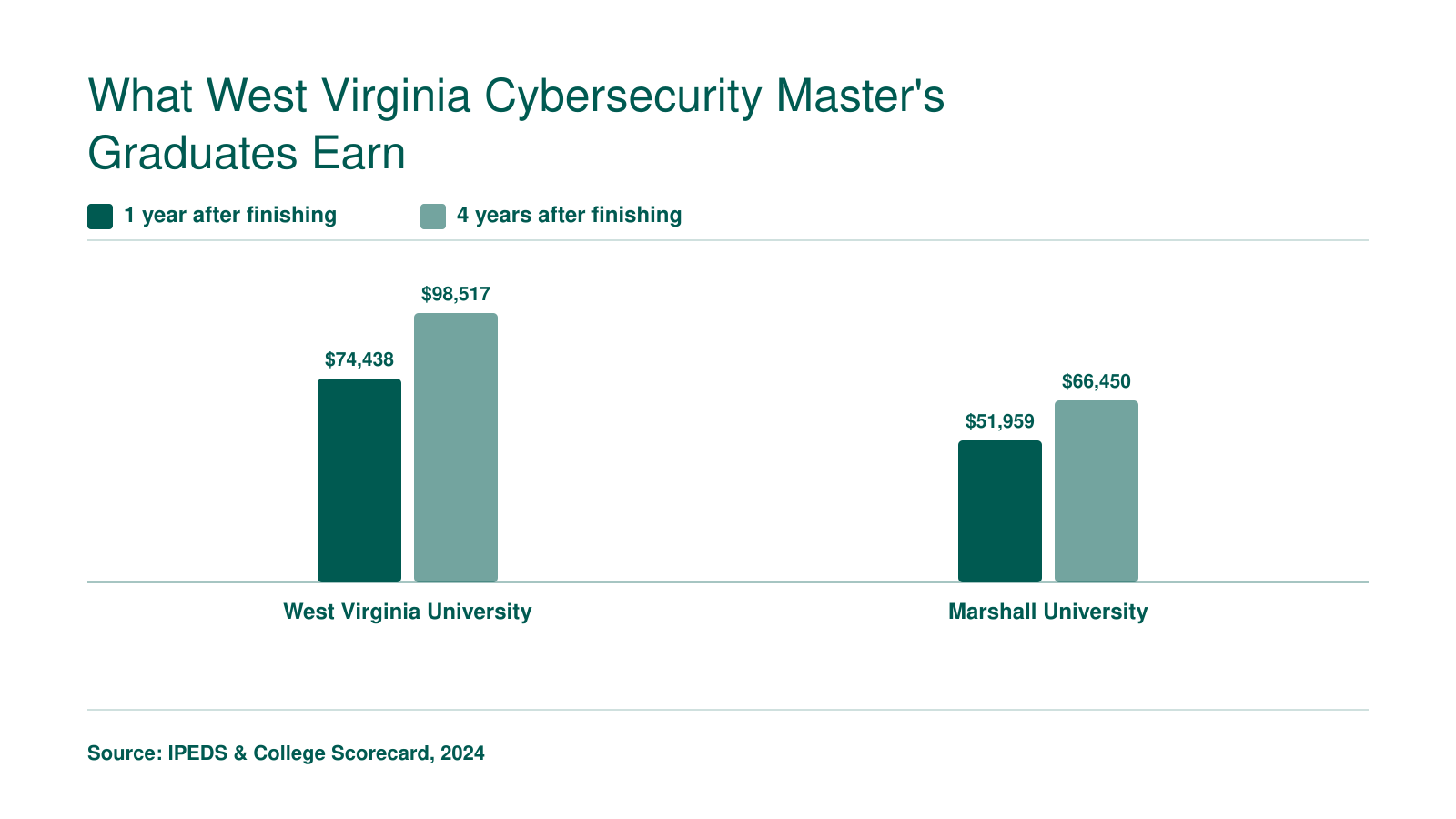
Published program-level figures show median earnings at West Virginia University and Marshall University. West Virginia University graduates report median earnings of $74,438 one year after finishing and $98,517 four years after finishing, while Marshall University reports $51,959 and $66,450 over the same periods. West Virginia University borrowers also carry a median federal debt of $29,500.
West Virginia Cybersecurity Credentialing Snapshot
Cybersecurity Master's Cost in West Virginia: Per-Credit Tuition, Aid, and Certification Value
Cybersecurity master's pricing in West Virginia now splits between flat online rates and campus fees that reset each year. Across the programs below, published graduate tuition starts at $8,700 and climbs to $17,729 for in-state students; out-of-state rates range from $8,700 to $29,538. WVU's online cybersecurity master's is $805 per credit, so the 30-credit program totals about $24,150. Its Business Cybersecurity Management M.S. is $1,063 per credit, or roughly $31,890 for 30 credits; both online paths include a $100 per-credit learning fee. On campus, WVU adds a $250 Mountaineer Athletics Advantage Fee each fall and spring. Institution-wide net price is only a rough guide: West Virginia University's is about $15,634. Financial aid varies, but American Public University System advertises employer reimbursement and military benefits. Salem's cybersecurity track and WVU's business cybersecurity track align coursework with CISSP domains, which can make the tuition spend more directly useful if you plan to sit for that exam.
Quick Answers for West Virginia Cybersecurity Grad School Applicants
Prospective students often ask the same questions before applying to West Virginia cybersecurity master's programs. These quick answers cover admission, deadlines, credit loads, and certifications, with details in the sections below.
Which West Virginia cybersecurity master's program is best overall?
Can I earn a cybersecurity master's in West Virginia without taking the GRE?
What is the lowest-cost route to an online cybersecurity master's from a West Virginia school?
When are application deadlines and start terms for West Virginia cybersecurity master's programs?
Do I need a computer science bachelor's degree to apply?
How many credits does a West Virginia cybersecurity master's require, and how long does it take part-time?
Which industry certifications pair best with a West Virginia cybersecurity master's?
Compare Cybersecurity programs on the data that matters
Explore more Computers & IT specializations or browse every graduate field.
All Computers & IT programs