Most Affordable Master's in Cybersecurity Programs
Compare 440+ accredited most affordable Cybersecurity programs at 380+ schools, with graduate earnings, cost, debt, and completion data from IPEDS and the U.S. College Scorecard.

Published tuition for a cybersecurity master's in the programs below spans roughly $3,200 at University of the Cumberlands to more than $27,000 out of state at the University of Colorado Denver. That gap can shift a student's bill by over $20,000 before mandatory fees. As with the Most Affordable MBA in Cybersecurity, affordability here weighs net price and aid, not sticker price alone.
The ranked programs are paired with per-credit cost math, quick answers on CAE status and online study, aid options, and graduate earnings. For many students, federal aid and employer tuition reimbursement lower the real cost below the published rate.
Key Points
- Multiply per-credit tuition by required credits then add every mandatory fee.
- CAE designation confirms curriculum alignment, not a guaranteed hiring edge.
- CyberCorps Scholarship for Service funds full tuition but requires federal service.
10 Most Affordable Master's in Cybersecurity Programs
These ten programs rose to the top because their published graduate tuition, fees, and aid profiles add up to the lowest realistic bill for a cybersecurity master's. We note the delivery mode and concentration for each because value looks different for an online learner than for a campus-based one.
Turtle Mountain College
#1Belcourt, ND · ~$4,000/yr (est.)
Best for: Tribal and public-sector cyber policy students
This tribal college pairs cyber law and policy with a focus on Indigenous data sovereignty, making it distinct among affordable cybersecurity master's degrees. Its online 36-credit program builds on TMC's cyber defense ladder and closes with a capstone tied to the college's Cyber Clinics. Graduate tuition and fees are $2,794 for both in-state and out-of-state students, so the price stays exceptionally low.
- 36 total credit hours
- Fully online delivery
- Capstone linked to Cyber Clinics
- NSA/DHS CAE curriculum framework
- Focus on Indigenous data sovereignty
- Prerequisite courses required
CUNY John Jay College of Criminal Justice
#2New York, NY · ~$12,000/yr (est.)
Best for: Law-enforcement digital forensics and cybercrime track
John Jay's on-campus MS in Digital Forensics & Cybersecurity is a strong value for students targeting public-sector investigations and law-enforcement careers, with evening classes and no entrance exam. The school reports 85% of students graduate with no debt, and in-state and out-of-state graduate tuition and fees are $7,470 and $15,420, respectively. Its partnerships with the NYPD, FBI, Secret Service, and National Cyber-Forensics Training Alliance give students direct exposure to real cybercrime cases.
- Evening classes Monday through Thursday
- Full-time and part-time options
- No entrance exam required
- Up to six equivalency credits for practitioners
- Internships and cooperative education
- CSIBridge certificate pathway for prerequisites
California State University-San Bernardino
#3San Bernardino, CA · ~$10,000/yr (est.)
Best for: Campus learners combining analytics and public policy
Cal State San Bernardino offers two campus-based cybersecurity master's paths: a STEM-designated MS in Cybersecurity and Analytics and an MPA with a cybersecurity concentration. The MS runs 18 months and includes penetration testing, incident handling, and network protection, while the MPA adds five cybersecurity courses to a public administration core. In-state and out-of-state graduate tuition and fees are $8,093 and $20,693, respectively, and the school holds a National Center of Academic Excellence designation.
- 18-month STEM-designated program
- Face-to-face campus delivery
- Penetration testing and incident handling
- Data analytics integration
- AACSB accreditation
- Practicum or capstone included
- Five additional cybersecurity courses
- In-person course delivery
- Core MPA curriculum required
- Scholarship for Service program available
- Optional online bootcamp for non-technical students
- Meets CNSS standards
University of the Cumberlands
#4Williamsburg, KY · ~$3,000/yr (est.)
The University of the Cumberlands keeps its master's cybersecurity programs inexpensive by charging a flat $355 per credit and offering them fully online with 8-week or 16-week courses. Graduate tuition and fees are $9,875 in state and $9,875 out of state. Both the Cyber Engineering and Information Systems Security tracks carry NSA/DHS CAE-CD designation and include CISSP alignment for working IT professionals.
- 31 credit hours required
- Fully online delivery
- 8-week or 16-week course options
- Covers network security and digital forensics
- Includes artificial intelligence
- Math or IT prerequisites required
- NSA/DHS CAE-CD designated program
- Prepares for CISSP certification exam
- Aligned with the CISSP Common Body of Knowledge
- Designed for working IT professionals
- Full-time and part-time options
- Financial aid available
Florida State University
#5Tallahassee, FL · ~$11,000/yr (est.)
Florida State's campus-based MS in Computer Science with a Cybersecurity Major requires 30 graduate-level semester hours and leads to a Cyber Security Major Certificate. It is a research-oriented path with core work in computer security, cryptography, network security, and offensive security. In-state and out-of-state graduate tuition and fees are $5,656 and $18,786, respectively, which is very competitive for a public research university.
- 30 semester hours required
- Campus-based delivery
- Cyber Security Major Certificate included
- Core courses in computer security and cryptography
- Network security and offensive security coursework
- Undergraduate prerequisites required
Columbia Southern University
#6Orange Beach, AL · ~$4,000/yr (est.)
Columbia Southern's online M.S. Cybersecurity/General keeps a flat $359 per credit with textbooks included and 11 start dates per year, which makes the schedule unusually flexible. Graduate tuition and fees are $6,760 for both in-state and out-of-state students. The program combines security risk analysis with management principles and carries SACSCOC accreditation plus military and scholarship support.
- $359 per credit hour
- Textbooks included
- 11 start dates per year
- Fully online and available 24/7
- SACSCOC accredited institution
- Military benefits accepted
- Alumni tuition discount
Marshall University
#7Huntington, WV · $5,000 – $10,000/yr (est.)
Marshall's fully online Master of Science in Cybersecurity is built around three concentrations: Cyber Defense, Cyber Forensics, and Cyber Management. The 30-credit program requires a 2.75 GPA and uses state-of-the-art tools, with bridge courses available for students from other majors. Graduate tuition and fees are $9,162 in state and $20,342 out of state, and the program holds a National Centers of Academic Excellence designation.
- 30 credit hours required
- Fully online delivery
- Concentrations in Cyber Defense, Cyber Forensics, Cyber Management
- Core courses in cyber threat intelligence and IoT security
- Admission GPA minimum of 2.75
- Bridge courses available for non-related majors
University of Nevada-Reno
#8Reno, NV · ~$7,000/yr (est.)
The University of Nevada, Reno offers an online MS in Cybersecurity with both 30-credit and 36-credit paths, plus a bridge option for students needing prerequisite work. The curriculum balances 15 technical credits with 15 leadership credits, including cryptography, digital forensics, and cybersecurity law. In-state and out-of-state graduate tuition and fees are $9,578 and $27,720, respectively.
- 30-credit and 36-credit program options
- Fully online delivery
- Bridge program available for prerequisites
- Minimum GPA of 2.75
- Technical and leadership coursework
- Two letters of recommendation required
Empire State University
#9Saratoga Springs, NY · ~$12,000/yr (est.)
Empire State University's fully online Cybersecurity MS is priced at the non-MBA tuition rate and offers a 30-credit STEM pathway or a 33-credit option with an additional IT essentials course. Students can finish in 20 to 27 months with full-time or part-time enrollment. Graduate tuition and fees are $7,648 in state and $17,558 out of state.
- 30-credit STEM pathway or 33-credit option
- Fully online delivery
- 20 to 27 month completion
- Fall and spring enrollment
- Non-MBA tuition rate
- Additional IT essentials course for career changers
University of Colorado Denver/Anschutz Medical Campus
#10Denver, CO · $5,000 – $10,000/yr (est.)
CU Denver's MS in Cybersecurity and Information Assurance is a 30-credit program offered fully online, hybrid, or in evening hybrid classes that meet once a week. Most courses run in 8-week sessions, and the curriculum carries a CAE-CD designation with a practicum or internship option. In-state and out-of-state graduate tuition and fees are $10,383 and $29,391, respectively.
- 30 total credit hours
- Fully online and hybrid evening options
- 8-week course sessions
- CAE-CD designated curriculum
- Test optional with no entrance exam required
- Design Science Practicum or internship option
Cost & outcomes by school
Federal data for the highest-earning Cybersecurity programs, independent of the ranking above. Earnings are this field's master's graduates four years after completing, where the Scorecard reports them.
| School | Earnings | Tuition / yr | Debt | Grads/yr | Format |
|---|---|---|---|---|---|
| Embry-Riddle Aeronautical University-Prescott AZ | $145,240 | $22,770 | — | 3 | Campus |
| Embry-Riddle Aeronautical University-Daytona Beach FL | $145,240 | $22,870 | — | 3 | Campus |
| Excelsior University NY | $144,427 | — | — | 60 | Online |
| University of San Diego CA | $137,533 | $31,240 | $48,077 | 39 | Hybrid |
| Champlain College VT | $134,853 | $10,710 | $35,971 | 45 | Online |
| University of Maryland Global Campus MD | $106,787 | $9,882 | $39,520 | 109 | Online |
| Nichols College MA | — | $1,200 | — | — | Online |
| Columbia Southern University AL | — | $3,936 | — | — | Online |
| Turtle Mountain College ND | — | $3,938 | — | — | Online |
| Middle Georgia State University GA | — | $4,534 | — | — | Online |
| Fort Hays State University KS | — | $4,949 | — | — | Online |
| University of the Potomac-Washington DC Campus DC | — | $5,850 | — | — | Online |
Sources: U.S. Department of Education. Tuition and graduates: IPEDS. Earnings and debt: College Scorecard, this field's master's graduates; a dash means no figure is reported.
Cost, debt & payoff
Median earnings of this field's master's graduates (4 yrs after completing) vs. their median federal loan debt · U.S. College Scorecard
Across these programs the median graduate earns about $89,165 and finishes with roughly $41,000 in debt — a ratio that clears a common rule of thumb (keep debt below first-year salary). Tuition and debt vary widely school to school, so check the per-school figures in the table above before you shortlist.
Cybersecurity Master's Tuition by Credit: What You'll Really Pay
Per-credit tuition is the fairest way to compare cybersecurity master's programs because credit requirements and fee schedules vary enough to make headline totals misleading.
Start with the math: multiply the per-credit rate by required credits, then add mandatory fees. Georgia Tech's online master's in cybersecurity charges $387 per credit for U.S. nonresidents, so 32 credits equals $12,384 before the online-learning fee of $212 per semester part-time or $531 full-time. Shenandoah University's $700 per-credit rate equals $21,000 for 30 credits, plus a $20 per-course technology and distance-services fee. American Military University lists an $85 per-course technology fee and a $350 graduation fee on top of tuition.
Fees that push the total higher
- Technology and online-learning fees: $85 per course at American Military University, $20 per course at Shenandoah.
- Per-term fees: Georgia Tech charges $212 or $531 per semester depending on enrollment.
- Lab or virtual-lab charges, books, and certification exam vouchers are often separate from published tuition totals.
Residency and prerequisites
Residency treatment varies. Georgia Tech differentiates Georgia residents ($373 per credit) from other U.S. students ($387) and international students ($406), while Longwood's Virginia and out-of-state rates are only $10 apart. American Military University's $250 to $470 per-credit range depends on military affiliation rather than state residency. Published materials do not list a fixed prerequisite bridge sequence, but students without a technical background should confirm whether preparatory courses would add credits and cost.
Related Articles
Scholarships, Assistantships, and Employer Aid That Cut Your Cybersecurity Tuition
Federal investment in cybersecurity talent has made full-ride and near-full-ride funding more attainable than many applicants realize, but the money is tied to service commitments and eligibility rules worth reading closely.
CyberCorps Scholarship for Service
The largest lever is CyberCorps Scholarship for Service. At participating schools, it can cover tuition and required fees for up to three years, plus a stipend of $37,000 per academic year for graduate students and up to $6,000 annually for approved professional expenses.1 The tradeoff is real: you agree to work in a cybersecurity role for a U.S. federal, state, local, or tribal agency, national lab, or qualifying institution for the same length of time you received funding, and a summer government internship is generally required.1 Eligibility is limited to U.S. citizens or permanent residents, and awardee schools may add their own GPA and program-length rules.2
Other Scholarships and Assistantships
The (ISC)2 Graduate Cybersecurity Scholarship is directory-reported at $1,000 to $5,000 with a stated 3.5 GPA threshold for master's students.3 WiCyS runs a security training scholarship for members who are 18 or older.4 Many cybersecurity master's programs also offer graduate assistantships that waive tuition and pay a stipend in exchange for research or teaching work.
Employer Assistance
If your employer has a qualifying Section 127 educational assistance program, the first $5,250 per calendar year of tuition or eligible loan payments is tax-free in 2025-2026.56 Stack that benefit with a low per-credit program, and your out-of-pocket cost can approach zero.
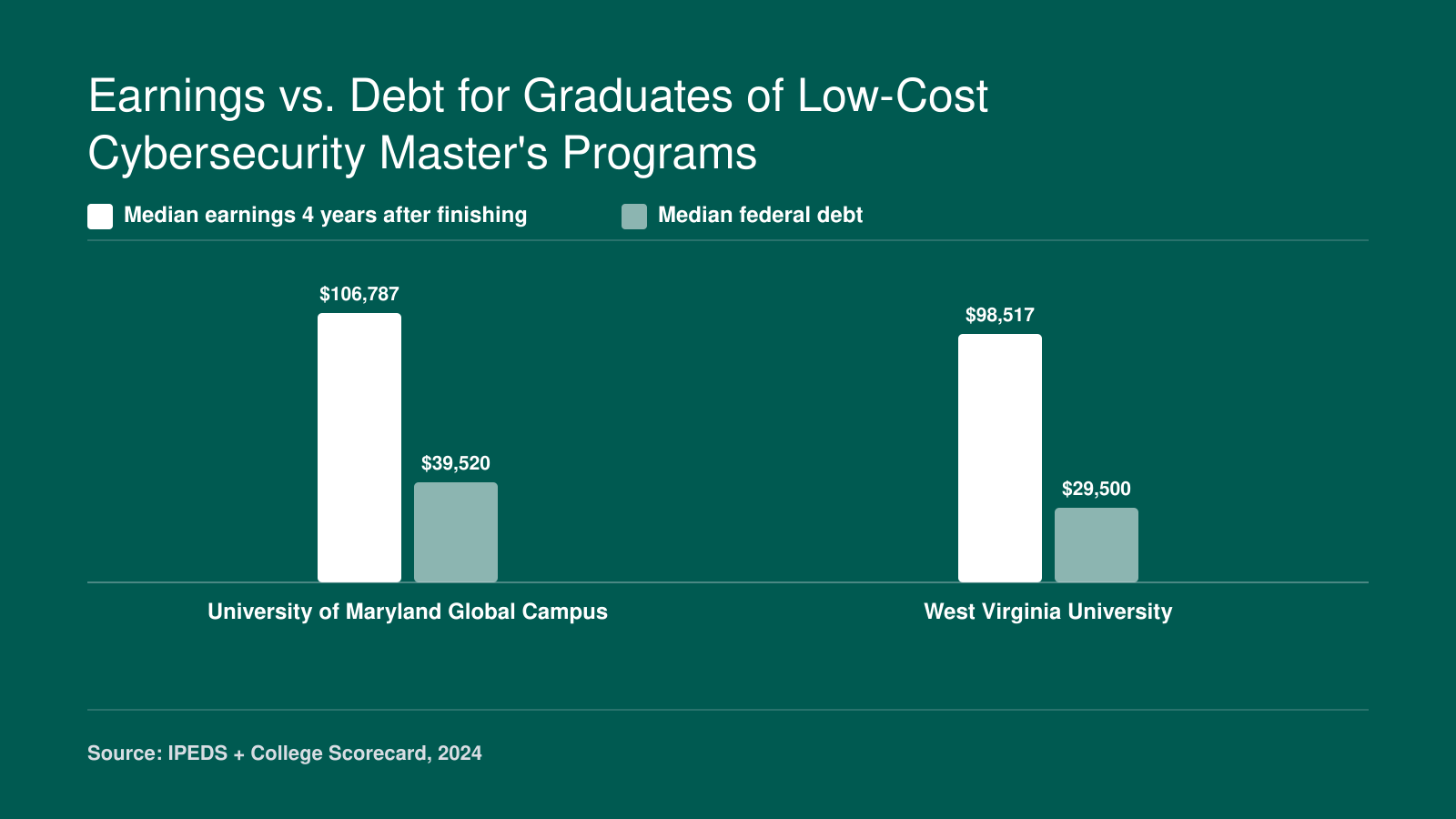
Earnings vs. Debt for Graduates of Low-Cost Cybersecurity Master's Programs
Low tuition only pays off if graduates leave with manageable debt and a real salary. This chart pairs each program's median earnings with its median federal debt, showing the gap that matters most.
Cybersecurity programs by state
Quick Answers on Cybersecurity Master's Costs, CAE Status, and Online Study
Choosing an affordable cybersecurity master's means weighing cost, delivery, and whether a program's designation actually changes your job prospects. These quick answers clarify the tradeoffs that matter most.
What does a master's in cybersecurity typically cost from start to finish?
Which online cybersecurity master's programs charge the lowest tuition?
What is the difference between CAE-CD and CAE-R designation, and does either affect hiring?
Can I finish a cybersecurity master's entirely online with no campus visits?
Will transfer credits or graduate certificates shorten the program and lower the bill?
Is a low-cost cybersecurity master's worth it compared with certifications alone?
What admission prerequisites do budget-friendly cybersecurity master's programs usually require (technical background, GPA, GRE waivers)?
Compare Cybersecurity programs on the data that matters
Explore more Computers & IT specializations or browse every graduate field.
All Computers & IT programs