Best Master's in Cybersecurity Programs in California
Compare 18 accredited Cybersecurity programs in California at 16 schools, with graduate earnings, cost, debt, and completion data from IPEDS and the U.S. College Scorecard.

A cybersecurity master's in California can be a 12-month online degree or a two-year research program at a public university, and the price gap between them is wide. CSU San Marcos lists its fully online program at $900 per unit, while USC's 28-unit degree is priced at private-university rates.
Applicants weigh campus, hybrid, and online options against each other, so this ranking treats them as one pool.
Program-level earnings data is published for very few of these degrees, so cost deserves as much scrutiny as the school's name.
Key Points
- CSU San Marcos lists its fully online cybersecurity master's at $900 per unit.
- University of San Diego is the only school with published program-level earnings.
- California has no general cybersecurity license, so employers look to certifications like CompTIA Security+.
The 10 Best Master's in Cybersecurity Programs in California for 2027
These 10 California programs cover campus, hybrid, and fully online formats, from public research universities to working-professional options. Graduation rates shown on each card describe the whole institution, not the cybersecurity program. Earnings are cited only where federal data publishes them at the program level, and each figure is tied to its time window.
University of California-Davis
#1Davis, CA · $15,000 – $20,000/yr (est.)
Best for: Aspiring researchers wanting a thesis path
UC Davis offers its cybersecurity training as an MS in Computer Science with a Computer and Information Security concentration, taught on campus with thesis, project, or exam options. Program-level federal data shows median earnings of about $65,300 one year after finishing and about $84,500 four years after, drawn from a small group of 11 completers. It suits students who want a research-oriented computer science foundation rather than a purely applied security degree.
- Concentration in Computer and Information Security
- Plan I requires 30 units; Plan II requires 36 units
- Thesis, project, or exam options to finish
- Campus-based, with research units available
- Admission requires a 3.0 GPA and three recommendation letters
- Time to degree runs 1.5 to 3 years
University of Southern California
#2Los Angeles, CA · ~$72,000/yr (est.)
Best for: International students seeking STEM OPT eligibility
USC's Viterbi School runs a 28-unit MS in Cyber Security Engineering covering secure operating systems, security policy, and cryptography. Tuition is the same whether students attend on campus or online, and the program is STEM OPT extension eligible for international students. The program reports an average graduate salary of $112,200, a self-reported figure rather than federal data.
- 28 units of coursework, no thesis option
- Covers cryptography, key management, and secure systems
- Directed research possible after the first semester
- Available online through DEN@Viterbi at the same tuition
- Fall admission only; scholarship deadline December 15
- STEM OPT extension eligible
University of San Diego
#3San Diego, CA · ~$31,000/yr (est.)
Best for: Working practitioners studying fully online
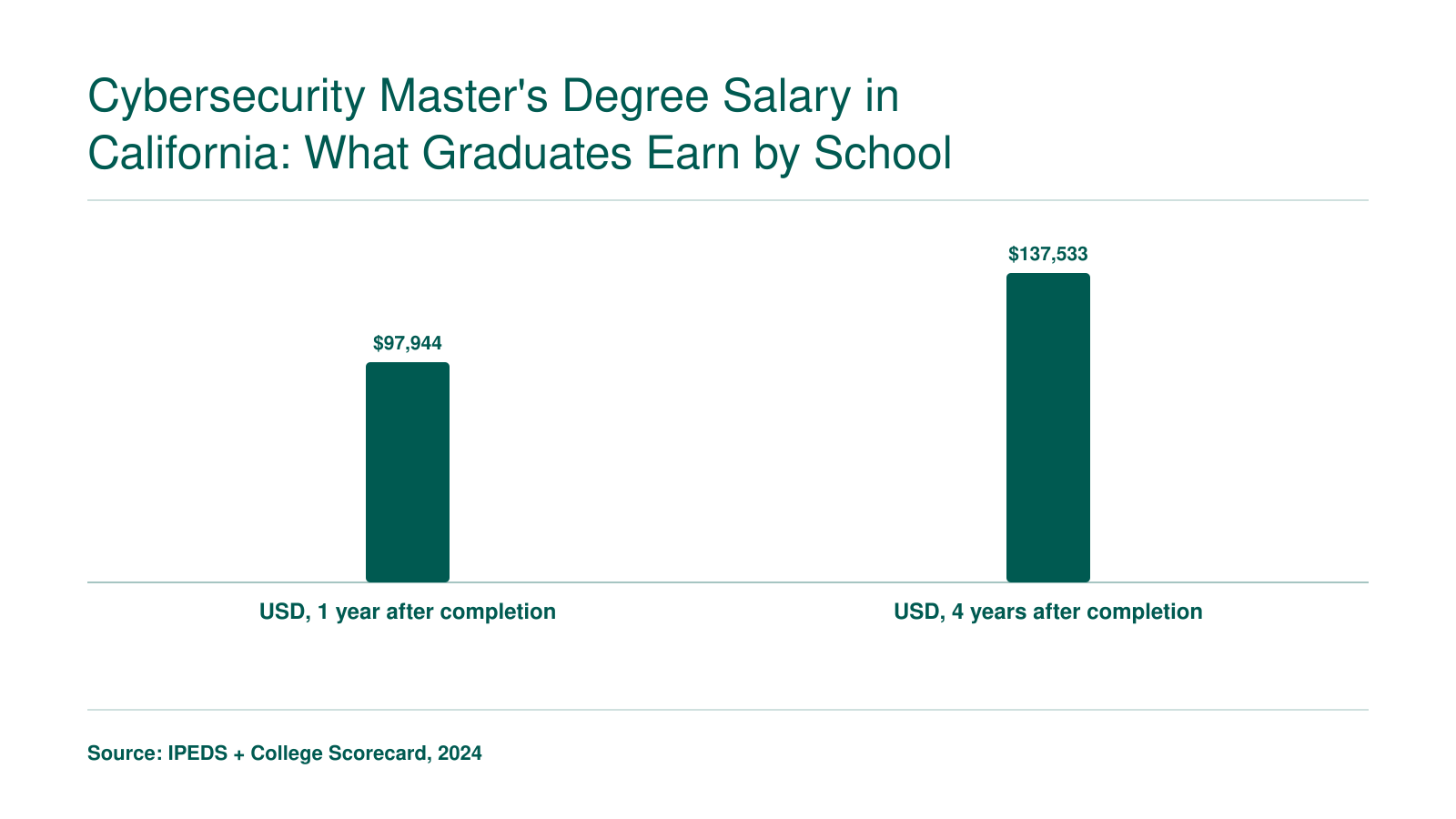
The University of San Diego offers an MS in Cyber Security Engineering that can be taken fully online or on campus, full-time or part-time. Students take one seven-week class at a time, and the curriculum is aligned with the NICE Cybersecurity Workforce Framework. Program-level federal data shows median earnings of about $97,900 one year after finishing and about $137,500 four years after, from 69 completers.
- 30 to 36 total units, completed in 18 to 24 months
- Fully online option with asynchronous classes
- One seven-week class at a time, year-round
- Curriculum aligned with the NICE framework
- Software and hardware security focus
- Priority deadline November 2; international deadline October 1
San Diego State University
#4San Diego, CA · ~$10,000/yr (est.)
San Diego State's Fowler College of Business offers an MS in Cybersecurity Management for people who will manage security risk rather than engineer systems. It is campus-based and requires 12 units of selected courses with a 3.0 minimum GPA in program courses. Research puts estimated 2025-26 cost at $2,340 per credit for California residents and $2,784 for nonresidents.
- Management-focused curriculum in the Fowler College of Business
- 12 units; students select four classes
- Courses include Fundamentals of Cybersecurity Management
- Minimum 3.0 GPA needed in program courses
- Advanced certificate option available
- Campus-based delivery
California State University-San Bernardino
#5San Bernardino, CA · ~$10,000/yr (est.)
Cal State San Bernardino pairs cybersecurity with data analytics in an 18-month, STEM-designated MS taught face to face and accredited by AACSB. It also offers a Master of Public Administration with a cybersecurity concentration for public-sector careers. Both are on campus only, and the school lists no online path for international students on F-1 visas.
- 18-month, STEM-designated program
- Courses in penetration testing, incident handling, network protection
- Practicum or capstone included
- OPT extension eligible for international students
- Face-to-face campus delivery
- Five cybersecurity courses added to the core MPA curriculum
- Cannot be earned entirely online
- Cybersecurity courses taught in person
- Scholarship for Service program available
- Partnership with National Defense University
National University
#6San Diego, CA · ~$16,000/yr (est.)
National University's MS in Cybersecurity is built for working professionals, offered online or hybrid with no application fee. Students choose from four specializations, including ethical hacking and cloud security. Program-level federal data shows median earnings of about $50,500 one year after finishing and about $66,200 four years after, from 56 completers. Research notes partnership tuition discounts, including 25% for San Diego Miramar College bachelor's graduates.
- 58.5 graduate units, finishing in about 24 months
- Online or hybrid format with flexible pacing
- Four specializations to choose from
- Faculty advisor interview before enrollment
- WASC accredited; NCAE in Cyber Defense designation
- Transfer credits accepted
- Nine foundation courses plus four specialization courses
- Focus on governance, policy, and organizational security
- Serves commercial and government organizations
- Covers vulnerability assessment and protection implementation
- Specialization requires 18 graduate units
- Four-week course structure
- No essays or exams for application
- Free tutoring and 24/7 support services
California Lutheran University
#7Thousand Oaks, CA · ~$22,000/yr (est.)
Cal Lutheran offers cybersecurity as a track within its MSIT, with evening classes on the Thousand Oaks campus for working professionals. The 36-credit program takes 12 to 24 months and requires no prior cybersecurity experience. Lab-based work covers ethical hacking, cloud security, digital forensics, and risk management.
- 36 credits across 12 courses
- Typically completed in 12 to 24 months
- Evening classes; part-time available
- No thesis or capstone required
- Four cybersecurity electives: hacking, cloud, forensics
- Hands-on penetration tests in a controlled lab
- No prior cybersecurity experience required
California State University-San Marcos
#8San Marcos, CA · ~$10,000/yr (est.)
Cal State San Marcos delivers a fully online MS in Cybersecurity as a cohort-based Professional Science Master's, blending technical instruction with MBA-level business training. Classes meet on weekday evenings, and students finish in five semesters through a real-world capstone rather than a thesis. The program carries a National Center of Academic Excellence designation.
- Fully online, cohort-based, weekday evening classes
- Complete in five semesters
- Costs $900 per unit and is eligible for financial aid
- Real-world capstone project instead of a thesis
- Professional Science Master's accredited by NPSMA
- Credit for Prior Learning option
- Admission requires a degree in computer science or a related field
Alliant International University-San Diego
#9San Diego, CA · ~$20,000/yr (est.)
Alliant International University's San Diego campus offers a cybersecurity concentration within its STEM-designated MS in Information Systems and Technology. Eight-week terms allow completion in about 12 months, with on-ground, online, or hybrid classes. Coursework covers network security, ethical hacking, cryptography, and digital forensics, with practical training from the first term.
- 33 credit hours; about 12 months to finish
- STEM-designated graduate program
- Eight-week course terms
- Weekly (evening) and Executive tracks
- Fully online option available
- Prerequisite courses required
- Prepares for industry certifications
DeVry University-California
#10Ontario, CA · ~$10,000/yr (est.)
DeVry University's online Master of Information Technology Management with a Cybersecurity and Information Assurance emphasis pairs management training with security skills. It can be finished in as few as 12 months on an accelerated schedule, or in about two years at a normal pace. Students can waive up to three courses for prior coursework and earn a graduate certificate along the way.
- 39 credit hours across 13 courses
- Accelerated schedule can finish in 12 months
- Technology management capstone required
- Graduate Certificate in Cybersecurity and Information Assurance earned along the way
- Waive up to three courses with prior coursework
- Accredited by the Higher Learning Commission
Cost & outcomes by school
Federal data for the highest-earning Cybersecurity programs, independent of the ranking above. Earnings are this field's master's graduates four years after completing, where the Scorecard reports them.
| School | Earnings | Tuition / yr | Debt | Grads/yr | Format |
|---|---|---|---|---|---|
| University of San Diego CA | $137,533 | $31,240 | $48,077 | 39 | Hybrid |
| California State University-Los Angeles CA | $92,683 | $8,688 | $17,079 | 20 | Campus |
| University of California-Davis CA | $84,479 | $15,141 | — | 16 | Campus |
| National University CA | $66,173 | $16,416 | $34,433 | 87 | Online |
| California State University-Dominguez Hills CA | — | $8,978 | — | — | Campus |
| California State University-Long Beach CA | — | $8,898 | — | — | Campus |
| California State University-Northridge CA | — | $8,982 | — | — | Campus |
| California State University-San Bernardino CA | — | $9,612 | — | — | Online or campus |
| California State University-San Marcos CA | — | $9,606 | — | — | Online |
| DeVry University-California CA | — | $9,832 | — | — | Online |
| San Jose State University CA | — | $9,934 | — | — | Campus |
| San Diego State University CA | — | $10,252 | — | — | Campus |
Sources: U.S. Department of Education. Tuition and graduates: IPEDS. Earnings and debt: College Scorecard, this field's master's graduates; a dash means no figure is reported.
Cost, debt & payoff
Median earnings of this field's master's graduates (4 yrs after completing) vs. their median federal loan debt · U.S. College Scorecard
Across these programs the median graduate earns about $75,326 and finishes with roughly $34,433 in debt — a ratio that clears a common rule of thumb (keep debt below first-year salary). Tuition and debt vary widely school to school, so check the per-school figures in the table above before you shortlist.
How We Built This Ranking of California Cybersecurity Master's Programs
A big name and a big outcome are not the same thing, so every school in these best master's in cybersecurity programs had to earn its spot on three numbers that hit your wallet: what you pay, what you borrow, and what graduates earn.
The Inputs
We started with degree-aware graduate tuition and each school's average net price, then layered in program-level earnings and debt where the federal data publishes them. Institution-wide graduation rate rounded out the picture. Two caveats matter: net price and graduation rate are campus-wide figures, not cybersecurity-specific ones, so read them as context rather than a direct measure of your program.
Why CAE Status Counts
Several schools here hold NSA/DHS National Center of Academic Excellence in Cyber Defense (CAE-CD) designations, including National University and Cal State San Marcos.1 That matters because CAE status can help with federal cybersecurity roles and CyberCorps Scholarship for Service eligibility per the Cyber Defense CAE Overview. We confirmed designations against the official list and flagged only what the record supports.
Online, Hybrid, and Accelerated One-Year Cybersecurity Master's Options in California
The best online cybersecurity master's programs in California now split between slower, working-professional schedules and compressed tracks that promise a faster finish.
CSU San Marcos and DeVry University-California are listed as online. National University offers online or hybrid study. University of San Diego and Alliant International University-San Diego are hybrid, and each also lists a fully online option. CSU San Marcos describes its classes as asynchronous and cohort-based. USD also lists asynchronous classes. None of the pages we reviewed confirm a campus residency requirement, so ask admissions before you enroll.
Can you finish in one year?
Two programs advertise 12 months: Alliant (33 credit hours, 8-week terms) and DeVry (39 credit hours, 13 courses). Treat both as the school's stated pace and confirm it before you commit. Otherwise, CSU San Marcos takes five semesters, USD runs 18 to 24 months, and National University lists 24 months.
International students
Fully online programs generally do not support F-1 visas, so campus or hybrid enrollment matters if you are considering masters programs in california for international students. Confirm visa eligibility with the school's international office.
Admissions Prerequisites for a Cybersecurity Master's in California
Requirements vary widely across the schools here. Check each program's current admissions page before you apply.
- Bachelor's degreeEvery program here expects an accredited bachelor's. USC prefers engineering or computer science. CSU San Marcos asks for a computer science degree or its equivalent.
- Minimum GPACSU San Bernardino lists 2.5 overall and 3.0 in the major. CSU San Marcos lists 2.5. UC Davis, University of San Diego, and San Diego State list 3.0.
- Technical courseworkCSU San Marcos lists MATH 270, CS 311, CS 351, and CS 370, with CS 311 finished before starting. UC Davis requires B or better in prerequisite proficiencies. Alliant requires prerequisite courses.
- Bridge options for career changersUniversity of San Diego accepts non-CS applicants and may add CYBR 505 (Computational Roots of Cyber Security). California Lutheran and CSU San Bernardino do not require prior cybersecurity experience.
- Work experienceUniversity of San Diego requires IT experience, though no formal CS background. Other schools here do not publish a minimum number of years.
- Statements and recommendationsUC Davis asks for three recommendation letters. USC requires a resume and personal statement, with a recommendation optional.
- Selectivity contextThese are institution-wide admit rates, not program rates. USC admits about 10% of applicants, UC Davis about 42%, University of San Diego about 52%, and CSU San Bernardino and CSU San Marcos above 90%.
Related Articles
Cybersecurity Master's Program Tuition, Financial Aid, and Certification in California
The table lists published institution-wide tuition and net price, sorted from lowest to highest cost, and these are not program quotes. At the low end, California State University-San Marcos lists its fully online cybersecurity master's at $900 per unit. At the high end, the University of San Diego lists $2,000 per unit for its on-campus program and $995 per unit for its online option. Total program costs are not confirmed for these programs, so check each bursar page. The public in-state versus nonresident gap matters: California State University-San Bernardino charges about $8,100 in-state and $20,700 out-of-state, and UC Davis about $16,800 and $51,000. Aid routes include general financial aid, scholarships, UC Davis teaching assistant opportunities, and employer tuition assistance. CyberCorps Scholarship for Service participation is not confirmed for these programs. Net price is an institution-wide average, not a quote.
| School | In-state tuition and fees | Out-of-state tuition and fees | Average net price |
|---|---|---|---|
| California State University-San Bernardino | $8,093 | $20,693 | $4,564 |
| California State University-San Marcos | $8,082 | $20,682 | $10,229 |
| University of California-Davis | $16,774 | $50,974 | $14,741 |
| San Diego State University | $8,728 | $21,328 | $15,364 |
| National University | $13,284 | $13,284 | $22,878 |
| Abraham Lincoln University | $10,440 | $10,440 | $28,584 |
| California Lutheran University | $52,560 | $52,560 | $30,109 |
| University of San Diego | $59,486 | $59,486 | $30,365 |
| University of Southern California | $72,097 | $72,097 | $32,740 |
| DeVry University-California | $17,408 | $17,408 | $33,744 |
California Has No Cybersecurity License, but Certifications Count
Cybersecurity Master's Degree Salary in California: What Graduates Earn by School
University of San Diego is the only school here with published program-level earnings for its cybersecurity master's, the MS in Cyber Security Engineering, so it is the only school charted. Other schools are left out rather than filled in with institution-wide figures, which would blend in graduates from unrelated fields. Against median program debt of $48,077 and a 10-year loan payment of about $547 a month, median earnings of $137,533 four years after completion suggest a strong return.
Compare Cybersecurity programs on the data that matters
Explore more Computers & IT specializations or browse every graduate field.
All Computers & IT programs