Best Master's in Finance Programs in California
Compare 31 accredited Finance programs in California, with graduate earnings, cost, debt, and completion data from IPEDS and the U.S. College Scorecard.

How much does a master's in finance cost in California? Among the Business & Management Master's Programs ranked here, annual graduate tuition runs from roughly $11,000 at the low end to about $72,000 at private institutions, a spread of more than sixfold for the same credential.
That range shapes everything. A nine-month degree at a public school and a 16-month program at a Los Angeles private school both end in the same master's, but the debt and admissions barriers differ sharply. Format and test policy vary just as widely, with some programs fully in-person and others waiving the GMAT entirely.
Most of these degrees now carry STEM designation, a detail that matters more to international applicants than any brand name.
Key Points
- Program-level graduate earnings are not yet published, so school-reported placement is the best outcome signal.
- Net price is an institution-wide average, so check each master's in finance program's own tuition.
- STEM-designated degrees give F-1 students 24 extra months of OPT beyond the standard 12.
Top 10 Master's in Finance Programs in California for 2027
This list favors programs that combine strong graduate outcomes with manageable cost and a format that fits real schedules. Tuition figures come from federal data and program pages, and graduation rates describe the whole institution, not the finance program alone.
Claremont McKenna College
#1Claremont, CA · ~$72,000/yr (est.)
Best for: Liberal arts graduates wanting small cohorts
Claremont McKenna's Master of Arts in Finance sits in the Robert Day School of Economics and Finance and centers on advanced financial markets. It is aimed at high-achieving students, including those from the Claremont Colleges and partner liberal arts schools. Graduate tuition is listed at about $72,294 a year, and the college graduates 91% of its students overall.
- Housed in the Robert Day School of Economics and Finance
- Focus on advanced financial markets
- Includes personal and professional development
- Campus-based program in Claremont
Santa Clara University
#2Santa Clara, CA · ~$32,000/yr (est.)
Best for: Working professionals needing evening classes
Santa Clara University's MS in Finance & Analytics blends core finance with Python, R, and econometrics, and every student completes a capstone or a practicum with a Silicon Valley partner. It can be taken on campus or fully online, with evening and weekend classes. Tuition is listed at $1,581 per credit across 36 credits, and the school graduates 88% of its students.
- 36 credit hours with a capstone or practicum
- Fully online option available alongside on-campus study
- On-campus track is STEM-designated
- Entrance exam required (GMAT or GRE) unless a waiver applies
- Full-time and part-time options
- Fall and spring start dates
- Evening and weekend classes
University of Southern California
#3Los Angeles, CA · ~$72,000/yr (est.)
Best for: Career changers targeting investment banking
USC Marshall's Master of Science in Finance is a 16-month, STEM-designated program with a summer internship term and electives in hedge funds, real estate finance, and fintech. It is a cohort program in Los Angeles. Graduate tuition is listed at about $69,904 a year, and USC graduates 92% of its students.
- 16-month cohort program starting each fall
- 36 credit hours
- STEM OPT eligibility for international students
- Summer internship term
- Electives in hedge funds, real estate finance, and fintech
Lincoln University
#4Oakland, CA · ~$11,000/yr (est.)
Lincoln University's Master of Science in Finance Management in Oakland is built around financial analysis, planning, and forecasting for management-level roles. It is one of the lowest-priced options here, with graduate tuition listed at about $10,710 a year. Transfer credit rules are flexible for students with prior graduate work.
- 36 units: 16 core and 20 concentration
- Transfer up to 9 graduate units from other institutions or work experience
- Up to 18 units from another Lincoln graduate program
- Covers issues facing multinational firms
- Campus-based in Oakland
University of San Diego
#5San Diego, CA · ~$31,000/yr (est.)
The University of San Diego's STEM-designated MS in Finance runs 10 months and follows the CFA curriculum, preparing students for the first two exam levels. The Finance Lab offers 48 Bloomberg Terminals, and students can connect with the local CFA Society. Total program tuition is listed at $59,070, and the university graduates 84% of its students.
- 10-month on-campus program starting each fall
- STEM-designated
- Prepares for CFA Levels I and II
- 48 Bloomberg Terminal workstations
- Study abroad opportunities
- Military benefits accepted
San Jose State University
#6San Jose, CA · ~$10,000/yr (est.)
San Jose State's new Master of Science in Finance, with a corporate finance concentration, is a campus-based public option in Silicon Valley. Curriculum details are still emerging, so check the department page before applying. Graduate tuition is listed at about $7,608 a year for California residents and $17,688 for nonresidents.
- New program in the Department of Accounting and Finance
- Corporate finance concentration
- Campus-based in San Jose
- Public tuition rates differ for residents and nonresidents
University of California-Riverside
#7Riverside, CA · ~$15,000/yr (est.)
UC Riverside's Master of Finance takes nine months full time and covers more than 70% of CFA exam material, with Wiley CFA Level I prep built in. Students can help run the Hylander Student Investment Fund with real dollars. Program tuition is about $80,208 before annual adjustment, and California applicants receive an automatic discount.
- 9 months full time, flexible path up to 15 months
- 48 units including two capstone seminars
- STEM-designated
- GMAT and GRE scores are optional
- Bloomberg Terminal access and a real-dollar student fund
- Scholarships available
San Diego State University
#8San Diego, CA · ~$10,000/yr (est.)
San Diego State's STEM-designated MS in Finance is offered through the Fowler College of Business and is structured to meet CFA exam education requirements. Students finish with a thesis or comprehensive exam and can add electives in business analytics. Graduate tuition is listed at about $7,608 a year for residents and $17,688 for nonresidents.
- STEM-designated graduate degree
- Structured to prepare for the CFA exam
- Thesis or comprehensive exam option
- Electives in business analytics and big data
- Campus-based in San Diego
University of San Francisco
#9San Francisco, CA · ~$30,000/yr (est.)
The University of San Francisco's MS in Financial Analysis is a quantitative, STEM-certified program that follows the CFA Institute's body of knowledge and is taught partly by working charter holders. It comes as an 18-month full-time track or a part-time hybrid that meets monthly. The university graduates 70% of its students.
- 35 credit hours, no thesis or capstone required
- Full-time and part-time hybrid formats
- STEM-certified
- CFA Institute University Affiliate since 2006
- Covers equity valuation, fixed income, and derivatives
Pepperdine University
#10Malibu, CA · $40,000 – $45,000/yr (est.)
Pepperdine's Graziadio MS in Applied Finance runs 12 to 15 months on the Malibu campus, with specializations in financial management or investments and coursework that includes AI and machine learning. GMAT and GRE scores are not required. Graduate tuition is listed at about $43,400 a year.
- 12 to 15 months, fall start
- No GMAT or GRE required, test optional
- STEM-designated with a 24-month OPT extension for F-1 students
- Two concentrations: financial management or investments
- Bloomberg terminal access
- 20% tuition discount for Seaver graduates
Cost & outcomes by school
Federal data for the highest-earning Finance programs, independent of the ranking above. Earnings are this field's master's graduates four years after completing, where the Scorecard reports them.
| School | Earnings | Tuition / yr | Debt | Grads/yr | Format |
|---|---|---|---|---|---|
| San Diego State University CA | $110,830 | $10,252 | — | — | Campus |
| Golden Gate University CA | $107,694 | $17,070 | $41,941 | 17 | Online |
| Abraham Lincoln University CA | — | $8,160 | — | — | Online |
| California State University-Los Angeles CA | — | $8,688 | — | — | Campus |
| California State University-Fullerton CA | — | $8,994 | — | — | Campus |
| California State University-Long Beach CA | — | $8,898 | — | — | Campus |
| California State Polytechnic University-Pomona CA | — | $9,305 | — | — | Hybrid |
| California State University-Sacramento CA | — | $9,542 | — | — | Hybrid |
| San Jose State University CA | — | $9,934 | — | — | Campus |
| DeVry University-California CA | — | $9,832 | — | — | Online |
| University of California-Los Angeles CA | — | $14,476 | — | — | Campus |
| University of California-Irvine CA | — | $14,827 | — | — | Campus |
Sources: U.S. Department of Education. Tuition and graduates: IPEDS. Earnings and debt: College Scorecard, this field's master's graduates; a dash means no figure is reported.
Master's in Finance Tuition in California and Certification Paths
The table shows graduate tuition and fees alongside net price from federal IPEDS and College Scorecard data. Net price is an institution-wide average, not a quote for any single master's in finance program. Among the schools here, Sacramento State is the one that publishes a total program cost in the material we reviewed: $30,550 for its 30-credit program at $975 per credit. Private programs often price per program rather than per year, so compare total cost rather than annual tuition. No California state license is required to work in finance. The relevant credentials are the CFA charter from CFA Institute (three exam levels plus 4,000 hours of experience over at least 36 months), FINRA exams such as the SIE and Series 7, and the CPA through the California Board of Accountancy for accounting-adjacent paths. The CPA currently requires 150 semester units. From January 1, 2027, a new pathway replaces that with a bachelor's degree plus 24 accounting, 24 business, and 3 ethics units. Cal State Los Angeles is the most affordable option here on graduate tuition, at $8,688 in-state and $18,768 out-of-state.
| School | Format | Graduate tuition, in-state | Graduate tuition, out-of-state | Net price (institution-wide average) |
|---|---|---|---|---|
| California State University-Los Angeles | Campus | $8,688 | $18,768 | $3,967 |
| California State University-San Bernardino | Campus | $9,612 | $19,692 | $4,564 |
| California State University-Fullerton | Campus | $8,994 | $19,074 | $6,555 |
| California State University-Sacramento | Hybrid | $9,542 | $19,622 | $9,338 |
| California State University-Long Beach | Campus | $8,898 | $18,978 | $10,440 |
| California State Polytechnic University-Pomona | Hybrid | $9,305 | $19,385 | $11,531 |
| University of California-San Diego | Campus | $15,097 | $30,199 | $12,470 |
| University of California-Los Angeles | Campus | $14,476 | $29,578 | $12,548 |
| University of California-Berkeley | Campus | $15,866 | $30,968 | $13,481 |
| San Jose State University | Campus | $9,934 | $20,014 | $13,760 |
Salary Outcomes for California Master's in Finance Graduates
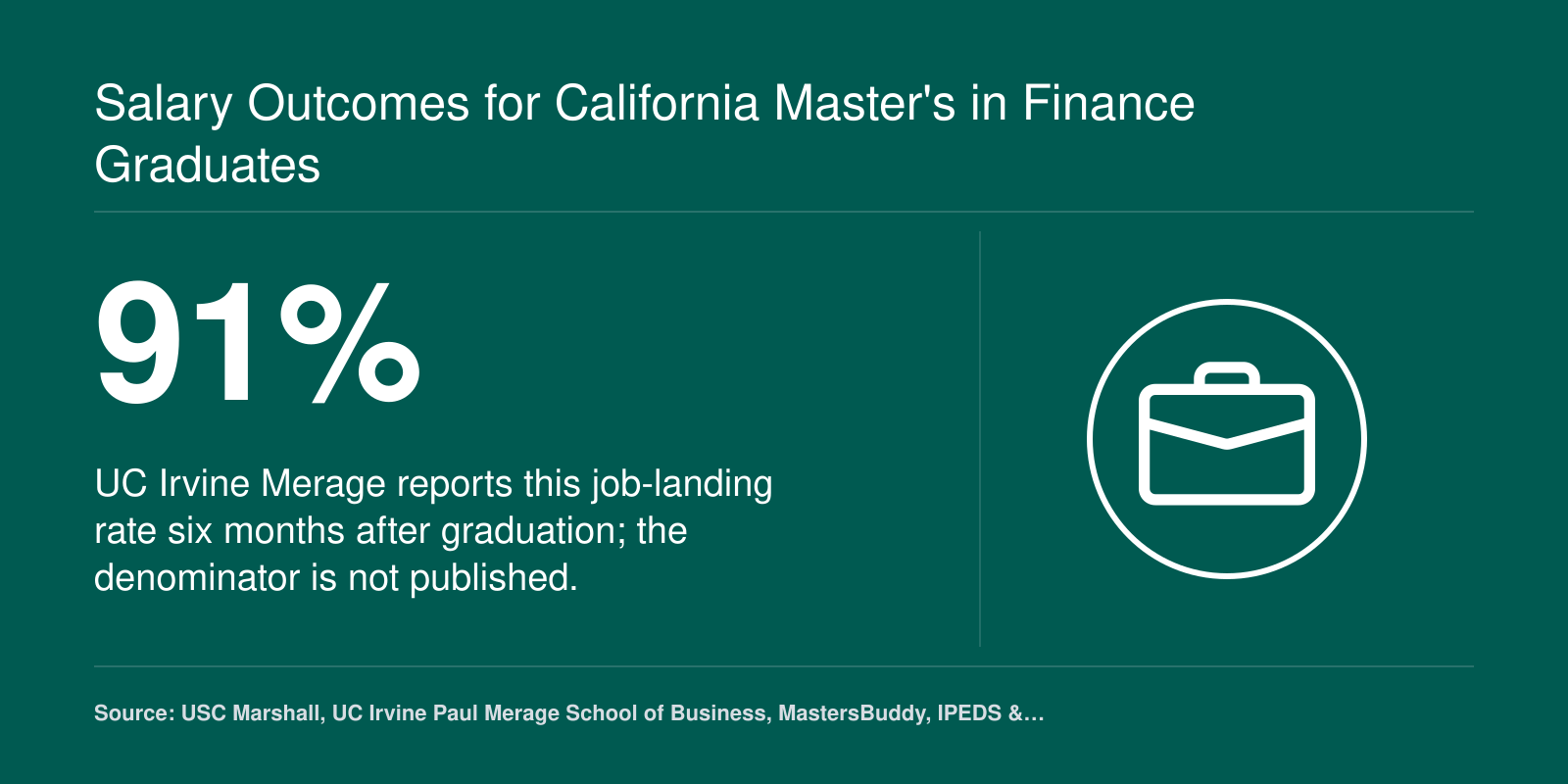
Program-level median earnings for the California finance master's programs here are not yet published in College Scorecard, so we are not charting salaries and will not substitute institution-wide figures. School-reported placement is the best signal available. USC Marshall reports 87% of Fall 2024 graduates employed. A secondary source puts UC San Diego at 85% or more within six months, with an average of roughly $80,000-$100,000 (an approximate average, not a median). These rates are not directly comparable: schools often exclude students not seeking work and rarely publish the denominator, while Scorecard measures outcomes for federal-aid recipients. Ask each admissions office for its denominator, response rate, and median salary.
Related Articles
Online and Hybrid Master's in Finance Options in California
Most California master's in finance programs remain built around full-time, in-person cohorts, and online masters programs in California are concentrated in just a few schools. USC, the University of San Diego and Pepperdine are on-campus or in-person, and the others here, including Claremont McKenna, San Jose State, UC Riverside, San Diego State and Lincoln University, are listed as campus programs.
Santa Clara is the clearest option for working professionals. Its MS in Finance and Analytics offers both campus and fully online delivery, with asynchronous classes, evening and weekend scheduling, and two start dates a year (fall and spring). Students must attend a residency at the start of the program. Whether online and campus tuition differ is not published, so confirm with admissions.
The University of San Francisco lists its Financial Analysis degree as hybrid, with full-time and part-time options. The program page does not spell out how much of it meets in person, so ask before planning around a full-time job.
Which Ranked California Master's in Finance Programs Waive the GMAT or GRE
Several programs below have moved away from mandatory testing, a shift seen across many no-GRE master's programs, but the details differ enough that you should confirm each policy on the school's own admissions page before you commit.
- USC Marshall: The GMAT and GRE are optional, so there is no separate waiver to request. Applicants are expected to hold at least a 3.0 cumulative GPA, and the next cycle's deadline is November 1, 2026.
- UC San Diego Rady: A GMAT or GRE score is required, but waiver consideration is available if you meet the stated criteria, including a minimum 3.00 undergraduate GPA.1 Below-3.00 requests are reviewed only in exceptional cases, and meeting the GPA floor alone does not guarantee approval.
- Pepperdine: No entrance exam is required, and no separate waiver process is published. Its Fall 2025 class spanned ages 20 to 52, was 41% female, and averaged about one year of work experience.2
- Golden Gate University: Neither test is required. Work experience is preferred rather than mandatory, with many students bringing one to three years.3
- CSU Fullerton: Test-optional. You can apply without a score by demonstrating quantitative ability through coursework or relevant professional experience, though a score is strongly recommended if your GPA falls below 3.0.
Sticker price tells you what a master's in finance costs. Program-level earnings tell you whether it pays off. Compare the two before a famous name makes the decision for you.
STEM Designation and CFA Alignment at California Finance Master's Programs
A STEM-designated degree lets F-1 international students extend post-graduation OPT by 24 months beyond the standard 12. Several schools here advertise that status: Santa Clara University, the University of San Diego, UC Riverside, San Diego State University, the University of San Francisco, and Pepperdine University (which cites the 24-month extension directly). USC lists STEM OPT eligibility. Confirm the program's CIP code with each school's international office before relying on it.
On the CFA side, the University of San Francisco says it has been a CFA Institute University Affiliate since 2006 and covers most of the exam body of knowledge. UC Riverside cites over 70% of CFA material plus Level I prep, and the University of San Diego prepares students for Levels I and II. San Diego State and Pepperdine describe CFA preparation without specifics.
None of these schools publishes a CFA pass rate in the material reviewed, so treat "prepares for the CFA" as curriculum alignment, not a result. Lengths run from 9 months at Santa Clara and UC Riverside to 16 months at USC and two years at San Francisco.
Questions About Master's in Finance Programs in California
These answers draw on published admissions pages and the outcome data collected for this page. Deadlines and policies change, so confirm each detail with the school before you apply.
Which California finance master's program offers the best overall value?
Are reported employment figures based on the full graduating class?
When are application deadlines for Fall 2027 entry at ranked California programs?
Can international students work in the U.S. after a STEM-designated finance master's?
Compare Finance programs on the data that matters
Explore more Business & Management specializations or browse every graduate field.
All Business & Management programs