Master's Programs in New York
Every master's program reported by a school in New York: 2,400+ programs at 120+ graduate schools, with the online options, costs and outcomes behind each one.

Private or public: the same master's in New York can cost four to six times more per credit at a private university than at CUNY in-state. Columbia, NYU, and Cornell run some of the country's most selective and expensive programs. Meanwhile, CUNY and SUNY teach many of the same fields for far less, and more programs now run fully online or hybrid.
Tuition is only one variable. Graduate earnings, borrowing, licensure rules, visa limits for international students, and New York City versus upstate living costs all shift the math.
Program-level federal earnings data remains patchy, so net price and expected debt often reveal more about value than a famous name.
Key Points
- Private per-credit rates run roughly four to six times CUNY's in-state rate.
- No reliable program-level ranking by earnings and debt exists, so verify each program.
- Online master's programs rarely skip in-person work, and F-1 visas generally require on-campus study.
Popular degrees in New York
Master's programs in New York by field
Business & Management
- Management94 programs
- Marketing76 programs
- Accounting72 programs
- Analytics66 programs
- Finance63 programs
- Healthcare Administration60 programs
- Healthcare Management54 programs
- General Business32 programs
Education & Teaching
- Special Education98 programs
- Teaching77 programs
- Reading & Literacy56 programs
- Early Childhood Education43 programs
- STEM Education or Science Education or Mathematics Education39 programs
- Secondary Education36 programs
- Elementary Education27 programs
- Library Science or Library and Information Science or Library Media24 programs
Nursing
- Nursing Education or Nurse Educator35 programs
- Family Nurse Practitioner (FNP)28 programs
- Psychiatric Mental Health Nurse Practitioner21 programs
- Nurse Administrator17 programs
- Adult Gerontology Primary Care Nurse Practitioner13 programs
- Pediatric Nurse Practitioner10 programs
- Adult Gerontology Acute Care Nurse Practitioner7 programs
- Health/Nursing Informatics7 programs
Healthcare
- Speech Pathology39 programs
- Public Health35 programs
- Health Administration32 programs
- Health Informatics18 programs
- Nutrition14 programs
- Health Education12 programs
- Exercise Science8 programs
- Clinical Research Management1 program
Communications & Media
- Speech Pathology45 programs
- Communication30 programs
- Communication Disorders30 programs
- Journalism15 programs
- Public Relations8 programs
- Strategic Communication7 programs
- Media Communication6 programs
- Health Communication3 programs
Psychology
- Educational Psychology or School Psychology28 programs
- General Psychology21 programs
- School Psychology20 programs
- Applied Behavior Analysis16 programs
- Counseling Psychology10 programs
- Industrial Organizational Psychology9 programs
- Forensic Psychology4 programs
- Developmental Psychology4 programs
Social Work & Social Sciences
- Social Work51 programs
- Social Work Advanced Standing26 programs
- Sociology25 programs
- Political Science, Government11 programs
- Human Services5 programs
Computers & IT
- Data Analytics32 programs
- Cybersecurity31 programs
- Machine Learning18 programs
- Information Security & Assurance12 programs
Counseling
- Clinical Mental Health Counseling40 programs
- School Counseling29 programs
- Marriage and Family Therapy or Marriage and Family Counseling15 programs
- Addiction Counseling1 program
Arts & Design
- Creative Writing48 programs
- Fine Arts20 programs
- Interior Design4 programs
Science & Engineering
- Environmental Science31 programs
- Sustainability or Environmental Management31 programs
- Geography9 programs
Criminal Justice & Law
- Public Policy15 programs
- Master of Laws14 programs
- Legal Studies6 programs
- Homeland Security6 programs
- Business Law2 programs
- Cybercrime1 program
- Fire Science or Fire Administration or Fire Leadership1 program
Religion & Theology
- Divinity8 programs
- Theology8 programs
- Christian Leadership4 programs
- Christian Ministry3 programs
How Much Does a Master's Program Cost in New York? CUNY, SUNY, and Private Tuition Compared
All figures below are for the 2026-2027 academic year and come from each school's bursar or tuition page. Private per-credit rates in this table run roughly four to six times the CUNY in-state rate, and program-specific pricing such as NYU Tisch or Cornell's professional master's degrees can climb well above general graduate rates. Mandatory fees are charged on top of tuition at every school, so treat these totals as a floor, not a final bill. Private schools list one standard rate, so out-of-state is marked N/A for them.
| School | Sector | In-State / Standard Per-Credit Tuition | Out-of-State Per-Credit Tuition | Typical Credits | Estimated Total Tuition |
|---|---|---|---|---|---|
| Baruch College (CUNY) | Public (CUNY) | $470 | $855 | N/A | N/A |
| Brooklyn College (CUNY) | Public (CUNY) | $470 | $855 | N/A | N/A |
| NYU Steinhardt | Private | $2,363 | N/A | N/A | N/A |
| NYU School of Professional Studies | Private | $2,896 | N/A | 10-12 per fall or spring term | $28,664 |
| Syracuse University (Main Campus Graduate) | Private | $2,086 | N/A | 18 | $37,548 |
| Cornell University (Professional and Select Master's Degrees) | Private | N/A | N/A | N/A | $73,946 per year |
| Cornell University (MFA in Creative Visual Arts) | Private | N/A | N/A | N/A | $32,450 per year |
| NYU Tisch School of the Arts | Private | N/A | N/A | 12-18 | $82,900 |
The Cheapest Ways to Earn a Master's in New York, Including Scholarships at NYU and Columbia
Sticker price in New York is increasingly a starting point, because funding at the school or program level often decides what a master's really costs.
Public Options and the Residency Rule
The lowest-cost route is usually a CUNY or SUNY program at the in-state rate. We could not verify a campus-by-campus ranking of graduate rates, so compare each campus's published per-credit tuition before you commit. To qualify as a resident, you generally need to be a legal New York resident for 12 continuous months. CUNY's published rules treat this as the common basis for resident tuition, though exceptions exist. Confirm SUNY's specific requirements with the campus.
Funded Routes That Cut Net Price Sharply
Assistantships are the closest thing to a free master's. The CUNY Graduate Center offers graduate assistantships that cover in-state tuition within a student's first 10 registered semesters. Terms are not identical across every CUNY campus, so ask the department. Columbia's Teachers College and Engineering also offer assistantships and fellowships,1 though Engineering's Dean's MS Academic Excellence Fellowship is partial tuition, per its Graduate Funding Opportunities.
NYU and Columbia: Real Aid, but Mostly Partial
Most private-school master's aid is school-specific and partial. Plan on reducing the bill, not erasing it.
- NYU SPS (2026): Distinguished Scholars awards run $7,000 to $11,000, Guaranteed Admission merit awards $8,000 to $11,000, and Dean's Scholars (for already-enrolled NYU students) $10,000. New applications reopen for Spring 2027.
- NYU Stern: Aid varies by program. Qualified Master in Management students can become teaching or graduate fellows after 9 credits, with up to $8,000 tuition remission per semester, according to NYU Stern's Online MS in Management Scholarships and Fellowships. MS Business Analytics and AI offers partial Dean's Scholarships.2
- Columbia SPS: Merit fellowships reportedly range from $1,000 to $20,000 and are considered automatically for admitted M.S. and M.P.S. students.3
- Columbia GSAPP: Merit scholarships are awarded at admission, with a separate, limited process for continuing students.4
NYU generally considers admitted applicants for merit aid without a separate application, but check each school's rules.5
Filling the Gap
Ask your employer about tuition assistance before you borrow, since some programs have no-extra-paperwork structures for sponsored students. Then use federal loans for what remains. Federal graduate borrowing limits have changed recently, so confirm current unsubsidized caps and whether Grad PLUS is available to you before relying on either.
Best Master's Programs in New York by Graduate Earnings and Debt
No reliable, apples-to-apples ranking of New York master's programs by earnings and debt exists today, and any list claiming otherwise is guessing. The federal data is real, but it is patchy at the program level. Stony Brook's master's in computer science shows 246 graduates in College Scorecard, yet median earnings, national comparison earnings, and median federal debt all read "Data Not Available."1 That is a large public program with no published outcome figures, and the same gap can appear for NYU, Columbia, Cornell, Baruch, Hunter, and Buffalo.
The reasons are structural. According to the College Scorecard Data Glossary, Scorecard covers only federal-aid recipients who completed the award, were working, and were not enrolled, and it suppresses results when graduate counts are too small to protect privacy. It sorts programs by four-digit CIP code, so MBA programs or "social work" may map to several related fields. Earnings are measured years after completion, and the measurement window has changed across releases, so figures from different cohorts are not interchangeable, as noted in the College Scorecard Data Changelog. Federal debt also leaves out private loans.
Find the Numbers Yourself
- Step 1: Open College Scorecard (collegescorecard.ed.gov), search the school, and open its field-of-study listings. Filter to master's level.
- Step 2: Note the program, graduate count, median earnings, and median federal debt. Check which cohort and measurement period the figures use.
- Step 3: Use the compare tool to put two or three schools side by side for the same field.
- Step 4: Check BLS.gov (Occupational Employment and Wage Statistics and the Occupational Outlook Handbook) for the New York wage of the job you want, not just the degree.
If a program shows no data, move to the school itself. Search phrases like "NYU MBA employment report," "Columbia Business School career report," or "[school] social work graduate outcomes." Many business and professional schools publish their own salary and placement reports.
Professional Associations Worth Checking
- MBA: GMAC surveys of graduating students and corporate recruiters.
- Computer science: ACM salary and workforce reports.
- Nursing: ANA workforce and pay resources.
- Social work: NASW workforce studies.
- Education: AACTE reports on teacher preparation and the workforce.
- Accounting: AICPA data on hiring and pay.
Ask Admissions Directly
Email the program office and ask for specific numbers:
- What was the median starting salary for the last graduating class, and what share responded?
- What percentage were employed in field within six months?
- What was the median federal and private debt at graduation?
- Does the figure include graduates on part-time or employer-sponsored tracks?
A program that will not answer is telling you something.
Run a Debt-to-Earnings Check
Divide total expected debt by expected first-year earnings. Under 0.5 is generally manageable. Approaching 1.0 means a heavy repayment burden. Build the debt figure from tuition, fees, and living costs minus aid, and use the lower of the school's reported earnings and the BLS median for your target role.
Fully Online and Hybrid Master's Programs in New York
Yes, fully online master's programs exist in New York, but "online" rarely means no in-person requirements. Online MSW, nursing, and counseling programs still require supervised in-person field placements, and some private online programs charge per-credit rates as high as on-campus tuition, so compare cost before assuming savings. The table below lists Syracuse University programs with verified 2026 details. Check SUNY Online, CUNY, Columbia, NYU, Fordham, and Pace directly for current format and pricing. If you live outside New York and are pursuing a licensure-track program, confirm the school is authorized to serve students in your state before you enroll.
| School | Program | Format | Residency / Campus Requirement | Delivery Style | Per-Credit Tuition |
|---|---|---|---|---|---|
| Syracuse University (Whitman) | Online MBA | Online with required residencies | Three in-person residencies; locations may be on campus, in other U.S. cities, or international | Asynchronous, self-paced weekly coursework | $2,086 (2026-27) |
| Syracuse University (Whitman) | M.S. in Professional Accounting Online | Online | None stated | N/A | $2,086 (2026-27) |
| Syracuse University (Whitman) | M.S. in Business Analytics Online | Online | None stated | N/A | $2,086 (2026-27) |
| Syracuse University (Whitman) | M.S. in Entrepreneurship Online | Online | None stated | N/A | $2,086 (2026-27) |
| Syracuse University (Whitman) | M.S. in Supply Chain Management Online | Online | None stated | N/A | $2,086 (2026-27) |
| Syracuse University | M.P.S. in Project Management | N/A | N/A | N/A | $2,086 (Summer 2026 to Spring 2027) |
| Syracuse University | Online Master of Social Work (MSW) | Fully online coursework with in-person fieldwork | No campus residency stated; supervised in-person fieldwork placements required in your local community | Synchronous: live weekly Zoom sessions plus self-paced coursework | $1,226 |
| Syracuse University (iSchool) | Online Information Systems for Executives Master's Degree | Flexible online | None stated | Mix of asynchronous online modules and scheduled live sessions in evening or non-traditional hours | N/A |
| Syracuse University (College of Engineering and Computer Science) | Online master's programs (30 credits each) | Online | None stated | N/A | $2,015 (2025-26), plus one-time $100 technology fee |
Admissions Requirements: GRE Waivers, Prerequisites, and What New York Schools Ask For
Admissions rules in New York are set by each program, not by the university. Confirm every requirement on the exact program's admissions page before you apply.
- Bachelor's degreeMost programs expect a degree from an accredited institution, and some fields want a related major.
- Minimum GPAA 3.0 is a common benchmark, but it varies. Columbia Engineering lists no general minimum, while Columbia's Computer Engineering MS expects at least a 3.2 in technical coursework.
- TranscriptsSubmit records from every college you attended, and expect official copies if you are admitted.
- Statement of purposeExplain your goals and why this program fits them, with specifics about the curriculum.
- RecommendationsPrograms typically ask for academic or professional references who can speak to your readiness.
- ResumeHighlight relevant work, research, or projects. Some programs weigh experience heavily.
- GRE/GMAT: requiredColumbia Business School's MS programs require the GMAT or GRE and offer no waivers. Scores are self-reported at first and stay valid for five years. Columbia's Computer Engineering MS requires the GRE General Test.
- GRE/GMAT: optionalColumbia Engineering did not require the GRE overall for the 2025 cycle. Columbia GSAPP makes tests optional for some master's programs, though applicants without a strong analytical or finance background are encouraged to submit one.
- NYU, Cornell, CUNY, SUNYTesting and waiver policies differ by program, and we could not confirm 2026 rules for them. Check each program page, including NYU Stern's.
- Field prerequisitesNursing (MSN) programs generally require an RN license, and data science programs often expect statistics or programming coursework. Some education master's degrees require a teaching certification. Confirm the details with each program.
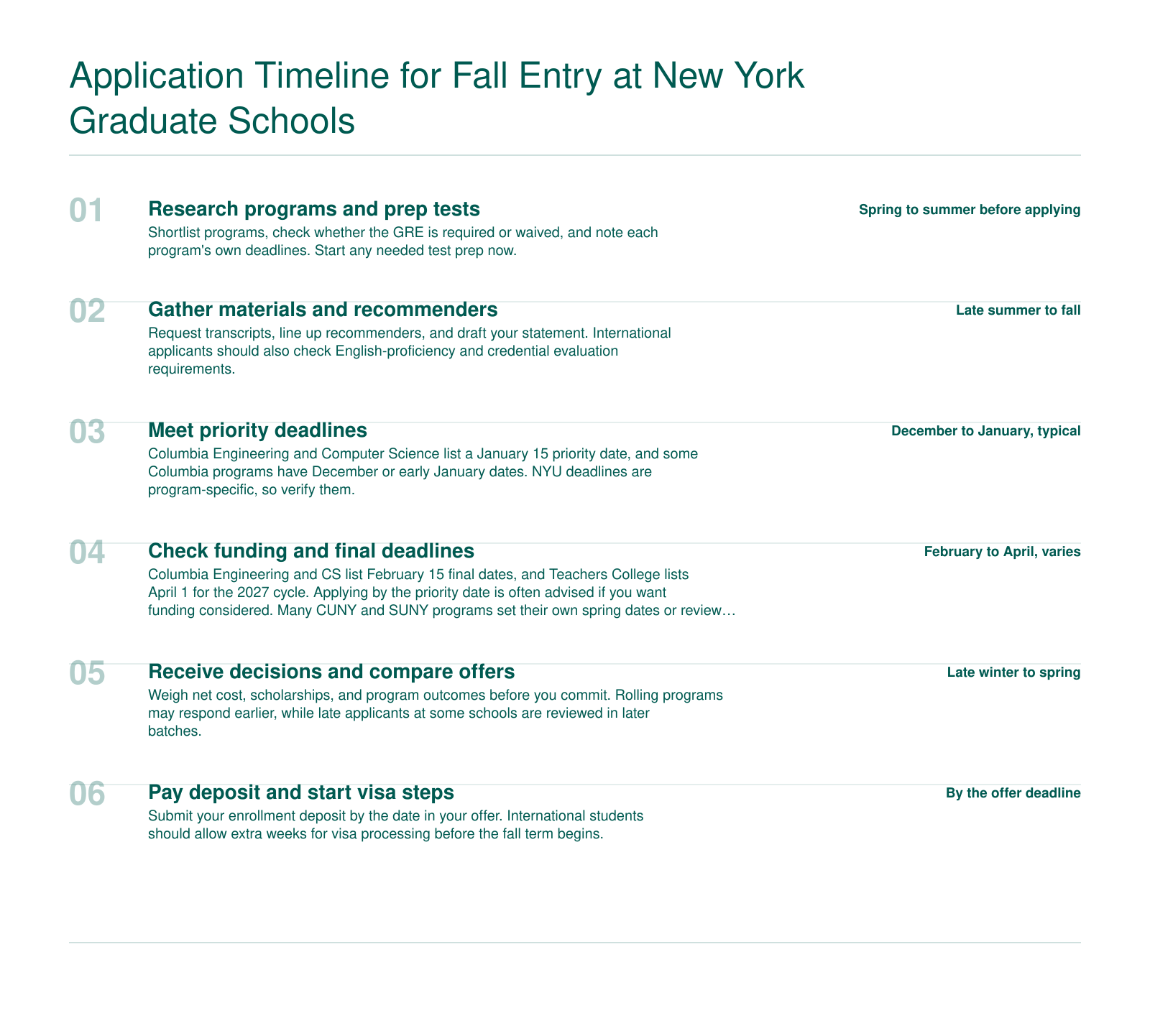
Application Timeline for Fall Entry at New York Graduate Schools
Deadlines vary by school and program, so treat these windows as typical patterns and confirm dates on each program page. Columbia examples below are drawn from published admissions pages; NYU, Cornell, CUNY, and SUNY dates are program-specific and should be checked directly.
Who Licenses Professionals in New York
Master's Degrees That Lead to Licensure in New York
If your goal is a license to practice, the master's degree is only one piece of the puzzle. New York licenses most regulated professions through the State Education Department (NYSED) Office of the Professions, and the state cares about three things: the right degree from a program it recognizes, a set number of supervised hours, and a passing exam score. Each row covers one profession and what the state actually requires.
Counseling and Social Work
- Licensed Master Social Worker (LMSW): An MSW from a CSWE-accredited MSW program that is NYSED-acceptable.1 No post-degree supervised experience is required for the LMSW itself.2 Exam: the ASWB Masters examination.2
- Licensed Clinical Social Worker (LCSW): An MSW that includes at least 12 clinical credits, from a CSWE-accredited, NYSED license-qualifying program.3 Supervised experience runs at least 36 months and NYSED's profile specifies 2,000 client-contact hours.4 Exam: the ASWB Clinical examination.4
- Licensed Mental Health Counselor (LMHC): A master's in counseling, typically 60 semester hours, from a NYSED-registered program or substantial equivalent.5 Supervised experience totals 3,000 hours, of which at least 1,500 must be direct client contact.6 Exam: the NCMHCE.7
Note that New York's standard for counseling is NYSED registration or substantial equivalence rather than CACREP accreditation specifically, though many qualifying programs hold CACREP status.
Nursing, Teaching, CPA, and Speech-Language Pathology
Several other master's-level paths lead to New York credentials, including nurse practitioner programs, teacher certification, the CPA license, and speech-language pathology master's programs. Each carries its own degree, accreditation, supervised-experience, and exam requirements through the relevant state board or NYSED unit. Because those specific 2026 requirements are not confirmed in our source material, confirm them directly with NYSED and the applicable national accreditor (for example, CCNE or ACEN for nursing, CAEP or NYSED registration for teaching, and ASHA's CAA for speech-language pathology) before you enroll.
Why Program Registration Matters
The single most important rule: enroll only in a NYSED-registered, licensure-qualifying program. This matters most for online degrees offered by schools based outside New York. A program can be fully accredited and still fail to meet New York's course-by-course requirements, which can leave you with a degree that does not qualify you to sit for the exam here. Before you pay a deposit, ask the school in writing whether the program is NYSED license-qualifying for your profession, and verify it against the Office of the Professions directly.
New York City vs. Upstate: Where Should You Study?
The choice usually comes down to proximity versus price: New York City puts you inside the industries you want to work in, while upstate campuses let you finish the same credential with far less spent on housing. Neither answer is universally right, and the better question is which cost you can absorb and which access you actually need.
What New York City offers
The city's labor market is enormous, with roughly 4.17 million people employed as of August 20261, and its wage floor sits well above the national one: the city's median annual wage was about $61,430 in 2025 compared with roughly $50,980 nationally, and average annual salary in the city reached about $129,030.2 Those figures cover all workers, not master's graduates specifically, so treat them as a signal about the market rather than a forecast of your salary. What they do confirm is a dense concentration of finance, media, technology, healthcare, and nonprofit employers, which translates into part-time internships you can reach by subway and alumni networks clustered in the same few zip codes. The tradeoff is housing. Rent is the single largest line in most city students' budgets, and it can quietly exceed tuition savings at a public campus.
What upstate hubs offer
Albany, Buffalo, Rochester, Syracuse, and Ithaca each pair a research university with a lower overall cost of attendance. SUNY flagships deliver strong graduate research, funded assistantships in many departments, and in-state tuition that is hard to match downstate. Private options upstate add selectivity without New York City living costs. Industry access is narrower but not absent: healthcare administration, optics and imaging, advanced manufacturing, MPA programs, and higher education all cluster regionally.
How to decide
If your target field hires primarily through city-based internships, pay the premium and plan housing early. If your field is research-driven, licensure-driven, or remote-friendly, an upstate program usually leaves you with less debt for an equivalent credential. Compare total cost of attendance, not tuition alone, before you commit.
New York consistently ranks among the top few U.S. states for hosting international students, according to the Institute of International Education's Open Doors report. NYU and Columbia are regularly counted among the largest host institutions nationwide, so you'll find a large international community in both the classroom and the city.
Applying to New York Master's Programs as an International Student
Almost all on-campus master's programs in New York welcome international students, but fully online programs, including online MPH programs and online MBA programs, generally cannot support an F-1 visa because the visa requires physical presence in the U.S. If you plan to study online from your home country, you do not need an F-1 visa, but you will not be eligible for OPT or CPT work authorization.
English Proficiency Requirements
Most New York universities, including NYU, Columbia, and SUNY campuses, ask international applicants whose first language is not English to submit TOEFL, IELTS, or Duolingo scores. Minimums vary widely by school and department; some graduate programs set higher thresholds for teaching or writing-intensive fields. Waivers are common if you completed a prior degree in an English-speaking country or at an institution where English was the primary language of instruction. Check each program's international admissions page because requirements are not standardized across the state.
I-20 and Proof of Funding
After admission, you will need a Form I-20 from the school to apply for an F-1 visa. To receive it, you must show proof of liquid funds covering at least one year of tuition plus estimated living costs in New York. Living costs differ greatly between New York City and upstate regions, so the amount on your I-20 will reflect the school's location. Plan to pay the SEVIS I-901 fee after you receive the I-20, then schedule a visa interview at a U.S. embassy or consulate. Visa appointment wait times can be long, so start the process as soon as you have your admission letter and funding documents.
STEM-Designated Programs and OPT Extension
A major draw for international students is the opportunity to work in the U.S. after graduation. Master's programs classified as STEM-designated, including many in engineering, data science, computer science, and quantitative business fields, qualify for a 24-month extension of Optional Practical Training beyond the standard 12 months. That means up to 36 months of U.S. work authorization. If you are deciding between otherwise similar master's in accounting programs, STEM designation can significantly change your long-term options, so confirm a program's Classification of Instructional Programs code before applying.
Graduate schools in New York with the most master's programs
| School | City | Type | Master's programs | Online | Grad tuition / yr |
|---|---|---|---|---|---|
| New York University | New York | Private nonprofit | 87 | 27 | $42,726 |
| University at Buffalo | Buffalo | Public | 76 | 10 | $14,530 |
| Syracuse University | Syracuse | Private nonprofit | 73 | 20 | $48,132 |
| Hofstra University | Hempstead | Private nonprofit | 65 | 17 | $31,120 |
| Stony Brook University | Stony Brook | Public | 64 | 29 | $14,222 |
| Pace University | New York | Private nonprofit | 60 | 29 | $30,770 |
| St. John's University-New York | Queens | Private nonprofit | 55 | 25 | $36,227 |
| Long Island University | Brookville | Private nonprofit | 53 | 15 | $25,990 |
| University at Albany | Albany | Public | 49 | 12 | $13,808 |
| Columbia University in the City of New York | New York | Private nonprofit | 49 | 11 | $57,973 |
| Touro University | New York | Private nonprofit | 47 | 25 | $14,979 |
| Molloy University | Rockville Centre | Private nonprofit | 47 | 39 | $27,520 |
| Adelphi University | Garden City | Private nonprofit | 44 | 21 | $32,822 |
| CUNY Hunter College | New York | Public | 44 | 12 | $11,398 |
| CUNY Queens College | Queens | Public | 43 | 10 | $11,612 |
Program counts are the verified master's listings in our directory; tuition is the school-wide average for a full-time graduate student (IPEDS).
Frequently Asked Questions About Master's Programs in New York
These answers draw on federal outcome data and each school's published admissions and scheduling policies. Requirements change by program and year, so confirm details with the department before you apply.
What is the best master's program in New York?
Do I need GRE scores for New York master's programs?
Can I work full time while earning a master's in New York?
Is a CUNY or SUNY master's degree respected as much as one from NYU or Columbia?
Compare programs nationwide
Many New York residents study online. Every ranked list above has an online lens, or browse every field.
Online master's programs Browse all fields