Best Master's in Journalism Programs in New York
Compare 15 accredited Journalism programs in New York at 7 schools, with graduate earnings, cost, debt, and completion data from IPEDS and the U.S. College Scorecard.

New York holds the country's densest concentration of newsrooms, networks, and digital publishers, which means a master's here can double as a hiring pipeline. The cost spread is the complication.
Full-time graduate tuition at Columbia runs about $71,845 a year, while St. Bonaventure's online digital journalism M.A. publishes a $24,450 total. Columbia's M.S. graduates report median earnings of $54,170 one year out.
Entry-level reporting salaries rarely track tuition, so debt load, not prestige, usually decides whether the degree pays back.
Key Points
- St. Bonaventure's online M.A. in Digital Journalism totals $24,450 at $815 per credit.
- Columbia's M.S. reports 95.4% employment and $54,170 median first-year earnings.
- NYU's online American Journalism program is fully remote with no residency requirement.
Best Master's in Journalism Schools in New York: 2027 Rankings
Each card below shows the school's city, program formats, concentrations, and any program-level earnings or debt that federal data reports. Graduation rates describe the school as a whole, not the journalism program, and net price is an institution-wide average after aid, so use it as a starting point rather than a quote for your own bill.
Columbia University in the City of New York
#1New York, NY · ~$58,000/yr (est.)
Best for: Aspiring data and investigative reporters
Columbia offers two campus-based M.S. paths in New York City: Data Journalism and an Investigative Specialization. The school's graduation rate is about 96%. Federal data for its journalism master's reports median earnings of $54,170 one year after completion and $78,880 four years out, with median debt of $69,000. It is the most expensive option on the list, so weigh that debt figure against the earnings.
- Three-semester program ending in a major data-driven Master's Project
- Teaches Python, R, SQL, and visualization tools
- No prior data or coding background required
- Campus-based, with work produced on real deadlines
- Investigative training offered since 2006, directed by Sheila Coronel
- Platform-neutral specialization covering investigative tools and methods
- Stipends available for post-graduation reporting
- Campus-based, with global reporting opportunities
New York University
#2New York, NY · ~$43,000/yr (est.)
Best for: Globally minded reporters pairing regional studies
NYU offers three journalism routes: a campus-based Global & Joint Program Studies degree, an American Journalism online master's, and a Graduate School of Arts and Science M.A. with business and cultural reporting tracks. The school's graduation rate is about 88%. Program-level earnings and debt are not reported in federal data for this program, so compare it on format and focus rather than outcomes.
- Graduate School of Arts and Science M.A. offered online
- Business and Economic Reporting and Cultural Reporting and Criticism tracks are open
- American Journalism concentration is currently suspended
- Three writing samples required; GRE not required
- Multimedia work and unpublished samples accepted
- 30 credits across 8 courses, full-time or part-time
- Synchronous online classes in a cohort structure
- Fall and spring starts; complete within 3 years
- Electives include Audio Storytelling
- Students publish work and pitch media startup ideas
- Joint M.A. pairing journalism with a regional or international studies degree
- Eight concentration options; no entrance exam required
- Small cohorts of about 15 students
- Ends in a professional project of roughly 7,000 to 10,000 words
- Mentorship from program graduates
Stony Brook University
#3Stony Brook, NY · ~$14,000/yr (est.)
Best for: Working professionals wanting evening classes
Stony Brook is the public, lower-tuition option among the larger programs, with a hybrid M.S. built around solutions journalism. The school's graduation rate is about 76%. Classes run in the evening with some synchronous online sessions, which suits people who work while studying. Program-level earnings and debt are not yet reported for this program.
- 33 credits in about 1.5 years, full-time or part-time
- GRE scores optional; 3.0 GPA minimum
- Solutions journalism focus with a required capstone
- Newsroom, broadcast studio, and podcasting studio on campus
- No journalism background required
- Fall start; 2026 application deadline listed as March 15
Syracuse University
#4Syracuse, NY · $45,000 – $50,000/yr (est.)
Syracuse runs a 12 to 13 month, full-time campus master's with strong sports media options, plus a Public Affairs track and a Washington capstone. The school's graduation rate is about 84%. Federal data reports median earnings of $41,856 one year after completion and $62,512 four years out, with median debt of $56,444.
- Sports Media and Communications track covering play-by-play, anchoring, and reporting
- Hands-on work with NCC News, WAER, and Citrus TV
- Washington Capstone reporting on politics and breaking news
- 13-month program; no journalism background required
- Public Affairs Journalism track with the Maxwell School
- 13-month, full-time cohort; no entrance exam required
- Rolling admissions after the January 15 priority deadline
- Weeklong Washington Capstone experience
- 12-month, full-time program
- Investigative reporting and multimedia storytelling across platforms
- Newhouse Foundation Fellowship available
- Rolling admissions after the January 15 priority deadline
Hofstra University
#5Hempstead, NY · $30,000 – $35,000/yr (est.)
Hofstra's campus M.A. in Hempstead sits just outside New York City and can be finished in as little as three semesters. The school's graduation rate is about 69%. Federal data reports median earnings of $74,266 four years after completion for the program. Debt is not reported at the program level.
- 30 credits, as little as three semesters; full-time or part-time
- Specializations: Community and Investigative, Sports and Entertainment
- No GRE required; rolling admissions
- Hands-on work in the NewsHub newsroom and WRHU Radio
- Capstone project becomes a portfolio centerpiece
- Dual BA/MA option and scholarships available
St Bonaventure University
#6Saint Bonaventure, NY · ~$16,000/yr (est.)
St. Bonaventure offers a fully online, asynchronous M.A. in Digital Journalism with no GRE or GMAT requirement and total program tuition of $24,450. The school's graduation rate is about 67%. Federal data reports median earnings of $58,647 one year after completion and $82,191 four years out, with median debt of $27,582, the lowest debt on this list. New York residents may also qualify for the university's Bona Access Guarantee, subject to eligibility.
- 30 credits in about 1.5 years, in 7-week terms
- Fully online and asynchronous
- $815 per credit; $0 application fee; no GRE or GMAT
- Covers data journalism, social storytelling, and HTML, CSS, JavaScript
- Three-course capstone producing a major digital project
- Jandoli School of Communication is accredited by ACEJMC
- Corporate partnership discount of 15% for eligible employees
CUNY Graduate School and University Center
#7New York, NY · $10,000 – $24,000/yr (est.)
CUNY's Craig Newmark Graduate School of Journalism is the public, resident-priced option in New York City. For 2026 to 2027, in-state full-time charges are listed at $6,136.45 for fall and $6,336.45 for spring, well below out-of-state rates. Federal data reports median earnings of $74,415 five years after completion. The school's graduation rate is not reported.
- 43 credits, completed in as few as 16 months
- Required paid summer internship and capstone
- Media format specializations such as audio, data, or broadcast
- January Academy enrichment workshops
- Same 43-credit, 16-month structure; full-time or part-time
- Six subject concentrations to choose from
- Data, audio, and video skills built in
- Paid summer internship and capstone required
- 43 credits with seven foundational courses
- Core coverage of ethics, safety, and legal issues
- Foundational data journalism skills
- Capstone project in the final semester
Cost & outcomes by school
Federal data for the highest-earning Journalism programs, independent of the ranking above. Earnings are this field's master's graduates four years after completing, where the Scorecard reports them.
| School | Earnings | Tuition / yr | Debt | Grads/yr | Format |
|---|---|---|---|---|---|
| St Bonaventure University NY | $82,191 | $16,087 | $27,582 | 8 | Online |
| Columbia University in the City of New York NY | $78,880 | $57,973 | $69,000 | 230 | Campus |
| Hofstra University NY | $74,266 | $31,120 | — | 8 | Campus |
| Syracuse University NY | $62,512 | $48,132 | $56,444 | 55 | Campus |
| CUNY Graduate School and University Center NY | — | $10,294 | — | — | Campus |
| Stony Brook University NY | — | $14,222 | — | 3 | Hybrid |
| New York University NY | — | $42,726 | — | 30 | Online |
Sources: U.S. Department of Education. Tuition and graduates: IPEDS. Earnings and debt: College Scorecard, this field's master's graduates; a dash means no figure is reported.
Cost, debt & payoff
Median earnings of this field's master's graduates (4 yrs after completing) vs. their median federal loan debt · U.S. College Scorecard
Across these programs the median graduate earns about $68,389 and finishes with roughly $56,444 in debt — a ratio that clears a common rule of thumb (keep debt below first-year salary). Tuition and debt vary widely school to school, so check the per-school figures in the table above before you shortlist.
Online and Hybrid Journalism Master's Programs in New York
Delivery models
NYU's American Journalism Online Master's (AJO) is fully online with no residency requirement. It includes some synchronous sessions and is built for working professionals, with a part-time path of 15 months across fall, spring, and summer. St. Bonaventure's M.A. in Digital Journalism is fully online and asynchronous, with 7-week terms and a roughly 1.5-year completion. Stony Brook's Master of Science in Journalism is hybrid, with synchronous online classes, evening courses, and full-time or part-time options for working journalists.
What online students gain and give up
online master's in journalism programs and hybrid formats trade flexibility for in-person presence. Working professionals in fully online master's programs in New York keep their jobs and avoid relocating, and they can study outside fixed class hours. What they give up includes spontaneous access to campus newsrooms, faculty office hours, and local media networking that campus students can use daily. This is the main tradeoff, not academic rigor.
Career support equivalence
NYU says its online AJO students get dedicated career guidance, resume and cover-letter review, and weekly emails listing jobs, internships, and fellowships, but it does not claim that package matches what campus journalism students receive. St. Bonaventure and Stony Brook do not state whether their online or hybrid students receive the same career-services and internship support as residential students, so prospective students should ask admissions directly.
Which New York Journalism Master's Programs Waive or Make the GRE Optional
Where we could confirm a policy on an official admissions page, the GRE is not required for the journalism master's programs below. We did not confirm a GRE policy for the other schools ranked here, so check their admissions pages before you plan test prep. Instead of scores, programs typically weigh writing samples, a personal statement, and sometimes a multimedia portfolio or published clips.
| School | GRE Policy | Other Key Application Materials |
|---|---|---|
| New York University (American Journalism, online M.A.) | Not required. Applicants should disregard any application prompt saying the GRE is required. | Official transcripts, three letters of recommendation, a personal statement, and three writing samples. Samples may be unpublished or replaced by links to multimedia work. |
| New York University (Journalism M.A., on-campus programs) | Not required for any journalism program. In some cases scores are optional and considered if submitted. | Transcripts, three letters of recommendation, three writing samples, and a statement of purpose. Published clips are optional and rarely decisive. Multimedia work may count as a writing sample in select programs. |
| Hofstra University (Journalism M.A.) | Not required, but may be submitted. | Application, official undergraduate transcript, a 500 to 750 word personal essay serving as a writing sample, current résumé, and two letters of recommendation. Published clips are strongly encouraged but not required. |
Related Articles
Master's in Journalism Cost in New York, Plus Licensure and Certification
New York journalism master's degrees are not priced the same way, and sticker price can overstate what students actually pay. St. Bonaventure's online M.A. in Digital Journalism publishes the clearest program-level total: $815 per credit for 30 credits, or $24,450 total tuition. NYU's American Journalism Online master's also requires 30 credits, but its current-year tuition is not published; applicants must check the bursar. CUNY's Craig Newmark School does not publish a comparable total or per-credit cost.
Institution-Wide Tuition and Net Price
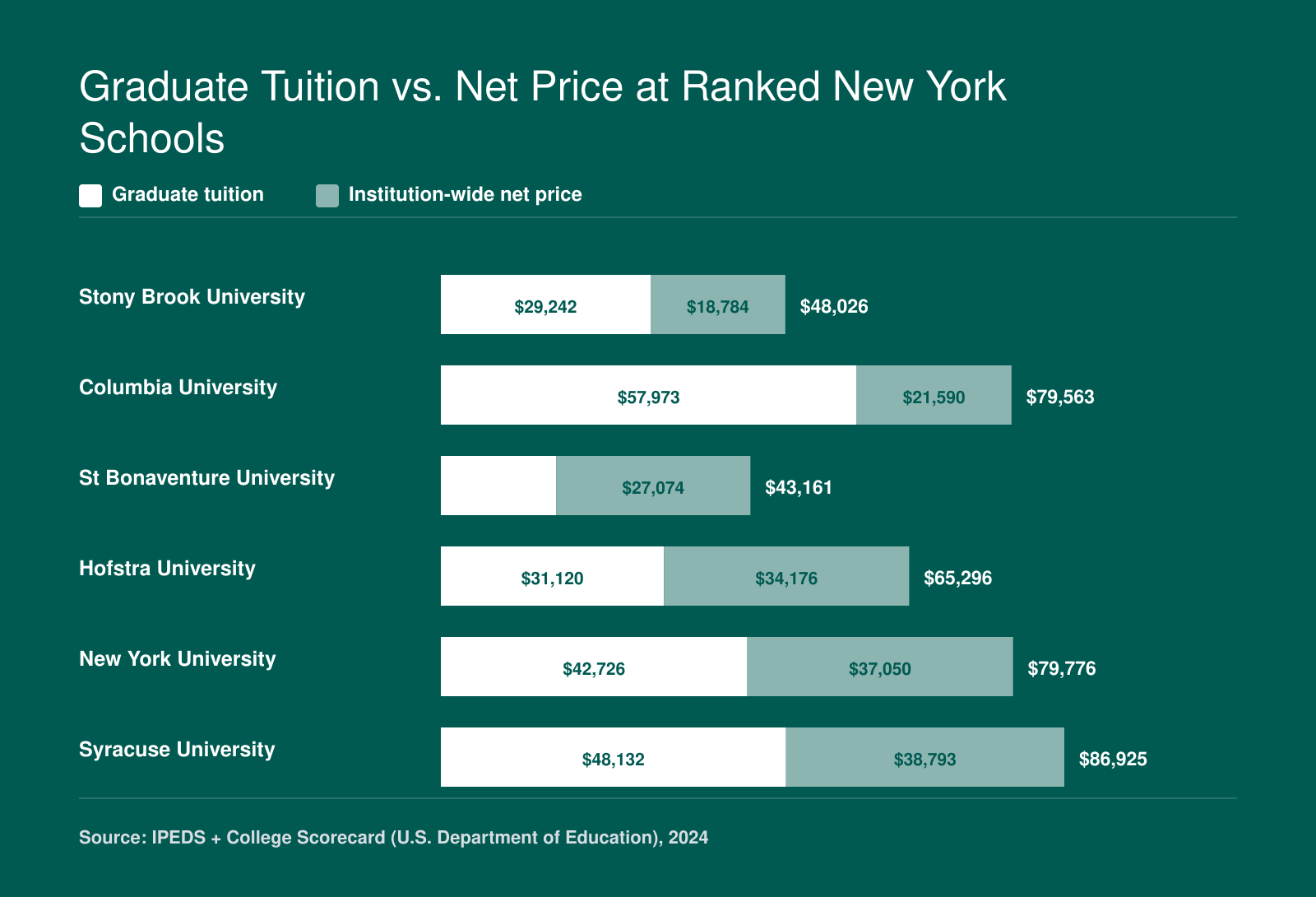
Published institution-wide graduate tuition among the schools here ranges from about $14,000 at Stony Brook to about $58,000 at Columbia. Net price is an approximate average and can be much lower: Stony Brook's is around $18,800, Columbia's about $21,600, and Syracuse's about $38,800. These are not program prices, so ask the journalism department for a cohort-specific estimate and fee schedule. Program-level median debt and 10-year monthly payment data are not published for these programs.
Licensure and Accreditation
New York does not require a general license or certification to work as a journalist. The only related state credential identified is the Certified Shorthand Reporter license, which applies narrowly to court reporting and is not a journalism requirement. Accreditation matters more than licensure here. ACEJMC accreditation signals a program meets professional journalism and mass communications standards. Columbia, CUNY, Hofstra, St. Bonaventure, Syracuse, and NYU hold ACEJMC accreditation, with St. Bonaventure reaccredited in 20243, Hofstra in 20222, and CUNY in 20201.
Graduate Tuition vs. Net Price at Ranked New York Schools
Net price is an institution-wide average after grant aid, not a quote for a journalism master's, and it includes living costs, so it can exceed tuition at some schools. The widest gap between sticker price and net price is at Columbia University in the City of New York: $57,973 in graduate tuition against a $21,590 net price, a difference of $36,383. At St Bonaventure University and Hofstra University, the institution-wide net price is higher than the listed graduate tuition.
Career Outcomes and Internships for New York Journalism Master's Graduates
Read the outcome window
Program-level Scorecard data are strongest at Columbia and St. Bonaventure. One year after graduation, Columbia's M.S. reports a 95.4% employment share and median first-year earnings of $54,170; 90.1% of its completers earn above the poverty threshold at three years. One year after graduation, St. Bonaventure's digital journalism M.A. reports 100% employment share, 96.4% above poverty, and median first-year earnings of $58,647. CUNY reports 87.8% of completers above the poverty threshold at three years, but no one-year employment share is published; its published median earnings are $74,415 at five years. One-year outcomes are not reported for NYU, Stony Brook, Hofstra, or Syracuse.
Documented internship pipelines
- CUNY Newmark: required 3-credit, 280-hour paid summer internship, but no named partners or placement rate.
- CUNY Social Journalism: required 280-hour internship, mixed pay with a $3,000 stipend for unpaid placements; partners not published.
- NYU: required newsroom internship. Older combined class-of-2019 results show 84% had NYU internships, 94% landed jobs, fellowships, internships, or freelance work, and named destinations include Financial Times, Forbes, Newsweek, Bloomberg, CNBC, and Inc. This is not current M.A.-only data.
- Hofstra's M.A. in Journalism: final-year internship or independent study required, but no placement rate or partners published.
Weigh prestige against proof
A well-known name is not the same as current program-level evidence. Prioritize schools that publish one-year employment and earnings data and name internship placements. Compare Columbia's first-year employment share and St. Bonaventure's 100% one-year employment against net price and debt before choosing.
Top Early-Career Earnings Among Ranked Programs
Highest program-level median earnings one year after completion among the schools ranked here:
Master's in Journalism in New York: Common Questions
Which New York journalism master's program is best for investigative reporting?
What are the acceptance rates for New York journalism master's programs?
Is a master's in journalism worth it?
Compare Journalism programs on the data that matters
Explore more Communications & Media specializations or browse every graduate field.
All Communications & Media programs