Best Master's in Communication Programs
Compare 530+ accredited Communication programs at 360+ schools, with graduate earnings, cost, debt, and completion data from IPEDS and the U.S. College Scorecard.

A master's in communication runs about $57,973 in tuition at Columbia and $9,992 a year at Purdue, and the earnings gap between the two is far narrower than the price gap. Columbia's strategic communication graduates report median earnings near $93,000 a year after finishing; Purdue's report roughly $70,000 at a fraction of the cost.
That spread is the actual decision. Communication carries no licensure requirement and no single programmatic accreditor, so value shows up in concentration, placement, and debt rather than in a credential employers verify. Earnings track the specialty more than the diploma: strategic communication and digital media graduates consistently out-earn those from general communication studies tracks.
Key Points
- In-state graduate tuition among ranked schools runs from $8,416 at BYU to $22,017 at Minnesota.
- Columbia's strategic communication master's posts the highest program-level earnings figure among the ranked schools.
- Compare credits, capstone or thesis requirements, and delivery format before choosing, since they set your timeline and total cost.
The 10 Best Master's in Communication Programs for 2027, Ranked
Below is this year's ranked list of master's in communication programs, with campus, online, and hybrid options side by side. Use each card to compare the format, cost after aid, and graduate outcomes before you apply.
Columbia University in the City of New York
#1New York, NY · ~$58,000/yr (est.)
Best for: Career switchers seeking New York media roles
Columbia's M.S. in Strategic Communication blends full-time campus study with a part-time hybrid option for working professionals. The program emphasizes strategic frameworks, storytelling, digital strategy, and a capstone project presented to real executives. Median earnings one year after completion were $93,452.
- 16-month full-time on-campus program
- Optional graduate-level practicum
- Capstone project with real organization
- Small class sizes and elective access across Columbia
- 24-month part-time hybrid format
- Synchronous online classes with in-person residencies
- Two cohort options by experience level
- Capstone project with real client
- Financial aid and scholarships available
University of Southern California
#2Los Angeles, CA · ~$72,000/yr (est.)
Best for: Aspiring academics needing thesis-focused training
USC's Master of Arts in Communication takes a humanistic and social scientific approach, with core courses in communication theory and methods. Students choose between a six-hour comprehensive exam and a thesis, and can transfer up to four units. Median earnings one year after completion were $68,587.
- 32 total credit hours with 8 courses
- Two concentration options
- Thesis or comprehensive exam tracks
- Core courses: COMM 525, 526, 550, 552
- Up to 4 transfer units accepted
- 3.0 GPA minimum
University of Florida
#3Gainesville, FL · ~$13,000/yr (est.)
Best for: Budget-conscious online learners
Florida's M.A. in Mass Communication is built for customization, with a mix-and-match curriculum that can be finished in as little as three semesters. Online students can choose a Public Interest Communication or Public Relations concentration, both with asynchronous coursework and capstone projects. Median earnings one year after completion were $58,996.
- Can be completed in three semesters
- Customizable mix-and-match curriculum
- Top-10 public research university
- 36 total credit hours, 16 months full-time
- $484 per credit ($17,441 total program tuition)
- Asynchronous online classes
- Capstone required
- Careers in advocacy and government
- First-of-its-kind interdisciplinary program
- 36 total credit hours, 1.5 years
- $586 per credit ($21,087 total program tuition)
- 100% online via recorded lectures
- First online PR program with CEPR certification
- Core courses include strategic writing and management
Northwestern University
#4Evanston, IL · ~$55,000/yr (est.)
Northwestern's M.S. in Communication prepares strategic leaders through core themes of managing complexity, collaborative leadership, and effective communication. Students choose between the in-person Custom Leadership Program with concentrations in AI, Strategic Communication, and Organizational Leadership, or the fully virtual Online Leadership Program. Median earnings one year after completion were $87,012.
- Three concentration options (AI, Strategic Communication, Organizational Leadership)
- In-person Custom Leadership Program or fully online option
- Full-time and part-time enrollment
- Asynchronous online classes
- 1:1 career coaching and alumni mentoring
University of North Carolina at Chapel Hill
#5Chapel Hill, NC · ~$13,000/yr (est.)
UNC-Chapel Hill's online M.A. in Digital Communication is a cohort-based, part-time program for mid-career professionals with at least three years of experience. The 30-credit curriculum includes nine sequential courses, a final thesis project, and two required on-campus experiences. Median earnings one year after completion were $56,634.
- 30 total credit hours, 9 sequential courses
- Part-time cohort capped at 20 students
- Two required on-campus experiences
- Thesis required
- 3.0 GPA and three years professional experience
- GRE not required
University of California-Davis
#6Davis, CA · $15,000 – $20,000/yr (est.)
UC Davis's M.A. in Communication focuses on mediated communication, examining how digital media, technology, and society intersect. Students choose between a thesis track for research careers and a non-thesis track for professional roles. The campus program provides close faculty mentorship and a collaborative graduate community.
- 2-year program with thesis or non-thesis tracks
- Focus on mediated communication
- Financial aid available
- Dedicated graduate advising support
Purdue University
#7West Lafayette, IN · ~$10,000/yr (est.)
Purdue's online M.S. in Communication offers six concentrations, including Strategic Communication/Public Relations, Branding and Marketing, and Digital Media and Communication Technologies. The 30-credit program can be completed in as little as one year, and credits from Purdue graduate certificates transfer in. Median earnings one year after completion were $70,112.
- 30 total credit hours
- Can be completed in as little as one year
- No prior communication experience needed
- Credit transfer from graduate certificates
- Curriculum covers branding and public relations
- Taught by industry experts
- 30 total credit hours
- Part-time rolling admission
- Average salary increases of 25-75%
- Credit transfer from graduate certificates
- 30 total credit hours
- $525 per credit
- Financial aid available
- Median advertised salary $90.6k
- 30,019 unique job postings
University of Washington-Seattle Campus
#8Seattle, WA · ~$19,000/yr (est.)
Washington's M.A. in Communication bridges humanistic and social scientific traditions across six research areas, including political communication, technology and society, and international communication. Students complete a unified core curriculum, methods training, and a research thesis with an oral defense. The program prepares graduates for doctoral study or communication leadership roles.
- 45 total credit hours
- Thesis with oral defense required
- Six research areas including political, cultural, digital
- Core courses: COM 500 and COM 501
- Prepares for doctoral study or terminal degree
CUNY Bernard M Baruch College
#9New York, NY · $11,000 – $21,000/yr (est.)
Baruch's M.A. in Strategic Communication blends theory with real-world application across crisis communication, brand management, and digital strategy. The 36-credit program in New York City offers fall and spring starts, with thesis or capstone project options. Students benefit from a strong professional network and internship access.
- 36 total credit hours
- Fall and spring start dates
- Two letters of recommendation minimum
- $75 application fee
Villanova University
#10Villanova, PA · $20,000 – $25,000/yr (est.)
Villanova's M.A. in Communication develops leaders in ethical and strategic thinking, speaking, writing, and research. The program covers media production, PR writing, audience analysis, organizational communication, and rhetoric, with small class sizes and dedicated faculty mentors. Median earnings one year after completion were $50,854.
- NCA Outstanding Master's award winner
- Small class sizes, dedicated faculty
- Prepares for PhD or careers
- Can earn Graduate Certificate in Strategic Communication alongside MA
Cost & outcomes by school
Federal data for the highest-earning Communication programs, independent of the ranking above. Earnings are this field's master's graduates four years after completing, where the Scorecard reports them.
| School | Earnings | Tuition / yr | Debt | Grads/yr | Format |
|---|---|---|---|---|---|
| Johns Hopkins University MD | $107,409 | $64,730 | $39,737 | 262 | Hybrid |
| University of Florida FL | $86,823 | $12,737 | $29,671 | 322 | Campus |
| Washington State University WA | $86,450 | $14,845 | $26,714 | 41 | Campus |
| Purdue University IN | $84,920 | $9,992 | $34,280 | 78 | Online |
| Grand Canyon University AZ | — | $10,015 | $31,340 | 112 | Online |
| Middle Georgia State University GA | — | $4,534 | — | — | Online |
| Park University MO | — | $4,783 | — | — | Hybrid |
| University of West Georgia GA | — | $6,046 | — | — | Online |
| Georgia Southern University GA | — | $6,646 | — | — | Hybrid |
| Texas A & M International University TX | — | $6,650 | — | — | Campus |
| Kennesaw State University GA | — | $6,702 | — | — | Campus |
| Worcester State University MA | — | $6,813 | — | — | Campus |
Sources: U.S. Department of Education. Tuition and graduates: IPEDS. Earnings and debt: College Scorecard, this field's master's graduates; a dash means no figure is reported.
Cost, debt & payoff
Median earnings of this field's master's graduates (4 yrs after completing) vs. their median federal loan debt · U.S. College Scorecard
Across these programs the median graduate earns about $68,264 and finishes with roughly $33,774 in debt — a ratio that clears a common rule of thumb (keep debt below first-year salary). Tuition and debt vary widely school to school, so check the per-school figures in the table above before you shortlist.
Credits, Capstones, and Thesis Tracks at Top-Ranked Programs
Before you commit to a program, look past the brochure and into the catalog. The structure of a degree, how many credits it demands, how it ends, and whether it builds in real-world work, shapes both your timeline and what you can do with the credential afterward.
How Many Credits You'll Actually Take
Most communications & media master's programs land in the 30 to 36 credit range. Columbia's strategic communication degree and the M.A. programs at UTSA and Texas A&M University-Corpus Christi all require 36 credits123. UNC Chapel Hill's digital communication track sits at 334. A few run longer: Drexel's program spans 45 to 46 credits5, and the University of Oregon requires 48, including a 6 credit capstone6. Louisiana State University generally runs 30 to 36 hours plus prerequisites7. More credits usually means more time and more tuition, so the count matters when you compare value.
Thesis, Capstone, or Comprehensive Exam
Most programs end one of three ways, and the choice signals who the degree is built for.
- Thesis: A research-heavy project, often 6 credits (as at UTSA and Texas A&M-Corpus Christi)23, that suits students aiming for a PhD or academic track. Many schools gate it behind a GPA floor, such as UTSA's 3.25 minimum2.
- Applied capstone: A practitioner-focused project, required at Columbia and UNC14, where you solve a real communication problem for an actual organization. This is the path for working professionals building a portfolio.
- Comprehensive exam: A knowledge-based option offered at schools like LSU7 and Lasell for students who prefer coursework over an extended project.
Internships and Practicums for Career Changers
Hands-on experience can be the deciding factor if you're switching fields. Drexel requires an internship, though it carries no credit5. Lasell's capstone can be fulfilled through a 150 hour supervised internship, and La Salle's strategic communication students can complete a 75 hour placement once they meet enrollment and GPA conditions8. Columbia offers an optional graduate-level practicum that extends the program to a fourth term1. For anyone entering communication from another career, these placements turn a transcript into a resume line.
Translating Credits Into Time
Full-time students typically finish in 12 to 24 months. Columbia moves through three consecutive terms (four with the practicum)1, and UNC's cohort follows three full-time terms4. Part-time schedules stretch longer, which is often the right trade for students working while they study.
What a Master's in Communication Costs: Tuition, Net Price, and Debt
Among the ranked schools, annual in-state graduate tuition and fees run from $8,416 at Brigham Young University to $22,017 at the University of Minnesota-Twin Cities. The next-cheapest options are the University of Central Florida ($8,872) and Purdue University ($9,992). Michigan State ($21,772) and the University of Delaware ($20,304) sit near the top of the range.
The In-State vs. Out-of-State Gap
Residency can change the bill more than the school name does. At the University of Florida, tuition is $12,737 in-state and $30,130 out-of-state. Indiana University-Bloomington jumps from $11,756 to $33,454, and Michigan State from $21,772 to $41,848. BYU and the University of Delaware list one rate for everyone ($8,416 and $20,304), so nonresidents pay no premium at either.
Online delivery can change this math. Some public universities charge online students a flat per-credit rate regardless of where they live. Purdue's online master's in communication advertises $520 per credit for 30 credits, roughly $15,600 total, well below its $28,794 out-of-state figure. Confirm the format-specific rate before assuming out-of-state pricing applies to you.
Net Price After Aid
Sticker price is only a starting point. The net prices below are approximate institution-wide averages after grants and scholarships, not quotes for a communication master's student, so treat them as rough guides.
- Lowest: Baruch College, at about $3,033.
- Mid-range: the University of Florida, about $6,541, and UCF, about $10,411.
- Higher: Delaware, about $17,799, and Michigan State, about $19,680.
Assistantships can shift the picture further. NC State notes that graduate assistantships cover tuition, and Delaware lists teaching assistantships with a stipend.
What Borrowing Looks Like
Program-level debt figures exist for only a few schools. Graduates of Purdue's program finish with median debt of $34,280, which works out to about $390 a month on a 10-year plan. Florida's median is $29,671, or about $338 a month. Georgia's is higher at $51,250, roughly $583 a month. Other ranked programs have no published program-level debt, so ask each admissions office what students typically borrow.
A rule of thumb: compare the monthly payment against the starting pay you can realistically expect, not against the tuition number alone.
Beyond Tuition: Where the Rest of Your Money Goes
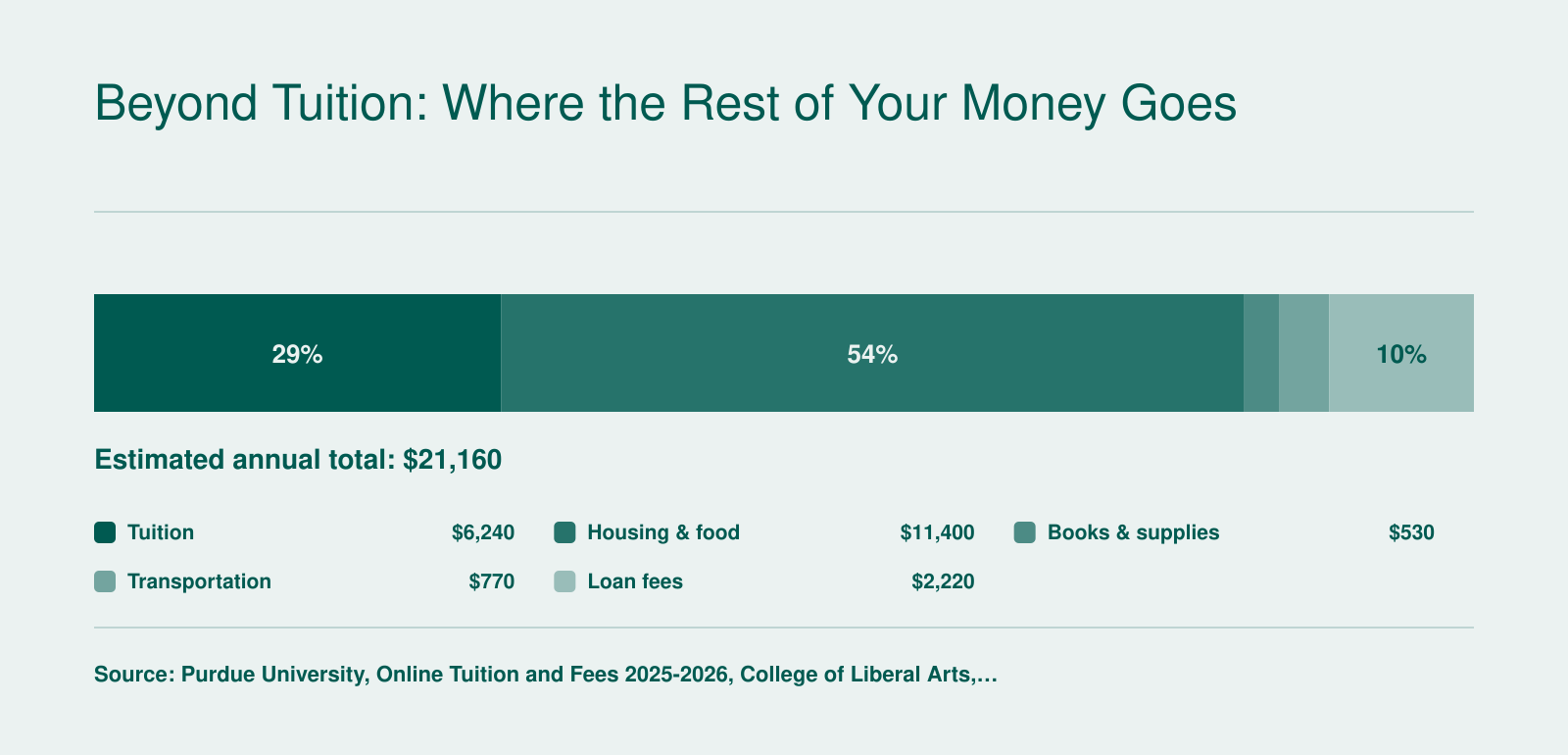
Tuition is only part of the bill. Purdue's published 2025-26 cost of attendance for its Master of Science in Communication assumes 6 credit hours in each of the fall and spring semesters, billed at $520 per credit, which comes to $6,240 in tuition. Housing and food, books, transportation, and federal loan fees add far more. Purdue does not list a separate technology or distance fee for this program. Online students often skip the housing line, but should check other schools for per-credit distance or technology fees, which Rutgers, for example, adds to its online semester fees.
Related Articles
Top Program-Level Earnings Among Ranked Schools
The highest program-level earnings figure among the ranked schools belongs to Columbia University's Master of Science in Strategic Communication.
Online vs. On-Campus Master's in Communication: How the Formats Differ
The format you choose affects your schedule, your access to internships, and, for international students, whether you can enroll at all. The ranking above labels each program as online, on-campus, or both, so you can filter before comparing the details below. Always confirm specifics with the program, because residency and scheduling rules vary even among fully online degrees.
| Factor | Online | On-Campus |
|---|---|---|
| Class schedule | Varies by program. University of Wisconsin Whitewater and University of Kentucky (Information Communication Technology) run asynchronously. University of Arkansas at Little Rock mixes Zoom and asynchronous courses, with live sessions in evenings and on weekends in U.S. Central Time. | Classes meet at set times on campus, so your work and commute schedule has to fit the department's calendar. |
| Residencies or intensives | Some programs require none. Wisconsin Whitewater has no requirement to come to campus. Check each program's page for residencies before you apply. | Not applicable, since you attend in person throughout the program. |
| Networking and internships | Networking happens through virtual cohorts, discussion boards, and faculty contacts. You usually arrange internships near where you live. | Easier access to faculty office hours, campus events, assistantships, and local employers, especially in a big media or corporate market. |
| Cost structure | You avoid relocation and commuting costs and can often keep your current job. Compare per-credit tuition and technology fees directly with the campus version. | Tuition plus housing, transportation, and possibly reduced work hours. Net price depends on aid and your residency status. |
| International students (F-1 visa) | Federal rules let only one online class, or 3 credits, count toward an F-1 student's full course of study each term. University of Hartford and Florida International University cannot support F-1 visas for their fully online programs. Franklin University lets international students earn a U.S. degree online from outside the country. | F-1 eligible, subject to the same limit of one online class or 3 credits per term. Schools handle visa sponsorship through their international student offices. |
| Employer perception | Most diplomas do not note delivery format, and the same faculty often teach both versions. Employers tend to focus on the school and your portfolio. | Carries no perception difference of its own, but may offer more in-person practice such as presentations, labs, and student media. |
What Top Communication Programs Ask for in an Application
Requirements vary by school, so confirm each program's current policy before you apply. These are the patterns across the programs we reviewed.
- Bachelor's degreeAn accredited four-year degree is the baseline. Many programs welcome career switchers, but policies differ. Delaware accepts any academic background, while Arizona State and Cincinnati ask for a related or communication major.
- Minimum GPAA 3.0 is the most common floor (Delaware, Cincinnati, Butler, Arizona State, Georgetown, American). Kent State lists 2.75. Delaware encourages applicants below 3.0 to apply if other strengths stand out.
- GRE policyMost programs no longer require it. Oregon, Georgetown, and Delaware do not, and UT Martin makes it optional. Rowan's official page still lists the General GRE, with a possible exemption for current undergraduates.
- Work experienceMost programs set no minimum. Butler requires four years of professional experience. Columbia says most full-time applicants have 0–5 years, and those with under two need strong internships.
- Application materialsExpect a statement of purpose, resume, and recommendation letters. Writing samples range from one 1,000-word piece at UT Martin to three at Oregon. Rowan asks for a portfolio and discourages term papers. International applicants typically submit TOEFL, IELTS, or similar scores.
- Selectivity contextInstitution-level admission rates reflect undergraduate admissions, so treat them as a loose signal only. Columbia's is about 4% and Rutgers' about 58%, and neither tells you how competitive the master's program is.
Communication programs by state
Quick Answers for Prospective Communication Grad Students
These are the three questions applicants ask most often before committing to a master's in communication. Requirements and timelines vary by school, so confirm details with each program before you apply.
Do I need a communication bachelor's degree to apply to a master's in communication?
Are online master's in communication programs respected by employers?
Can you finish a master's in communication in one year?
Compare Communication programs on the data that matters
Explore more Communications & Media specializations or browse every graduate field.
All Communications & Media programs