Best Master's in Organizational Communication Programs
Compare 50+ accredited Organizational Communication programs at 40+ schools, with graduate earnings, cost, debt, and completion data from IPEDS and the U.S. College Scorecard.

Florida State University's online organizational communication master's costs about $10,600 a year for in-state students; Seton Hall's campus cohort runs roughly $37,500 regardless of residency. That $27,000 spread captures the field's core tension: employers reward applied messaging and change-management skill, but no license sets a minimum credential, so price and format matter as much as a campus name.
Some of the best online master's in communications programs, including Florida State's online option, waive the GRE, lowering a major admissions barrier. The practical test is whether tuition and delivery model fit the internal-communication leadership roles graduates can actually land.
Key Points
- Florida State charges $26,707 out of state versus $10,553 in-state, a $16,154 gap.
- Most programs here are delivered online, so you can study around a full-time job.
- Thesis, applied capstone, or comprehensive exam: your final-project choice shapes both workload and career fit.
10 Top Master's in Organizational Communication Programs for 2027
These organizational communication master's programs stand out for applied coursework in change management, strategic communication, culture, and conflict, with flexible delivery options across online, campus, and asynchronous formats. The list below emphasizes programs that connect graduate study to real organizational work through capstones, internships, client projects, or research clusters. Use the cards to compare concentration depth, final project requirements, and the practical skills each program builds.
Florida State University
#1Tallahassee, FL · ~$11,000/yr (est.)
Best for: Online learners wanting behavior-analysis emphasis
Florida State pairs organizational communication with behavior analysis and performance management in a single applied degree. The curriculum moves through communication theory, group dynamics, project management, intercultural communication, and behavioral performance methods. A required capstone portfolio and comprehensive exam push students to convert coursework into tools for conflict resolution, data-driven strategy, and team motivation. It is built for working professionals who want a leadership-oriented, no-GRE path with multiple start dates.
- No GRE required
- 33 total credit hours and 12 courses
- Fully online with fall, spring, and summer start terms
- Capstone portfolio and comprehensive exam required
- Behavior analysis and communication focus
- Designed for working professionals
- Three letters of recommendation and statement of purpose
University of South Florida
#2Tampa, FL · ~$10,000/yr (est.)
Best for: Campus students focused on organizational culture
South Florida frames organizational communication through culture, crisis, resilience, and justice, using a research-cluster model that pools faculty across disciplines. Seminar-style classes emphasize dialogue, power, and the ways communication both shapes and reflects organizational life. Students study career communication strategies and organizational control alongside core organizational theory. It suits learners who want a critical, collaborative academic setting rather than a purely technical training program.
- Research cluster focus across communication fields
- Multiperspectival approach to organizing
- Courses include Organizational Communication
- Courses include Power and Control in Organizations
- Emphasizes crisis, resilience, and organizational justice
- Small seminar-style classes
University of Oklahoma – Hudson College of Public Health
#3Norman, OK · ~$9,000/yr (est.)
Best for: Research-minded students planning academic or applied careers
Oklahoma's organizational communication master's is centered on scholarship: leadership, decision-making, culture, socialization, and technology use in organizations. Students receive training in quantitative or qualitative methods and complete a thesis, making it a strong feeder for academic or applied research careers. Faculty research spans risk communication, small group dynamics, and health organizations, with courses in conflict management and communication leadership.
- Thesis required
- Training in quantitative or qualitative research methods
- Courses in conflict management and leadership
- Faculty research in risk communication and group dynamics
- Faculty experts in organizational communication
The University of Alabama
#4Tuscaloosa, AL · ~$12,000/yr (est.)
Alabama's communication studies master's with an organizational leadership specialization emphasizes conflict and negotiation, group leadership, and organizational communication theory. The capstone asks students to integrate learning into a real-world project. Electives in diversity and relational communication let learners tailor the degree toward team dynamics, corporate training, or HR paths.
- $480 per credit
- 30 total credit hours
- Complete in less than two years
- Capstone in final term
- No advanced math requirement
- Choose from four elective courses
- Year-round application acceptance
Seton Hall University
#5South Orange, NJ · ~$37,000/yr (est.)
Seton Hall's communication master's is an evening program for working professionals who want an organizational track grounded in decision-making, employee relations, management communication, and digital interaction. The 36-credit curriculum includes a thesis and is supported by industry-experienced faculty. Small cohort advising and proximity to New York metro employers are practical draws for students targeting corporate communication and HR roles.
- 36 total credit hours and 12 courses
- Thesis required
- Evening classes once per week
- Rolling admissions
- GRE or MAT waiver for qualified applicants
- Faculty with industry experience
- Personal academic and career advising
University of Kansas
#6Lawrence, KS · $12,000 – $27,000/yr (est.)
Kansas offers an organizational communication master's built around trust, conflict, global team leadership, and employee engagement. Students can move full-time or part-time and choose synchronous or asynchronous sections. The capstone project applies research-based insights to real organizational communication challenges, preparing graduates for HR, communications, and management roles.
- 30 total credit hours
- Full-time and part-time options
- Synchronous and asynchronous classes
- Capstone project required
- One letter of recommendation required
- Focus on trust and conflict prevention
West Virginia University
#7Morgantown, WV · ~$11,000/yr (est.)
West Virginia's corporate and organizational communication concentration is an asynchronous, cohort-based program taught by the same faculty who instruct on-campus doctoral students. The curriculum covers persuasion, ethics, social media management, workplace relationships, diversity, and conflict. Graduates often use the capstone case study to advance within their current organizations.
- 30 total credit hours and 10 courses
- Asynchronous online classes
- No GRE or GMAT required
- No communication prerequisite required
- Capstone case study project
- Cohort-based with same faculty as PhD program
Western Kentucky University
#8Bowling Green, KY · $12,000 – $18,000/yr (est.)
Western Kentucky's applied communication degree operates in 8-week bi-terms and emphasizes the human side of organizations: culture, strategic messages, conflict, ethical persuasion, and engagement. Students can pull electives from partner certificate areas such as data analytics, health administration, or marketing. The program integrates hands-on projects, analysis reports, and a capstone portfolio geared toward executive and nonprofit leadership.
- 31 total credit hours
- 8-week bi-term courses
- Asynchronous online classes
- Capstone portfolio required
- Graduate assistantships available
- Optional graduate certificate pairings
- Alumni report median earnings above $100,000
Ohio University
#9Athens, OH · ~$10,000/yr (est.)
Ohio University's organizational communication master's balances theory with real-world practice in decision-making, problem-solving, and organizing processes. Accelerated 7-week terms allow completion in as few as 18 months, and optional stackable graduate certificates in crisis communication, strategic communication management, and team leadership add focus. The Scripps College network and alumni scholarship opportunities are part of the program's professional ecosystem.
- Rolling admissions
- $17,000 total program tuition
- 30 total credit hours
- Dedicated support advisors assigned
- Career paths in HR, training, and project management
- Part of Scripps College of Communication
- Crisis Communication concentration
- 18-24 months completion
- No GRE required
- Seven total courses
- Stackable graduate certificates available
- Strategic Communication Management concentration
- Accelerated 7-week course terms
- Asynchronous online format
- Canvas learning platform
Texas A & M International University
#10Laredo, TX · ~$7,000/yr (est.)
Texas A&M International locates organizational communication in transnational settings, drawing on its Laredo border context. Students choose between a 30-credit thesis track and a 36-credit non-thesis track, with coursework in internal communications, cross-cultural organizational dynamics, and transnational media. The program is a fit for students interested in bilingual, cross-border, or Latin American organizational contexts.
- Thesis track: 30 credit hours
- Non-thesis track: 36 credit hours
- Two letters of recommendation required
- 500-word personal statement required
- Writing sample required
- Focus on transnational and cross-cultural communication
Cost & outcomes by school
Federal data for the highest-earning Organizational Communication programs, independent of the ranking above. Earnings are this field's master's graduates four years after completing, where the Scorecard reports them.
| School | Earnings | Tuition / yr | Debt | Grads/yr | Format |
|---|---|---|---|---|---|
| The University of Texas at Austin TX | $83,467 | $12,006 | $47,657 | 35 | Campus |
| West Virginia University WV | $78,276 | $11,412 | $39,224 | 154 | Online |
| Florida State University FL | $77,547 | $10,553 | $31,020 | 62 | Online |
| Drexel University PA | $70,518 | $39,261 | — | 16 | Campus |
| Murray State University KY | $51,638 | $10,683 | — | 9 | Online |
| The University of Texas at El Paso TX | — | $7,166 | — | — | Campus |
| Tarleton State University TX | — | $7,527 | — | — | Hybrid |
| Texas Southern University TX | — | $8,328 | — | — | Campus |
| The University of Texas at Tyler TX | — | $8,480 | — | — | Online |
| North Dakota State University ND | — | $8,786 | — | — | Campus |
| California State University-Sacramento CA | — | $9,542 | — | — | Campus |
| University of Oklahoma OK | — | $9,353 | — | — | Campus |
Sources: U.S. Department of Education. Tuition and graduates: IPEDS. Earnings and debt: College Scorecard, this field's master's graduates; a dash means no figure is reported.
Cost, debt & payoff
Median earnings of this field's master's graduates (4 yrs after completing) vs. their median federal loan debt · U.S. College Scorecard
Across these programs the median graduate earns about $77,547 and finishes with roughly $39,224 in debt — a ratio that clears a common rule of thumb (keep debt below first-year salary). Tuition and debt vary widely school to school, so check the per-school figures in the table above before you shortlist.
Inside Our Scorecard: The Earnings, Debt, and Completion Data Behind This List
Every school on this page earned its place on figures students can verify. The figures come from IPEDS and the College Scorecard, two federal databases anyone can search.
What Goes Into Each Profile
For every master's in communication program we look at graduate tuition, average net price after aid, and the institution's graduation rate. Where the federal data publishes them, we add program-level earnings and debt for graduates. We also note which formats are offered (online, hybrid, or on campus), including online master's in communication options, since that shapes both cost and time to degree.
Limits Worth Knowing
The graduation rate and net price we show are school-wide figures, not outcomes for the organizational communication program. A school's completion rate blends every degree it awards. Net price averages across aided students, so treat it as a benchmark, not a quote. Your own figure depends on your residency, credit load, and assistantship or employer support. Program-level earnings and debt are shown only where they have been published. Where they haven't, we say so instead of estimating.
Accreditation: The Check That Matters
Institutional accreditation is the baseline. The University of Kansas1 and the University of Southern Indiana are accredited by the Higher Learning Commission, and Liberty University by the Southern Association of Colleges and Schools Commission on Colleges. For Murray State, Ohio University, and West Virginia University2, the program sources we reviewed don't name the accreditor, so confirm it directly before applying.
No single specialized accreditor covers organizational communication master's programs. ACEJMC accredits professional journalism and mass communication programs, not academic communication degrees, and we found no evidence that any school named here holds it. That makes the university's institutional accreditation your key check.
What Organizational Communication Master's Programs Really Cost
In-state resident vs. out-of-state nonresident is the single biggest lever on what you'll pay for an organizational communication master's. The sticker price can swing by thousands depending on where you live, and the programs ranked here show just how wide that gap runs.
The Spread Between Cheapest and Priciest
At the low end, Southern Illinois University-Edwardsville charges the same roughly $10,500 whether you live in Illinois or not. At the high end, nonresident annual tuition climbs past $29,500 at West Virginia University and into the high $20,000s at the University at Albany and Florida State. For in-state students, several public options land near or below $10,000 a year, including Texas Southern, the University of Oklahoma, and West Virginia. That's a meaningful difference across a 30 to 36 credit degree.
Why Residency Changes the Math
Public universities subsidize tuition for their own state's residents, which is why they often rank among the most affordable organizational communication master's programs if you qualify for in-state rates. The advantage can disappear the moment you cross a state line. West Virginia's roughly $10,100 in-state rate nearly triples for nonresidents, and Albany's jumps from about $10,900 to over $31,000. Run the out-of-state number before assuming a public school is the cheaper choice.
Net Price and Online Flat Rates
Average net price figures, where available, are institution-wide approximations after typical aid, not a quote for your program or your situation. Treat them as a ballpark, never a guarantee. One more wrinkle: some public schools charge online students a single flat rate regardless of residency, which can erase the nonresident penalty entirely. Several programs here, including Western Kentucky, Florida State, and West Virginia, run fully online. Confirm the exact online tuition policy directly with each school before you compare.
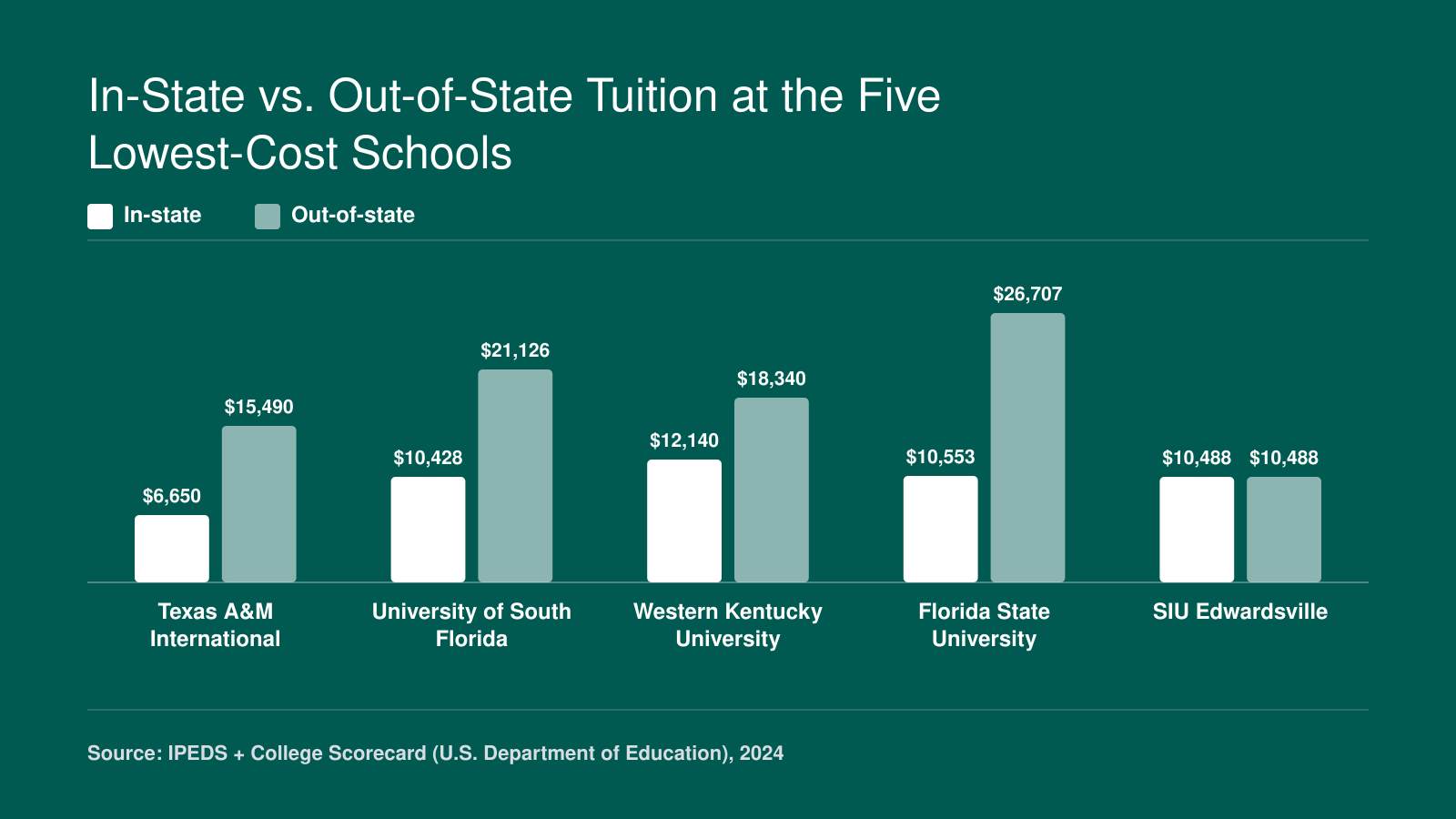
In-State vs. Out-of-State Tuition at the Five Lowest-Cost Schools
Residency changes the price of these programs far more at some schools than others. Florida State University shows the largest gap, at $26,707 for out-of-state students versus $10,553 in-state, a difference of $16,154. Southern Illinois University-Edwardsville has the smallest gap: it charges $10,488 regardless of residency, which makes it the most predictable option for out-of-state applicants.
Related Articles
Online, Hybrid, or on Campus: Pace, Scheduling, and Time to Degree
The tradeoff here is flexibility against structure: a self-paced online degree fits around a full-time job, while a campus cohort offers live faculty contact and a built-in network. Most of the programs below are delivered online. The University of South Florida, University of Oklahoma, Seton Hall, and Texas A&M International are campus-based.
Live Sessions vs. Self-Paced Courses
West Virginia, Western Kentucky, and Ohio University describe asynchronous classes. West Virginia uses a cohort model, while WKU and Ohio run short 8-week and 7-week terms. Kansas lists both synchronous and asynchronous options, plus full-time and part-time study. Seton Hall's campus program holds evening classes once a week. Gonzaga's online MA in Communication and Leadership Studies is broader than organizational communication and overlaps with organizational leadership, but it shows a common structure: online coursework plus one 3-day immersion, held on campus or online and synchronously.1
Time to Degree
A 30-credit online degree typically takes about two years when you study around a job. Florida State and West Virginia describe two-year timelines, and Alabama says less than two. Ohio lists 18 months, and WKU advertises a one-year program with part-time study available. Purdue's online Corporate Training & Communication lists 20 months. Southern Utah's online Professional Communication degree (36 credits, and broader than organizational communication) cites as few as 12 months. Treat accelerated claims as best-case, and ask each school how long full-time and part-time students typically take, since that is not always published.
Who Each Format Suits
- Working professionals: Asynchronous online programs with short terms are the easiest to fit around a job.
- Career changers: Cohort-based or synchronous formats make it easier to build contacts in a new field.
- Assistantship seekers: Campus programs are the more traditional route, though WKU's online program also mentions graduate assistantships. Confirm whether online students qualify.
Admissions Checklist: GRE Waivers, Prerequisites, and Deadlines
Requirements vary by school, so treat this as a planning guide and verify each program's current admissions page before you apply.
- Bachelor's degree and GPAPrograms expect a bachelor's degree from a regionally accredited institution or a foreign equivalent. Northeastern, Delaware, and Miami cite a 3.0 minimum GPA. Georgetown cites 3.00 for students applying in their final undergraduate year.
- GRE statusNo-GRE is common. USC, Georgetown, Minnesota, Delaware, Miami, and Oregon list no required exam, and Miami lets applicants submit scores voluntarily. Northeastern's catalog does not state a GRE policy, so ask the admissions office.
- PrerequisitesA communication major is generally not required. Delaware accepts any academic background, and Oregon welcomes varied backgrounds. Northeastern may require Foundations of Professional Communication (CMN 6005) of applicants without prior professional experience.
- Application materialsExpect a statement of purpose, resume, and recommendation letters. Some programs also request a writing sample or portfolio, as Oregon does. International applicants usually add TOEFL, IELTS, or similar English scores.
- DeadlinesFall deadlines range from June 15 at Georgetown to July 15 at Miami, with Minnesota at December 15, 2026 for Fall 2027. USC's Spring 2027 deadline is November 17, 2026. Delaware's Spring I deadline is January 21, 2027, and it admits on a rolling basis. Confirm current dates directly with each school.
In NACE's Job Outlook 2026 Spring Update, 78% of employers said they look for verbal communication skills on candidates' resumes, and 72% look for written communication skills. Those are the exact strengths a master's in organizational communication is built to sharpen, which makes them easy to showcase on a resume.
Thesis, Capstone, or Comprehensive Exam: Choosing Your Final Project
Near the end of an organizational communication master's, you have to prove you learned something. Programs ask for that proof in one of three ways: a thesis (original research you design, defend, and write up), an applied capstone (a project or portfolio built around a real organizational problem), or written comprehensive exams (timed essays covering the core curriculum).
What the paths look like in practice
Gonzaga's M.A. in Communication and Leadership Studies runs 30 credits, including 12 core credits and a 3-credit capstone built on COML 602.1 That capstone is applied rather than research-driven: students ground a project in communication theory, their own leadership philosophy, and ethics, then present it through a digital portfolio and a public forum. When a student has declared a concentration, such as strategic communication and organizational communication, the project topic is expected to connect to it.1
Western Kentucky University's M.A. in Applied Communication, with its organizational communication emphasis, gives you both doors. The thesis route uses 6 credits of COMM 599 and ends in an oral defense before a committee. The non-thesis route replaces those 6 credits with additional coursework (organizational communication, communication or human communication electives, or approved graduate courses outside the department) and adds written comprehensive examinations. Either way the degree totals 30 credits.2 WKU also offers a 1-credit applied communication portfolio course, COMM 598, for students assembling professional work samples.3
How to pick, and what the extra work costs you
Choose the thesis if a doctorate or a research-heavy role is plausibly in your future; the defense and committee experience is the closest thing to a PhD audition. Choose the capstone or portfolio if you want a tangible artifact to show hiring managers in corporate communication, internal comms, public relations, or HR-adjacent roles.
Internships exist at both schools but are not framed as universal requirements. Gonzaga's COML 520 carries 3 credits and roughly 120 hours with a site supervisor, arranged by the student1; WKU's COMM 596 is a 3-credit project-based internship under faculty direction.3 Neither school's published materials establish that every student must complete one. Budget extra time for a thesis, since defense scheduling rarely bends to your timeline, though neither program publishes a fixed added term.
Organizational Communication programs by state
Quick Answers for Prospective Org Comm Grad Students
These are the questions prospective students ask most often when comparing organizational communication master's programs. Figures reflect 2026 published program data and vary by residency, course load, and year, so confirm current rates with each school.
Which schools have the best master's in organizational communication programs?
What does a master's in organizational communication typically cost per credit?
Can I earn a master's in organizational communication fully online?
Which organizational communication master's programs waive the GRE?
How is a thesis track different from a non-thesis track in organizational communication?
How many credits and months does the degree usually take?
Is a corporate and organizational communication master's the same as a general communication master's?
Do employers care whether a communication master's program is regionally accredited?
Compare Organizational Communication programs on the data that matters
Explore more Communications & Media specializations or browse every graduate field.
All Communications & Media programs