Accelerated Master's in Organizational Communication Programs
Compare 50+ accredited fastest Organizational Communication programs at 40+ schools, with graduate earnings, cost, debt, and completion data from IPEDS and the U.S. College Scorecard.

Public relations managers earned a median $146,910 in May 2025, so the real question is whether a master's in organizational communication can be finished faster and for less than the standard two years. This is a verification guide, not a ranked list or count; schools are named only where their pages state the policy. What accelerated means, example pathways, admissions checks, shared-credit savings, accreditation, and salary outcomes follow. The shortlist test is whether a program's own catalog documents the savings.
Key Points
- Shared-credit pathways at Murray State, Ball State, Baylor, Virginia Tech save tuition.
- Public relations managers earned a median $146,910 in May 2025.
- Institutional accreditation makes credits transferable and eligible for federal aid.
Accelerated Master's in Organizational Communication Programs
-
#1
The University of Texas at Tyler
Master of Arts in Communication
$8,480grad tuition / yrNo GRE required30 credits12 monthsVisit program site →60score -
#2
Northeastern University
Master of Science in Corporate and Organizational Communication
$29,174grad tuition / yr12 monthsVisit program site →49score
How we rank. Each program is scored on graduate figures only: the field's master's earnings and debt, graduate tuition and the number of master's graduates, normalized across all programs in this field. Data comes from the U.S. Department of Education's IPEDS and College Scorecard; no school pays for placement.
Compare the top programs
| Rank | School | Earnings | Tuition / yr | Debt | Grads/yr | Format |
|---|---|---|---|---|---|---|
| 1 | The University of Texas at Tyler TX | — | $8,480 | — | — | Online |
| 2 | Northeastern University MA | — | $29,174 | — | — | Online |
Sources: U.S. Department of Education. Tuition and graduates: IPEDS. Earnings and debt: College Scorecard, this field's master's graduates; a dash means no figure is reported.
Cost, debt & payoff
Median earnings of this field's master's graduates (4 yrs after completing) vs. their median federal loan debt · U.S. College Scorecard
Across these programs the median graduate earns about $77,547 and finishes with roughly $39,224 in debt — a ratio that clears a common rule of thumb (keep debt below first-year salary). Tuition and debt vary widely school to school, so sort the ranking by "Most affordable" or "Lowest debt" to weigh cost against outcomes.
What 'Accelerated' Really Means: Shared-Credit Pathways vs. Compressed Course Terms
"Accelerated" is a marketing word, and schools use it for three different structures that save very different amounts of time and money.
The true accelerated master's, often called a 4+1, BA/MA, or combined degree, lets undergraduates take graduate courses that count toward both degrees. Because those shared credits are already completed, the master's can take about one extra year after the bachelor's instead of two.
Many online master's in organizational communication programs apply the same label to something else: 7- or 8-week terms. Each course moves faster, but the total credits required do not shrink, so you finish early only if you carry a heavier load.
One-year standalone master's programs are a third category. They share no credits with an undergraduate degree. They simply pack the full curriculum into a demanding schedule, which can make working while enrolled difficult.
Expect a master's in organizational communication to appear under other names. These pathways often sit inside broader communication, strategic communication, or mass communication master's programs as a concentration or track, so search those titles too. Then confirm that the program's own page states the accelerated policy in writing.
Example Accelerated Communication Pathways at Murray State, Ball State, Baylor, and Virginia Tech
A shared-credit cap tells you how much tuition you might skip; a GPA floor tells you whether you'll qualify at all (organizational communication master's tuition and total cost by school). The examples below come from each school's own published policy, not from any ranking, and they are listed only because the university states the terms itself.
- Murray State University (Accelerated BA/BS + MA/MS, Organizational Communication): up to 12 hours of shared graduate credit, a 3.0 cumulative GPA plus a 3.25 GPA in organizational communication coursework, and completion of four 300 to 400 level organizational communication courses by the end of the third year. Delivered entirely online.
- Ball State University (Accelerated Master's, Organizational and Professional Communication and Development): a 3.25 overall GPA and at least 75 earned credit hours, including 30 at Ball State. Online delivery.
The variation worth noticing is the entry gate. Murray State screens on coursework completed within the major and sets a higher bar inside the discipline than overall; Ball State screens on accumulated credit hours and applies one flat GPA. If Baylor or Virginia Tech is on your list, pull the department's accelerated pathway page directly. Credit caps, GPA minimums, and application windows change, so confirm the current terms before you apply.
What to Check on an Accelerated Program's Admissions Page
- GPA minimumsCheck separate cumulative and major GPA minimums, departments often set a higher bar in the major.
- Credit thresholdConfirm the completed credit or class standing requirement, such as junior status, before applying.
- Eligible majorsNote whether non-communication majors may enter and any required prerequisite coursework.
- Double-count limitsFind the maximum graduate credits that count toward both degrees and the minimum grade required for each.
- Deadlines and approvalCheck the application deadline and whether advisor approval or a faculty recommendation is required.
- Matriculation windowVerify how soon after the bachelor's you must start the master's, often within one or two terms.
Shared Credits and Tuition Savings: How to Read the Fine Print
The appeal of a shared-credit pathway is simple arithmetic, but the arithmetic only works if the fine print cooperates. Graduate courses you take as an undergraduate are usually billed at the undergraduate rate, and at many schools they fall inside flat-rate full-time tuition, meaning they cost nothing extra. Every credit that double-counts is a credit you never pay graduate tuition for later.
Running the numbers
Murray State publishes a graduate rate of $631 per credit hour for 2026-2027, applied to resident, regional, non-resident, and online students alike. Its fully online M.S. in Media and Strategic Communications requires 30 credits, 18 of them core coursework. At that rate, a pathway that double-counted nine credits would be worth roughly $5,700, and twelve credits roughly $7,600. Treat that as illustrative math rather than a quoted policy: Murray State's accelerated organizational communication pathway allows up to 12 shared credits, but for the strategic communication master's, confirm the figure with the department before you count on it.
Where the estimate moves
Add-on charges shift the total more than students expect. Murray State lists an online course fee of $50 per credit on its graduate tuition page and $75 per credit for web-format courses elsewhere, which is the difference between about $20,430 and $21,180 for the degree before semester charges. On-campus study adds a $200 technology fee and a $150 Racer Experience fee each semester. Also ask whether shared courses count against undergraduate credit caps, and whether out-of-state students pay the same rate.
Related Articles
Accreditation, Online Delivery, and Red Flags
Institutional accreditation is a review of the whole university by an agency recognized by the U.S. Department of Education, and it is what makes your credits transferable and your degree eligible for federal aid. Murray State, for example, is accredited by the Southern Association of Colleges and Schools Commission on Colleges, which authorizes it through the doctoral level. There is no single mandatory programmatic accreditor for organizational communication master's degrees, so institutional accreditation is the check that matters.
Delivery format varies and is often narrower than marketing suggests. Murray State offers its Media and Strategic Communications M.S. and its Mass Communications-Public Relations M.S. fully online; Ball State lists several communication master's options plus an online public relations program. Shared-credit pathways, though, usually require on-campus undergraduate enrollment for the overlapping courses, so confirm this directly with the department.
Watch for these warning signs:
- No named faculty or course list on the program page
- Vague language about which credits transfer or double-count
- An accreditor you cannot find in the Department of Education's DAPIP database or CHEA directory
- "Accelerated" claims that only mean eight-week terms
Median Pay for Public Relations Managers
Public relations managers earned a median annual wage of $146,910 in May 2025.
Career Paths and Salary Outcomes for Graduates
A master's in organizational communication opens several career lanes, but the degree alone does not set your pay. Typical roles include internal communications manager, public relations specialist, training and development specialist or manager, and corporate communications or change management lead, roles that overlap with organizational leadership master's careers.
BLS figures show the range. Public relations specialists earned a median of $74,750 in May 2025, with 2% projected growth for 2025 to 2035, slower than average.1 Training and development managers earned a median of $133,000, with 6% projected growth, faster than average.2 Public relations managers earned a median of $146,910.3 These are national occupational figures, not outcomes for any program's graduates.
The gap between $74,750 and $146,910 mostly reflects experience, industry, and management scope, not a single set of organizational leadership master's salary outcomes. O*NET reports that 83% of public relations managers hold a bachelor's as their required education and 14% a master's, so the degree helps but is not the gatekeeper.4
We found no published placement data for the Murray State, Ball State, Baylor, or Virginia Tech pathways. Ask each admissions office for first-destination data: employers, job titles, and the share employed within six months of graduation.
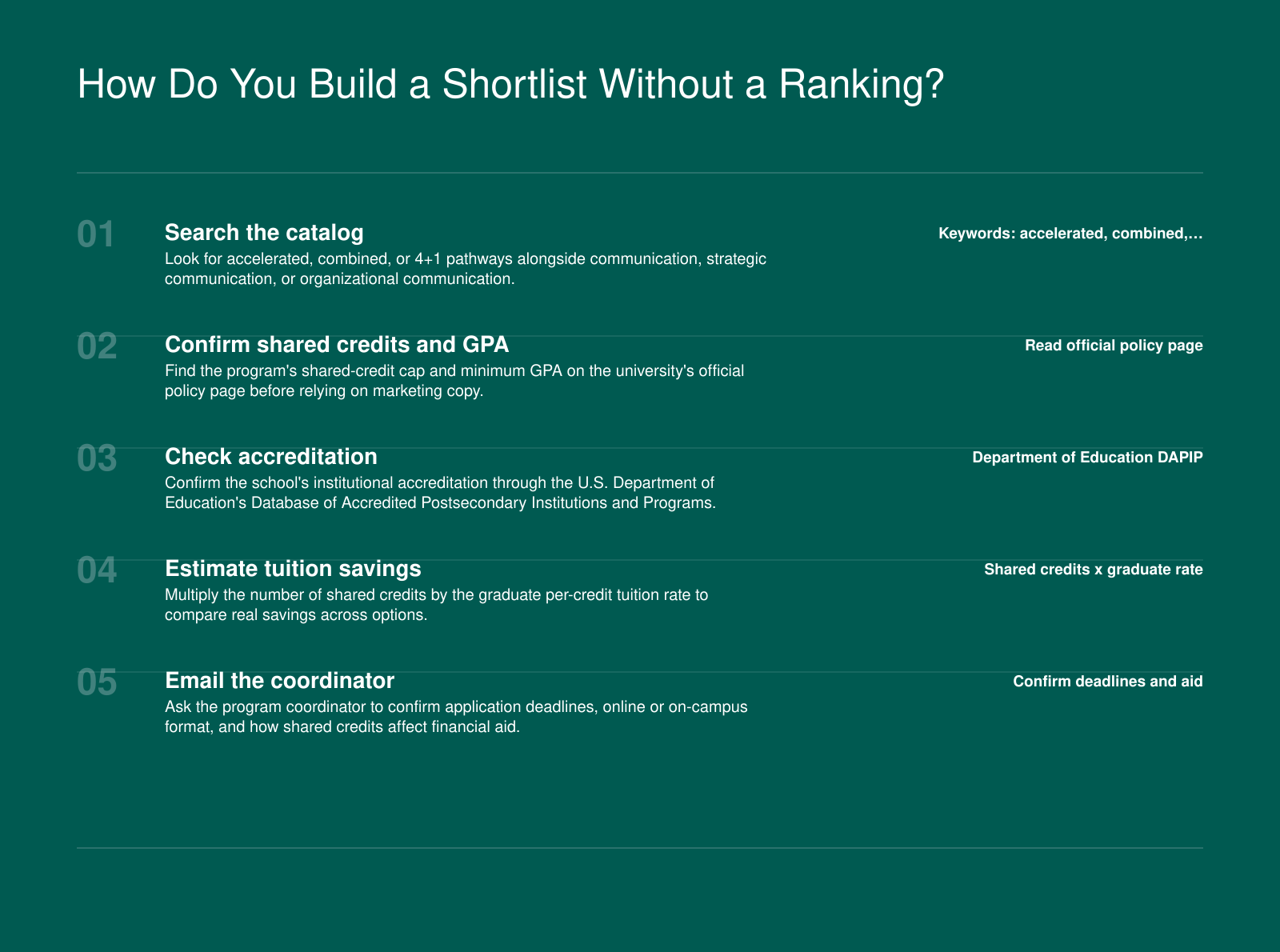
How Do You Build a Shortlist Without a Ranking?
A ranking is not the only way to find a strong fit. Check each program's own catalog, policy pages, and accreditation records to verify accelerated options and real savings before you apply.
Organizational Communication programs by state
Accelerated Organizational Communication Master's: Common Questions
How many credits can you double-count in an accelerated master's program?
Can you complete an accelerated organizational communication master's fully online?
Do accelerated students keep undergraduate financial aid during the shared-credit year?
Can accelerated students qualify for graduate assistantships or graduate-level federal loans once they move to graduate status?
Compare Organizational Communication programs on the data that matters
Explore more Communications & Media specializations or browse every graduate field.
All Communications & Media programs