Master's Programs in Idaho
Every master's program reported by a school in Idaho: 160+ programs at 10 graduate schools, with the online options, costs and outcomes behind each one.

How much does a master's degree actually cost in Idaho, and does the price gap between schools change what you earn afterward? Resident tuition at the state's public universities runs roughly $17,100 to $23,580 for a 30 to 36 credit degree, while nonresidents can pay two to three times that.
Idaho's graduate market is small, anchored by a handful of public universities and private options like Northwest Nazarene. With fewer schools competing, differences in cost, credit load, and study format matter more than any single name on a diploma.
That compact market also means licensure boards, not reputation, often determine whether a given program actually leads to the job you want.
Key Points
- Idaho residents pay roughly $17,100 to $23,580 in public master's tuition.
- University of Idaho requires a 3.0 GPA and no institution-wide GRE.
- Counseling licensure in Idaho needs 60 credits and a 280-hour practicum.
Popular degrees in Idaho
Master's programs in Idaho by field
Business & Management
- Accounting8 programs
- Public Administration7 programs
- Healthcare Administration4 programs
- Marketing3 programs
- Management3 programs
- General Business2 programs
- Finance2 programs
- Healthcare Management2 programs
Education & Teaching
- Curriculum & Instruction6 programs
- Educational Leadership5 programs
- Teaching4 programs
- Physical Education3 programs
- Special Education3 programs
- Music Education2 programs
- Secondary Education2 programs
- Elementary Education2 programs
Social Work & Social Sciences
- Social Work Advanced Standing6 programs
- Social Work6 programs
- Political Science, Government2 programs
Nursing
- Nursing Education or Nurse Educator5 programs
- Adult Gerontology Primary Care Nurse Practitioner2 programs
- Nurse Executive Leadership2 programs
- Adult Gerontology Acute Care Nurse Practitioner1 program
- Nurse Administrator1 program
- Direct Entry MSN (MENP) or (DEMSN)1 program
- Family Nurse Practitioner (FNP)1 program
Science & Engineering
- Environmental Science7 programs
- Sustainability or Environmental Management4 programs
- Geography1 program
Healthcare
- Public Health4 programs
- Nutrition3 programs
- Health Administration2 programs
- Exercise Science1 program
- Health Education1 program
- Speech Pathology1 program
Computers & IT
- Cybersecurity6 programs
- Information Security & Assurance2 programs
- Data Analytics1 program
- Machine Learning1 program
Counseling
- School Counseling3 programs
- Marriage and Family Therapy or Marriage and Family Counseling2 programs
- Clinical Mental Health Counseling2 programs
- Addiction Counseling1 program
Psychology
- Psychopharmacology3 programs
- General Psychology1 program
- School Psychology1 program
- Educational Psychology or School Psychology1 program
Religion & Theology
- Divinity2 programs
- Theology2 programs
- Youth and Family Ministry1 program
- Christian Leadership1 program
Arts & Design
- Creative Writing3 programs
- Interior Design1 program
- Fine Arts1 program
Communications & Media
- Communication2 programs
- Communication Disorders1 program
Criminal Justice & Law
- Public Policy1 program
- Homeland Security1 program
- Fire Science or Fire Administration or Fire Leadership1 program
How Much a Master's Degree Costs in Idaho: Tuition at Public and Private Schools
A 30 to 36 credit master's at an Idaho public university runs roughly $17,100 to $23,580 in tuition for residents and $31,110 to $65,448 for nonresidents, depending on the school. Figures reflect rates published in 2026 (Boise State in April, Northwest Nazarene in June, University of Idaho in October), cover tuition only, and can rise with program fees: the NNU MBA, for example, is $720 per credit plus a $150 technology fee each semester, and the University of Idaho online MBA is $850 per credit. Some online programs charge one rate regardless of residency, which erases the nonresident premium. Idaho State University's current rate was not available to us, so check its bursar page directly.
| School | Sector | Resident Graduate Tuition | Nonresident Graduate Tuition | Est. Tuition for a 30-36 Credit Degree |
|---|---|---|---|---|
| Boise State University | Public | $570 per credit for 1 to 8 credits; $5,855.50 per semester for 9 to 16 credits | $1,037 per credit for 1 to 8 credits; $15,699.50 per semester for 9 to 16 credits | $17,100 to $20,520 resident; $31,110 to $37,332 nonresident |
| University of Idaho (on campus) | Public | $655 per credit for 1 to 8 credits; $5,898 per semester for 9 to 20 credits | $1,818 per credit for 1 to 8 credits; $16,361 per semester for 9 to 20 credits | $19,650 to $23,580 resident; $54,540 to $65,448 nonresident |
| University of Idaho (part-time online, 1 to 9 credits) | Public | $655 per credit plus a $35 per credit web-based course fee | Same as resident: $655 per credit plus a $35 per credit web-based course fee | $20,700 to $24,840 for all students, regardless of residency |
| Northwest Nazarene University | Private | $964 per credit for NNU graduate students | $1,928 per credit for non-NNU graduate students | $28,920 to $34,704 for NNU graduate students; $57,840 to $69,408 for non-NNU graduate students |
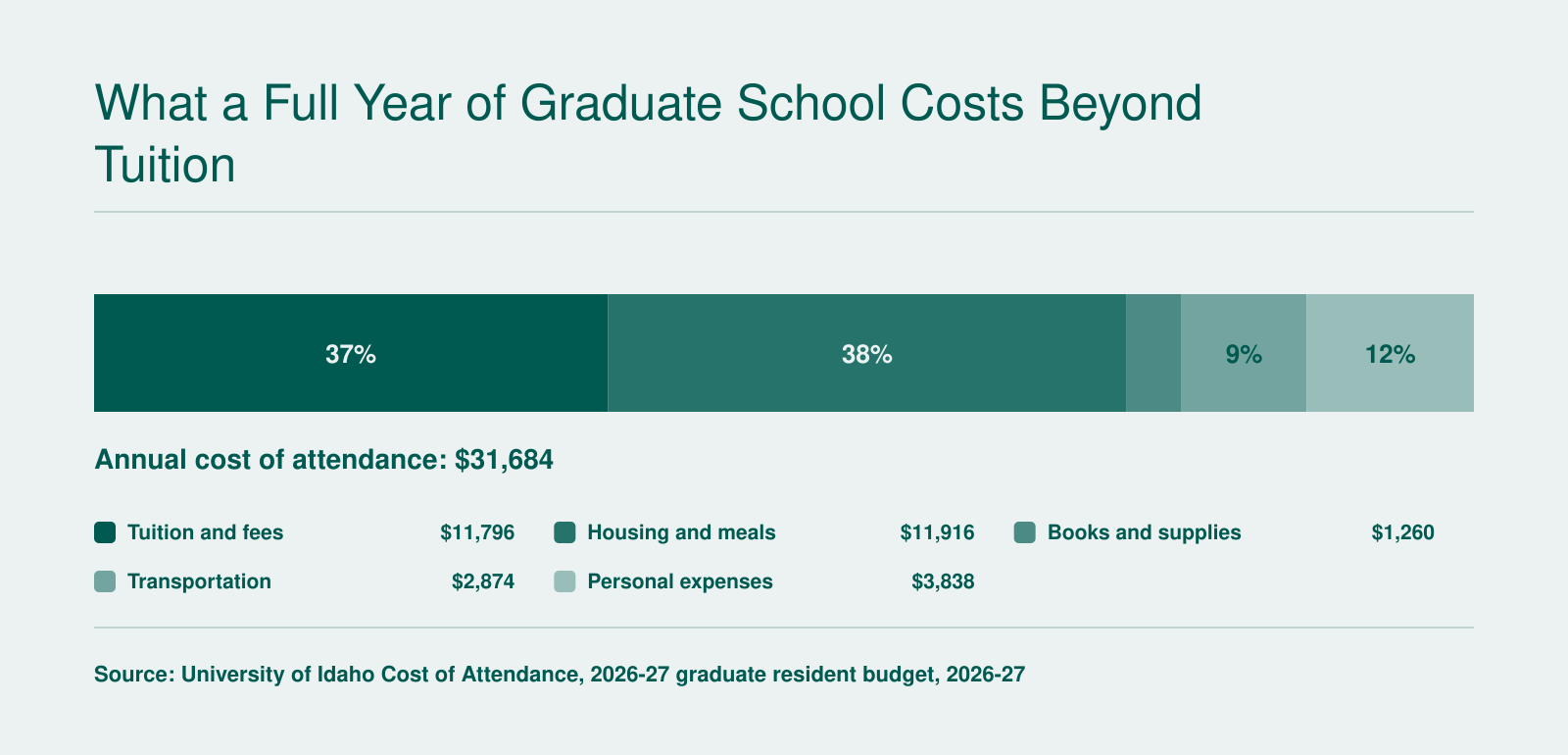
What a Full Year of Graduate School Costs Beyond Tuition
Tuition is only about a third of the University of Idaho's published 2026-27 graduate budget for an Idaho resident. The rest covers housing and meals, books, transportation, and personal costs. These are estimates, and your actual spending will depend on housing, meal plan, and enrollment. Living costs in Boise usually run higher than in Moscow or Pocatello, so the same budget can stretch further at a school outside the Treasure Valley.
The Cheapest Ways to Earn a Master's in Idaho
Start With Resident Tuition and a Shorter Degree
The lowest-cost route usually starts with Idaho resident tuition at a public university, not out-of-state or private rates. Next, compare the total credit load: a 30-credit master's is structurally cheaper than a comparable 36-credit degree, and flat-rate online programs, where available, can reduce campus fees and commuting costs. The exact difference depends on each school's published cost per credit and fee schedule, so check those figures before comparing advertised tuition alone.
Use Accelerated 4+1 Pathways
Several Idaho public universities let undergraduates begin graduate coursework before finishing the bachelor's.
- Boise State: Boise State's accelerated programs typically allow up to 9 graduate credits during the senior year to count toward both degrees, but the number varies by program. The electrical and computer engineering 4+1 track allows up to 9 credits and requires enrollment in the BSEE, at least 75 applicable credits, a 3.0 overall GPA, and a 3.3 GPA in ECE coursework.1
- University of Idaho: The 4+1 option is designed for current students who move directly into a one-year non-thesis master's after the bachelor's.
- Idaho State: Accelerated pathways allow up to 12 graduate-level credits during undergraduate study to count toward both degrees, while students still complete 120 undergraduate credits and at least 30 graduate credits.
Transfer Credit and WRGP Tuition
Graduate transfer credit can shorten the degree and lower cost. Idaho State caps external graduate transfer credit at 30 percent of the degree requirements, up to 12 credit hours, and accepts credit only from regionally accredited institutions. Individual programs may accept fewer, and only credit hours transfer, not grades. Boise State does not publish a single university-wide transfer maximum, so students should confirm the limit with the department.
Students from other WICHE states may be able to pay Idaho resident tuition through the Western Regional Graduate Program. Boise State's qualifying WRGP programs include anthropology, biology, criminal justice, history, political science, and raptor biology. These require WICHE-state residency and a minimum 3.30 GPA, and they are not available online. University of Idaho also participates in WRGP for selected graduate programs and does not list a minimum credit requirement for the tuition benefit.
Online, Hybrid, and On-Campus Master's Formats in Idaho
Online master's study is widely available in Idaho, but "online" rarely means you never set foot in a school, a clinic, or a classroom. Format varies by university and, more importantly, by program.
Which Idaho universities offer online master's programs
Boise State University offers master's study on campus, fully online, and in hybrid formats. Its online degrees are built to be flexible and asynchronous, so you can work through material on your own schedule. Some online master's programs there are described as requiring no campus visits, but that is a program-level feature, not a university-wide guarantee.
The University of Idaho offers fully online master's degrees alongside traditional formats, and it markets them to students across the country. Its 4+1 option lets a current undergraduate finish a master's in about 12 months after the bachelor's. The tuition benefit is limited to Idaho residents, though nonresidents may be able to qualify for Idaho residency.
Idaho State University delivers online and hybrid master's programs in education, health, business, social sciences, and humanities, plus specialized fields. Delivery can be asynchronous, synchronous, or mostly online, depending on the program.
Northwest Nazarene University (NNU) runs online master's programs aimed at working adults, especially in education and management. The M.Ed. in Curriculum, Instruction, and Innovation is 33 credits. The Educational Leadership: Principal M.Ed. is 36 credits and can be completed in 21 months.
Fully online, hybrid, or campus-only
Fully online programs suit coursework-based fields like business, curriculum and instruction, and some education tracks. Hybrid programs mix online sessions with scheduled in-person meetings. Campus-only programs are most common where hands-on instruction can't be moved online.
Clinical and field-based degrees are the main exception to "online." Nursing, clinical mental health counseling, and physical therapy typically require supervised practicums, clinical hours, or residencies in person. Idaho State notes that some programs require sponsorship, field experiences, practicums, or face-to-face clinical work. NNU's online educational leadership program includes a nine-month administrative internship in a school, which may be completed at your own teaching school with district and program-director approval.
Pacing for working professionals
Program length depends on the credit load and the field. Among NNU's online options, the Master of Management is described as a 15-month accelerated program, and the online Master of Arts in Teaching in Elementary Education runs about 16 months including a student-teaching semester. Many online programs use accelerated terms, while others follow standard semesters. Neither university-wide term lengths nor part-time timelines are standardized, so check each program's published schedule.
Out-of-state restrictions
Online does not always mean available everywhere. Licensure rules and state authorization can limit which states a program may enroll students from, especially in teaching, counseling, and nursing. If you live outside Idaho, confirm eligibility before you apply.
What Idaho Graduate Schools Typically Ask For
Requirements vary by program, but most master's applications at Idaho schools follow the same pattern. Confirm specifics on each department's page, since deadlines and test rules change from year to year.
- Accredited bachelor's degreeApplicants generally need a bachelor's degree from a regionally accredited institution. Some programs want a related major; others accept any field if prerequisites are met.
- Minimum GPAA 3.0 undergraduate GPA is a common benchmark, and some schools calculate it on your last 60 credits. Applicants slightly below the cutoff are sometimes admitted conditionally or on a probationary basis.
- Transcripts and applicationExpect to complete an online graduate application, pay a fee, and submit official transcripts from every college you attended.
- Statement of purpose and recommendationsMost programs ask for a statement of purpose and two to three recommendation letters. Academic or professional references carry the most weight.
- Resume and program-specific materialsA resume is standard. Some programs, such as design, writing, and counseling, may also require a portfolio, writing sample, or interview.
- GRE or GMATSubmit scores only where a program requires them. Many Idaho programs have dropped or waive these tests, so check before you spend money on an exam.
- English proficiency for international applicantsApplicants whose prior education wasn't in English typically submit TOEFL, IELTS, or Duolingo scores. Minimum scores differ by school and program.
- Prerequisites and licensureFields like nursing, counseling, and speech-language pathology may require specific prerequisite courses, clinical background, or an active license before you can enroll.
Application Deadlines, Test Policies, and GPA Minimums by School
University of Idaho sets a 3.0 minimum GPA through its College of Graduate Studies, charges a $50 application fee, and does not require the GRE institution-wide, though individual departments can set their own testing rules. Its April 1 priority deadline for fall and summer sits alongside rolling admission. Treat every figure below as a starting point: program-level deadlines, especially for assistantship consideration, often fall in early winter and can differ from the university-wide date. Cohort programs such as PA, PT, OT and SLP use fixed deadlines and sometimes centralized applications like CSDCAS or PTCAS, so confirm dates with the department before you apply.
| School | Minimum GPA | Application Fee | GRE/GMAT Policy | Typical Fall Deadline |
|---|---|---|---|---|
| University of Idaho | 3.0 | $50 | GRE not required institution-wide; departments may set their own requirements | April 1 priority deadline for fall and summer; rolling admission |
| Boise State University | 3.00 cumulative GPA for all undergraduate work | Non-refundable fee required; amount not stated on the cited page | Program-dependent; if required, send scores using Boise State code 4018 | Varies by program; confirm with the department |
| Idaho State University | Not confirmed here; check the graduate school | N/A | N/A | Varies by program; confirm with the department |
| Northwest Nazarene University | Not confirmed here; check the graduate school | N/A | N/A | Varies by program; confirm with the department |
Funding Your Master's: Assistantships, Scholarships, and Loans in Idaho
Start with funding before borrowing.
Graduate Assistantships: Tuition, Stipend, and Insurance
University of Idaho assistantship packages vary by department and funding source. Full-time appointments may cover 100% of tuition and half-time appointments 50%, but the unit that pays tuition depends on whether the position is a teaching or research assistantship. Out-of-state students generally receive a nonresident tuition waiver proportional to the appointment. Advertised fall 2026 stipends in a few programs range from about $19,000 to $23,400, but there is no universal amount. Health insurance is not usually part of the package, so assistants often need their own coverage or enroll in the student health insurance plan.
Boise State is more uniform. A full assistantship, up to 20 hours per week, includes full standard tuition and fees (including the nonresident portion), the minimum salary, and full monthly health insurance premiums.1 A partial assistantship, up to 10 hours per week, includes at least half of standard tuition and fees, half the minimum salary, and still the full monthly health premium.1 For 2026-2027, Boise State's standard graduate tuition is $5,855.50 per semester, so a full tuition waiver removes that cost before any stipend.2
Idaho State's 2026-2027 assistantship application describes a living stipend plus tuition and fee waivers. Assistantships are typically 19.5 hours per week, require at least 9 graduate credits, and run for one year with possible renewal. State Board rules require assistants to be full-time, fee-paying students, and students may still be charged full-time tuition and fees if approved for fewer credits or after a contract ends.
Scholarships, State Programs, and Where to Ask
Start with school-level scholarship portals. University of Idaho, Boise State, and Idaho State each maintain graduate funding pages with scholarships, fellowships, and program-specific awards. Statewide options for graduate students are less consistently published for 2026. Health workforce and teacher loan repayment programs may be available for students in eligible fields, but deadlines, awards, and service obligations change, so confirm directly with the state agency or your school's financial aid office.
Because assistantship funding is usually awarded at the program level, contact the department graduate coordinator as well as the graduate school. Ask what the appointment covers: tuition and fee waiver, stipend amount and payment schedule, health insurance, summer support, and renewal terms.
Federal Loans and Employer Tuition Assistance
If aid and savings do not cover costs, federal borrowing starts with Direct Unsubsidized Loans, which most graduate students may borrow up to $20,500 per academic year, subject to an aggregate limit that includes undergraduate debt. Grad PLUS Loans can cover remaining cost of attendance for borrowers who pass a credit check. Before borrowing, check current federal interest rates and any updated borrowing limit guidance for 2026-2027.
Employer tuition assistance is underused. Major Idaho employers sometimes reimburse a portion of graduate tuition for job-related coursework, so ask your human resources department before assuming a program is unaffordable.
Licensure and Career Outcomes for Idaho Master's Graduates
For most clinical and school-based master's degrees, the license or certificate matters as much as the diploma, and Idaho ties each one to a different agency. Check the current rules with the issuing board before you enroll, because details change.
Counseling and Social Work
Counselors are licensed through the Idaho Division of Occupational and Professional Licenses (DOPL). The Licensed Professional Counselor (LPC) path starts with a master's or doctoral degree in counseling, generally summarized as 60 semester credits, followed by the National Counselor Examination and roughly 1,000 post-degree hours under an approved supervisor.1 The Licensed Clinical Professional Counselor (LCPC) is a second tier. It requires an active LPC2, the NCMHCE exam, and 2,000 post-degree hours, including 1,000 hours of direct client contact, over at least two years.1
Social work runs through the Idaho Board of Social Work Examiners. The LCSW requires an MSW or DSW from a CSWE-accredited program1, an active LMSW before clinical supervision begins, the ASWB Clinical exam1, and 3,000 post-degree hours3 with at least 100 hours of face-to-face supervision4. Confirm the LMSW requirements directly with the board.
Nursing and Education
Nurse practitioners are regulated by the Idaho Board of Nursing. Expect a graduate degree from an approved nurse practitioner program plus national certification, but verify the exact APRN requirements with the board. School counseling and administrator candidates need certification from the State Department of Education, which typically involves graduate coursework and a field placement. Check the current endorsement rules for your role.
What These Jobs Pay
The figures below are 2025 occupational wages for everyone in the job, not what new master's graduates earn, and the available data is regional rather than statewide.
- Mental health and substance abuse counselors (North Central Idaho): $44,940 median.5
- Educational, guidance, and career counselors (North Central Idaho): $47,690 median.5 The Northern Idaho figure is lower, at $43,240.6
- Nurse practitioners (North Central Idaho): $97,540 median.5
- All occupations (Idaho): $47,970 median, a useful baseline.7
Reliable wage figures for social workers and education administrators were not available for this page. Counseling wages in these regions sit near the all-occupation median, so weigh tuition and supervised-hour years carefully. The nurse practitioner figure stands well apart.
Demand and Out-of-State Warning
Growth in the Treasure Valley, along with healthcare and teacher shortages across the state, keeps demand for clinicians and school staff strong, though openings vary by region and employer.
If you plan to study online from outside Idaho, confirm that the program meets licensure requirements in your own state. Practicum placement rules, supervisor approval, and accreditation expectations differ, and a program built around Idaho standards may not transfer cleanly.
Idaho Counselor Licensing at a Glance
How to Choose the Right Idaho Program: Accreditation, Cost, Format, and Fit
Some applicants choose a master's program by name recognition; others choose by total degree cost and licensure fit. In Idaho, the second approach tends to produce a more durable return.
Start with accreditation and licensure
Institutional accreditation from the Northwest Commission on Colleges and Universities (NWCCU) is the baseline.1 Boise State's reaffirmation was received in 2026, with its next full review due in 2033.2 Idaho State has been accredited since 1918, and Northwest Nazarene since 1930.1 Institutional accreditation protects federal aid eligibility and credit portability, but it does not by itself qualify you for a professional license.
For licensed fields, verify the specialized accreditor that matches your career path: - AACSB for business - CSWE for social work - CACREP for counseling - CCNE or ACEN for nursing - ASHA CAA for speech-language pathology - CAEP for education
Boise State holds AACSB,3 CSWE,4 CACREP,4 and CCNE accreditation, with its nursing programs accredited through 2030.5 At University of Idaho, Idaho State, and Northwest Nazarene, current specialized accreditation details are less consistently published. Contact the department directly and ask for written confirmation before applying.
Run the full-cost math
Compare total degree cost, not per-credit tuition. A low per-credit rate can still produce a higher total bill if a program requires more credits, stacks on fees, or offers limited assistantship funding. Ask for a net price estimate after typical assistantships, scholarships, and fee waivers. Also request licensure pass rates or job placement data for recent graduates, especially in counseling, MSN programs, and M.Ed. programs.
Match format and deadlines
Decide whether online, hybrid, or on-campus works with your job and location. Then check admissions fit: GPA minimums, test policies (including whether you need No-GRE master's programs), prerequisite coursework, and reference requirements. Use that screen to shortlist two or three programs.
Next step
Contact each department before the priority deadline and ask about assistantships, funding timelines, and licensure outcomes. A shortlist built on accreditation, total cost, format, and fit will almost always beat a decision based on name alone.
Graduate schools in Idaho with the most master's programs
| School | City | Type | Master's programs | Online | Grad tuition / yr |
|---|---|---|---|---|---|
| Boise State University | Boise | Public | 51 | 27 | $10,803 |
| Idaho State University | Pocatello | Public | 43 | 24 | $11,522 |
| University of Idaho | Moscow | Public | 31 | 16 | $10,816 |
| Northwest Nazarene University | Nampa | Private nonprofit | 19 | 14 | $11,634 |
| The College of Idaho | Caldwell | Private nonprofit | 6 | 1 | $23,700 |
| Lewis-Clark State College | Lewiston | Public | 3 | 3 | $10,230 |
| Idaho College of Osteopathic Medicine | Meridian | Private for-profit | 3 | 3 | — |
| Eagle Gate College-Boise | Boise | Private for-profit | 3 | 3 | $19,068 |
| New Saint Andrews College | Moscow | Private nonprofit | 2 | 0 | $11,200 |
| Provo College-Idaho Falls Campus | Idaho Falls | Private for-profit | 2 | 2 | $19,068 |
Program counts are the verified master's listings in our directory; tuition is the school-wide average for a full-time graduate student (IPEDS).
Frequently Asked Questions About Master's Programs in Idaho
These answers cover the questions prospective students ask most often about Idaho graduate school. Tuition and policies change, so confirm figures with each school's current schedule before you apply.
How much does a master's degree cost in Idaho?
What are the admission requirements for University of Idaho graduate programs?
What master's programs does Idaho State University offer?
Can I qualify for Idaho resident tuition after moving to the state for grad school?
Do out-of-state online students pay nonresident tuition in Idaho?
Compare programs nationwide
Many Idaho residents study online. Every ranked list above has an online lens, or browse every field.
Online master's programs Browse all fields