Master's Programs in Georgia
Every master's program reported by a school in Georgia: 990+ programs at 40+ graduate schools, with the online options, costs and outcomes behind each one.

The University of Georgia alone advertises more than 200 graduate degrees, and that is before counting Georgia Tech's ten fully online master's programs, Emory's professional schools, Georgia State's urban campus, and the regional USG institutions that run low-cost online degrees. The spread of options is real, and so is the spread in price: some online master's programs cost under $10,000 in total, while a private degree can run well past $60,000.
That gap is the tension most applicants face. A bigger name does not automatically mean a better return, and residency, format, and program choice move the final bill far more than prestige does. In Georgia, the same credential can cost six times as much depending on where you earn it.
Key Points
- UGA lists over 200 graduate programs, and Georgia Tech offers ten fully online master's degrees.
- UGA's 2026-2027 on-campus budget for residents totals $29,184, with tuition about 35%.
- Check program-level accreditation and Georgia licensure rules before enrolling, especially for counseling and nursing.
Popular degrees in Georgia
Master's programs in Georgia by field
Business & Management
- Accounting35 programs
- Public Administration32 programs
- Healthcare Administration29 programs
- Marketing26 programs
- Management24 programs
- Healthcare Management21 programs
- General Business20 programs
- Analytics20 programs
Education & Teaching
- Teaching42 programs
- Elementary Education23 programs
- Special Education22 programs
- STEM Education or Science Education or Mathematics Education20 programs
- Educational Leadership19 programs
- Secondary Education16 programs
- Educational Technology or Instructional Design12 programs
- Art Education11 programs
Nursing
- Family Nurse Practitioner (FNP)16 programs
- Nursing Education or Nurse Educator16 programs
- RN to MSN8 programs
- Adult Gerontology Primary Care Nurse Practitioner6 programs
- Psychiatric Mental Health Nurse Practitioner6 programs
- Nurse Administrator6 programs
- Health/Nursing Informatics5 programs
- Public Health5 programs
Healthcare
- Health Administration13 programs
- Health Informatics13 programs
- Public Health12 programs
- Exercise Science9 programs
- Nutrition7 programs
- Health Education7 programs
- Speech Pathology7 programs
- Clinical Research Management2 programs
Communications & Media
- Communication13 programs
- Communication Disorders6 programs
- Speech Pathology6 programs
- Media Communication3 programs
- Public Relations3 programs
- Technical Communication2 programs
- Social Media2 programs
- Communication Management2 programs
Computers & IT
- Cybersecurity16 programs
- Data Analytics8 programs
- Information Security & Assurance8 programs
- Machine Learning7 programs
Counseling
- Clinical Mental Health Counseling18 programs
- School Counseling12 programs
- Marriage and Family Therapy or Marriage and Family Counseling4 programs
- Addiction Counseling2 programs
- Christian Counseling2 programs
Psychology
- Counseling Psychology11 programs
- Educational Psychology or School Psychology6 programs
- Applied Behavior Analysis5 programs
- General Psychology3 programs
- Industrial Organizational Psychology3 programs
- Clinical Psychology3 programs
- School Psychology1 program
- Sports Psychology1 program
Social Work & Social Sciences
- Social Work14 programs
- Social Work Advanced Standing8 programs
- Sociology7 programs
- Human Services3 programs
- Political Science, Government3 programs
Religion & Theology
- Theology9 programs
- Divinity8 programs
- Christian Ministry7 programs
- Christian Leadership2 programs
- Youth and Family Ministry1 program
Arts & Design
- Creative Writing13 programs
- Fine Arts3 programs
- Interior Design1 program
Science & Engineering
- Sustainability or Environmental Management6 programs
- Geography5 programs
- Environmental Science5 programs
Criminal Justice & Law
- Public Policy3 programs
- Master of Laws3 programs
- Legal Studies1 program
- Homeland Security1 program
- Cybercrime1 program
- Business Law1 program
Georgia's Top Graduate Schools at a Glance: UGA, Georgia Tech, Emory, GSU and More
The University of Georgia advertises more than 200 graduate degrees, certificates and programs of study across its colleges, and Georgia Tech runs ten fully online master's degrees plus three hybrid professional master's.1 Those two public research universities anchor the state's graduate landscape, but they are far from the only options worth comparing.
The Major Research Universities
- University of Georgia (UGA): Strong in education, MBA programs, public health, social work, engineering and data science. UGA lists 200+ graduate programs and has offered a sizable slate of fully online master's degrees (roughly 40 by an earlier count), so distance learners have real choices here.
- Georgia Tech: The clear leader for engineering, computing, data analytics, statistics and business. Ten of its master's degrees are fully online, including the widely known Online M.S. in Analytics,2 Online M.S. in Cybersecurity,1 and an online Electrical and Computer Engineering master's.3
- Emory University: The private option, with interdisciplinary graduate strengths in technology, data, health, biomedical innovation, economics and global development through its Laney Graduate School.4 Delivery formats vary by program, and online availability is not consistently published.
Georgia State and the Regional USG Schools
Georgia State University (GSU), Kennesaw State, Georgia Southern, Augusta University and Valdosta State round out the field as the regional USG schools; Mercer University is the private option, and its regional campuses often cater to working adults. We would normally list each school's exact master's count, signature strength and online status here, but current, comparable figures for these six are not published in a way we can verify this year. Different sites count degrees, concentrations, certificates and combined programs differently, so a single headline number can mislead.
What we can say plainly: GSU is a large Atlanta research university with broad graduate offerings, Augusta University is tied to health sciences, and Kennesaw State, Georgia Southern, Valdosta State and Mercer each run master's programs aimed partly at regional and online students. Confirm the specific program, format and current catalog directly with each school before you commit.
Where to Go Next
Program names are only half the decision. The sections that follow break down which Georgia master's degrees run fully online versus hybrid, what a year of graduate study actually costs at a public university here, and which programs come in cheapest, so you can weigh name recognition against real price and delivery format.
Online Master's Programs in Georgia: Fully Online, Hybrid and Campus Formats
The real tradeoff with online study is flexibility against hands-on contact. Georgia offers plenty of the former: UGA Online, Georgia Tech's online MS programs (OMSCS in computer science, OMSA in analytics and an Online M.S. in Cybersecurity), Georgia State and Kennesaw State all run online graduate options, and the University System of Georgia coordinates shared online programming through its eCampus. Offerings change often, so confirm current lists directly with each school.
Three Delivery Formats, Three Examples
- Fully online: UGA's M.Ed. in Learning, Design, and Technology (Research-Oriented Learning Design track) is 100% online and cohort-based, requiring at least 36 credits, typically completed full time over four semesters. Georgia Tech's Online M.S. in Cybersecurity, which appears among the Best Master's in Cybersecurity Programs, is also fully online and designed for part-time students, taking two to three years.1
- Hybrid: At least one Georgia Tech Professional Education online master's pairs two years of online coursework with three week-long visits to Atlanta.2 Some programs fall in between. UGA's online M.A.Ed. in Art Education lets students attend a one-week studio residency in Athens but doesn't require it, and that residency counts for no more than 5% of the 30 credits.
- Campus-only: Many research-heavy and lab-based degrees, such as Georgia Tech's residential MS programs, still expect you on campus for the full program.
Where "Online" Still Means Showing Up
In licensure-track fields, online coursework rarely covers everything. Nursing programs, including those ranked among the Best MSN Programs, require supervised clinical hours, counseling degrees require practicum and internship placements, and teacher-preparation programs require student teaching. These are usually done at an approved site near you, but they're scheduled, in-person and sometimes unpaid. Ask any program how it arranges placements before you enroll, especially if you live outside Georgia.
Online Tuition Isn't Always Residency-Free
Online rates can be a real advantage for out-of-state students, but don't assume a single flat price applies. Georgia Tech's flagship online programs are a good example. Beginning fall 2026, the Board of Regents approved separate in-state, out-of-state and out-of-country rates for OMSA, OMSCS and the Online M.S. in Cybersecurity. Georgia Tech reported increases of 1%, 5% and 10% for those three groups, compared with a 3% per-credit increase for its other online and professional master's programs.3 Even so, the costs stay low: OMSCS lists $227 per credit hour for fall 20264, OMSA shows about $11,880 in total tuition5, and the cybersecurity degree runs under $12,0001. Check which residency tier each figure applies to.
Fees add up as well. Georgia Tech charges an online learning fee of roughly $212 to $531 per semester depending on course load5, and UGA Online charges online students $431 per semester. Include those fees when you compare total cost.
How Much Does a Master's Degree Cost in Georgia?
What does a year of graduate school actually cost in Georgia, and how much does residency change the number? The honest answer is that published rates vary widely by school and by program, and only a few Georgia institutions post complete, current graduate schedules you can plan against.
Published 2026-2027 rates at UGA and Georgia State
These are the figures the two schools publish for the 2026-2027 academic year. Both exclude program-specific surcharges.
- University of Georgia: $431 per credit hour in-state and $1,326 out-of-state for 1 to 11 credits; full-time study at 12 or more credits is billed flat at $5,172 per semester in-state and $15,912 out-of-state.1 UGA's financial aid office uses weighted annual averages of roughly $10,124 in-state and $31,148 out-of-state for budgeting purposes.2 All of this excludes mandatory fees.
- Georgia State University: $516 per credit hour in-state and $1,442 out-of-state, with annual starting-at figures of $13,274 in-state, $36,716 out-of-state and $37,688 for out-of-country students, plus $660 in mandatory fees. Fully online students are quoted $464 per credit hour with a $660 online learning fee once they reach six credits.
Comparable current graduate schedules for Georgia Tech, Kennesaw State, Georgia Southern, Valdosta State, Emory and Mercer are not published in a form that allows a clean side-by-side comparison here. Check each bursar's office directly before you build a budget, and note that Emory and Mercer, as private universities, charge one rate regardless of where you live.
Fees and program rates change the math
The sticker tuition is rarely the final bill. Georgia State's mandatory fees add $660, and the amounts a reader sees quoted as "graduate tuition" almost never include them. Program-specific rates also diverge sharply from the standard schedule. UGA charges $664 per credit for the M.S. in Comparative Biomedical Sciences, $694 for the M.S. in Data Science, $871 for the Master of Business and Technology, and $914 for the M.S. in Civil and Environmental Engineering.3 Professional programs including the MBA programs, JD, MSW programs, PharmD and DVM are priced separately.1 Assume nursing, business and engineering cost more than the baseline, not the same.
Closing the residency gap
At Georgia's public universities, nonresidents pay roughly three times what residents pay. Two routes narrow that. First, online eRates: UGA sets per-program online graduate rates that apply no matter where you live3, and Georgia State's online per-credit rate sits below its in-state campus rate. Second, assistantships and tuition waivers, which many departments attach to funded positions. If you are out of state, ask about both before you accept an offer.
Where the Money Goes: A Typical Year of Graduate Study at a Georgia Public University
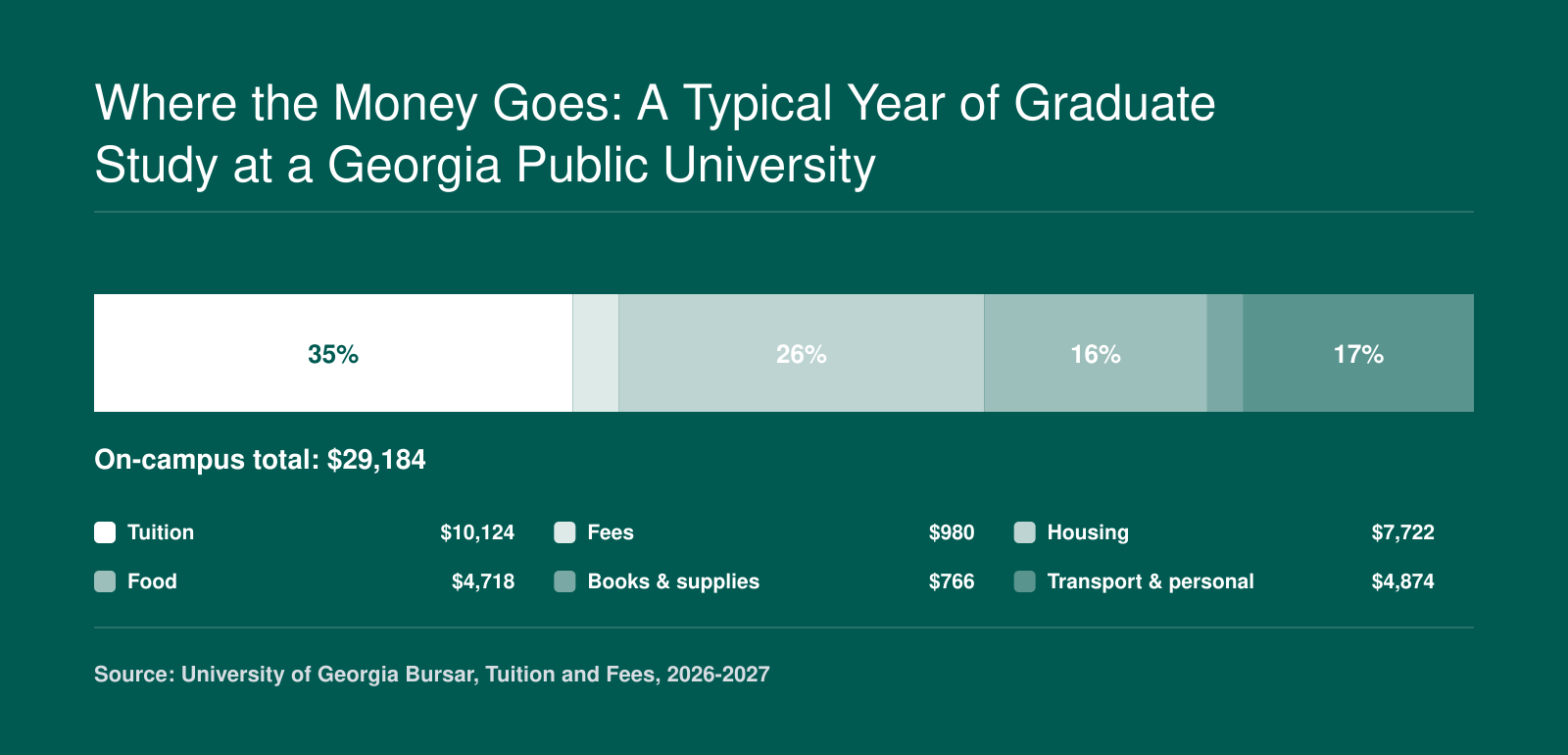
The University of Georgia publishes a graduate cost-of-attendance budget for Georgia residents. For 2026-2027, the on-campus budget totals $29,184. Tuition is about 35% of that, so for campus students it is often less than half the real annual cost. Off-campus students face a higher total of $35,494, mostly because housing and personal expenses are budgeted higher.
Cheapest Master's Programs in Georgia
The cheapest master's programs in Georgia are the ones with the lowest total bill for the whole degree, not just the lowest price per credit. Based on the official 2026 figures we could verify, Georgia Tech's Online MS in Computer Science (OMSCS) is the clearest low-cost benchmark. We could not confirm current tuition pages for Valdosta State, Georgia Southwestern State, Columbus State, Clayton State, or USG eCampus, so we cannot say which of them is cheapest. Check each school's bursar page before you rank them.
Georgia Tech Online Options
- OMSCS: Fall 2026 tuition is $227 per credit hour across a 30-credit minimum,2 about $6,810 in base tuition.1 Mandatory online-learning fees run $212 to $531 per semester,1 so your final total depends on course load.
- Online MS in Management: Georgia Tech estimates total tuition at $18,030 for Georgia residents, with out-of-state and international totals roughly $39,000 to $40,000. Semester fees ($176 to $440) are listed separately.3
- Online MS in Mechanical Engineering: Six credit hours cost $6,632 in tuition plus $440 in fees. A full-degree total is not published on the page we reviewed.4
- Online MS in Analytics and Cybersecurity: Approved FY2027 increases are 1% in-state, 5% out-of-state, and 10% out-of-country.5 We could not confirm the resulting per-credit rates.
Per-Credit Price Versus Total Cost
A low per-credit rate can mislead. A 48-credit program at a modest rate can cost more than a 30-credit program at a higher one. Semester fees add up too, especially if you take one course at a time over several years. Divide by required credits, then add fees for every term you will be enrolled.
Ways to Lower the Bill
- Assistantships: Graduate assistantships at regional USG campuses often include a tuition waiver plus a stipend, though availability varies by department.
- Differential waivers: Some schools reduce or waive the out-of-state tuition differential for certain students or programs. Ask the graduate office.
- Employer assistance: Tuition benefits can cover part of the cost, so check your company's policy before you enroll.
Tuition is subject to change, so confirm every figure with the school before you apply.
Admission Requirements, GRE/GMAT Waivers and Deadlines
Georgia master's admissions are set largely at the program level, so the department's page always outranks any general rule. The details below are drawn mainly from University of Georgia (UGA) published pages. Confirm current policies with Georgia Tech, Emory, Georgia State and Kennesaw State directly.
- Bachelor's degree and GPAExpect to need a bachelor's degree from a regionally accredited institution. Many programs look for a GPA of roughly 2.75 to 3.0, but UGA's Graduate School does not set one minimum for all master's programs. Competitive programs often admit students well above any stated floor.
- GRE/GMAT: required or waived?Many programs no longer require scores or offer waivers based on GPA or work experience, but this varies by department. UGA's Graduate School leaves exam requirements to each program, so there is no single UGA answer. Check the specific program page for current rules, including at Georgia Tech, Emory and Georgia State, whose policies we have not verified here.
- Application materialsPlan on official transcripts, letters of recommendation, a statement of purpose and a résumé. Some programs add writing samples or portfolios.
- English proficiencyNon-native English speakers are typically asked for TOEFL or IELTS scores. Minimum scores differ by program, so confirm them before you pay for a test.
- Fall deadlines (priority and funded programs)UGA's MA in Political Science and International Affairs sets a December 1 priority date and a February 15 final date for Fall 2026. Grady College's journalism and emerging media master's programs use March 1.
- Later and rolling-style deadlinesUGA's Graduate School lists July 1 for domestic fall applicants and April 15 for international applicants. The MS in Financial Planning follows those dates. Some programs start in summer: the Communication Sciences and Disorders master's closed January 15 for Summer 2026. Departments can set earlier dates than the university-wide ones, so always check the program page.
Your Application Timeline for Fall Entry
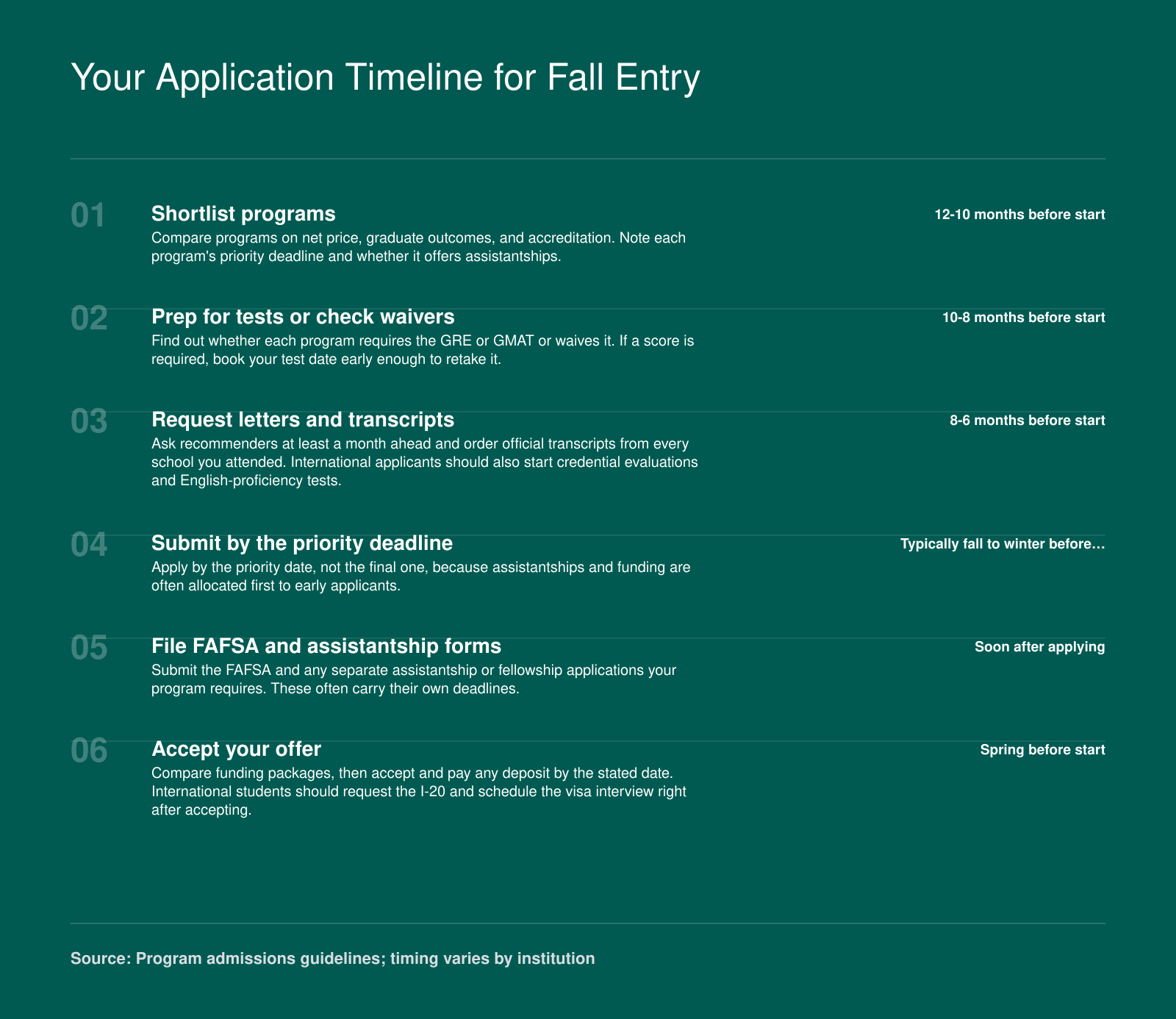
Fall admission runs on a 12-month clock, and the earliest deadlines are the ones tied to funding. Work backward from your target programs' priority dates, which vary by school and program, and confirm each one on the program's own admissions page.
Accreditation and Licensure: What to Verify Before You Enroll
Institutional accreditation
Georgia Tech, Emory and Georgia State are accredited by SACSCOC, the regional accreditor for the Southeast. Georgia Tech was reaffirmed in 20251 and Emory in 2024.2 Georgia State was last reaffirmed in 2019. Confirm UGA's current standing on the SACSCOC membership list2, since its review dates weren't established in our research. This matters because credits transfer more readily from accredited institutions, federal aid requires it, and employers and licensing boards expect it.
Programmatic accreditors by field
Institutional status does not replace field-specific review. Check the accreditor that matches your degree:
- Business: AACSB
- Counseling: CACREP
- Nursing: CCNE or ACEN
- Public health: CEPH
- Education & Teaching Master's Programs: CAEP
- Engineering: ABET
Some statuses are confirmed. Georgia State's counseling master's is CACREP accredited through October 31, 2027. CEPH accredits the UGA College of Public Health through July 1, 2029, and the Georgia State School of Public Health through December 31, 2028.3 CEPH can cover a whole school or only certain programs, so if you're comparing CEPH-accredited MPH programs, confirm your specific degree is included.
How accreditation links to licensure
Georgia's professional counselor rule requires a master's in counseling or applied psychology with at least 300 hours of supervised practicum or internship, from an institution regionally accredited by a CHEA-recognized body.4 CACREP is not universally mandated in that rule, but it can affect exam eligibility and moving your license to another state. Teaching is separate: educator preparation runs through Georgia Professional Standards Commission approval5, and school counselors need a master's or higher. CAEP and that state approval are different things. For nursing or nurse practitioner programs, ask which Georgia Board of Nursing requirements apply to your license or APRN role.
Online students living outside Georgia should also ask whether the university is authorized to enroll them in their home state, especially for licensure tracks.
A quick verification method
Search the school in the CHEA or U.S. Department of Education database. Then look up the program in the accreditor's own directory, such as CACREP, CEPH or CCNE. Match the institution, degree level and specialty, and note the expiration date.
Licensure in Georgia
Career and Salary Outcomes for Georgia Master's Graduates
Georgia's job market is pulling master's graduates toward healthcare management, technology, and education, and the pay gap between those paths is wide.
Which Master's Degrees Are in Demand
Georgia Department of Labor projections point to nurse practitioners, physician assistants, school and vocational counselors, education administrators, and occupational therapists5 as growing roles that typically call for graduate study.2 Georgia's workforce trends report also projects nearly 77,000 new STEM jobs through 2026, led by software developers and nurses.3 Computer science, cybersecurity, and data analytics master's programs feed that pipeline, though many tech roles accept a bachelor's degree plus experience, so the degree is an advantage rather than a requirement.
Atlanta's employer base shapes this demand: large health systems, logistics and supply chain management firms, fintech companies, and a sizable film and media sector all hire locally.
What These Fields Pay in Georgia
State labor figures for 2026 show how much the field matters:
- Nurse practitioners: median wage of $101,900, about 420 openings a year.2
- Physician assistants: $100,800, about 400 openings.2
- Education administrators (K-12): $94,400, about 730 openings.2
- School and vocational counselors: $55,300, about 1,270 openings.2
- Instructional coordinators: $57,600, about 700 openings.2
For comparison, the state's mean wage for workers with an advanced degree is $74,602.4
Weighing Earnings Against Debt
Field-level College Scorecard earnings for master's graduates at UGA, Georgia State, and Emory were not available in the data we reviewed, so we won't estimate them. The Scorecard profile for Georgia Tech lists median total debt after graduation of $21,672, but it does not say whether that figure covers master's students only.1 Treat it as a rough marker, not a program-specific number.
The practical test: compare a program's total cost with the median wage for the job it leads to. A counseling degree paying in the mid-$50,000s demands a lower price than family nurse practitioner programs paying roughly twice that. Check each program's own Scorecard page for earnings and debt before you commit.
Master's-Level Pay in Georgia
Nurse practitioners, a master's-level occupation, earn a median annual wage in Georgia of
Master's Programs in Georgia for International Students
Studying online from abroad and studying on a Georgia campus are two different paths, and only one of them comes with a student visa. International students can enroll in many online master's programs in Georgia from their home countries. But fully online study does not qualify for an F-1 visa. To live in the U.S. on that visa, you need a campus program, or a hybrid format that meets SEVP rules on in-person coursework. Confirm this with the school's international office before you pay a deposit.
What Campus Applicants Need
Schools such as Georgia Tech, UGA, Georgia State and Emory each set their own requirements, and minimums often vary by department. Check the program page for the exact numbers rather than relying on a general figure. Most applicants should expect to provide:
- English proficiency: TOEFL or IELTS scores that meet the program's minimum. Some schools waive this for applicants who earned a prior degree taught in English.
- Proof of funding: Bank or sponsor documentation showing you can cover tuition and living costs. The school uses it to issue your I-20, the form you need to apply for the F-1 visa.
- Credential evaluation: A course-by-course report from a service such as WES, where the program requires one for degrees earned outside the U.S.
STEM Designation and OPT
Many programs in engineering, computing, data science and the sciences carry a STEM designation, and Georgia Tech, GSU and UGA all offer such options. A designated degree can qualify you for the STEM OPT extension, which lengthens the time you can work in the U.S. after graduation beyond standard OPT. Eligibility depends on the program's federal classification code, not on how a department describes itself, so ask the school for the code and check it before you commit.
Cost and Funding
International students pay out-of-state tuition at public universities, which makes the sticker price higher than what Georgia residents see. Some graduate assistantships and departmental awards are open to international students, and these can reduce the cost, though competition is strong and availability varies by program. Research-oriented and thesis-track programs tend to offer more of this support than professional, coursework-only degrees, so ask each department directly about funding before you apply.
Graduate schools in Georgia with the most master's programs
| School | City | Type | Master's programs | Online | Grad tuition / yr |
|---|---|---|---|---|---|
| University of Georgia | Athens | Public | 84 | 27 | $11,002 |
| Georgia State University | Atlanta | Public | 72 | 26 | $8,664 |
| Kennesaw State University | Kennesaw | Public | 59 | 36 | $6,702 |
| Valdosta State University | Valdosta | Public | 53 | 39 | $6,316 |
| Columbus State University | Columbus | Public | 46 | 40 | $8,268 |
| Mercer University | Macon | Private nonprofit | 43 | 33 | $14,971 |
| Georgia Southern University | Statesboro | Public | 43 | 27 | $6,646 |
| University of West Georgia | Carrollton | Public | 40 | 30 | $6,046 |
| Albany State University | Albany | Public | 38 | 23 | $5,008 |
| Augusta University | Augusta | Public | 38 | 25 | $6,992 |
| Emory University | Atlanta | Private nonprofit | 35 | 14 | $48,750 |
| Brenau University | Gainesville | Private nonprofit | 29 | 25 | $15,840 |
| Herzing University-Atlanta | Atlanta | Private nonprofit | 28 | 24 | $9,370 |
| Clayton State University | Morrow | Public | 27 | 9 | $6,493 |
| Georgia College & State University | Milledgeville | Public | 26 | 17 | $8,376 |
Program counts are the verified master's listings in our directory; tuition is the school-wide average for a full-time graduate student (IPEDS).
Compare programs nationwide
Many Georgia residents study online. Every ranked list above has an online lens, or browse every field.
Online master's programs Browse all fields