MBA Programs With No GRE Required
Compare 5,400+ accredited no-gre MBA programs at 1,100+ schools, with graduate earnings, cost, debt, and completion data from IPEDS and the U.S. College Scorecard.

For a manager in operations, logistics, or procurement, skipping the GRE is often a scheduling decision more than a test-aversion decision. Many of these MBA tracks run from 12 to 21 months, so months of test prep can postpone an application cycle and a promotion.
Across the 10 ranked programs, formats mix online and hybrid with some campus-based executive MBA programs. Average net price after grant aid runs from roughly $14,300 at UC Irvine to $41,300 at Stevens Institute of Technology; program-level earnings figures are unavailable for this group.
Several schools describe themselves as test-optional or no entrance exam, but waiver rules differ by program and applicant profile. A no-GRE label usually means a conditional waiver, not an unconditional pass, and that distinction determines who actually saves months of prep.
Key Points
- No-GRE labels often depend on work experience, GPA, or a prior graduate degree.
- Net price is an institution-wide average, based on 2024 IPEDS and College Scorecard data.
- Program-level earnings are unavailable for these schools, so confirm 2027 policies and outcomes directly.
10 MBA Programs With No GRE Required
This list highlights MBA programs that make the no-GRE path more practical, whether through test-optional policies, waiver-friendly admissions, or no entrance exam at all. The ordering favors schools with stronger retention and completion records and solid institutional quality, with moderate attention to cost and earnings. One caveat: test-flexible does not always mean test-free, so some of these schools may still ask for a GRE or GMAT in certain cases, and readers should confirm current waiver details with each program.
Nebraska Wesleyan University
#1Lincoln, NE · ~$10,000/yr (est.) · ASWB pass rate 100% (2-yr weighted avg)
Best for: Working professionals seeking online analytics MBA
Based in Lincoln, Nebraska, Nebraska Wesleyan University offers an online MBA in business analytics with no GMAT or GRE requirement. Students work with SQL, Tableau, and advanced analytics while paired with a professional mentor for monthly meetings across two semesters. The school's overall graduation rate is about 66%, and the approximate average net price is $18,300.
- No entrance exam required
- Fully online in eight-week sessions
- Monthly mentoring for two semesters
- Hands-on SQL and Tableau training
- Bachelor's degree in any field accepted
- Five concentration options
- Real-world projects and case studies
University of Wisconsin-Madison
#2Madison, WI · ~$12,000/yr (est.) · ASWB pass rate 91.3% (3-yr weighted avg)
Best for: Mid-career managers wanting hybrid flexibility
In Madison, Wisconsin, UW-Madison offers a Professional MBA in General Management with hybrid evening and weekend classes plus a separate Executive MBA. Both treat the GRE, GMAT, or Executive Assessment as optional, though the professional program encourages scores below a 3.0 GPA. The school's overall graduation rate is about 90%, and the approximate average net price is $17,400.
- 44 total credit hours
- Choose 4 of 11 elective pathways
- Hybrid evening and weekend classes
- GRE and GMAT optional
- Five years to complete program
- Transfer up to 12 graduate credits
- No thesis or capstone required
- $86,400 total program tuition
- 18-month program
- 32 total credit hours
- Cohort-based structure
- Two week-long residences
- Evening and weekend courses
- Work experience required
- GRE and GMAT optional
University of Vermont
#3Burlington, VT · $14,000 – $34,000/yr (est.) · ASWB pass rate 91.5% (3-yr weighted avg)
Best for: Mission-driven sustainability and impact professionals
The University of Vermont's Sustainable Innovation MBA is a 12-month, 45-credit full-time campus program in Burlington, Vermont. It does not require the GMAT or GRE, and the curriculum includes sustainable business, impact investing, and supply chain management. The school's overall graduation rate is about 79%, and the approximate average net price is $19,300.
- No GMAT or GRE required
- 12-month, 45-credit program
- Full-time, in-person cohort
- Three letters of recommendation required
- MBA Math course cost covered
- 80% MBA Math quiz requirement
- Careers in impact investing and sustainable development
- Prefers 3+ years work experience
University of Maine
#4Orono, ME · ~$11,000/yr (est.) · ASWB pass rate 93.2% (3-yr weighted avg)
The University of Maine in Orono offers a dual MBA plus M.S. in Information Systems program that is fully online and requires no GRE or GMAT. Admission calls for a bachelor's degree with at least a 3.0 GPA, and the curriculum blends business courses with information systems training. The school's overall graduation rate is roughly 55%, and the approximate average net price is $17,500.
- Dual MBA and M.S. in Information Systems
- 30 credit hours required
- $626 per credit
- No GRE or GMAT required
- Minimum 3.0 GPA needed
- College-level algebra required
- Programming experience recommended
University of Iowa
#5Iowa City, IA · $13,000 – $32,000/yr (est.) · ASWB pass rate 87.7% (3-yr weighted avg)
The University of Iowa's Iowa MBA is a 45-semester-hour program with evening online courses and optional GMAT or GRE scores. Students can finish in as few as five semesters, though most take about three years, and electives span analytics, finance, marketing, and leadership. The school also offers an MBA and MD dual degree. The overall graduation rate is about 75%, and the approximate average net price is $22,500.
- No GMAT or GRE required
- 45 semester hours
- Evening online courses
- Rolling admissions
- Three start dates per year
- Capstone required
- Professional certificates often fit
- 2.8 GPA minimum
- 8 concentration options
- Management concentration
- No GMAT or GRE required
- 45 semester hours
- Evening online courses
- Global learning opportunities abroad
- 33 total credit hours
- 11 total courses
- Complete MBA in one additional year
- No GMAT or GRE required
- Waive work experience requirement
- Eight-week courses
University of Arkansas
#6Fayetteville, AR · ~$12,000/yr (est.) · ASWB pass rate 88.6% (3-yr weighted avg)
The University of Arkansas's Walton Executive MBA is a part-time hybrid program in Fayetteville that meets one Saturday per month and combines online learning with face-to-face instruction. It does not require the GMAT or GRE, and students can choose career tracks that include supply chain, finance, and retail marketing. The school's overall graduation rate is about 71%, and the approximate average net price is $18,200.
- No GMAT or GRE required
- $50,074 total program tuition
- Two-year part-time program
- Meets one Saturday per month
- Global immersion experience required
- Career coaching provided
- Fortune 500 network in region
- Finance career track
- 8 concentration options
- No GMAT or GRE required
- $50,074 total program tuition
- Walmart connection with real-world strategy
- New cohorts start each fall
University of North Carolina Wilmington
#7Wilmington, NC · $8,000 – $24,000/yr (est.) · ASWB pass rate 84.8% (3-yr weighted avg)
UNCW's online MBA stands out for its AACSB-accredited supply chain management specialization, which can be finished in as few as 12 months with no GMAT requirement. The school also offers online MBA tracks in finance, healthcare management, human resources, international business, and a hybrid Executive MBA in business analytics. The school's overall graduation rate is about 71%, and the approximate average net price is $20,100.
- AACSB accredited
- No GMAT required
- 36 credit hours over 12 courses
- As few as 12 months
- Six start dates per year
- Accelerated 7-week courses
- Logistics, procurement, operations focus
- $19,920 total in-state tuition
- Finance specialization
- No GMAT required
- $19,920 total program tuition
- $553 per credit
- Asynchronous online classes
- Real estate investment specialization
- Healthcare management concentration
- No GMAT required
- $19,920 total program tuition
- No thesis or capstone required
- Covers healthcare analytics tools
- Human resources concentration
- No GMAT required
- $19,920 total program tuition
- Fast 7-week course terms
- Covers compensation and benefits
- International business concentration
- No GMAT required
- $19,920 total program tuition
- Letters of recommendation may be waived
- Business analytics executive track
- $27,066 total program tuition
- 42 credit hours
- Two on-campus residencies
- International residency experience
- Test optional
Utah Valley University
#8Orem, UT · $10,000 – $15,000/yr (est.) · ASWB pass rate 88.2% (3-yr weighted avg)
Utah Valley University's MBA in management, located in Orem, covers strategic planning, operations and supply chain, and applied business research. The program offers online or in-person delivery with optional GMAT or GRE scores, and full-time students can finish in one year. The school's overall graduation rate is about 45%, and the approximate average net price is $6,400.
- No entrance exam required
- GMAT and GRE optional
- Complete in 1 to 2 years
- Full-time MBA takes 1 year
- International consulting course
- Operations and supply chain focus
- Project management focus
Binghamton University
#9Vestal, NY · $10,000 – $15,000/yr (est.) · ASWB pass rate 85.1% (3-yr weighted avg)
Binghamton University's School of Management offers a STEM-certified MBA with concentrations in business analytics, finance, marketing, MIS, and leadership or consulting. The program is test optional, with full-time, part-time, one-year, and 4+1 pathways, and strong career support. The school's overall graduation rate is about 82%, and the approximate average net price is $21,600.
- AACSB accredited
- No entrance exam required
- GMAT and GRE optional
- STEM-certified quantitative MBA
- Seven concentration options
- 80% job placement rate
- STEM OPT extension for international students
- Full-time and part-time options
Ohio State University
#10Columbus, OH · ~$14,000/yr (est.) · ASWB pass rate 84.8% (3-yr weighted avg)
Ohio State offers an Executive MBA with no entrance exam and a dual Master of Public Administration and MBA program that requires GRE or GMAT scores but offers waivers. This matters for applicants who want a no-test path, because the university's test-flexible status depends on the specific program. The school's overall graduation rate is about 88%, and the approximate average net price is $17,300.
- Requires GRE or GMAT scores
- Test waivers available
- 90 total credit hours
- 22 credit hours overlap
- Three-year dual degree
- Three letters of recommendation required
- Small class sizes
- No entrance exam required
- Test optional
- Financial aid available
- Personalized executive coaching
- Experiential immersions
- Collaborate with peers across industries
Cost & outcomes by school
Federal data for the highest-earning MBA programs, independent of the ranking above. Earnings are this field's master's graduates four years after completing, where the Scorecard reports them.
| School | Earnings | Tuition / yr | Debt | Grads/yr | Format |
|---|---|---|---|---|---|
| Western Governors University UT | — | $9,320 | — | 50,258 | Online |
| Liberty University VA | — | $8,730 | — | 19,236 | Online |
| Pennsylvania State University-Penn State Abington PA | — | $25,356 | — | — | Hybrid |
| University of North Texas TX | — | $9,091 | — | 9,932 | Online |
| Capella University MN | — | $15,092 | — | 14,818 | Online |
| Southern New Hampshire University NH | — | $21,387 | — | 19,416 | Online |
| University of Phoenix-Arizona AZ | — | $15,208 | — | 12,234 | Online |
| University of Maryland Global Campus MD | — | $9,882 | — | 7,086 | Online |
| Southeastern Oklahoma State University OK | — | $5,220 | — | 2,478 | Online |
| San Jose State University CA | — | $9,934 | — | 6,562 | Hybrid |
| University of West Georgia GA | — | $6,046 | — | 2,558 | Campus |
| University of North Carolina at Charlotte NC | — | $8,037 | — | 4,156 | Online |
Sources: U.S. Department of Education. Tuition and graduates: IPEDS. Earnings and debt: College Scorecard, this field's master's graduates; a dash means no figure is reported.
How GRE Waivers Typically Work for MBA Applicants
MBA admissions now treat test flexibility as the default in many programs, but applicants still need to know which path actually applies to them. Most no-GRE MBA programs fall into three broad categories, and each asks something different from your application file.
Three Common Waiver Models
First, an automatic test-optional policy means the program simply does not require a GMAT or GRE for any applicant; you do not need to request an exception. Second, a waiver by petition asks you to make a case after an initial application review or before you submit, typically based on professional experience, academic history, or both. Third, a conditional waiver is granted when you meet stated criteria such as a minimum number of years of full-time professional work, an undergraduate GPA above a program's stated floor, or an existing master's or professional degree. Automatic policies require no extra paperwork. Petition and conditional routes depend on your documented record.
What Replaces the Test
When the exam is waived, the rest of your file shoulders more of the evaluation. Admissions readers typically lean harder on your resume, essays, letters of recommendation, and interview. Some programs may also ask for a quantitative skills assessment, a short math or statistics prerequisite course, or evidence of recent quantitative coursework before an offer is finalized.
How Supply Chain Applicants Can Strengthen a Petition
Supply chain and operations professionals applying to MBA in Supply Chain Management programs may be able to strengthen a petition by pointing to quantitative coursework in statistics, economics, finance, or operations; analytics-heavy job duties such as demand planning, inventory modeling, transportation cost analysis, or procurement forecasting; and recognized industry credentials in supply chain or data analysis. These signals can help a reviewer see the academic readiness that a standardized test would otherwise demonstrate, but they do not replace each program's stated criteria.
A Practical Closing Note
If your undergraduate quantitative record is weak, submitting a strong GMAT or GRE score can still help, even at a test-optional program. Test-optional means optional, not discouraged; a solid score can offset a thin quant background. Because waiver policies differ by program, verify the current process directly with each school before you build your application timeline. Plan accordingly.
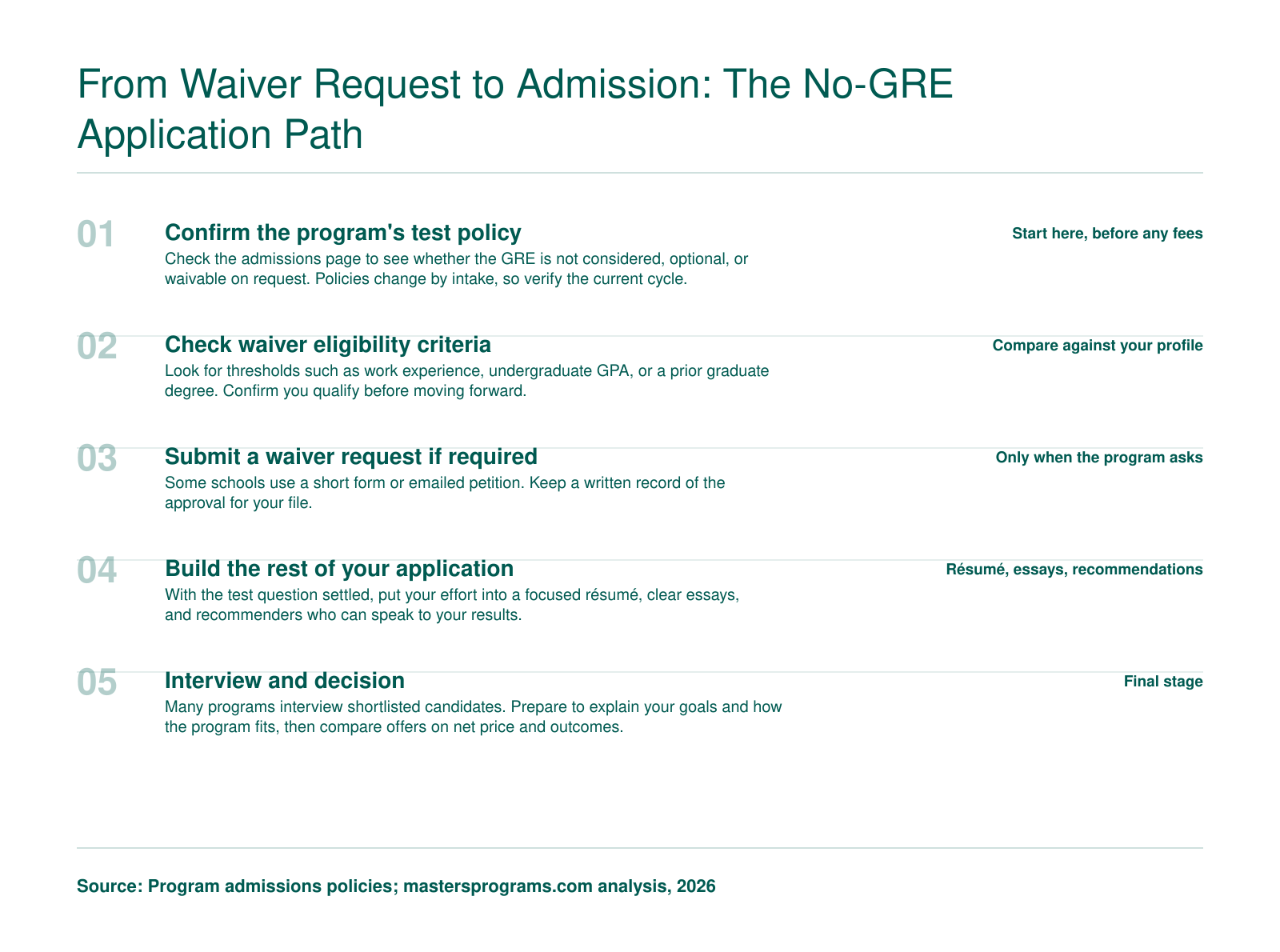
From Waiver Request to Admission: The No-GRE Application Path
Skipping the GRE is rarely automatic. Most programs either never ask for a test or grant waivers based on your record, so the order you work in can save you money and time. Follow this sequence before you commit to any application fee.
Related Articles
Lowest Net Price Options Among No-GRE MBA Schools
The table below highlights the lowest net price options among the no-GRE MBA schools covered here. Net price is an institution-wide average after aid and can differ from what a graduate business student actually pays; use the listed graduate tuition rates as a better guide. Public schools show a wide in-state to out-of-state gap, and some online or hybrid formats may charge a flat rate, so confirm the rate with the program.
| School | State | Format | In-State Tuition | Out-of-State Tuition | Net Price After Aid |
|---|---|---|---|---|---|
| Utah Valley University | UT | Hybrid | $10,224 | $22,834 | $6,376 |
| California State University-Fullerton | CA | Campus | $8,994 | $19,074 | $6,555 |
| Idaho State University | ID | Campus | $11,522 | $30,632 | $12,193 |
Weighing Cost Against Earnings and Debt
Weighing cost against earnings and debt means comparing what an MBA charges with what you would owe each month and what you can realistically earn once you finish. For the schools in this list, that comparison has a gap: program-level graduate earnings and debt figures are unavailable for these MBA programs, and we won't estimate them.
What the Numbers Can and Can't Tell You
The return-on-investment ratios in our rankings run from about 5.4 at the University of California-Irvine down to about 3.0 at Pace University. Treat them as a rough directional signal, not a promise of any particular payout. Without program-level debt and monthly payment figures, we can't translate them into a dollar amount you would pay each month.
The only earnings and debt numbers on hand describe each school as a whole, not its MBA graduates. Earnings are measured about ten years after students first enrolled, and the debt figure is the median for all graduates:
- University of Southern California: about $92,500 in whole-school earnings, with $18,000 in median graduate debt.
- Stevens Institute of Technology: about $108,800 and $27,000.
- Clarkson University: about $89,700 and $26,000.
- University of California-Irvine: about $80,700 and $15,000.
These tell you about the institution's general pull in the job market. They say nothing certain about what an MBA holder earns or borrows.
Sticker Price Versus Payment
Tuition varies enormously. USC's Executive MBA lists $180,000 in total program tuition, while the University of Maryland's lists $136,806. A larger bill usually means a larger monthly payment if you borrow, so the question is whether your post-MBA salary can carry it. Both are executive programs, built for people already employed, which changes the calculation.
Factors That Shift the Math
Employer tuition assistance can cut what you borrow, sometimes sharply. Several programs here note that employer reimbursement is supported, so ask HR before you assume you'll finance the whole cost. Skipping GRE prep also saves months of study time and the test fees, a small but real gain for applicants comparing accelerated MBA programs.
The Takeaway
A lower sticker price is not the whole story. Before you commit, estimate your likely monthly payment from the amount you'd borrow, then set it against a realistic post-MBA salary for your field and region. If that payment would strain your budget, one of the most affordable MBA programs or employer funding may be the better value.
Choosing a No-GRE MBA for a Supply Chain Career
A general MBA trains you to manage any part of a business. A supply chain concentration trains you to manage the part that moves product. Both can land you in operations, but the route differs, and so does how recruiters read your transcript.
Specialization Is the Minority, Not the Default
Among the MBA programs covered on this page, eight attach a supply chain, operations, or logistics focus to the degree: University of North Carolina Wilmington, Indiana University of Pennsylvania, University of Wisconsin-Whitewater, Ohio University, Baker University, Clarkson University, University of Wisconsin-Parkside, and Abilene Christian University. The remainder are general MBAs or concentrate in analytics, project management, accounting, cybersecurity, and similar fields. If supply chain is the goal, the named concentration is worth seeking out, but a general MBA with the right electives can get you to the same place. The difference is whether the credential says so on its face.
Questions to Put to Admissions
- Elective depth: How many credits are genuinely supply chain or analytics coursework, versus core business courses with an operations example thrown in?
- Applied work: Is there a capstone or consulting project, and does it involve an actual industry partner with real data? Ask who the recent partners were.
- Accreditation: Confirm the business school's current accreditation status directly with the school and with the accrediting body. Do not take a marketing page at its word, and do not take ours either.
Work History Is Your Strongest Card
Experienced supply chain professionals tend to be well positioned for experience-based test waivers. Procurement, demand planning, distribution center supervision, and logistics budget ownership all produce the kind of quantitative, accountable work history that admissions committees weigh in place of a test score. Ask the program what evidence it considers and how it wants that experience documented.
Match the Format to Your Current Job
Six of those eight supply chain options are delivered as online MBA programs, one is campus-based, and one is hybrid. That distribution favors people already working. If you are running shifts in a plant or distribution center, with peak season and rotating schedules, an asynchronous online format is the only thing that survives contact with your calendar. If you are switching into supply chain from another field, a campus program buys you something online cannot: physical proximity to recruiters, cohort relationships, and on-site career services. Pick for the job you have, or the one you want.
MBA programs by state
Common Questions About No-GRE MBA Programs
Test policies vary widely from school to school, and the details change from year to year. The answers below reflect general practice, so confirm current requirements with each program's admissions office before you apply.
Are MBA programs that don't require the GRE less respected by employers?
If a school waives the GRE, do I still need to take the GMAT?
Can supply chain certifications or work experience help me qualify for a test waiver?
Should I submit a GRE score anyway if the program is test-optional?
Compare MBA programs on the data that matters
Explore more MBA specializations or browse every graduate field.
All MBA programs