Best MBA Programs in Wisconsin
Compare 118 accredited MBA programs in Wisconsin at 20 schools, with graduate earnings, cost, debt, and completion data from IPEDS and the U.S. College Scorecard.

Tuition for MBA programs in Wisconsin runs from roughly $20,700 for UW-Parkside's online program to about $74,800 for UW-Madison's evening MBA, and the cheaper degree is not automatically the weaker one.
Format varies just as much: full-time campus cohorts, monthly-weekend hybrids, and fully asynchronous tracks. Test policies differ school by school.
Wisconsin employers in manufacturing, insurance, and health systems hire for operations and finance roles, where a named concentration, like an MBA supply chain management Wisconsin, often matters more than the name on the diploma.
Key Points
- Published MBA tuition runs from about $20,700 at UW-Parkside online to $74,800 for UW-Madison's evening MBA.
- UW-Madison offers no fully online MBA, but its Professional and Executive MBAs are hybrid.
- UW-Oshkosh's Professional MBA requires no GMAT or GRE, so test-averse applicants have a clear option.
Best MBA Schools in Wisconsin: 2027 Ranking
Wisconsin's MBA options range from a flagship research university and a Jesuit private school to low-cost online programs run by the Universities of Wisconsin. AACSB status appears below only where the AACSB directory confirmed it in October 2026. Earnings appear only where federal program-level data exist, and graduation rates describe the whole institution, not the MBA.
University of Wisconsin-Madison
#1Madison, WI · ~$12,000/yr (est.) · ASWB pass rate 91.3% (3-yr weighted avg)
Best for: Full-time students targeting supply chain careers
UW-Madison's Wisconsin School of Business is AACSB accredited in business and accounting, and the university graduates about 90% of its students. Its full-time MBA is built around specializations such as supply chain, finance, marketing and human resources, with a part-time hybrid Professional MBA and an Executive MBA alongside. The school has announced a redesigned full-time MBA for fall 2027 with a required experiential project, and Minnesota residents may qualify for reduced tuition under a reciprocity agreement.
- Two-year full-time on-campus program starting in fall
- STEM-designated by the U.S. Department of Homeland Security
- Six Sigma Yellow Belt certification included
- Global trips to places such as Norway and Japan
- Dedicated Grainger Center career support
- Full-time on-campus MBA with three finance pathways
- Federal Scorecard median earnings of $122,802 one year after graduation
- Applied consulting projects with real companies
- Bloomberg Terminal access
- Investment banking pathway with a dedicated investment banking course
- Business valuation and mergers and acquisitions coursework
- Support from the Nicholas Center and the Finance and Analytics Lab
- Entrepreneurial finance pathway within the full-time MBA
- Capital IQ and FactSet access
- Mentorship from finance professionals and an industry advisory board
- 52 total credit hours, full-time cohort
- Prepares students for SHRM-CP credential eligibility
- Capstone required
- Annual HR conference for networking
- Two-year full-time program starting in fall, with capstone
- Federal Scorecard median earnings of $117,372 one year after graduation
- Company visits with senior executives
- Marketing Leadership Institute support
- Coursework in marketing research, analytics and data visualization
- Marketing Consulting Practicum
- Experiments and causal methods course in year two
- Focus on B2B and product marketing manager roles
- Courses in tech product marketing management and analytics
- Alumni mentorship available
- Part-time hybrid format, about half on campus and half online
- 44 credits, completed in 2 to 5 years
- Classes meet on campus monthly, with virtual classes throughout the year
- 3.00 GPA required
- Test optional: GRE and GMAT are not required
- 11 concentration options, choose 4 elective pathways
- Evening and weekend classes, fall and spring starts
- Transfer up to 12 graduate credits
- 18-month hybrid cohort program with two week-long residences
- Test optional, work experience required
- $86,400 total program tuition
- Supports F-1 visas, no STEM OPT eligibility
- Up to 15 shared credits between the two degrees
- Apply to both programs in the same year
- MBA admission deferred one year
Marquette University
#2Milwaukee, WI · ~$25,000/yr (est.)
Best for: Mid-career managers seeking executive cohorts
Marquette is a private Jesuit university in Milwaukee, with AACSB accreditation in business and accounting held continuously since 1928. The school graduates about 83% of its students. Its MBA lineup covers a flexible campus MBA with eight concentrations and an online option, online specializations in finance and health systems leadership, an Executive MBA, and JD/MBA joint degrees.
- Eight concentration options
- Full-time and part-time, with a fully online option
- Rolling admissions with three start dates per year
- Employer tuition reimbursement supported
- Bachelor's-to-MBA path in five years
- Fully online MBA with a 12-credit finance specialization
- Topics include fintech, international finance and real estate
- Bank management and multiple finance electives
- Consistent tuition rate
- 100% online MBA with a 12-credit health systems specialization
- Core MBA courses plus electives
- Ethical healthcare leadership focus
- 17-month cohort that meets in person every other Saturday
- Federal Scorecard median earnings of $117,734 one year after graduation
- Immersive international trip
- Management-level classmates and small classes
- 81 law credits plus 22.5 to 30 MBA credits
- Up to 9 credits double-counted
- Separate applications to both schools, 3.0 MBA GPA required
- Completed in 4 to 5 years, full-time or part-time
- Earns a Sports Law Certificate
- First-year law curriculum required
University of Wisconsin-La Crosse
#3La Crosse, WI · $10,000 – $15,000/yr (est.)
Best for: Working professionals studying fully online
UW-La Crosse is AACSB accredited in business, a status it has held since 1982, and it graduates about 71% of its students. It is a managing partner in the UW MBA Consortium with UW-Eau Claire and UW-Oshkosh. The result is a 36-credit asynchronous online MBA that serves business professionals, engineers and health care providers.
- 36 credits, entirely online and asynchronous
- Most students finish in about three years
- Average class size of 24 students
- Delivered by three AACSB-accredited Universities of Wisconsin schools
- Up to 10 credits of electives across consortium campuses
University of Wisconsin-Green Bay
#4Green Bay, WI · ~$10,000/yr (est.) · ASWB pass rate 83.6% (3-yr weighted avg)
UW-Green Bay graduates about 48% of its students, an institution-wide figure. Its Executive Impact MBA is a one-year online program for working professionals, and no previous business degree is required. The program is notable for its pace and its partnership with the Green Bay Packers.
- 30 credits completed in one year
- Five 7-week sessions with two courses each
- No previous business degree required
- Stackable certificates earned along the way
- Green Bay Packers partnership for applied learning
University of Wisconsin-Eau Claire
#5Eau Claire, WI · ~$11,000/yr (est.)
UW-Eau Claire is AACSB accredited in business and serves as managing partner of the UW MBA Consortium. The university graduates about 64% of its students. Its online MBA offers Healthcare Management and Leadership emphases with no campus visits, and consortium students can take up to 10 credits of electives across the partner campuses.
- 36 credits, completed in 2.5 to 3 years
- Four emphasis options, with healthcare policy and delivery focus
- Asynchronous classes, no campus visits required
- Up to seven years to finish the degree
- 36 credits with 6.5 required leadership elective credits
- Capstone impact project applies MBA goals
- 3.0 GPA minimum
- Business Essentials waivers available by mastery
- Three start dates per year: spring, summer and fall
- Federal Scorecard median earnings of $108,374 one year after graduation
- Two professional references and an essay required
- Contact for questions: [email protected]
Viterbo University
#6La Crosse, WI · ~$10,000/yr (est.)
Viterbo is a private university in La Crosse that graduates about 68% of its students. It offers a healthcare-focused online MBA, a general MBA that can be taken in person or online, and a one-year online management MBA. Small classes and working-professional scheduling are the common thread.
- Two-year online program for nurses, physicians and administrators
- Two 2.5-day on-campus intensives
- Flexible asynchronous schedule
- Per-credit-hour tuition model
- Fully online option available
- Non-business majors welcome, 3.0 GPA minimum
- Transfer up to nine graduate credits
- Federal Scorecard median earnings of $83,328 one year after graduation
- 12-month program, 33 credits
- Four start dates per year, eight-week course intensives
- Quality improvement project with a local business
- Full-time and part-time options
University of Wisconsin-Milwaukee
#7Milwaukee, WI · $13,000 – $26,000/yr (est.) · ASWB pass rate 82.2% (3-yr weighted avg)
UW-Milwaukee's Lubar business school is AACSB accredited in business and accounting. The university graduates about 49% of its students. Its MBA offers a deep menu of elective tracks, including Business Analytics, and the school also has STEM-designated joint and executive options for IT and healthcare leaders.
- Six analytics courses, including R Programming and Web Mining
- Elective track within the MBA, one of 11 concentration options
- Campus-based delivery
- 48 to 51 credits combining MBA and STEM-designated MS in ITM
- GMAT or GRE required, with a published waiver policy
- Concentration in AI and Data Analytics
- Capstone required
- 16-month cohort with alternate Friday evening and Saturday classes
- Concentrations in Global Strategic Leadership or Integrated Health Care Leadership
- Federal Scorecard median earnings of $71,460 one year after graduation
- International residency, STEM-designated
Alverno College
#8Milwaukee, WI · $10,000 – $15,000/yr (est.)
Alverno is a Milwaukee college that graduates about 49% of its students. Its 33-credit MBA can be finished in under two years, with General Management and Organizational Leadership and Development options, and it emphasizes experiential learning across accounting, finance and operations.
- 33 credits, 10 courses, finishable in under two years
- Concentrations: General Management or Organizational Leadership and Development
- Full-time and part-time, no thesis or capstone
- Federal Scorecard median earnings of $57,804 one year after graduation
- Federal Scorecard median graduate debt of $38,974
Herzing University-Kenosha
#9Kenosha, WI · ~$9,000/yr (est.)
Herzing University-Kenosha is a private school that graduates about 72% of its students. Its MBA in Healthcare Management is aimed at students preparing for management roles in healthcare settings and uses problem-based learning.
- 39 semester credits: 9 foundation, 21 core, 9 healthcare concentration
- Covers healthcare administration, policy and health information management
- Problem-based curriculum with an ethical leadership focus
University of Wisconsin-Parkside
#10Kenosha, WI · ~$10,000/yr (est.)
UW-Parkside is AACSB accredited in business and graduates about 40% of its students. It runs a large, flexible online MBA with concentrations in supply chain, analytics, accounting, finance, HR, marketing, project management and global management. The program can be completed in 12 months, and many tracks are priced at $22,860 total with the same tuition in-state and out-of-state.
- 24 credits, 12 months, 7-week online courses
- Global supply chain, analytics and strategic decision-making
- GMAT waivers available based on GPA
- Work experience required, 2.3 GPA minimum
- 24 credits in 12 months, asynchronous online
- Business Advisory Board of 30 leaders guides the curriculum
- Foundation courses for non-business backgrounds
- 30 credits, $22,860 total tuition ($762 per credit)
- No entrance exam required, 2.8 GPA minimum
- Prepares for CPA exam eligibility
- Five start dates per year
- 30 credits, $22,860 total tuition with locked rate
- Prerequisite courses required
- Test optional, 2.8 GPA minimum
- 30 credits, $22,860 total tuition
- Faculty include SHRM-certified practitioners
- Foundation course waivers available
- 24 credits in 12 months
- Synchronous and asynchronous options
- Work experience and two recommendations required
- 30 credits across 15 courses
- Includes digital marketing and social media
- 2.3 GPA minimum, work experience required
- 30 credits, aligned with the PMI PMBOK Guide
- Case studies and Agile methodologies
- Two recommendations and work experience required
- 24 core credits plus six elective credits in 12 months
- In-person or online, with an online business simulation
- Electives include supply chain and data analytics
- Federal Scorecard median earnings of $99,850 four years after graduation
Cost & outcomes by school
Federal data for the highest-earning MBA programs, independent of the ranking above. Earnings are this field's master's graduates four years after completing, where the Scorecard reports them.
| School | Earnings | Tuition / yr | Debt | Grads/yr | Format |
|---|---|---|---|---|---|
| University of Wisconsin-Madison WI | — | $12,325 | — | 5,578 | Campus |
| Herzing University-Madison WI | — | $9,370 | — | 874 | Online |
| University of Wisconsin-Whitewater WI | — | $10,543 | — | 1,316 | Online |
| Viterbo University WI | — | $9,888 | — | 500 | Hybrid |
| Herzing University-Kenosha WI | — | $9,370 | — | — | Online or campus |
| Herzing University-Brookfield WI | — | $9,370 | — | 6 | Online |
| University of Wisconsin-Parkside WI | — | $10,184 | — | 544 | Online |
| University of Wisconsin-Oshkosh WI | — | $10,051 | — | 528 | Hybrid |
| University of Wisconsin-Green Bay WI | — | $10,244 | — | 414 | Hybrid |
| University of Wisconsin-Milwaukee WI | — | $12,728 | — | 2,438 | Campus |
| University of Wisconsin-La Crosse WI | — | $10,832 | — | 658 | Online |
| University of Wisconsin-Eau Claire WI | — | $10,665 | — | 402 | Online |
Sources: U.S. Department of Education. Tuition and graduates: IPEDS. Earnings and debt: College Scorecard, this field's master's graduates; a dash means no figure is reported.
Online and Hybrid MBA Options in Wisconsin
UW-Madison does not offer a fully online MBA. Its full-time MBA meets in person on weekdays, while its Professional MBA and Executive MBA are hybrid: weekly online classes plus one weekend per month on campus. This part-time model is common for working professionals in Madison and Milwaukee. The Executive track can be finished in 18 months, similar to an Accelerated MBA; the Professional track runs 24 to 60 months. The full-time MBA requires 53 credits, and the Professional MBA requires 44 credits.
For a fully online option in Wisconsin, the UW System Online MBA Consortium is a 36-credit program with emphases in general management, financial decision making, healthcare management, and leadership. Marquette University uses campus and online courses, with 31.5 to 42 credits depending on prior business coursework. UW-Oshkosh's Professional MBA requires 36 credits, including 9 elective credits. Across the ranked master's programs in Wisconsin, delivery formats span fully online, campus, and hybrid models.
Check tuition before enrolling: some Wisconsin online MBAs charge a flat per-credit rate regardless of residency, while others split in-state and out-of-state pricing.
Which Wisconsin MBA Programs Waive the GMAT or GRE?
UW-Oshkosh's Professional MBA is a No-GRE MBA, requiring no GMAT or GRE at all, reviewing applicants holistically with a 2.75 undergraduate GPA guideline and roughly two years of work experience; that experience expectation can itself be waived for applicants with a strong record, including a 3.5 GPA, and students below the full-standing GPA line may be considered for probationary admission at 2.25.1
Elsewhere, a waiver is something you request, not something you assume:
- UW-Madison: The GMAT or GRE is required, with case-by-case waivers for applicants who show quantitative readiness. Published criteria include a 3.0 GPA, around three years of relevant professional experience, a short quantitative readiness statement of about 250 words, and submitting the request roughly two weeks before you apply.
- Marquette: No general GPA or work-experience waiver for the MBA, and a score may be required if you lack college statistics or calculus or earned below a B-. The Executive MBA does waive testing for applicants with five or more years of progressive managerial experience.2
- UW-Milwaukee (Lubar): Waivers are discretionary, with routes tied to GPA in the 3.00 to 3.20 range, two to five years of experience, five years of military service, or a CFA, CPA, or Six Sigma credential.3
Other Wisconsin schools do not publish a current, verifiable policy we could confirm; compare No-GRE master's programs and check the admissions page directly, since these rules change by cycle.
Cost of Wisconsin MBA Programs and Employer Demand
How much does an MBA cost in Wisconsin? Published tuition runs from about $20,700 for the UW-Parkside online MBA to $74,800 for the UW-Madison evening MBA (44 credits at $1,700 each). UW-Madison's full-time MBA lists $27,764.80 resident and $51,413.28 nonresident in annual tuition and fees for 2026-27, and Marquette charges $1,450 per credit. In the table, net price is an institution-wide average after aid, so treat it as approximate and not an MBA-specific quote.
| School | In-state tuition | Out-of-state tuition | Net price after aid (institution-wide, approximate) | Published per-credit rate and program size |
|---|---|---|---|---|
| University of Wisconsin-Parkside (online) | $10,184 | $20,811 | $11,772 | $690 per credit, 30 credits, $20,700 total with fees |
| University of Wisconsin-Green Bay (Executive Impact MBA, hybrid) | $10,244 | $20,229 | $13,369 | 30 credits |
| University of Wisconsin-Whitewater (online) | $10,543 | $21,603 | $14,158 | $708 per credit, 36 credits |
| University of Wisconsin-Oshkosh (hybrid) | $10,051 | $19,935 | $14,305 | $876.71 per credit (2026), $881.82 for online MBA, 36 credits |
| University of Wisconsin-Milwaukee (Lubar) | $12,728 | $26,159 | $15,014 | $800 per credit, 33 credits, $26,400 total |
Wisconsin MBA Programs With the Highest Graduate Earnings
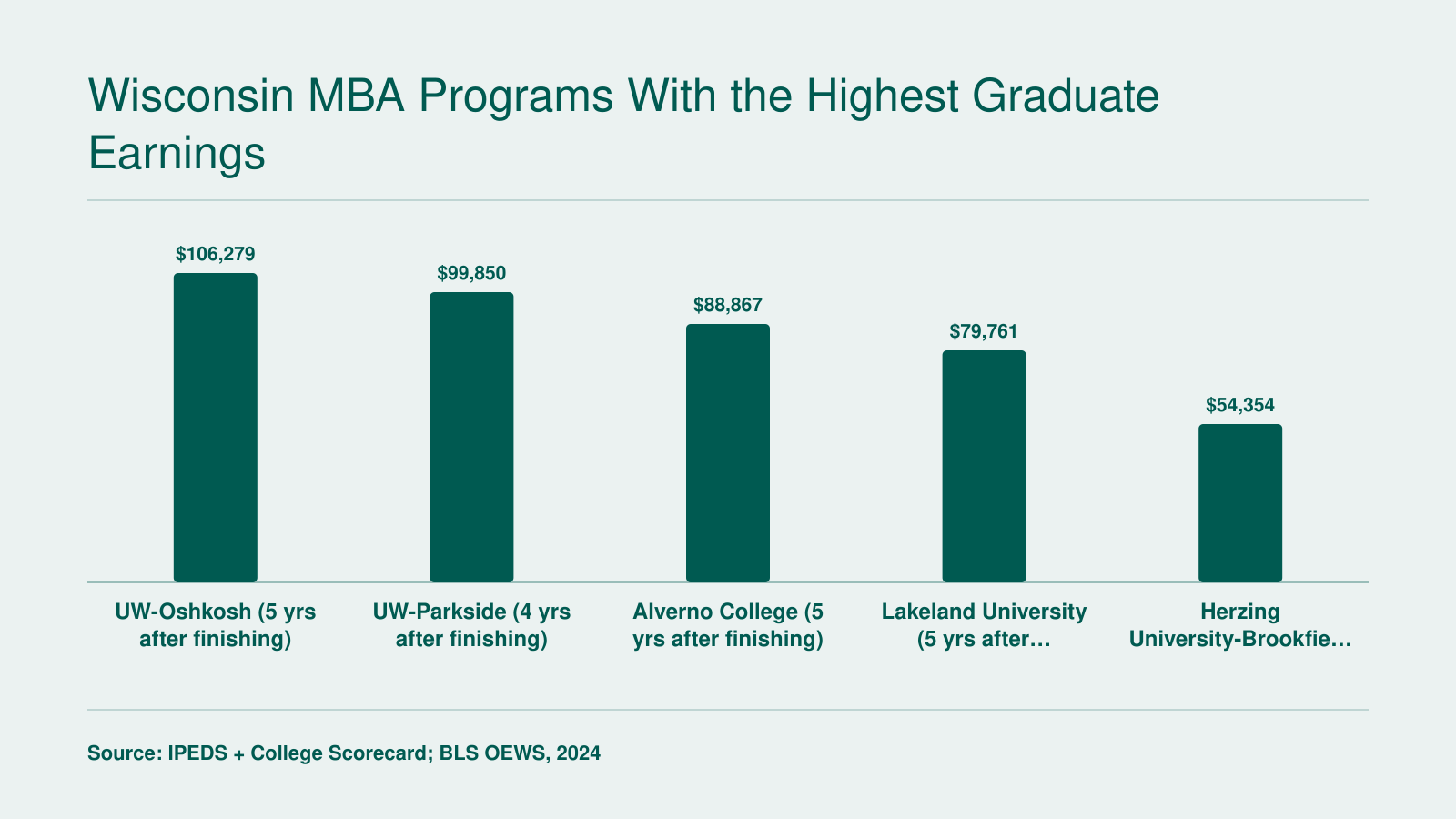
These are median earnings for graduates of each MBA program, taken from College Scorecard program-level data. The measurement window differs by school: UW-Parkside is measured four years after finishing, and the others five years after, so compare them with that in mind. For Wisconsin context, BLS counted 168,110 general and operations managers in the state in May 2024, and nationally the median financial manager wage was $186,910 in May 2025.
Related Articles
MBA Specializations in Wisconsin, Including Supply Chain
A general MBA builds broad management skills; a concentration points that degree at a specific function. Wisconsin programs offer both, with named tracks that span supply chain, business analytics, finance, healthcare management, and organizational leadership. The right choice depends on where you want the credential to take you.
Supply chain in a manufacturing state
Wisconsin's manufacturing and logistics base makes supply chain a natural fit, and several programs here teach it directly. UW-Parkside offers a Supply Chain Management concentration on campus and fully online, built from three courses totaling six credits. UW-Whitewater runs an Online MBA with a Supply Chain Management emphasis of nine credits covering operations, quality, sourcing, and logistics.1
One caveat for applicants: UW-Madison's MBA in Supply Chain Management will stop admitting new students after Fall 2026 and is scheduled for discontinuation in Fall 2029. If supply chain is your goal, Parkside and Whitewater are the clearly documented options still accepting applications.
Quick takeaways
- Breadth: Tracks range across supply chain, analytics, finance, healthcare, and leadership.
- Still open: UW-Parkside and UW-Whitewater offer supply chain concentrations online.
- Closing: UW-Madison's supply chain MBA stops new admissions after Fall 2026.
Frequently Asked Questions About Wisconsin MBAs
What is the best MBA program in Wisconsin?
Does UW-Madison offer an online MBA?
Which Wisconsin MBA programs are AACSB accredited?
What are the best MBA programs in Wisconsin for international students?
Compare MBA programs on the data that matters
Explore more MBA specializations or browse every graduate field.
All MBA programs