Accelerated MBA Programs (1-Year and Fast-Track)
Compare 5,400+ accredited fastest MBA programs at 1,100+ schools, with graduate earnings, cost, debt, and completion data from IPEDS and the U.S. College Scorecard.

How much does an MBA cost when you finish in about 12 months instead of 24? Across the ten programs ranked here, listed tuition runs from $8,112 at UNC Wilmington to $49,860 at Bryant. Institution-wide average net price runs from roughly $16,800 to $41,200.
Finishing in one year also removes a second year of forgone salary, which can outweigh the tuition gap. Five of the ten ranked programs are supply chain tracks, reflecting demand for operations skills without a two-year commitment.
Speed alone doesn't set price: a 12-month public online MBA can cost a fraction of a private one-year degree.
Key Points
- Rankings use federal IPEDS and College Scorecard data, not school brochures or advertising.
- South Carolina charges $14,134 in-state versus $30,160 out-of-state for its MBA.
- One-year formats often skip the summer internship, which hurts career switchers most.
Best Accelerated MBA Programs: 2027 Rankings
These accelerated MBA rankings cover one-year and fast-track MBA options, evaluated using federal outcome and cost data rather than prestige alone. We focused on programs that compress the timeline while keeping career payoffs and net price in view. Use the cost, delivery format, and earnings details in each card to narrow your list.
University of Missouri
#1Columbia, MO · ~$14,000/yr (est.) · ASWB pass rate 89.4% (3-yr weighted avg)
Best for: Working professionals needing online flexibility
The University of Missouri offers a fully online MBA in business administration with a generalist curriculum spanning finance, marketing, management, and quantitative analysis. Students complete 45 credit hours through eight-week online modules and 16-week courses, and can add graduate certificates in finance, marketing analytics, or global supply chain management. Full-time students typically finish in two years, while part-time students take about six credits per semester; an accelerated bachelor's-to-master's pathway is also available.
- 45 credit hours across 8-week online modules and 16-week courses
- Add graduate certificate in finance, marketing analytics, or global supply chain management
- Full-time completion in two years; part-time about six credits per semester
- Dual degrees with engineering, health administration, or law
- Field consulting project applies skills to real business challenges
- Accelerated bachelor's-to-master's pathway available
The University of Tennessee-Knoxville
#2Knoxville, TN · ~$16,000/yr (est.) · ASWB pass rate 88% (3-yr weighted avg)
Best for: Healthcare executives wanting hybrid one-year format
The University of Tennessee-Knoxville's Haslam College of Business offers two one-year executive MBA tracks: one in healthcare leadership and a physician-only program. Both are hybrid formats with on-campus residencies and online coursework, small cohorts, and an Organizational Action Project. The physician track reports median earnings of about $106,700 one year after completion and $132,000 four years after completion.
- One-year hybrid program with on-campus residencies and online coursework
- 33 credits; total program tuition $74,000
- Small cohorts of 30; starts each January
- Requires 5+ years of work experience and 2.7 minimum GPA
- No entrance exam required
- Healthcare policy immersion trip to Washington, D.C.
- Organizational Action Project often generates significant ROI
- Supports military benefits and employer tuition reimbursement
- One-year program completed in under a single calendar year
- Total program tuition $79,000
- Physician-only EMBA; over 1,000 alumni worldwide
- 80% job placement rate; 80% in physician leadership positions
- 50 CME credits upon completion
- Organizational Action Project included
University of Minnesota-Twin Cities
#3Minneapolis, MN · ~$22,000/yr (est.) · ASWB pass rate 90.2% (3-yr weighted avg)
Best for: Senior leaders needing hybrid executive scheduling
The University of Minnesota's Carlson School offers an executive MBA for experienced professionals pursuing senior leadership roles. The hybrid program meets every other Friday and Saturday, with a synchronous online option, and includes global virtual team projects plus an international residency. Graduates report median earnings of about $132,950 one year after completion and $162,817 four years after completion, and 40% earn a promotion within a year.
- 20-month program with classes every other Friday and Saturday
- Hybrid format: attend in person or join synchronously online
- Global virtual team projects and international residency
- 40% of graduates promoted within one year
- Requires at least six years of work experience
- Ranked #7 among U.S. public universities
- Merit-based scholarships available
Columbia University in the City of New York
#4New York, NY · ~$58,000/yr (est.) · ASWB pass rate 86.7% (3-yr weighted avg)
Columbia University pairs its full-time MBA with a Master of Science in Social Work in a dual degree that saves about a year compared with completing both degrees separately. Students apply to each school independently and register in one school per term, paying that school's tuition. This campus-based path suits careers in nonprofit management, healthcare administration, government, and social entrepreneurship; graduates report median earnings of about $59,891 one year and $75,980 four years after completion.
- Integrated dual degree combining Columbia Full-Time MBA and MS in Social Work
- Completed one year faster than earning both degrees separately
- Campus-based; apply separately to each school
- Register in one school per term and pay that school's tuition
- Prepares for nonprofit management, healthcare administration, government, social entrepreneurship
- Financial aid available from enrolling school; scholarships generally not transferable
University of North Carolina Wilmington
#5Wilmington, NC · $8,000 – $24,000/yr (est.) · ASWB pass rate 84.8% (3-yr weighted avg)
UNC Wilmington offers a fast online MBA that can be completed in as few as 12 months, with AACSB accreditation and seven-week courses. Concentrations include supply chain management, finance, healthcare management, international business, marketing, and information systems, alongside a hybrid executive MBA. The general MBA track reports median earnings of about $80,921 one year and $118,289 four years after completion, and tuition is $19,920.96 in-state and $54,023.04 out-of-state.
- 12-month online MBA with 36 credits across 12 courses
- AACSB-accredited; no GMAT required
- Accelerated 7-week courses; six start dates per year
- Focus on logistics, procurement, operations, and data analytics
- 12-month online MBA with 36 credits and 12 courses
- $19,920 total program tuition
- No GMAT required; test optional
- Real estate investment specialization available
- Taught by same full-time on-campus faculty
- 12-month online MBA, 36 credits
- Healthcare analytics tools and legislation coursework
- No thesis or capstone required
- Prepares for hospital CEO roles
- 12-month online MBA with 36 credits
- Pay-by-the-course tuition available
- Letters of recommendation may be waived
- Accelerated 7-week courses
- 12-month online MBA with 36 credits
- Digital marketing analytics specialization
- Consumer delight research focus
- Letters of recommendation may be waived
- 12-month online MBA, 36 credits, accelerated 7-week courses
- Total tuition $19,920.96 in-state; $54,023.04 out-of-state
- No prerequisites needed
- Two years work experience required
- 12-month hybrid program with 42 credits across 14 courses
- $27,066 total program tuition
- Two on-campus residencies plus international residency in Europe or Asia
- Cohort-based structure and capstone required
- 12-month hybrid executive MBA with business analytics concentration
- Consult with actual foreign clients
- No prerequisites required
- 12-month hybrid executive MBA with cybersecurity concentration
- International residency in Europe or Asia
- Small interactive cohorts
- 12-month online MBA specialization in Information Systems
- $20,257 total program tuition
- Bridges business and technology for working professionals
University of Minnesota-Duluth
#6Duluth, MN · $22,000 – $33,000/yr (est.) · ASWB pass rate 90.4% (3-yr weighted avg)
The University of Minnesota-Duluth's Labovitz School offers a 12-month accelerated MBA in a primarily face-to-face campus format with day and evening classes. The 32-credit curriculum includes core courses, electives, and a strategic management capstone, plus optional short-term study abroad. Applicants typically need the GMAT or GRE, with preferred credentials including a 3.0 GPA and at least two years of full-time work experience.
- 12-month accelerated MBA, 32 graduate credits
- Core courses, electives, and 3-credit strategic management capstone
- Campus-based with day and evening classes
- Requires GMAT or GRE; some exemptions
- Preferred 3.0 GPA and 2+ years work experience
- Online foundation courses at undergraduate tuition
- Electives can include short-term study abroad
Binghamton University
#7Vestal, NY · $10,000 – $15,000/yr (est.) · ASWB pass rate 85.1% (3-yr weighted avg)
Binghamton University's School of Management offers an AACSB-accredited MBA with one-year options for both business and non-business majors, plus a four-semester path that includes an internship. Electives span accounting, business analytics, finance, marketing, and supply chain management, and a career services office supports recruitment. Graduates report median earnings of about $74,554 one year and $118,876 four years after completion.
- AACSB-accredited with four-semester and one-year MBA options
- One-year track for business majors; prerequisite economics/statistics for non-business majors
- Electives in accounting, business analytics, finance, marketing, and supply chain management
- Four-semester option includes internship
- 80% of recent graduates received full-time offers within three months
- Career services office with counseling, mock interviews, and resume critiques
- 4+1 options for current Binghamton undergraduates
Syracuse University
#8Syracuse, NY · $45,000 – $50,000/yr (est.) · ASWB pass rate 84.3% (3-yr weighted avg)
Syracuse University's Whitman School offers a combined online MBA and Master of Science in Professional Accounting that shares 15 credits across the two degrees, reducing the total load to as few as 69 credits. Students can apply while enrolled or within one year of graduating, and other pairings such as business analytics and professional accounting are available. Graduates report median earnings of about $81,011 one year and $110,435 four years after completion.
- Combined MBA and M.S. in Professional Accounting delivered online
- 69 to 87 total credits, 15 fewer than separate degrees
- MBA requires 54 credits; accounting master's 30 to 48
- Open to enrolled students and graduates within one year
- Other pairings include Business Analytics and Professional Accounting
Commonwealth University of Pennsylvania
#9Bloomsburg, PA · ~$12,000/yr (est.) · ASWB pass rate 88.8% (3-yr weighted avg)
Commonwealth University of Pennsylvania's Zeigler College of Business offers an accelerated MBA with concentrations in accounting, analytics, healthcare management, leadership, marketing, and strategic global decisions, plus a build-your-own option. The fast-track MBA can be completed in three semesters using six-week online sessions, and undergraduates can start graduate coursework early. The general MBA track reports median earnings of about $71,757 one year and $92,190 four years after completion.
- Accounting concentration within the MBA
- Accelerated MBA open to any major; graduate credits count toward bachelor's
- Benner-Hudock Center for Financial Analysis supports finance and accounting
- Accounting Association student organization
- 36 credit hours, 12 courses, can finish in one year
- Fully online with six-week intensive sessions
- Open to any undergraduate major
- Employer reimbursement supported
- Dual MBA and MS in Information Technology
- 100% online with full-time and part-time options
- GMAT or GRE waivers available above 2.5 GPA
- SAS and Python certificates included
- Focus on systems and cybersecurity
Carlow University
#10Pittsburgh, PA · $20,000 – $25,000/yr (est.) · ASWB pass rate 82.2% (3-yr weighted avg)
Carlow University's IACBE-accredited MBA in Leadership and Management is an online program focused on ethical decision-making, corporate social responsibility, and leading teams through change. It offers accelerated and flexible formats, several tracks, and an executive option for working adults. Graduates report median earnings of about $69,536 one year and $82,739 four years after completion.
- IACBE-accredited, fully online
- Leadership and management track within flexible MBA
- Accelerated and steady formats available
- Ethics, corporate social responsibility, and change management focus
- Executive MBA option also online
- Five MBA tracks available
Cost & outcomes by school
Federal data for the highest-earning MBA programs, independent of the ranking above. Earnings are this field's master's graduates four years after completing, where the Scorecard reports them.
| School | Earnings | Tuition / yr | Debt | Grads/yr | Format |
|---|---|---|---|---|---|
| Western Governors University UT | — | $9,320 | — | 50,258 | Online |
| West Virginia School of Osteopathic Medicine WV | — | $12,700 | — | — | Hybrid |
| Bethany College KS | — | $17,650 | — | — | Campus |
| Capella University MN | — | $15,092 | — | 14,818 | Online |
| Southeastern Oklahoma State University OK | — | $5,220 | — | 2,478 | Online |
| University of West Georgia GA | — | $6,046 | — | 2,558 | Campus |
Sources: U.S. Department of Education. Tuition and graduates: IPEDS. Earnings and debt: College Scorecard, this field's master's graduates; a dash means no figure is reported.
How We Rank Accelerated MBA Programs
Every figure on the cards in this list comes from federal IPEDS and College Scorecard data, not from school brochures or admissions pages. That is the main difference between this page and a promotional program listing: nothing here was supplied by a school's marketing team.
What You See on Each Card
- Graduate tuition: The published price for graduate study at the institution.
- Average net price: What students pay on average after grant aid.
- Program-level earnings and median debt: Shown where the federal government publishes them for that specific program.
- Graduation rate: The institution-wide rate, not an MBA-only figure.
The Accelerated Filter
Only one-year and fast-track MBA programs are included. The ranked order reflects that filter, so a school's traditional two-year MBA does not appear here, and the position you see is among accelerated options only.
Limits Worth Knowing
Net price is an institution-wide average after aid. It blends many kinds of students and degree levels, so it may not match what you would pay. Graduation rate is also school-wide, which tells you about the institution rather than the MBA cohort. Some programs have no published earnings figure, and in those cases the card says so rather than estimating one.
Confirm Before You Apply
Program length, start dates, and current tuition change, and federal data lags behind. Check each of those directly with the school before you apply, and ask the admissions office what the total cost looks like for your specific enrollment path. Treat the cards as a starting point for comparison, not a final quote.
What Is an Accelerated MBA? 1-Year vs Fast-Track Formats
An accelerated MBA is the full MBA credential finished in less time than the standard two years. Schools get there through compressed terms, year-round study, or waived core courses for students who already have business coursework. The degree is the same. The calendar is not.
The Two Main Models
Full-time one-year MBAs run about 12 months and usually expect a business background. Kellogg's One-Year MBA starts in June, runs through the summer with three to five courses, then joins the second-year Full-Time MBA class in September for electives. It requires 15.5 course credits. Emory Goizueta's One-Year MBA also takes 12 months but starts in early May, while its Two-Year MBA starts in late July. Cornell Johnson also offers a one-year MBA1, though the university does not publish its credit requirement in the sources we reviewed.
Fast-track part-time and online MBAs are typically pitched at roughly 12 to 18 months. The real timeline depends on your course load, whether you enroll continuously, and whether the school uses quarters, semesters, or competency-based progression.
How Many Credits, and What Gets Cut
Credit totals are hard to compare across schools, even among affordable MBA programs. Kellogg counts course credits, not semester credit hours, so its 15.5 cannot be converted directly. Emory and Cornell Johnson do not publish a comparable total in the sources we reviewed, and we could not verify a standard two-year figure either. Before you apply, check each program's catalog for the total and its unit definition.
What usually disappears is the summer internship, along with some electives. That is the real cost of speed.
Who Each Model Fits
- Career accelerators: If you plan to stay in your field and already have business fundamentals, a one-year or fast-track format saves a year of tuition and lost salary.
- Career switchers: If you need an internship to break into a new industry, the two-year path is often the better fit, since a compressed schedule leaves little room for one.
So how long is an accelerated MBA? For the full-time examples above, 12 months. For online and part-time formats, it depends on your pace.
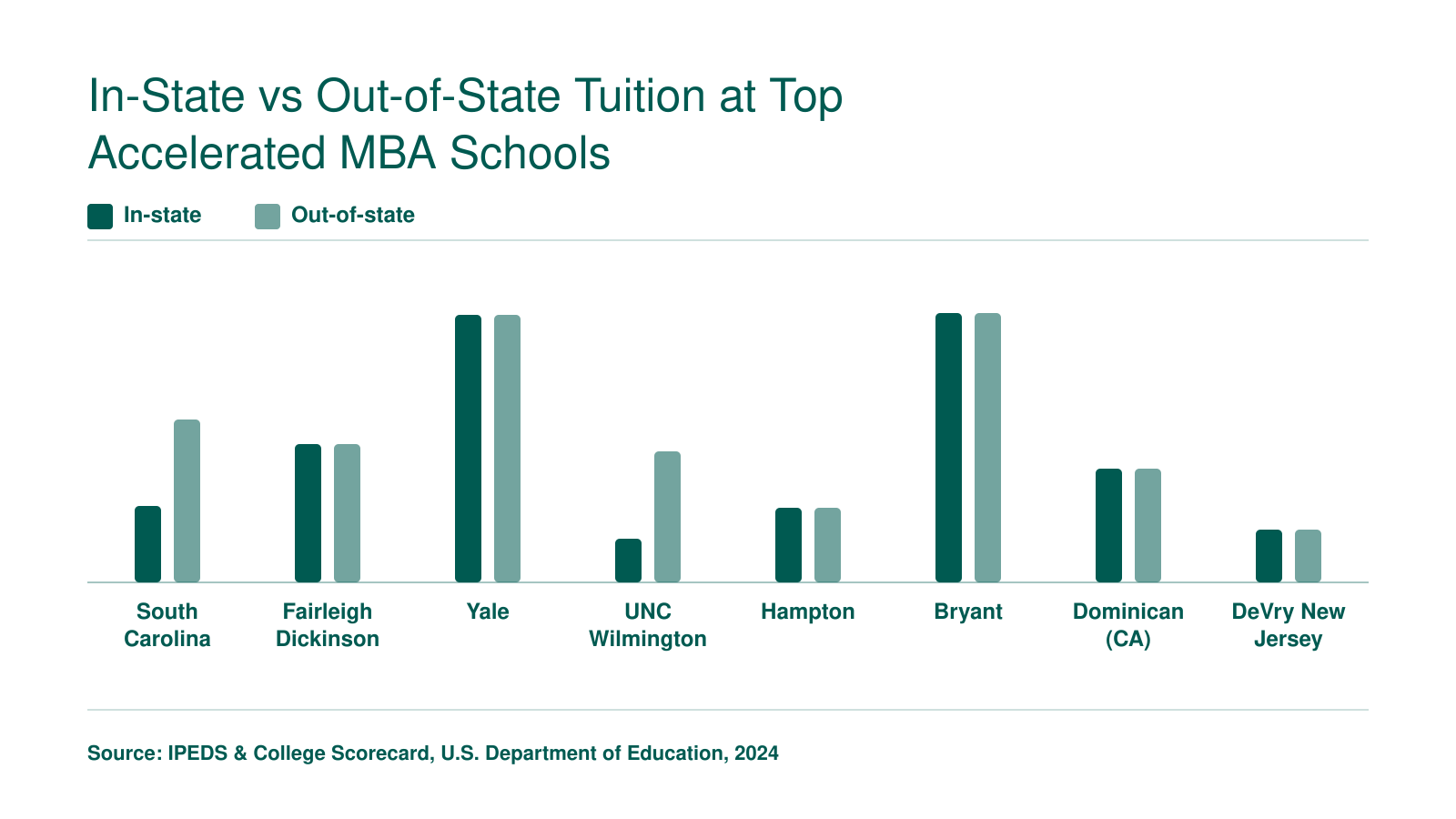
In-State vs Out-of-State Tuition at Top Accelerated MBA Schools
Residency only changes the price at public universities. The University of South Carolina charges $14,134 in-state and $30,160 out-of-state, and UNC Wilmington charges $8,112 versus $24,198. The six private schools in this group (Fairleigh Dickinson, Yale, Hampton, Bryant, Dominican, and DeVry New Jersey) charge one rate to everyone, so their bars match. These are graduate tuition and fees only, not total cost of attendance, so housing, books, and living costs come on top.
Related Articles
Online, Hybrid, and Campus Accelerated MBAs Compared
Of the five accelerated programs we reviewed for delivery details, two are fully online (Bentley and the University of Miami), one is hybrid (Carnegie Mellon Tepper's online hybrid), and two are on campus (Tepper's full-time program and UMass Amherst Isenberg). Tepper is the only school in that group offering both a campus and a flexible format. The right choice depends mostly on whether you can leave your job and how much in-person access you want.
| Format and example | Typical length | Residency requirement | Working while enrolled | Networking and recruiting access | Best fit |
|---|---|---|---|---|---|
| Online, no residency (Bentley Accelerated Online MBA) | 12 to 18 months, built on six-week course intervals | No on-campus residency or immersion identified; courses are asynchronous, with an optional synchronous online hybrid course | Designed so students can balance study with professional and personal commitments | Virtual only, so connections depend on your own initiative | Working professionals who need maximum flexibility |
| Online with one immersion (University of Miami Accelerated Online MBA) | 12 months | 1 immersion in the accelerated format; coursework mixes asynchronous work with live virtual sessions | Flexible digital delivery is designed around student schedules | Live virtual sessions plus one in-person immersion | Students who want online flexibility with some live interaction and in-person contact |
| Hybrid (Carnegie Mellon Tepper Online Hybrid Accelerated MBA) | 24 months | Several immersive Access Weekends each year; online courses run year-round | Structured for flexibility, but the program description does not expressly say students can work full time | Periodic in-person weekends with the cohort | Applicants with undergraduate business coursework who want a flexible format with recurring in-person experiences |
| On campus (Tepper Full-Time Accelerated MBA; UMass Amherst Isenberg accelerated option) | Tepper: 12 months, or 16 with an internship. UMass: one year in the accelerated option | Tepper: full on-campus experience in Pittsburgh, with classes Monday through Thursday. UMass: in-residence program, with credits completed online in Winter and Summer in the accelerated option | Tepper's weekday schedule is not presented as compatible with full-time work. UMass does not say whether students can work throughout | Strongest in-person access to classmates and faculty; Tepper's optional internship adds a recruiting window | Career changers or those heading toward a job offer who can step away from work |
Accelerated MBA Admissions: GMAT/GRE, Work Experience, and Eligibility
Requirements differ more by program than by format. These are the patterns at three leading one-year programs, and where you should check the school directly.
- Degree and prerequisitesYou need a bachelor's degree from a regionally accredited institution. Some one-year programs also require business prerequisites. Kellogg's One-Year track wants a B or better in prerequisite courses and a transcript within a 10-year window. It does not accept work experience, AP credits, CFA certification, or online courses as substitutes.
- GMAT/GRE policyKellogg's One-Year MBA requires a GMAT or GRE score from a single sitting, with no superscoring, and no general waiver is established. Emory Goizueta and Cornell Johnson allow waiver requests. Emory asks for a conferred bachelor's and at least two years of full-time work. Cornell considers a STEM, business, or analytical degree with a 3.0 GPA or upper honors, a CPA or CFA, or analytical work after undergrad. Neither school is test-optional across the board.
- Work experienceFull-time one-year programs expect at least two years of experience. Kellogg strongly recommends it, and Emory intends the program for it, except for joint-degree students. Cornell does not require full-time work, but its students average two to five years. Online fast-track MBAs vary widely, and some list experience as required, so confirm each program.
- Application materialsExpect transcripts, a résumé, essays, recommendations, and often an interview. Recommendation counts differ by program.
- English proficiencyInternational applicants typically submit TOEFL or IELTS scores unless they qualify for an exemption. Minimum scores vary, so check each school's published threshold.
MBA programs by state
Accelerated MBA FAQs
These answers cover the questions applicants ask after they have compared formats and costs. Federal loan rules changed in 2026, so confirm details with each school's financial aid office before you commit.
Do employers view a one-year MBA differently from a two-year MBA?
Can you qualify for federal student loans in an accelerated MBA?
Can a specialized master's or prior graduate credits shorten an MBA even further?
What is the fastest accelerated MBA format available in the U.S.?
Compare MBA programs on the data that matters
Explore more MBA specializations or browse every graduate field.
All MBA programs