Best MFA Programs
Compare 180+ accredited Fine Arts (MFA) programs, with graduate earnings, cost, debt, and completion data from IPEDS and the U.S. College Scorecard.

Annual tuition for the studio art MFAs on our list runs from about $7,300 at West Texas A&M University to roughly $71,500 at the University of Southern California. Across the field, some programs are fully funded with tuition remission and a stipend, while others cost six figures over the full degree. Price rarely tracks prestige.
Our 2027 list ranks the best master's in public policy programs on outcomes and affordability, not reputation alone.
Program-level earnings for these degrees are not yet published, so cost is the one variable you can measure before you enroll.
Key Points
- Our ten ranked programs lean toward studio art and social practice MFAs.
- Fully funded means tuition remission plus a stipend, usually earned through assistantships.
- Iowa Writers' Workshop admits an estimated 1.5% to 2.5% of applicants.
Best MFA Schools: 2027 Rankings
Our 2027 ranking of the best MFA programs compares verifiable outcomes, including graduation rates and early-career earnings, across full-residency, low-residency, and hybrid formats. The 10 schools below rose to the top for their studio intensity, funding packages, and career preparation.
University of Notre Dame
#1Notre Dame, IN · ~$65,000/yr (est.)
Best for: Fully funded studio art students
The University of Notre Dame's Studio Art MFA is a three-year, studio-intensive program where every student receives a renewable full-tuition waiver, a private studio, and one-to-one faculty mentorship. Students access a wood shop, digital printing, 3D printing, and the Raclin Murphy Museum of Art, with Chicago 90 minutes away. The program culminates in a formal exhibition and supports travel, residencies, and materials.
- 3-year studio-intensive program
- 1:1 faculty mentorship
- Private studios with windows
- Wood shop, digital printing, 3D printing, CNC router
- Faculty are active artists
- 90-minute drive to Chicago
University of Southern California
#2Los Angeles, CA · ~$72,000/yr (est.)
Best for: Artists targeting LA contemporary art careers
USC's two-year, 52-unit MFA in Fine Arts emphasizes rigorous studio work, group critiques, and seminars in art history, theory, and global contemporary art, culminating in an exhibition and written thesis. The program offers close faculty mentorship, regular visiting artists, and teaching assistantships, with all incoming students considered for departmental funding. Located in Los Angeles, it immerses students in a major contemporary art community.
- 2-year, 52-credit professional degree
- Close mentorship from influential faculty
- Studio visits with leading artists
- Thesis exhibition and written thesis required
- All incoming students considered for departmental funding
- Immersed in contemporary art community
Indiana University-Bloomington
#3Bloomington, IN · $12,000 – $33,000/yr (est.)
Best for: Midwest studio artists seeking Big Ten resources
Indiana University Bloomington's Studio Art MFA is offered jointly by the Eskenazi School of Art, Architecture + Design and the Graduate School. The campus-based program combines studio practice with an Academic Pathway resource to help students graduate on time. Eligible students from participating Midwest states may qualify for reduced tuition through the Midwest Student Exchange.
- Jointly offered by Eskenazi School of Art, Architecture + Design
- Studio art concentration
- Academic Pathway resource supports on-time graduation
Wheaton College (Massachusetts)
#4Norton, MA
Wheaton College offers a 4+1 Creative Industries master's that lets students earn a bachelor's and a master's in five years, with concentrations in Creative Industries or Arts Management. The 32-credit program blends media production, business skills, grant writing, and non-profit management, featuring a campus summer residency and asynchronous online courses. Alumni have landed roles at HarperCollins, Sony Music, and the Museum of Fine Arts.
- 4+1 format: bachelor's plus master's in fifth year
- 32 credits, eight courses
- Concentrations: Creative Industries or Arts Management
- Blends media production, business, grant writing, non-profit management
- Campus summer residency with asynchronous online fall/spring
- Alumni at HarperCollins, Sony Music, Museum of Fine Arts
San Francisco State University
#5San Francisco, CA · $5,000 – $10,000/yr (est.)
San Francisco State University's 60-unit MFA in Art is a two-year campus program allowing interdisciplinary work across seven areas including ceramics, digital media, painting, photography, printmaking, sculpture, and textiles. Every student gets individual studio space, and the program includes studio seminars, peer critiques, and teaching opportunities. Western-state residents may qualify for in-state tuition through WRGP.
- 60-unit, two-year campus program
- Seven interdisciplinary areas: ceramics, digital media, painting, photography, printmaking, sculpture, textiles
- Individual studio space for every student
- Studio seminars, peer critiques, one-on-one tutorials
- Teaching assistant or instructor roles available
- Western states may pay resident tuition via WRGP
- Thesis exhibition and written thesis report required
The New School
#6New York, NY · ~$44,000/yr (est.)
The New School's Parsons School of Design offers a 60-credit MFA in Fine Arts in Greenwich Village, with interdisciplinary work across painting, sculpture, film, video, performance, sound, and writing. Faculty have exhibited at the Venice Biennale, Whitney Biennial, and MoMA, and students receive one-on-one studio visits and group critiques. Paid teaching assistantships and research fellowships support both domestic and international students.
- 2-year, 60-credit full-time on-campus program
- Interdisciplinary across painting, sculpture, film, video, performance, sound, writing
- Faculty exhibited at Venice Biennale, Whitney Biennial, MoMA
- One-on-one studio visits, group critiques, critical theory seminars
- Paid teaching assistantships and research fellowships available
- Located in Greenwich Village with access to NYC galleries, museums
- Thesis exhibition required
California State University-San Bernardino
#7San Bernardino, CA · ~$10,000/yr (est.)
California State University San Bernardino's 60-unit Studio Art MFA emphasizes critical theory, contemporary art, and professional writing, with nine elective units to tailor the degree. Graduate Teaching Assistantships and paid Teaching Associate roles in years two and three offer hands-on teaching experience. The program culminates in a public exhibition and artist statement.
- 60-unit rigorous studio art MFA
- Graduate Teaching Assistantships with paid Teaching Associate roles in years 2-3
- Curriculum in critical theory, contemporary art, professional writing
- Nine elective units tailored to student goals
- Portfolio of 15 artwork images required
- Culminating Master's Project with public exhibition
Portland State University
#8Portland, OR · ~$18,000/yr (est.)
Portland State University's Contemporary Art Practice MFA is the world's oldest social practice program, a three-year flexible-residency degree blending individual research, group projects, and community partnerships. Students complete a public graduate project, publication, and artist lecture, with opportunities like SoFA Journal, KSMoCA, and the annual Assembly conference. The program is ranked among the top 15 art programs by Artsy.
- 3-year flexible-residency program
- World's oldest social practice MFA
- Combines individual research, group projects, experiential learning
- Public graduate project, publication, artist lecture required
- Community partnerships like KSMoCA, SoFA Journal, annual Assembly conference
- Top 15 art program by Artsy
Sam Houston State University
#9Huntsville, TX · ~$9,000/yr (est.)
Sam Houston State University's 60-hour MFA in Art and Social Practice trains artists to create community-engaged work over three years. Coursework covers contemporary art theory, research methods, and studio critique, with a thesis/exhibition and collaboratively designed publication. Small seminars and faculty reviews provide a supportive environment.
- 60-hour terminal degree over three years
- Community-engaged projects and public exhibitions
- Thesis/exhibition with collaboratively designed publication
- Courses in contemporary art theory, research methods, studio critique
- Small studio seminars and faculty reviews at milestones
West Texas A & M University
#10Canyon, TX · $5,000 – $10,000/yr (est.)
West Texas A&M University's 60-credit Studio Art MFA offers nine concentration areas including painting, drawing, ceramics, sculpture, glass, printmaking, and computer art, with cross-disciplinary exploration encouraged. The program requires five semesters of on-campus residency and culminates in a thesis exhibition and written paper. With roughly two students admitted per semester, it provides close mentorship.
- 60-credit terminal degree
- Nine concentrations: painting, drawing, ceramics, sculpture, glass, printmaking, computer art, 2D, 3D
- Five semesters of on-campus residency required
- Thesis project with public exhibition and written paper
- Graduate committee reviews every student each semester
- Small cohort, typically two students admitted per semester
Cost & outcomes by school
Federal data for the highest-earning Fine Arts (MFA) programs, independent of the ranking above. Earnings are this field's master's graduates four years after completing, where the Scorecard reports them.
| School | Earnings | Tuition / yr | Debt | Grads/yr | Format |
|---|---|---|---|---|---|
| Liberty University VA | — | $8,730 | — | 19,236 | Campus |
| Southern New Hampshire University NH | — | $21,387 | — | 19,416 | Online |
| University of North Texas TX | — | $9,091 | — | 9,932 | Campus |
| University of Florida FL | — | $12,737 | — | 11,112 | Campus |
| University of Illinois Urbana-Champaign IL | — | $19,278 | — | 12,978 | Campus |
| The University of Texas at Arlington TX | — | $11,249 | — | 9,724 | Campus |
| New York University NY | — | $42,726 | — | 21,902 | Campus |
| Florida International University FL | — | $11,334 | — | 7,196 | Campus |
| San Jose State University CA | — | $9,934 | — | 6,562 | Campus |
| University of South Florida FL | — | $10,428 | — | 6,756 | Campus |
| The University of Texas at Austin TX | — | $12,006 | — | 6,768 | Campus |
| University of California-Los Angeles CA | — | $14,476 | — | 7,688 | Campus |
Sources: U.S. Department of Education. Tuition and graduates: IPEDS. Earnings and debt: College Scorecard, this field's master's graduates; a dash means no figure is reported.
How We Rank MFA Programs
The real tradeoff in choosing an MFA is prestige versus what the degree costs you and what it pays back. Many "best MFA" lists lean on reputation surveys and name recognition, which tell you little about whether graduates leave with manageable debt. Our rankings start from outcomes instead.
What We Weigh
- Cost and net price: What students actually pay after grants and aid, not just sticker tuition.
- Earnings and debt: Program-level graduate earnings and borrowing from federal College Scorecard data, where published.
- Completion: Institutional completion data, a signal of whether students finish what they start.
A famous program that leaves graduates with heavy debt and modest earnings can rank below a lesser-known school with strong funding. We would rather say that plainly than reward a brand.
Accreditation as a Trust Signal
Two kinds of accreditation matter, and they answer different questions. Regional accreditation reviews the whole institution, including governance, finances, and student services, and it matters for every MFA. NASAD accreditation is specialized for art and design programs.1 According to the NASAD Handbook 2024-25, an MFA requires the equivalent of two years of full-time study, at least 60 semester hours, and at least 65% studio credit.
Neither replaces the other. Search the NASAD Accredited Institutions Directory for the exact campus and degree title, since a school's listing doesn't mean every advertised program is approved. Confirm regional accreditation separately through the regional accreditor or the U.S. Department of Education's database.
Where the Data Falls Short
Net price is an institution-wide average, so it may not reflect what an MFA student pays, especially in funded programs. Program-level earnings are also not yet available for some MFAs. Where figures are missing, we say so rather than fill the gap with guesses.
Fully Funded MFA Programs: Tuition Remission, Stipends, and Assistantships
What does "fully funded" actually mean for an MFA? In practice, it means tuition remission plus a living stipend, usually earned through a teaching or graduate assistantship. You need both halves. A tuition waiver with no stipend still leaves you covering rent and groceries on your own.
What Funding Looks Like at Iowa
The University of Iowa's Nonfiction Writing Program offers the clearest published example. It lists full funding for all three years, delivered through assistantships and fellowships.3 Under the university's 2026-27 schedule, an assistantship of 25% or more carries a tuition scholarship of at least $6,180 per semester (for nine or more hours), plus coverage of half the mandatory fees ($371.25 per semester).1 A separate Graduate College page lists a lower figure, $3,807 per semester, without explaining the gap, so confirm the number with the department.2 No single annual stipend is published.
Teaching loads are specific: a half-time assistantship means three courses a year, and a third-time assistantship means two.3 Entering students may also receive a one-year Iowa Arts Fellowship with full tuition and no departmental service,4 and the MFA Summer Fellowship adds a $5,500 summer stipend.5
Other Programs Worth Researching
The University of Michigan's Helen Zell Writers' Program and UT Austin's Michener Center are both two-year MFAs. Poets & Writers describes their funding as variable and notes that teaching is not mandated. Yale School of Art chooses its teaching assistants each year from the second-year class.6 Cornell and Brown are also known for strong funding, but we could not verify current 2026 stipend or remission figures for any of these five. Check each program's own financial aid page before you rely on a number.
The Trade-Offs
Funded programs tend to be small and far more selective, since every seat costs the school real money. Teaching loads vary widely, and hours spent grading are hours not spent writing or painting. A sticker-price tuition figure means little until you see the actual offer. Ask each school:
- Funding rate: What percentage of admitted students receive full funding?
- Stipend: What is the dollar amount, and is it guaranteed for every year?
- Workload: How many courses or hours do you teach or assist?
- Fees: Are mandatory fees covered, or do you owe a share?
A Practical Tip
Apply broadly to funded programs, then compare offers on net cost after stipend. A smaller stipend in a low-cost city can leave you better off than a larger one in an expensive city, and the offer you can live on is the one that gives you time to work.
Most Affordable MFA Programs on Our List
The table below shows the lowest-cost MFA programs on our list, using published graduate tuition, average net price, and program format. Average net price is an institution-wide figure after grant and scholarship aid, so it may not reflect each studio art student's exact cost. In-state residency changes the picture meaningfully at these public schools: residents pay several thousand dollars less per year than out-of-state students.
| School | In-State Tuition | Out-of-State Tuition | Average Net Price | Format |
|---|---|---|---|---|
| California State University-San Bernardino | $9,612 | $19,692 | $4,564 | Campus |
| Portland State University | $17,745 | $23,334 | $9,552 | Campus |
| San Francisco State University | $9,370 | $19,450 | $12,278 | Campus |
Poets & Writers' MFA Programs Database lists 250 programs for creative writers, yet admission to the most generous ones is brutal. The Iowa Writers' Workshop, described as fully funded, is estimated to accept only about 1.5% to 2.5% of applicants (2026), so funding and selectivity tend to rise together.
Best MFA Programs for Creative Writing, Poetry, and Painting
Which MFA is best depends on your medium, and the details that matter differ sharply between writing and studio tracks. Here is what the official program pages establish for each.
Creative Writing (Fiction)
Small cohorts are the main draw. The University of Michigan's Helen Zell Writers' Program is a fully funded, 24-month MFA that admits 18 students per entering class, 9 in fiction and 9 in poetry, from a pool of roughly 1,000 applicants.1 It also lists 12 or more visiting writers a year.1 Vanderbilt's fully funded, 36-month MFA in Creative Writing enrolls 18 students at once, but each entering class is only 6 (3 fiction writers, 3 poets). Vanderbilt says classes that small keep any one writer's work from being overshadowed.
Johns Hopkins takes a different shape: a 24-month program with two full years of residency in Baltimore and two courses per semester, one workshop and one literature course.2 Its pages reviewed here don't state cohort size or funding, so confirm both before applying. Published faculty-to-student ratios and journal or reading-series ties are also not detailed on these pages. Ask each program directly.
Poetry
Michigan and Vanderbilt both give poetry an equal share of seats, which is unusual. Michigan's poetry cohort is 9 per class.1 Vanderbilt's is 3 per class, with 9 poets in residence across three years. That means more individual attention at Vanderbilt and a larger peer group at Michigan. Neither page sets out a separate poetry curriculum, so read faculty publications to judge fit.
Painting and Studio Art
Studio programs hinge on facilities and critique structure. Yale School of Art's Painting/Printmaking program treats painting as discursive, built around individual and group critiques, visiting critics, seminars, and studio electives. Listed spaces include Green Hall Gallery, 32 Edgewood Gallery, the Printshop at 353 Crown Street, a Finishing Shop, and a Crown Spray Booth. Students get 24-hour access after required training, though the page doesn't say whether that covers every facility.
SAIC's MFA in Studio is 60 credits across 12 departments, with graduate studios clustered across campus. Painting and Drawing emphasizes studio production, critical discourse, and material rigor, and students have access to the Art Institute of Chicago's collection. Columbia's 24-month MFA in Visual Arts is interdisciplinary rather than medium-specific, with painting as one of several areas.3 Studio dimensions and exact space allocation aren't published for SAIC or Columbia.
Name Recognition vs. Funding
Lists of the best art schools in the world tend to be dominated by the same few names: RISD, Yale, SAIC, and UCLA. Those programs carry real advantages, but they are not the only strong options. Regional programs can offer better funding, and a fully funded offer from a smaller school often beats a high-debt degree from a famous one. Compare any studio offer on studio access, critique format, and net cost, not reputation alone.
Related Articles
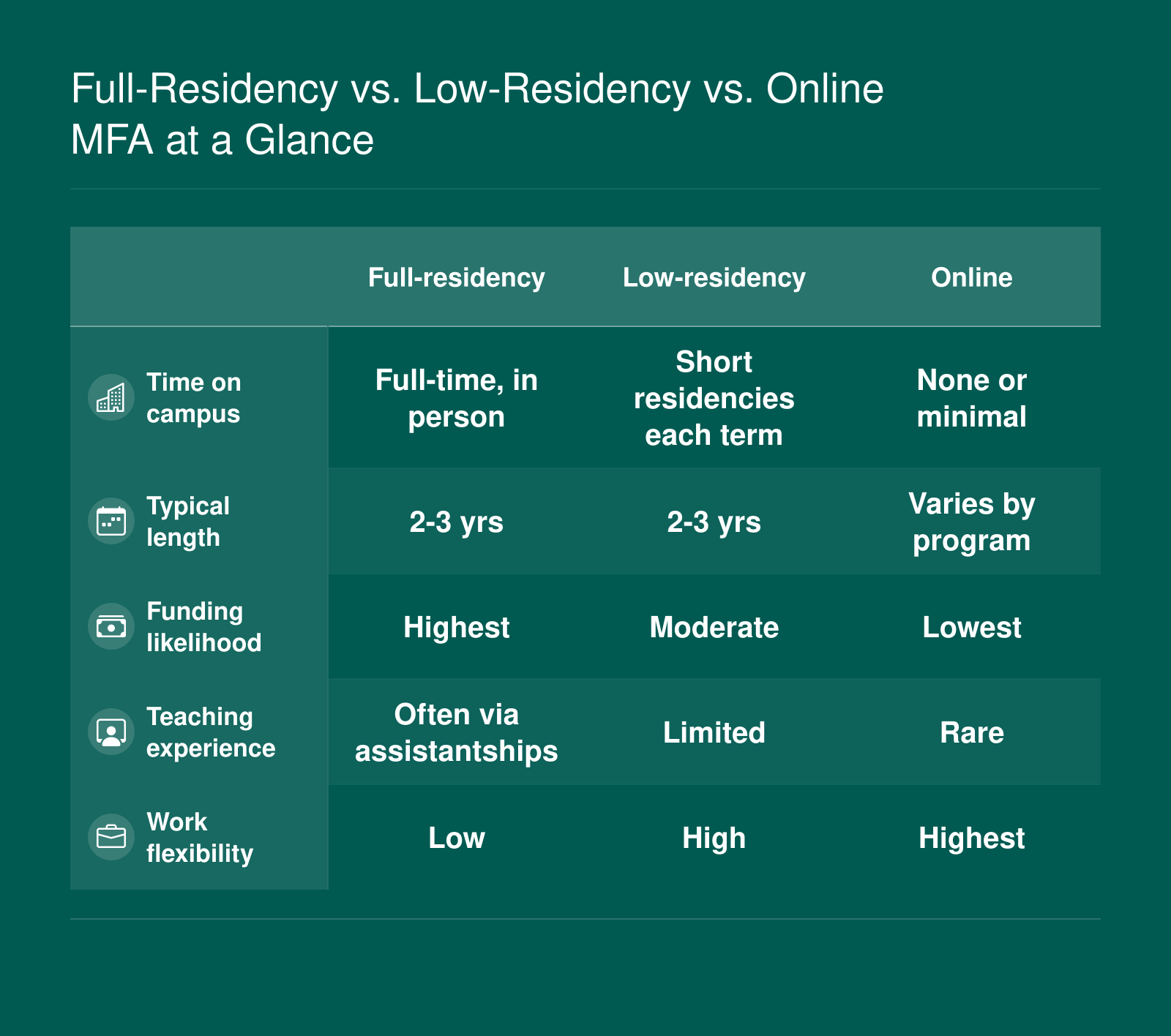
Full-Residency vs. Low-Residency vs. Online MFA at a Glance
The right MFA format depends on whether you can relocate, whether you need funding, and whether you want teaching experience. Use this side-by-side to narrow your choice, then check each program's own details for exact residency dates, length, and aid.
How to Apply: Portfolios, Writing Samples, and Deadlines
Requirements vary by program and department, and some pages were last updated before the 2026–2027 cycle. Confirm every detail on the program's official admissions page before you apply.
- Writing sample (fiction)Michigan's Helen Zell Writers' Program asked for up to 40 double-spaced pages of a novel excerpt or short stories, per its 2024 page.
- Writing sample (poetry)Michigan asked for 15 pages of poems, with each new poem starting on a new page.
- Studio portfolioYale School of Art lists 16 still or moving-image files, all from the last three years, with at least 8 from the past 12 months. SAIC's MFA in Studio asks for 15–20 still images, or up to 10 minutes of time-based work, though wording varies by department.
- Statement of purpose, letters, transcripts, CVThese are standard components of MFA applications, but counts and length limits differ, so check each program's page for specifics.
- GREMichigan and Iowa's Nonfiction Writing MFA both list the GRE as not required. Policies at other schools weren't confirmed, so check each one.
- DeadlinesFall-entry deadlines commonly fall in the winter. SAIC's MFA in Studio is due January 10 by 11:00 p.m. Central time, and its Visual Communication Design MFA has a reduced-fee deadline of December 1. Confirm dates for Michigan, Iowa, Yale, and others directly.
- Application feesSAIC charges $90, or $45 for the Visual Communication Design early deadline. Iowa's Nonfiction Writing MFA charges $60 for domestic and $100 for international applicants. Ask each admissions office about fee waivers.
Fine Arts (MFA) programs by state
Frequently Asked Questions About MFA Programs
These answers cover the questions prospective students ask most about cost, funding, teaching credentials, and admission requirements. Figures reflect the latest published program data for 2026, and requirements vary by school, so confirm details with each program before you apply.
How much does an MFA program cost?
Which MFA programs offer full funding or assistantships?
Is an MFA a terminal degree for teaching at the college level?
Can you get into an MFA program without an undergraduate degree in art or writing?
Compare Fine Arts (MFA) programs on the data that matters
Explore more MFA specializations or browse every graduate field.
All MFA programs