Best Master's in Interior Design Programs
Compare 21 accredited Interior Design programs at 17 schools, with graduate earnings, cost, debt, and completion data from IPEDS and the U.S. College Scorecard.

A graduate interior design degree is a major investment, and program type and accreditation matter far more than a school's name. First-professional, post-professional, and interior architecture tracks lead to different credentials, and only some are CIDA-accredited programs.
Cost widens the gap. Across the ranked schools, annual in-state tuition runs from about $12,700 at the University of Florida to roughly $65,100 at Washington University in St. Louis. Out-of-state rates at public universities can more than double the lower figure.
Thirty U.S. states now regulate interior design in some form, so confirm that a program satisfies licensing requirements before you pay a deposit.
Key Points
- A master's degree is not required for NCIDQ certification, but CIDA accreditation can shorten your work experience.
- Interior design legislation exists in 30 U.S. states as of 2026, so check your state.
- First-professional tracks train career changers, while post-professional degrees assume you already practice.
10 Master's in Interior Design Programs
The ten schools below draw from institutional outcomes and the latest program catalog. Because not every school in this ranking lists a dedicated master's in interior design, each entry shows the graduate program captured in our data. Review the program name and concentration closely before applying.
University of Florida
#1Gainesville, FL · ~$13,000/yr (est.)
Best for: Aspiring interior designers seeking practice-focused mentorship
The University of Florida is a public research university. Its Master of Interior Design uses an evidence-based curriculum that goes beyond undergraduate foundations and offers three paths to the degree. The program emphasizes mentorship from design research leaders and practicing designers, with connections to leading design firms.
- Three paths to the Master of Interior Design
- Evidence-based curriculum beyond undergraduate foundations
- Faculty mentorship from design researchers and practicing designers
- Connections with leading design firms and industry professionals
- Prepares graduates for practice and research leadership
University of California-Los Angeles
#2Los Angeles, CA · ~$14,000/yr (est.)
Best for: California learners exploring architecture and design pathways
UCLA is a public research university. Its broader design landscape includes graduate architecture and urban design programs at Perloff Hall and an Extension interior design certificate. The graduate program captured in this ranking for this school is a Master of Education, so prospective interior design students should verify the program name before applying.
- Graduate Program in Education at UCLA's Moore Hall
- School of Education and Information Studies
- Designed for advanced study in the field of education
University of Pennsylvania
#3Philadelphia, PA · ~$48,000/yr (est.)
Best for: East Coast students considering private research university options
The University of Pennsylvania is a private Ivy League research university. The graduate program captured in this ranking is a Master of Science in Engineering in Bioengineering, which is not an interior design degree. Students comparing interior design master's programs should review the program listing carefully.
- Nine concentration options, including Biomedical Devices and Neuroengineering
- Two-year program with thesis or non-thesis track
- Core coursework in math, biological science, and bioengineering
- Prepares for careers in biotech, medical devices, pharmaceuticals, and academia
Cornell University
#4Ithaca, NY · ~$30,000/yr (est.)
Cornell University is a private Ivy League research university. The graduate program captured here is a Master of Science in Mechanical Engineering, an unrelated field, so it may not serve interior design applicants. Prospective students should confirm the degree name before applying.
- Seven concentration areas, including energy and sustainability and robotics
- Research-oriented curriculum with classroom and laboratory methodology training
- Prepares for careers in industry, government, and academia
- Self-funded MS with no financial support available
University of California-San Diego
#5La Jolla, CA · $15,000 – $20,000/yr (est.)
UC San Diego is a public research university. Its captured graduate program is an online Master of Data Science, unrelated to interior design, so it may not fit this article's focus. The university's strong outcomes and affordability may still appear in comparisons.
- Complete in as little as 18 months, 10 total courses
- Cohort-based learning model for working professionals
- Capstone required: 10-week research project
- Ranked #18 online IT program by U.S. News
- Priority application deadline January 31, 2026
University of California-Davis
#6Davis, CA · $15,000 – $20,000/yr (est.)
UC Davis is a public research university. The program captured in our data is an online Master of Management, which is not an interior design degree. Prospective students should review the program listing carefully.
- 15-month, part-time program for early-career professionals
- First online Master of Management in the UC system
- Core courses in accounting, economics, finance, marketing, and strategy
- Taught by the same faculty as the top-ranked MBA program
- Partnership with edX and 2U
University of Notre Dame
#7Notre Dame, IN · ~$65,000/yr (est.)
The University of Notre Dame is a private Catholic research university. Its captured graduate program is an online Master's in Data Science, unrelated to interior design. Students should confirm the degree name before applying.
- 21-month program, 30 total credit hours
- Synchronous and asynchronous class options
- Capstone with corporate partners including AT&T
- Exclusive immersion weekends in Silicon Valley and on campus
- No quantitative background required for admission
Northwestern University
#8Evanston, IL · ~$55,000/yr (est.)
Northwestern University is a private research university. The graduate program captured for this school is an online Master of Science in Data Science, which is not an interior design degree. Prospective students should verify the program name.
- Six concentration options, including Artificial Intelligence and Data Engineering
- Part-time completion in as little as two years, full-time in one year
- 12 total courses with thesis or capstone option
- Rolling admissions, four start dates per year
- Learn Python, R, and Go
- No GRE required
- Faculty are industry practitioners
- Stackable graduate certificates available
Washington University in St Louis
#9St. Louis, MO · ~$65,000/yr (est.)
Washington University in St. Louis is a private research university. The captured graduate program is a Master of Science in Engineering Data Analytics and Statistics, unrelated to interior design. Students should confirm the degree name before applying.
- 30 total credit hours, full-time and part-time options
- Thesis or project specialization available
- Covers probability, statistics, engineering mathematics, and computational methods
- Small class sizes and collaborative environment
- Department Chair's Master's Fellowship available for research-oriented students
University of Illinois Urbana-Champaign
#10Champaign, IL · ~$19,000/yr (est.)
The University of Illinois Urbana-Champaign is a public research university. Its captured graduate program is a Master of Computer Science, unrelated to interior design. Prospective students should review the program listing carefully.
- Complete in as little as three semesters, 32 total credit hours
- Coursework-only program, no thesis or capstone required
- Broadest course selection within Grainger College of Engineering
- Top-ranked computer science program with world-class faculty
- Big 10 campus experience with access to 30 libraries
Cost & outcomes by school
Federal data for the highest-earning Interior Design programs, independent of the ranking above. Earnings are this field's master's graduates four years after completing, where the Scorecard reports them.
| School | Earnings | Tuition / yr | Debt | Grads/yr | Format |
|---|---|---|---|---|---|
| The New School NY | $86,473 | $44,423 | $42,587 | 78 | Campus |
| Pratt Institute-Main NY | $82,883 | $40,372 | $123,755 | 87 | Campus |
| Drexel University PA | $80,986 | $39,261 | — | 7 | Campus |
| George Washington University DC | $75,210 | $36,414 | $75,495 | 24 | Campus |
| Marymount University VA | $69,957 | $23,446 | $95,211 | 2 | Campus |
| The University of Texas at Austin TX | — | $12,006 | — | 35 | Campus |
| Iowa State University IA | — | $12,967 | — | 18 | Campus |
| Florida State University FL | — | $10,553 | — | 6 | Campus |
| Ball State University IN | — | $12,342 | — | 10 | Hybrid |
| University of Florida FL | — | $12,737 | — | 10 | Campus |
| University of Idaho ID | — | $10,816 | — | — | Campus |
| Washington State University WA | — | $14,845 | — | 4 | Campus |
Sources: U.S. Department of Education. Tuition and graduates: IPEDS. Earnings and debt: College Scorecard, this field's master's graduates; a dash means no figure is reported.
Cost, debt & payoff
Median earnings of this field's master's graduates (4 yrs after completing) vs. their median federal loan debt · U.S. College Scorecard
Across these programs the median graduate earns about $80,986 and finishes with roughly $85,353 in debt — a ratio that clears a common rule of thumb (keep debt below first-year salary). Tuition and debt vary widely school to school, so check the per-school figures in the table above before you shortlist.
How We Rank the Best Master's in Interior Design Programs
Glossy studio photos and school reputations tell you very little about what a graduate degree will cost or return, so this ranking leans on public federal data instead.
What the Ranking Draws On
We use information from IPEDS and the College Scorecard: graduate tuition, average net price, institution-wide graduation rate, and delivery format (on campus, hybrid, or online). Where program-level earnings and debt figures have been published, we factor those in too. For many interior design master's programs, a subset of Arts & Design Master's Programs, those figures are not yet available, and we say so rather than estimate.
We describe these criteria qualitatively and do not publish numeric weights. Programs that pair lower net price with strong outcomes and flexible formats tend to rise.
Limits to Keep in Mind
Two caveats affect how you read the numbers:
- Graduation rates: These reflect the whole institution, not the interior design program specifically.
- Net price: This is an approximate average across students, not a personal quote. What you pay depends on aid, residency, and enrollment status.
The ranking also does not measure studio culture, faculty reputation, or the quality of graduates' portfolios, all of which matter in a design career. Verify CIDA accreditation, curriculum, and overall fit directly with each school before you apply, and treat this list as a starting point for comparison, not a final verdict.
First-Professional vs. Post-Professional vs. Interior Architecture Master's Degrees
One master's trains you to enter the profession, and another assumes you are already in it. Program titles rarely tell you which is which, so the difference is worth understanding before you apply.
First-Professional Master's
This track (MFA, MA, or MS) is built for career changers whose bachelor's degree is outside design. It covers entry-level content and is the type CIDA can accredit.1 George Washington University's Interior Architecture MFA is a clear example: 60 credits over 24 months, open to applicants with a non-design bachelor's, and CIDA-accredited.2 Pratt's Interior Design MFA shows how background changes the length. Applicants with a design degree complete 60 credits in two years, while those without add a 24-credit core year, for 84 credits and about three years.3
Post-Professional Master's
This track is for people who already hold an interior design, architecture, or related degree and want research, specialization, or teaching credentials. CIDA does not accredit these programs, so they do not serve as a licensure route.1 GWU's Interior Architecture MA runs 30 credits in 12 months.4 The University of North Texas MFA is a longer exception: 60 credits over roughly four years, aimed at university teaching, and requiring a design bachelor's plus two years of professional experience.
Where Interior Architecture Fits
Interior architecture programs (MIA or MArch-I) lean harder toward building systems, structure, and adaptive reuse than a decorative or space-planning curriculum does. The labels are not consistently interchangeable with interior design, though. Check each program's admissions, curriculum, and CIDA status. Some states also regulate who may use the title "interior designer," so confirm local rules.
Boston Architectural College offers both types. Its Master of Interior Architecture is first-professional for non-design undergraduates. Its online MS in Interior Architecture is post-professional: 30 credits over four semesters.5
A Quick Rule of Thumb
If you are changing careers and want to pursue NCIDQ certification, choose a first-professional program. If you already practice and want depth, research, or a teaching credential, a post-professional degree usually fits better.
CIDA Accreditation and NCIDQ Eligibility: Why They Matter
What does CIDA accreditation actually change for your NCIDQ timeline and state licensure path? The short answer: it can shorten the supervised work experience you need before sitting for the exam, but it does not grant a license by itself. CIDA accreditation alone does not confer a license, registration, or protected-title right.1
What CIDA Actually Accredits
The Council for Interior Design Accreditation accredits individual professional-level degree programs, not universities. A school may hold CIDA accreditation for one named master's program while other graduate degrees at the same institution are not covered. The review is voluntary and based on the CIDA Professional Standards, a program self-evaluation, student work review, and a three-member peer site visit before the Accreditation Commission decides.1
Several master's programs are listed in CIDA's directory, including the Master of Interior Architecture at Florida International University, the Master of Interior Architecture at Kansas State University, the Master of Interior Design at UT Austin, the Master of Fine Arts in Interior Architecture and Design at Academy of Art University (offered on-campus and online), the Master of Interior Architecture at Cal Poly Pomona, and the Master of Interior Design at University of Manitoba. George Washington University's MFA in Interior Architecture also appears. Confirm the latest status in CIDA's online directory before applying, because accreditation terms are program-specific and renewal dates vary.2
NCIDQ and Licensure Payoff
For NCIDQ certification, a CIDA-accredited degree generally satisfies the education component.1 Candidates still must complete NCIDQ's work experience requirement and pass the exam. State registration boards may recognize a CIDA-accredited degree as part of eligibility, but the state board determines actual legal requirements, which vary by jurisdiction and graduation date. Employers and design firms also commonly treat CIDA accreditation as a signal of a standardized professional foundation. Because CIDA accredits entry-level professional preparation, the designation matters most for students using the master's as their first professional interior design credential.
When a Non-Accredited Program Is Fine
A master's program without CIDA accreditation is not automatically a worse choice. Post-professional degrees, which build on a first professional interior design degree, may not hold CIDA accreditation because they are not entry-level preparation. If you already hold a CIDA-accredited bachelor's degree, you may have the education component covered and choose a post-professional master's for specialization. If this is your first professional interior design credential, though, check the licensure path carefully, because a non-accredited degree changes the NCIDQ experience timeline and may affect state registration eligibility.
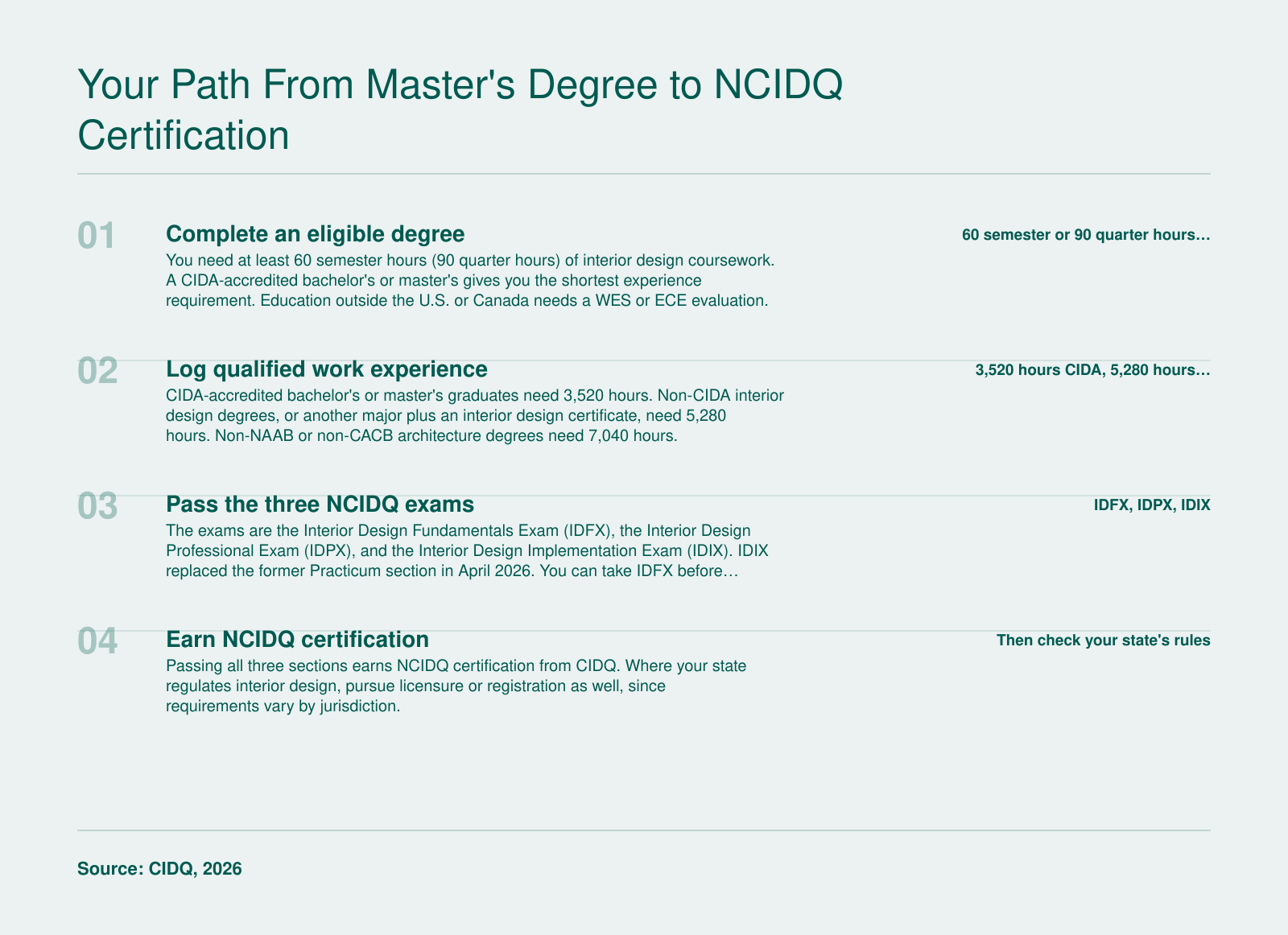
Your Path From Master's Degree to NCIDQ Certification
A master's degree is not required for NCIDQ certification. A qualifying bachelor's in interior design also works, and so does another eligible education route with more work experience. The CIDQ requirements below reflect 2026.
Related Articles
Admissions Requirements: Portfolio, Prerequisites, and Testing
Requirements vary by school and track, and several programs here do not publish full details in a form we could verify for 2026. Pratt is the clearest example below. Confirm every item with each admissions office before you apply.
- Bachelor's degreeEvery master's program expects a completed bachelor's degree or international equivalent. Pratt accepts applicants from any field but sorts them by background: those with a related design degree enter the 60-credit MFA directly, while those without one complete a 24-credit Graduate Core Year first, for 84 credits in total. Other schools may handle first-professional and post-professional tracks differently, so ask about it.
- PortfolioPratt requires a portfolio from all MFA applicants, including those without a design background. It should match your transcript and show process work as well as finished pieces. Pratt suggests research, physical models, hand drawings, and renderings, plus project details such as course, software used, and your role in group work. Non-designers can generally draw on sketches, photography, or other art, but page or image counts differ by school and Pratt does not state one for this program, so check the current guidelines.
- Prerequisites and levelingPratt's Core Year serves as its foundation sequence for career changers. SCAD notes that up to five additional graduate intensives (95–115 total hours) may be assigned, though we could not confirm this is tied to background. Expect drawing, design history, and CAD to come up as leveling topics, and ask each school whether summer foundation options exist.
- GREPratt does not require the GRE for any program. We could not verify current policies for SCAD, Cornell, Virginia Tech, or Cincinnati. One third-party source says Cincinnati requires the GRE for some international applicants, with an exemption for those holding a qualifying U.S. or equivalent degree with a 3.0 GPA or higher. Treat that as unconfirmed and verify it with the school.
- Statement, references, and résuméExpect a statement of purpose and a résumé at most schools. Pratt asks for two letters of recommendation. Choose recommenders who can speak to your design ability or work habits.
- GPA and English proficiencyPratt's graduate minimum is a 3.0 GPA, or the equivalent. Some schools admit applicants below the minimum when the portfolio is strong. International applicants whose first language is not English typically submit a TOEFL, IELTS, or similar score, with minimums set by each school.
Interior design is regulated in more places than many students expect. According to ASID, 30 U.S. states and 32 U.S. jurisdictions have enacted interior design legislation as of 2026, and CIDQ notes Idaho recently became the 30th state. Check your state's rules before you choose a program.
Interior Design programs by state
Frequently Asked Questions About Master's in Interior Design Programs
These answers cover the questions prospective students ask most often when comparing graduate interior design options. Program lengths and requirements vary by school and by your prior education, so confirm details with each department before you apply.
Do I need a master's in interior design to become NCIDQ certified?
What is the difference between interior design and interior architecture?
Can I get a master's in interior design without an undergraduate design degree?
How long does a master's in interior design take, and are there accelerated options?
Is an MFA or an MS/MA better if I want to teach interior design?
Compare Interior Design programs on the data that matters
Explore more Arts & Design specializations or browse every graduate field.
All Arts & Design programs