Accelerated Master's in Interior Design Programs
Compare 21 accredited fastest Interior Design programs at 17 schools, with graduate earnings, cost, debt, and completion data from IPEDS and the U.S. College Scorecard.

A master's in interior design usually takes two to three years, but a 4+1 or credit-sharing pathway lets undergraduates count graduate courses toward both degrees and finish sooner. The catch is licensure: NCIDQ eligibility depends on accredited education plus supervised work hours.
Speed, cost, accreditation, and format drive the choice, and the fastest programs are ranked next. Many accelerated tracks fall outside CIDA's scope.
Key Points
- Rankings here prioritize speed, then net price and outcomes.
- Per-credit tuition spans $896 at Brenau to $1,045 at Fairfield.
- CIDA accredits a narrow slice of fast interior design master's tracks.
Best Accelerated Master's in Interior Design Programs for 2027
This roundup is ordered first by speed to completion and then by net price and outcomes. We emphasize programs with verifiable interior design credentials or flexible delivery, and call out graduate tuition and format where available.
Florida State University
#1Tallahassee, FL · ~$11,000/yr (est.)
Best for: Post-professional designers pursuing thesis research
Florida State University's Advanced Professional MS in Interior Design is a post-professional pathway for students who already hold an undergraduate degree in design or architecture. The campus program offers project and thesis tracks, with a project sequence that can run fall to spring and a thesis route aimed at research and teaching. The university reports a graduation rate above 85 percent and offers in-state graduate tuition near $5,700 per year.
- Admits students with prior interior design or architecture degree
- Project track runs two semesters, Fall to Spring
- Thesis track runs five semesters within two years
- Requires 3.0 GPA on last 60 undergraduate hours
- GRE waived at that GPA; otherwise desired 305 combined
- CIDA and NASAD accredited
- Teaching assistantships provide tuition waiver and stipend
- 15-20 piece portfolio and interview required
Fairfield University
#2Fairfield, CT · ~$21,000/yr (est.)
Best for: Online career changers needing flexible pacing
Fairfield University offers an online Master of Arts in Interior Design that welcomes students from any undergraduate background, so career changers can enter without a prior design degree. The part-time, synchronous format is designed for working adults, and certificate coursework can transfer into the master's path. The program is structured for NCIDQ exam preparation and industry-reviewed portfolio work.
- Fully online with synchronous daytime or evening sections
- No prior design degree required
- 63 credits; typically four to four and a half years part-time
- $1,045 per credit, about $65,835 total at 2026-27 rates
- Prepares for NCIDQ certification and ASID membership
- Capstone research project presented to industry experts
- Residential or professional interior design certificate option
- Priority deadlines: August 1 fall, December 1 spring
Rutgers University
#3New Brunswick, NJ · ~$23,000/yr (est.)
Rutgers University is a large public research university in New Brunswick, NJ, with strong graduate programs across medicine, health sciences, and other fields. The school reports a graduation rate above 80 percent and a freshman retention rate above 90 percent. In-state graduate tuition is below $18,000, while out-of-state exceeds $37,000.
- Five biomedical and health sciences tracks available
- Full-time students can finish in one year
- Part-time students have up to four years
- Taught by Robert Wood Johnson Medical School faculty
- Covers anatomy, physiology, pharmacology, microbiology, and immunology
- Prepares for medical school or doctoral studies
Syracuse University
#4Syracuse, NY · $45,000 – $50,000/yr (est.)
Syracuse University is a private research university in Syracuse, NY, known for strong graduate programs in technology, policy, and the arts. The institution reports a graduation rate above 80 percent and offers one-year accelerated options in several fields. Graduate tuition is above $65,000.
- 31-credit, one-year campus program
- Concentrations in data science, cloud computing, project/team management
- Human-centered AI curriculum with responsible AI focus
- Portfolio capstone and hands-on projects
- Test optional; GRE, GMAT, LSAT accepted
- Career services and research lab access
Texas Christian University
#5Fort Worth, TX · $35,000 – $40,000/yr (est.)
Texas Christian University is a private university in Fort Worth, TX, with strong graduate education offerings and a compact student-faculty ratio. The school reports a graduation rate above 85 percent and a retention rate above 90 percent. Graduate tuition is around $61,650.
- Four specializations: curriculum studies, language/literacy, math, science
- 30-credit hour program with thesis or capstone emphasis
- Traditional or accelerated pathways
- Prepares for instructional coordinator or curriculum specialist roles
- Designed for practicing teachers and educational professionals
University of Delaware
#6Newark, DE · $20,000 – $25,000/yr (est.)
The University of Delaware is a public research university in Newark, DE, offering practical master's degrees through the Biden School of Public Policy and Administration. The school reports a graduation rate above 80 percent and in-state graduate tuition near $16,800. Out-of-state tuition is roughly $41,400.
- Specializations in public administration, policy, health, disaster science
- Urban analytics and energy/environmental policy tracks
- 4+1 accelerated bachelor's to master's options
- Scholarship opportunities and real-world impact focus
Indiana University-Bloomington
#7Bloomington, IN · $12,000 – $33,000/yr (est.)
Indiana University Bloomington is a public research university with strong graduate programs in information and library science, business, and public affairs. The school reports a graduation rate above 80 percent and a freshman retention rate above 90 percent. In-state graduate tuition is near $12,100.
- Offered by Luddy School of Informatics, Computing, and Engineering
- 4+1 accelerated program available for undergrads
- Dual degree options with MPA or Central Eurasian Studies
- Prepares for information management and data analysis roles
Susquehanna University
#8Selinsgrove, PA · ~$8,000/yr (est.)
Susquehanna University is a private liberal arts college in Selinsgrove, PA, with a small student-faculty ratio and a campus-based Master of Education program. The school reports a graduation rate above 80 percent and a freshman retention rate above 85 percent. Graduate tuition is around $58,750.
- 34-credit Curriculum & Instruction program
- Can be completed in as few as five semesters
- Evening classes for working teachers
- $685 per credit
- Optional 4+1 pathway to finish in one year
- Add ESL certification option
- 100% of students receive financial aid
Assumption University
#9Worcester, MA · ~$15,000/yr (est.)
Assumption University is a private university in Worcester, MA, offering graduate programs in education and health sciences. The school reports a graduation rate above 75 percent and a freshman retention rate above 80 percent. Graduate tuition is roughly $51,356.
- 36-credit program blends online and on-campus learning
- Complete in as little as one year full-time
- DESE Approved with Distinction
- Leads to Massachusetts Initial or Professional Licensure
- No entrance exam required
- 400 clinical hours and practicum placement support
- Small classes of 4-15 students
Sacred Heart University
#10Fairfield, CT · ~$34,000/yr (est.)
Sacred Heart University is a private university in Fairfield, CT, with graduate programs in communication, health, and business. The school reports a graduation rate above 70 percent and a freshman retention rate above 80 percent. Graduate tuition is near $50,404.
- 36-credit program can be completed in one year full-time
- $985 per credit
- No entrance exam or GRE required
- Small classes of 10-15 students
- Internship with media or nonprofit partners
- PRSSA membership included
- MacBook Pro laptop included
None of the ranked Interior Design programs match the fastest lens yet. The full ranking is at the link above.
Cost, debt & payoff
Median earnings of this field's master's graduates (4 yrs after completing) vs. their median federal loan debt · U.S. College Scorecard
Across these programs the median graduate earns about $80,986 and finishes with roughly $85,353 in debt — a ratio that clears a common rule of thumb (keep debt below first-year salary). Tuition and debt vary widely school to school, so check the per-school figures in the table above before you shortlist.
How Accelerated Paths Work: 4+1, MFA, Interior Architecture, and Online Options
The fastest route to a Master's in Interior Design depends less on the school than on your undergraduate background.
4+1 and Post-Bachelor's Routes
In a 4+1 or BS/MA model, undergraduates take graduate courses that count toward both degrees, which brings the total to about five years. Several schools ranked here run 4+1 tracks, though in other fields. We could not verify a current interior design version at SCAD, Pratt, or NewSchool, so confirm with admissions.
Students who already hold a design degree can look for intensive or year-round master's programs of roughly 12 to 18 months. Career changers usually need a first-professional master's, which is often longer because foundation studios come first.
MA/MS, MFA, and Interior Architecture
An MA or MS in interior design emphasizes professional practice and is usually the shortest. SCAD's M.A. is 45 credits, and Academy of Art University's M.A. in Interior Architecture & Design is 36 units.
The Best MFA Programs are terminal studio degrees built for research and teaching. SCAD's M.F.A. is 90 credits, so it is not an accelerated option.
Interior architecture leans toward building structure, systems, and code alongside spatial design.
Online Formats and Pacing
SCAD offers its M.A. online through SCADnow, and Academy of Art University offers its M.A. online and on campus. Academy's duration is reported inconsistently, as one year over three semesters in one listing and two years full time in another, so verify it directly.
Most of the one-year programs in the ranking are campus-based. Wheaton's 4+1 is asynchronous online; Assumption's program is in special education, not interior design. Part-time online pacing stretches completion, while full-time cohorts in Online Master's in Interior Design programs finish fastest.
CIDA Accreditation and NCIDQ Eligibility: What Accelerated Students Must Check
Fast master's tracks are multiplying, but the accreditor that matters most for licensure still certifies only a narrow slice of them. CIDA accredits professional-level programs that culminate in a bachelor's or a professional master's, so many accelerated or post-professional master's programs carry no CIDA status of their own. Among master's programs, CIDA-accredited interior design master's programs in CIDA's accredited program directory for 2026 include Academy of Art University (MFA), Arizona State, Florida International, and Kansas State, and that list may not be exhaustive.
How NCIDQ eligibility works
NCIDQ eligibility combines education with supervised work experience, and the hours depend on your degree type. CIDQ's 2026 pathways require 3,520 hours for graduates of CIDA-accredited professional programs.1 A non-CIDA master's also lands at 3,520 hours, while a non-CIDA bachelor's requires 5,280.1 Education pathways call for 60 semester (90 quarter) interior design credits, and up to 1,760 hours earned before graduation may count.1 A certified or licensed designer must verify your hours, and you have 10 exam administrations to pass all three sections.1
Why states care
CIDQ reports that regulated jurisdictions require NCIDQ certification, with California the exception.2 Alabama is one example, and Idaho became the 30th regulated state through a protected title for NCIDQ Certificate Holders.3 Requirements vary by registration type, so check your state's specific rules.
Your practical check
Before enrolling, look up the program in CIDA's accredited program directory and confirm the degree level and accreditation dates. A marketing page claiming "CIDA-aligned" or "CIDA-accredited" is not a substitute for the directory listing.
Related Articles
What Does Graduate Tuition Cost at the Fastest Interior Design Master's Programs?
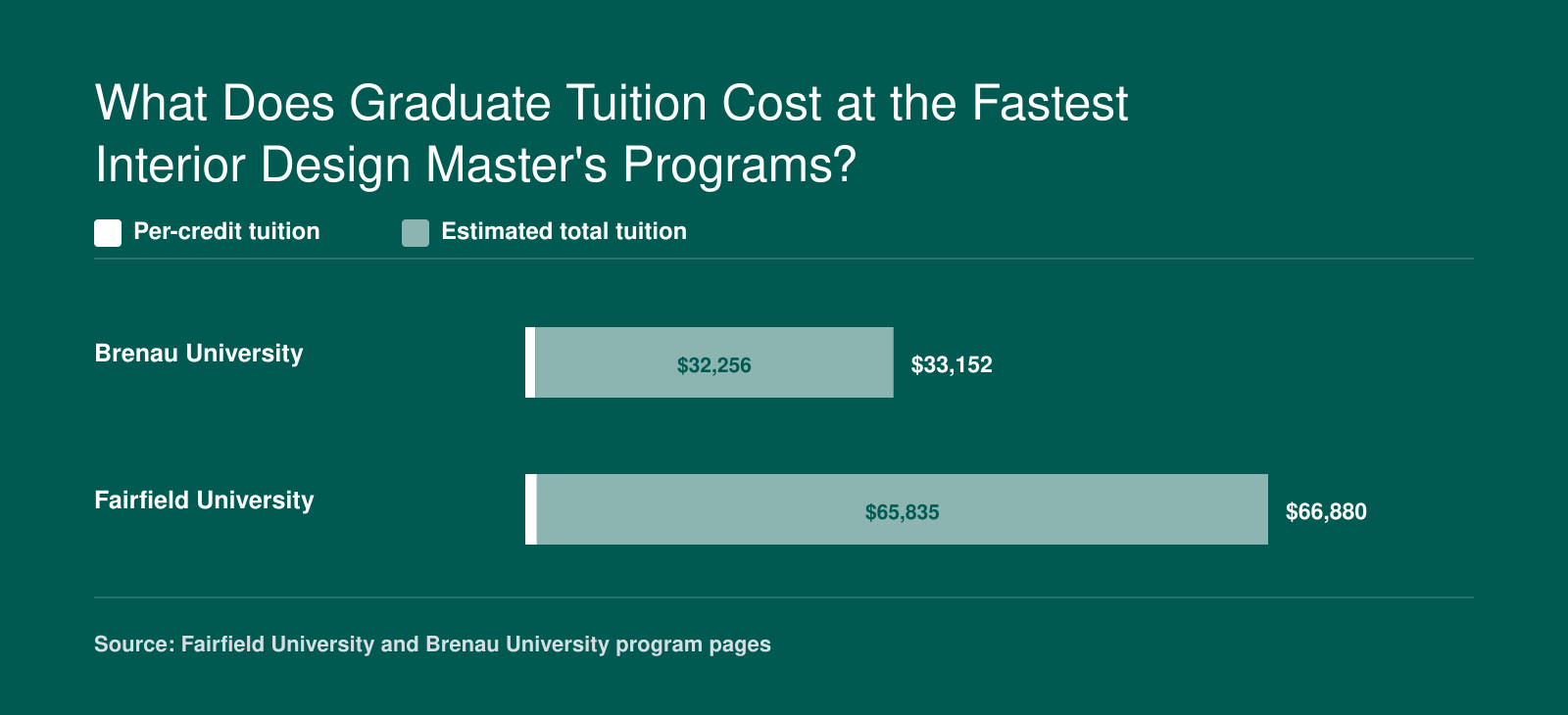
Published per-credit tuition is the clearest public cost signal for accelerated interior design master's programs, spanning $896 at Brenau University to $1,045 at Fairfield University. Fairfield's rate prices a 63-credit program at an estimated $65,835 before fees, while Brenau's 36-credit online total is $32,256 and up to nine transfer credits can lower it; the net price reported in federal data is an institution-wide average after aid, not a program quote. A 4+1 structure cuts total cost by sharing 9 to 12 graduate credits between the bachelor's and master's, reducing billed graduate credits and one year of living costs.
Admission Requirements for Accelerated Interior Design Master's Programs
- Bachelor's degree and GPAMost tracks require a bachelor's in interior design, architecture, or a related field with a 3.0 or higher. Drexel asks for 3.2 overall and 3.5 in studio courses; Texas Tech and Washington State use 3.0.
- When to applyUndergraduates usually apply in the junior year or after about 90 credits. Deadlines are generally fixed rather than rolling: Washington State November 20, Texas Tech December 1, Florida International January 15.
- Portfolio and prerequisite courseworkPortfolios range from studio work to freehand drawings; Florida International asks for stairs, a bicycle or part, and a third piece, and digital files are common. Prereqs include Design Studio 1–4 with C or better at FIU and ID 540 with B or better at WSU. Career changers may need foundation courses.
- Essays, recommendations, and GREA statement of purpose is typical, Washington State asks for 250–500 words, Drexel for a goals and leadership essay, and Drexel lists two recommendation letters. GRE is not required at Texas Tech; Florida International requires it only below a 3.0 GPA.
Interior Design programs by state
Interior Design Master's FAQs
Is a master's in interior design worth it?
What can you do with an interior design master's?
What is the difference between a master's in interior design and interior architecture?
Is an interior design MFA a terminal degree for teaching?
Compare Interior Design programs on the data that matters
Explore more Arts & Design specializations or browse every graduate field.
All Arts & Design programs