Master's Programs in Washington
Every master's program reported by a school in Washington: 460+ programs at 23 graduate schools, with the online options, costs and outcomes behind each one.

A resident seat at a public university in Washington and a seat at a private one in Seattle can differ by five figures a year for the same credential. Nonresident rates at the publics widen that gap further, and a teaching or research assistantship can close it almost entirely, depending on the department you land in.
That spread is the real decision. Format matters too: a full-time cohort usually finishes in about two years, while part-time or online master's programs often run longer and rarely carry funding.
And for clinical mental health counseling, social work, and nursing, the degree is only the first step. Washington licensure adds supervised hours after graduation, which pushes the true timeline well past commencement.
Key Points
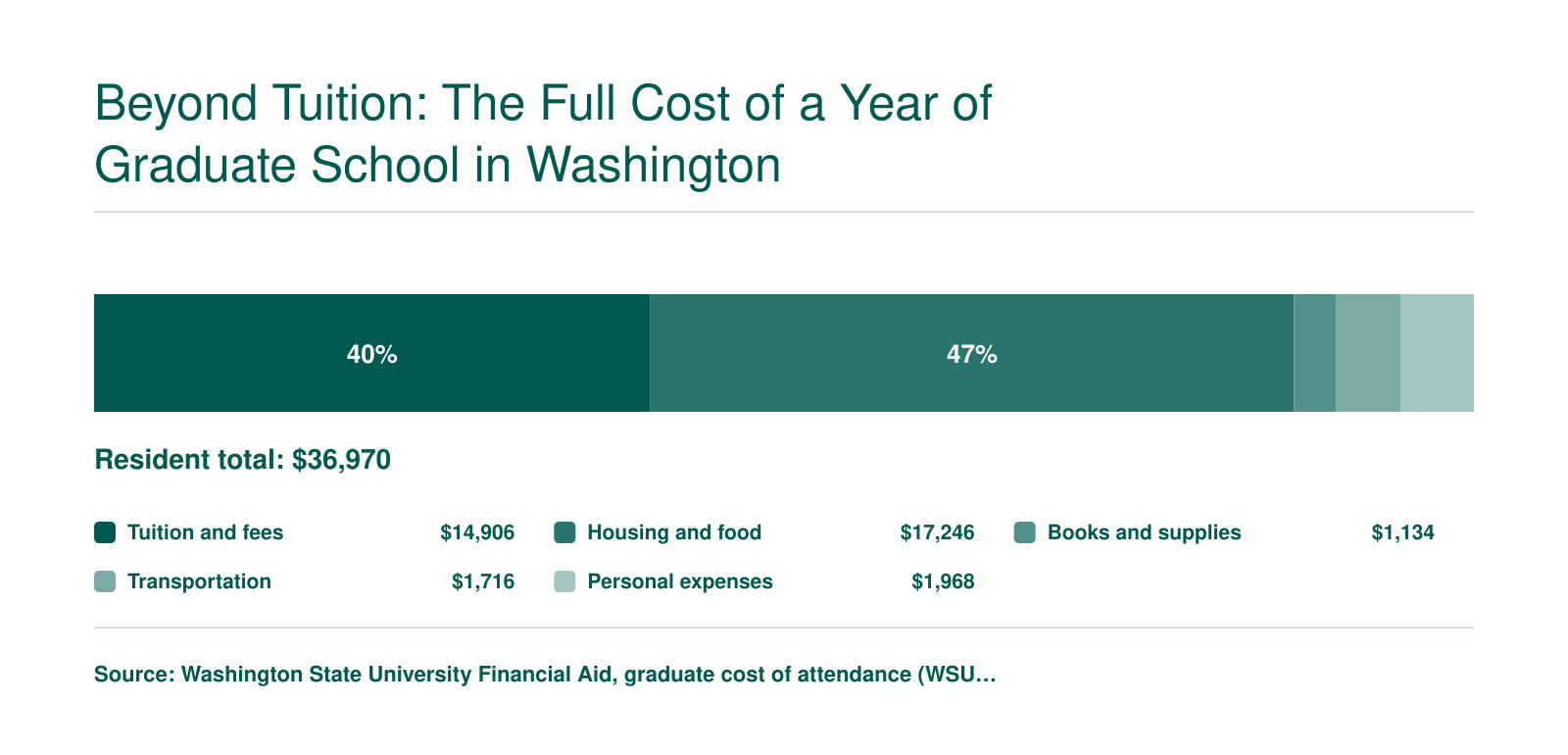
- Housing and food can outweigh tuition in a Washington master's budget, such as WSU Tri-Cities for 2026-27.
- Most full-time master's degrees take 1.5 to 2 years, and part-time paths run longer.
- Assistantships fund research programs far more often than professional or online ones, so ask each program directly.
Popular degrees in Washington
Master's programs in Washington by field
Education & Teaching
- Teaching30 programs
- Educational Leadership19 programs
- Special Education19 programs
- Elementary Education9 programs
- Reading & Literacy7 programs
- Curriculum & Instruction6 programs
- Secondary Education6 programs
- Music Education6 programs
Business & Management
- Accounting12 programs
- Management12 programs
- General Business11 programs
- Analytics11 programs
- Healthcare Administration8 programs
- Public Administration7 programs
- Finance7 programs
- Project Management7 programs
Counseling
- Clinical Mental Health Counseling12 programs
- School Counseling9 programs
- Marriage and Family Therapy or Marriage and Family Counseling7 programs
- Addiction Counseling1 program
- Christian Counseling1 program
Healthcare
- Speech Pathology6 programs
- Exercise Science5 programs
- Public Health5 programs
- Health Administration5 programs
- Nutrition4 programs
- Health Education2 programs
- Health Informatics1 program
Arts & Design
- Creative Writing21 programs
- Fine Arts2 programs
- Interior Design1 program
Communications & Media
- Communication9 programs
- Communication Disorders4 programs
- Speech Pathology4 programs
- Strategic Communication2 programs
- Organizational Communication2 programs
- Public Relations1 program
- Health Communication1 program
Social Work & Social Sciences
- Social Work10 programs
- Social Work Advanced Standing7 programs
- Political Science, Government2 programs
- Sociology1 program
Religion & Theology
- Theology8 programs
- Divinity4 programs
- Christian Ministry4 programs
- Christian Leadership3 programs
Nursing
- Nursing Education or Nurse Educator6 programs
- Family Nurse Practitioner (FNP)4 programs
- Nurse Administrator3 programs
- Psychiatric Mental Health Nurse Practitioner2 programs
- RN to MSN2 programs
- Health/Nursing Informatics1 program
- Direct Entry MSN (MENP) or (DEMSN)1 program
Psychology
- Counseling Psychology6 programs
- Applied Behavior Analysis4 programs
- Educational Psychology or School Psychology2 programs
- General Psychology1 program
- Child Psychology1 program
- Industrial Organizational Psychology1 program
- School Psychology1 program
- Sports Psychology1 program
Computers & IT
- Data Analytics7 programs
- Cybersecurity4 programs
- Information Security & Assurance4 programs
- Machine Learning2 programs
Science & Engineering
- Environmental Science6 programs
- Sustainability or Environmental Management6 programs
- Geography1 program
Criminal Justice & Law
- Public Policy4 programs
- Master of Laws2 programs
- Legal Studies1 program
- Business Law1 program
What a Master's Degree Costs in Washington: Public vs. Private Tuition
Graduate tuition in Washington is the published price a school charges per year or per credit for a master's program. Public universities set a lower resident rate and a much higher nonresident rate. Private universities charge one rate to everyone. The figures below are the most recent published numbers for 2026-2027 (Seattle University's and Gonzaga's are 2026 rates), and they are a starting point, not a quote.
Published Tuition at a Glance
- University of Washington Seattle: $28,398 resident, $44,073 nonresident per year. This is an estimate for a full-time student in one applied engineering master's program, so other UW programs will differ.
- Washington State University: $14,476 resident, $31,148 nonresident per academic year, built from two semesters of tuition and fees.1
- Eastern Washington University: $12,824 resident, $28,228 nonresident per year, with listed fees included.2
- Seattle University (private): about $749 to $1,073 per graduate credit, depending on the program.3
- Gonzaga University (private): about $750 to $1,265 per credit for most graduate programs, and $2,024 per credit for a traditional three-year program.4
The in-state discount at the public schools is large, roughly $15,000 to $16,000 a year at WSU and EWU. If you can establish Washington residency, or your program has a regional exchange arrangement, that gap matters more than almost any other cost decision.
Why Your Program May Not Match the Table
Standard graduate tuition is only the baseline. MBA programs, MSN programs, engineering, and online fee-based programs often carry differential or per-credit pricing set by the program itself. That is why Seattle University and Gonzaga publish ranges rather than a single number. Always find the rate for your specific program and delivery format.
Fees and a Realistic Total
Sticker tuition leaves out mandatory charges. WSU lists $215 per semester in mandatory fees1, and public schools commonly add technology and services and activities fees. Some campuses also bundle a transit pass such as the U-PASS, so confirm what your campus charges and whether you can opt out.
For a typical two-year degree, resident tuition and fees at a public university run roughly $25,000 to $57,000 in total, with regional schools at the low end and UW's higher-priced programs at the top. At Seattle University's published range, a 36-credit program comes to roughly $27,000 to $38,600 before fees.3 Treat these as estimates, and compare the total program cost, not the annual rate.
Beyond Tuition: The Full Cost of a Year of Graduate School in Washington
Tuition is only part of what a master's year costs. This example uses the 2026-27 resident graduate budget at Washington State University Tri-Cities, which lists tuition and fees, housing, food, books, transportation, and personal expenses. Housing and food together exceed tuition and fees even at this lower-cost campus, and in the Seattle area housing often costs as much as or more than tuition for resident students, a gap we compare region by region below. Tuition varies by program and campus, and the budget excludes loan fees.
How Long a Master's Takes in Washington: Full-Time, Part-Time, Online, and Accelerated Paths
Most full-time master's degrees in Washington take 1.5 to 2 years, and part-time evening or online formats commonly stretch to 2.5 years or more. Some paths run shorter. One-year options and combined bachelor's/master's tracks exist, but they are the exception.
Quarters vs. Semesters
The University of Washington, Western Washington, Eastern Washington, and Central Washington all run on the quarter system. Three main terms a year (autumn, winter, spring) with a summer session mean shorter terms and more credits counted in total. A quarter credit equals two-thirds of a semester credit, so a 45-quarter-credit degree is roughly a 30-semester-credit degree. Compare credit totals only after converting. Some private schools, Gonzaga among them, use semesters, which usually means fewer, longer terms and fall or spring starts. Quarter schools offer more entry points on paper, but many programs still admit only once a year, so check each program's start term.
Online, Hybrid, and Evening Formats
UW Professional & Continuing Education offers fee-based master's programs in online, hybrid, evening, and weekend formats, including online MHA programs.1 Listed timelines vary widely:
- Executive Master of Health Administration: about 24 months part time, with evening, weekend, and flexible scheduling.2
- Health Informatics: about 18 months part time.2
- Aerospace Engineering: about 36 months part time.2
- Supply Chain Transportation & Logistics: 12 to 24 months, with a September 2026 start. Its weekend residency can be completed online or in person in Seattle, so travel is optional.3
Start dates differ by program, and some listings point to 2027, so confirm that a program is admitting now. WSU Global Campus also offers online graduate degrees, and Seattle University runs evening and online options, so ask each MHA program in Washington whether classes are live (synchronous) or self-paced (asynchronous) and whether any campus visits are required.
Accelerated Paths
Gonzaga's accelerated program lets enrolled undergraduates take 9 graduate credits in their final undergraduate year at undergraduate tuition, with potential savings above $9,000.4 Students can then finish the master's in about a year or study online while working. The whole path can take as little as five years. Courses are online, with on-campus immersion opportunities.
Two Caveats
Some fee-based online programs charge one rate regardless of where you live, so out-of-state students should ask whether residency changes the price. And online does not mean fully remote for licensure. Seattle University's online Clinical Mental Health Counseling program, one of its M.Ed. programs, includes a yearlong internship5, and licensure-track programs generally require in-person practicum placements. Plan for that time on top of coursework.
Washington Master's Admissions: Requirements, Deadlines, and GRE Policies
Washington's graduate schools set a common baseline, but each program decides its own details. Confirm every requirement with the program before you apply.
- Bachelor's degree and GPAYou need a bachelor's degree from a regionally accredited institution. The University of Washington Graduate School sets a 3.0 minimum, calculated on your full degree or on your last 90 quarter or 60 semester credits. WSU also generally expects a 3.0, though some programs state their own method. Seattle University lists no single minimum and reviews cumulative coursework from your most recent degree.
- GRE and GMATMost Washington programs no longer require the GRE. UW's Graduate School does not require it, and Seattle University treats GRE/GMAT scores as optional in most cases. Some STEM, economics, and competitive MBA programs may still ask for scores, and others offer waivers based on experience or GPA.
- DeadlinesThere is no central fall deadline. Priority and funding deadlines often fall between December and February, and WSU Civil and Environmental Engineering lists January 10. Many online and professional programs admit on a rolling basis or later.
- Application materialsExpect a statement of purpose, letters of recommendation, and a résumé. Fields such as nursing, counseling, and data science may also require prerequisite coursework.
- English proficiencyInternational applicants usually need a test score. UW requires proof with no waivers: IELTS 6.5, Duolingo 110, and TOEFL iBT 80 before 2026 scoring changes (4.0 on the new scale). Seattle University exempts degrees from the U.S., Canada, Great Britain, Ireland, New Zealand, and Australia.
Paying for Your Washington Master's: Assistantships, WRGP, Aid, and Employer Benefits
Assistantships are the best funding in graduate school, and they are far more available in research programs than in professional or online ones. At the University of Washington and Washington State University, a TA or RA appointment generally means about 20 hours per week in exchange for a tuition waiver, a stipend, and often health insurance. Stipends have no single university-wide figure. They vary by department, appointment percentage, funding source, and program.
Read the Waiver Terms
At WSU, a half-time (20 hour) appointment qualifies for a full tuition waiver, while a quarter-time appointment earns a partial one.1 Residency matters: nonresident assistants get the out-of-state portion waived in the first year, then owe nonresident tuition if they have not established Washington residency. International students keep the out-of-state waiver throughout.1 At UW, resident operating and technology fees may be waived, though not every fee necessarily is. WSU also introduces a new graduate waiver code effective August 16, 2026, so confirm how your offer is coded.1
The Western Regional Graduate Program
The WICHE Western Regional Graduate Program covers 16 Western states and territories.5 Residents of participating places can enroll in select out-of-state public graduate programs at a reduced rate, set at 150 percent of resident tuition.4 Eligibility is program-specific.4 UW's Environmental and Occupational Health Sciences department, for example, treats all of its graduate options except the MPH as WRGP-eligible for students with 12 months of residency in a participating state before starting. Check WICHE's current directory before assuming a program qualifies.4
Federal Loans After the 2026 Changes
Graduate PLUS loans were eliminated beginning July 1, 2026.3 A narrow exception exists for students continuously enrolled in the same program at the same institution as of June 30, 2026, who received a Direct Loan for that program before July 1.3 It lasts a maximum of three years, so confirm your status with the financial aid office.3 For everyone else, Direct Unsubsidized loans carry a $20,500 annual limit, a $100,000 aggregate cap, and a $257,500 lifetime limit.3 Limits can differ by program type, so verify yours. New loans are also limited to two repayment options: Tiered Standard Repayment (10 to 25 years) and the Repayment Assistance Plan (forgiveness after 30 years).3
Employer and State Support
Tuition assistance is common among Seattle-area tech, healthcare, and public employers, and it can make part-time study far cheaper. Ask HR about annual caps and any service commitments. Health and education workers should also look into Washington Health Corps and educator loan repayment programs, but confirm current amounts, service terms, and shortage-area rules directly with the agencies.
Apply by the earliest funding deadline. Assistantship and fellowship decisions are often tied to it, and late applicants frequently compete for what is left.
Washington Wages for a High-Demand Master's-Level Role
Nurse practitioners, who typically need a master's degree, show how graduate training can pay off in Washington.
Seattle, Tacoma, Bellingham, or Spokane: Regional Tradeoffs for Grad Students
Where you study in Washington shapes your real cost of living as much as tuition does. A stipend that stretches comfortably in Pullman or Ellensburg can feel tight in Seattle, where rents run far higher.23 But any specific number you read today will be stale tomorrow: rents move month to month, vary sharply by neighborhood, and differ depending on whether a source reports a median or an average, a one-bedroom or an all-unit figure. Rather than anchor to a snapshot, learn to check current data yourself before you commit to a city.
Where to Find Current Rent and Cost Data
Start with housing sources that update regularly and show their methodology:
- Rent medians and trends: Zillow and Apartment List publish one-bedroom and all-unit figures by city and ZIP code.12 Note which metric each uses, since medians and averages are not interchangeable.
- Cost-of-living indexes: MERIC and ACCRA (C2ER) compile comparative indexes, though city-level Washington coverage is uneven; confirm whether your target city is actually included.
- Inflation and wages: BLS.gov offers the Consumer Price Index, the Consumer Expenditure Survey, and regional wage data to sanity-check what a budget really needs.
- School sources: Campus housing and graduate-student life pages often post off-campus cost estimates tuned to each town.
Verify With Local and Professional Sources
Aggregators lag the ground truth. For vacancy rates, rent trends, and tenant-cost context, contact the Washington Multi-Family Housing Association, local apartment associations, and city or county housing authorities. Campus housing offices can tell you which neighborhoods current students actually rent in.
Build a Side-by-Side Budget
Turn the data into a decision. For each city you are weighing, build a monthly budget that lists rent, utilities, transportation, and program fees, then set it against the stipend or salary you expect there. A larger Seattle stipend may not beat a smaller one in Spokane or Pullman once housing is subtracted; a shorter commute in Bellingham or Tacoma can change the math again.
Finally, pressure-test your numbers against people who live them. Ask current students or program staff what they actually pay by neighborhood before you sign a lease or accept an offer. That last conversation often reveals costs no index captures.
Washington Counseling and Social Work Licensure
Graduate schools in Washington with the most master's programs
| School | City | Type | Master's programs | Online | Grad tuition / yr |
|---|---|---|---|---|---|
| University of Washington-Seattle Campus | Seattle | Public | 55 | 12 | $18,792 |
| Eastern Washington University | Cheney | Public | 51 | 35 | $14,106 |
| Washington State University | Pullman | Public | 51 | 17 | $14,845 |
| Gonzaga University | Spokane | Private nonprofit | 37 | 22 | $21,987 |
| Seattle University | Seattle | Private nonprofit | 31 | 9 | $24,216 |
| Central Washington University | Ellensburg | Public | 29 | 22 | $13,220 |
| Western Washington University | Bellingham | Public | 27 | 8 | $13,878 |
| City University of Seattle | Seattle | Private nonprofit | 24 | 21 | $12,533 |
| Pacific Lutheran University | Tacoma | Private nonprofit | 24 | 15 | $30,535 |
| Seattle Pacific University | Seattle | Private nonprofit | 20 | 9 | $20,910 |
| University of Washington-Tacoma Campus | Tacoma | Public | 17 | 6 | $18,987 |
| Saint Martin's University | Lacey | Private nonprofit | 17 | 5 | $17,332 |
| Northwest University | Kirkland | Private nonprofit | 13 | 10 | $20,332 |
| Whitworth University | Spokane | Private nonprofit | 12 | 7 | $14,146 |
| Northwest University-Center for Online and Extended Education | Kirkland | Private nonprofit | 11 | 9 | $15,364 |
Program counts are the verified master's listings in our directory; tuition is the school-wide average for a full-time graduate student (IPEDS).
Frequently Asked Questions About Master's Programs in Washington
These answers cover the questions prospective students ask most about cost, admissions, residency, and licensure. Figures vary by school and year, so confirm details with each program before you apply.
How much does a master's degree cost in Washington?
Do Washington graduate schools require the GRE?
Can out-of-state students get in-state tuition for a Washington master's?
Can I earn a Washington-licensable degree fully online?
Compare programs nationwide
Many Washington residents study online. Every ranked list above has an online lens, or browse every field.
Online master's programs Browse all fields