Best Master's in Finance Programs in Washington
Compare 3 accredited Finance programs in Washington, with graduate earnings, cost, debt, and completion data from IPEDS and the U.S. College Scorecard.

Which Washington master's in finance program is worth the tuition when the choice comes down to a few schools in Seattle and Tacoma? With so few options, fit, cost, and earnings matter more than prestige.
Graduate tuition ranges from $18,792 for Washington residents at the University of Washington to $32,811 for nonresidents, while Seattle University and Pacific Lutheran University charge one rate regardless of residency.
CFA alignment varies across these campus programs, and that gap shows up in how much exam prep graduates still pay for.
Key Points
- University of Washington charges lower in-state tuition; private schools charge one rate.
- Foster MSF waives GRE and GMAT for 2027 applicants.
- Series 65 is the qualifying exam for Washington investment adviser representatives.
Best Master's in Finance Schools in Washington: Our Ranking
Washington's master's in finance offerings are concentrated in Seattle and Tacoma, with three campus-based programs that serve different paths into banking, investment management, and corporate finance. The strongest choices pair rigorous financial training with connections to the Pacific Northwest's employers.
University of Washington-Seattle Campus
#1Seattle, WA · ~$19,000/yr (est.)
Best for: Recent graduates targeting Seattle finance roles
The University of Washington's Foster School of Business houses a newly launched, STEM-designated Master of Science in Finance that sits close to Seattle's tech and finance employers. Students can choose a standard route or an Applied Learning track, and the fee-based program welcomes career changers and recent graduates. UW-Seattle reports an institution-wide graduation rate of 85%.
- Campus-based in Seattle
- Standard and Applied Learning tracks offered
- Fee-based graduate program through Foster School of Business
- No prior finance experience required
- In-state graduate tuition and fees: $12,973
- Out-of-state graduate tuition and fees: $43,209
Seattle University
#2Seattle, WA · ~$24,000/yr (est.)
Best for: CFA candidates wanting small classes
Seattle University's Master of Science in Finance is a STEM-designated, AACSB-accredited program with a strong CFA focus. The Investments track is one of three concentrations, and the curriculum covers 70% of CFA exam material while small classes and projects connect students with Seattle finance leaders. Seattle University reports an institution-wide graduation rate of 75.5%.
- Campus-based in Seattle
- Investments concentration among three paths
- Covers 70% of CFA exam material
- CFA Institute affiliated university
- STEM-designated, AACSB-accredited program
- Total program tuition listed at $48,285
- In-state and out-of-state graduate tuition and fees: $56,721
- Full-time and part-time options, three start dates annually
Pacific Lutheran University
#3Tacoma, WA · ~$31,000/yr (est.)
Best for: Cohort learners wanting student-run fund experience
Pacific Lutheran University's Master of Science in Finance is a 10-month, cohort-based, CFA-aligned program on its Tacoma campus. Students complete a capstone and internship while managing the Gary Baughn MSF Student Investment Fund. PLU reports an institution-wide graduation rate of 68.6%.
- Campus-based in Tacoma
- 10-month cohort-based structure
- CFA Institute University Recognized Program
- STEM-designated program
- AACSB-accredited School of Business
- In-state and out-of-state graduate tuition and fees: $52,254
- Includes capstone and internship
- Cohort manages Gary Baughn MSF Student Investment Fund
Cost & outcomes by school
Federal data for the highest-earning Finance programs, independent of the ranking above. Earnings are this field's master's graduates four years after completing, where the Scorecard reports them.
| School | Earnings | Tuition / yr | Debt | Grads/yr | Format |
|---|---|---|---|---|---|
| Pacific Lutheran University WA | — | $30,535 | — | — | Campus |
| University of Washington-Seattle Campus WA | — | $18,792 | — | — | Campus |
| Seattle University WA | — | $24,216 | — | — | Campus |
Sources: U.S. Department of Education. Tuition and graduates: IPEDS. Earnings and debt: College Scorecard, this field's master's graduates; a dash means no figure is reported.
Master's in Finance Salary and Career Outcomes for Washington Graduates
Students also complete a 4-credit fourth-quarter course alongside the practicum. The program does not guarantee placement, so the career services infrastructure is the real support system.
Seattle University master's programs are supported by the Albers Career Center, which provides job-search preparation, virtual or in-person advising, and internship information; employers connect through informational sessions, on-campus interviews, networking events, and career fairs. Albers Handshake access is nationwide, so students can search beyond Seattle. Pacific Lutheran University's MSF adds a cohort-run Student Investment Fund and an internship opportunity, giving students direct portfolio management exposure.
Published program-level median earnings are not reported for these Washington master's in finance programs, so early-career salary comparisons should not be assumed. Instead, prospective students should weigh the internship requirement and employer-facing channels at each school, since those are the most concrete career-outcome signals currently available. Students should also confirm with advisors which Seattle-area firms recruit on campus each cycle.
Washington Investment Adviser Licensing and Finance Credentials
Online and Hybrid Master's in Finance Options in Washington
Every master's in finance program ranked here is a campus degree, so Washington students seeking an online master's in finance or hybrid option will not find one on this list. What separates these schools is schedule flexibility.
- UW Foster: A full-time, in-person cohort on the Seattle campus with daytime weekday classes, designed for early-career candidates. The standard path runs about 10 months over four quarters, with a three-quarter early-exit option. Foster anticipates its first cohort in September 2027.
- Seattle University Albers: In person at the First Hill campus, with full-time and part-time options and three start dates per year. Students typically finish in five semesters.
- Pacific Lutheran University: A 10-month, cohort-based program in Tacoma that starts each fall.
None of these programs publishes online coursework, so the live-versus-self-paced question does not apply. Every program here is STEM-designated, which matters for international students. F-1 visa holders generally need an in-person program to qualify for the 24-month STEM OPT extension, and Seattle University explicitly lists that eligibility.
For Seattle-area professionals comparing a master's in finance with an MBA in Finance Washington, the real tradeoff is income versus speed. If you want to keep your paycheck and your employer offers tuition support, Seattle University's part-time route is the realistic fit. Foster and PLU suit candidates ready to step away for one focused year.
Related Articles
Which Washington Master's in Finance Programs Waive or Make the GRE Optional?
Policies change by cycle, so treat this as a starting point and confirm on each program's admissions page, especially among No-GRE master's programs.
University of Washington-Seattle Campus
The Foster MSF treats the GRE and GMAT as optional for the 2026 application cycle, like many master's in finance no GMAT or GRE programs, with no preference between them. Foster recommends submitting scores. Applicants who skip them should show quantitative readiness through coursework, professional experience, or technical skills. There is no formal waiver test, but the program requires a minimum 3.0 GPA. The application opens October 1, 2026, with a February 2, 2027 deadline.
Seattle University
The Albers MSF is test optional, with one exception: international applicants holding a three-year undergraduate degree must submit a score. Albers encourages scores because they can make an application more competitive. No GPA, coursework, or work-experience waiver criteria appear on its page.
Pacific Lutheran University
No clear GMAT or GRE policy for the finance master's was available for Pacific Lutheran. Contact its admissions office before you plan around testing, and do not assume either way.
Tip: even when testing is optional, a strong quant score can offset a weak math transcript.
Admissions Requirements, Deadlines, and Application Tips
- UW Foster deadlineApplications open October 1, 2026, with a single February 2, 2027 deadline for domestic and international applicants. No separate priority round is published.
- Seattle University deadlinesFor enrollment before Summer 2027, Spring deadlines are February 8 (domestic) and December 1 (international). Starting Summer 2027, Fall deadlines are July 1 (domestic) and March 1 (international); Spring deadlines are November 1 (domestic) and September 1 (international).
- Prerequisites and GPAUW Foster requires a four-year U.S. bachelor's and a 3.0 minimum GPA; no specific finance or math major is required, but readiness should be shown through coursework, test scores, or work experience. Seattle University requires a four-year baccalaureate.
- Supporting materialsSubmit transcripts, a résumé, and a statement of purpose. UW Foster requires one recommendation and a video essay; no live interview is specified. Seattle University does not publish a live-interview requirement.
- English proficiencyUW Foster offers degree-based waivers for graduates of U.S. and certain English-speaking institutions. Otherwise, TOEFL iBT minimums are 4.5 (new scoring) or 92 (pre-January 21, 2026); Duolingo minimum is 120, with 125 recommended.
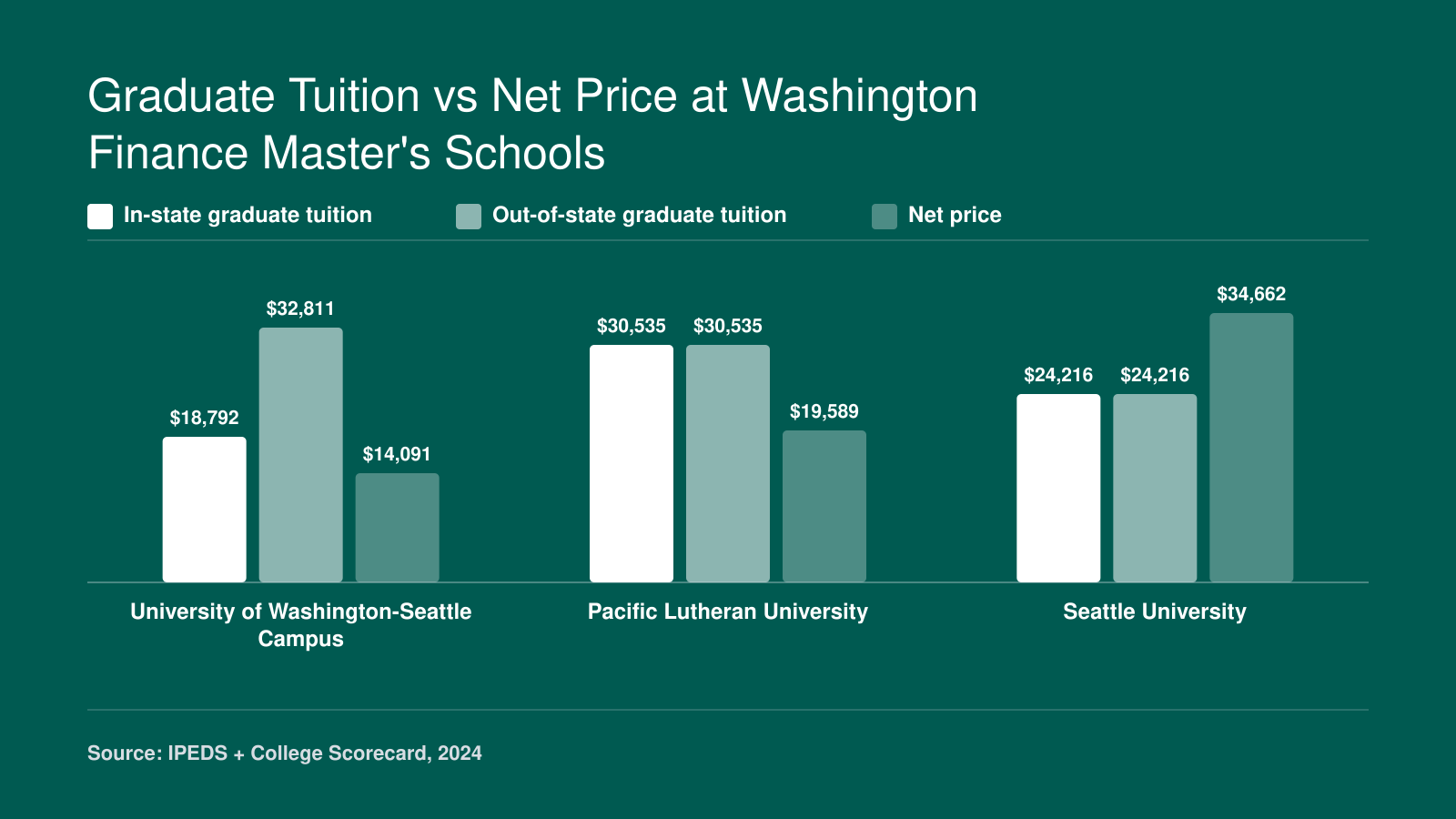
Graduate Tuition vs Net Price at Washington Finance Master's Schools
The public university here lists a lower in-state graduate rate than its out-of-state rate, while the private universities charge the same tuition regardless of residency. Net price is the institution-wide average after aid and does not represent an individual finance master's student's cost. UW-Seattle's in-state rate is the lowest tuition figure among the ranked schools.
Cost, Financial Aid, and CFA Preparation for Washington Master's in Finance Students
Cost, credential alignment, and aid terms separate these Washington programs as much as curriculum. The tuition and net-price chart above carries the headline figures; compare them with the Most Affordable Master's in Finance Programs to see what changes your actual bill and CFA path.
CFA and Credential Alignment
Foster's MSF does not publish a CFA affiliation or alignment percentage.
Accreditation and Aid
AACSB accreditation is confirmed for Seattle University Albers and Pacific Lutheran University. Foster does not publish program-level AACSB accreditation, so weigh aid letters and employer support closely. Seattle U's Incoming Student Graduate Scholarship requires the application form and distributes only in fall and spring; scholarships require at least six credits per semester. Foster lists scholarships, personal funds, employer assistance, and loans as typical financing routes but no named MSF merit award. PLU lists scholarships and aid without publishing specific merit amounts.
A Cost-Saving Move
Apply by each school's priority deadline and submit the scholarship form with the application at Seattle U. If you work, pair the fee-based Foster MSF with employer tuition assistance, or compare Accelerated Master's in Finance Programs for a faster format.
Compare Finance programs on the data that matters
Explore more Business & Management specializations or browse every graduate field.
All Business & Management programs