Best Master's in Finance Programs in Massachusetts
Compare 23 accredited Finance programs in Massachusetts at 19 schools, with graduate earnings, cost, debt, and completion data from IPEDS and the U.S. College Scorecard.

Boston University's M.S. in Finance lists $67,626 in graduate tuition. UMass Amherst's Master of Finance runs $17,410 for Massachusetts residents. Both feed the same Boston market of asset managers, custody banks, and fintech employers.
Outcomes spread just as widely. Boston College graduates show median earnings of $182,242 five years out against $41,000 in median debt; Bentley pairs $143,094 with $20,500.
Campus, hybrid, and fully online degrees are ranked together here, because in this field sticker price and eventual pay do not move in step.
Key Points
- Boston College graduates earn $182,242 five years out, with $41,000 in debt.
- UMass Boston offers its M.S. in Finance online, in person, or hybrid.
- Northeastern's STEM-designated quantitative finance degree adds a 24-month OPT extension.
Top 10 Master's in Finance Programs in Massachusetts
These ten Massachusetts programs cover campus, hybrid, and fully online study, from 9-month full-time degrees to part-time options built around a full-time job. Earnings figures are program-level medians from federal data and carry the time window shown. Graduation rates describe the whole school, not a single program.
Harvard University
#1Cambridge, MA · $55,000 – $60,000/yr (est.)
Best for: Working professionals studying mostly online
Harvard Extension School offers the finance field of its Master of Liberal Arts as a hybrid degree. Students take 11 of 12 courses online and add a short residency in Cambridge. Median earnings for graduates were about $111,894 one year after finishing, and the school graduates about 98% of its students. Tuition is $3,580 per course, and 80% of students work full time.
- 12 courses, finishable in 2 to 5 years
- 11 courses online plus a short Cambridge residency
- Tuition $3,580 per course
- No finance background required; prerequisite courses apply
- Performance-based admission through foundational courses
- Stackable certificates in corporate finance, data analytics, real estate
- Spring 2027 registration runs Nov 5, 2026 to Jan 19, 2027
Boston College
#2Chestnut Hill, MA · ~$38,000/yr (est.)
Best for: Full-time students targeting quantitative finance
Boston College houses its M.S. in Finance in the Carroll School's Seidner Department of Finance. Students choose a regular Finance track or a STEM-designated Quantitative Finance track, and full-time study takes about 12 months. Median earnings were about $117,278 one year after finishing, and the school graduates about 91% of its students.
- 10 courses, 12 months full time
- Part-time track finishes in about 20 months
- 3 concentration options
- Quantitative Finance track is STEM-designated
- Course waiver exam option available
- 10 hours of community service required
- Careers in corporate finance, asset management, investment banking
Bentley University
#3Waltham, MA · ~$47,000/yr (est.)
Best for: Aspiring analysts wanting a fintech specialization
Bentley's Master of Science in Finance, in Waltham, offers four separate specializations and a trading room with Bloomberg and FactSet. Program materials cite a Financial Times top-five U.S. placement and alignment with all three CFA exam levels. Median earnings were about $76,511 one year after finishing, and the school graduates about 87% of its students.
- 10-course major, 9 to 15 months
- CFA exam aligned curriculum
- Multimillion-dollar trading room
- Student-run Bentley Investment Group
- M&A project-based course
- STEM-designated, up to two extra years of OPT
- Hands-on Bloomberg, FactSet and Python
- Careers in risk, fintech, compliance
- STEM-designated, two years of OPT
- Covers blockchain, AI, data analytics
- Blends finance and computer information systems
- Fintech major chosen after admission
- Careers in wealth management, private banking
- Advanced Excel financial modeling
- Case studies and written financial plans
University of Massachusetts-Amherst
#4Amherst, MA · $15,000 – $20,000/yr (est.)
UMass Amherst offers a campus-based Master of Finance that can be finished in 9 to 15 months, depending on academic background. It is a public flagship with lower in-state tuition. The program centers on financial strategy, ethics, and fast-changing markets.
- 30 to 33 credits based on background
- Complete in 9 to 15 months
- Focus on best practices and ethics
Boston University
#5Boston, MA · $65,000 – $70,000/yr (est.)
Boston University's Questrom School of Business runs a 9-month, full-time M.S. in Finance with a fall start. The curriculum aligns with the CFA Institute body of knowledge and is STEM OPT eligible. Median earnings were about $93,057 one year after finishing, and the school graduates about 89% of its students.
- 33 credits, 9 months full time, fall start
- Five core and five elective courses
- 16-month track adds a summer practicum
- 2.7 GPA minimum
- STEM OPT eligible
- Aligned with CFA Institute curriculum
- NECHE accredited university
College of Our Lady of the Elms
#6Chicopee, MA · ~$18,000/yr (est.)
Elms College offers a fully online M.S. in Accounting & Financial Planning, which suits aspiring planners more than traders or bankers. It pairs core accounting with courses in retirement, tax, insurance, and estate planning. The school graduates about 68% of its students.
- Fully online format
- Financial planning curriculum totals 21 credits
- Covers corporate taxation and forensic accounting
- Capstone course required
- Careers as financial advisors, planners, analysts
Hult International Business School
#7Cambridge, MA · ~$56,000/yr (est.)
Hult's Cambridge-listed Master's in Finance is a one-year STEM program with a live capstone and a CFA University Affiliation. Median earnings were about $59,131 one year after finishing, and the school graduates about 67% of its students. Dual-degree and scholarship options add flexibility.
- 1-year, STEM-designated program
- Capstone project required
- CFA University Affiliation Program
- Dual degree: two master's in 18 months
- $95 application fee
- Scholarships and financial aid available
University of Massachusetts-Lowell
#8Lowell, MA · ~$16,000/yr (est.)
UMass Lowell's M.S. in Finance is AACSB accredited and STEM-designated. It runs online, on campus, or hybrid, full or part time, and can be completed in 18 months. Median earnings were about $72,648 one year after finishing, and the school graduates about 65% of its students.
- 30 credits, 10 courses, about 18 months
- Fully online option available
- GRE and GMAT test optional
- $655 per credit
- Student Managed Fund course invests real money
- CFA exam review elective
- Bachelor's-to-master's fast track
- 2 recommendation letters, $75 application fee
University of Massachusetts-Boston
#9Boston, MA · ~$20,000/yr (est.)
UMass Boston's M.S. in Finance is a STEM-designated degree with fully online, in-person, and hybrid formats. CFA preparation is built into the curriculum, and the school awards up to 10 CFA scholarships each year. It has fall and spring starts, with deadlines of June 15 and December 1.
- Fully online option available
- Fall and spring starts
- CFA exam preparation embedded in curriculum
- Up to 10 CFA scholarships annually
- STEM-designated, OPT up to 36 months
- Bloomberg Terminal training
- $75 application fee; waived for UMass alumni
Merrimack College
#10North Andover, MA · ~$37,000/yr (est.)
Merrimack College's M.S. in Finance runs fully online or in hybrid and hyflex formats, and it welcomes non-business undergraduates. The 32-credit curriculum includes CFA exam content and uses Bloomberg, FactSet, and Morningstar. The school graduates about 70% of its students.
- 32 credits
- Fully online option available
- Hybrid and hyflex formats
- 3.0 GPA minimum
- No prerequisites required
- Curriculum includes CFA exam content
- Housed in the Girard School of Business
Cost & outcomes by school
Federal data for the highest-earning Finance programs, independent of the ranking above. Earnings are this field's master's graduates four years after completing, where the Scorecard reports them.
| School | Earnings | Tuition / yr | Debt | Grads/yr | Format |
|---|---|---|---|---|---|
| Northeastern University MA | $169,234 | $29,174 | $36,150 | 18 | Campus |
| Northeastern University MA | $169,234 | $26,020 | $36,150 | — | Campus |
| Harvard University MA | $153,797 | $57,248 | $28,268 | 121 | Hybrid |
| Boston College MA | $151,547 | $37,520 | $41,000 | 45 | Campus |
| Bentley University MA | $131,993 | $46,920 | $20,500 | 85 | Campus |
| Boston University MA | $117,293 | $67,626 | — | 95 | Campus |
| Hult International Business School MA | $106,868 | $55,570 | $77,030 | 138 | Campus |
| Worcester State University MA | — | $6,813 | — | — | Campus |
| University of Massachusetts-Amherst MA | — | $17,410 | — | — | Campus |
| Worcester Polytechnic Institute MA | — | $29,040 | — | — | Campus |
| College of Our Lady of the Elms MA | — | $17,670 | — | 4 | Online |
| University of Massachusetts-Lowell MA | — | $16,434 | — | — | Hybrid |
Sources: U.S. Department of Education. Tuition and graduates: IPEDS. Earnings and debt: College Scorecard, this field's master's graduates; a dash means no figure is reported.
Cost, debt & payoff
Median earnings of this field's master's graduates (4 yrs after completing) vs. their median federal loan debt · U.S. College Scorecard
Across these programs the median graduate earns about $131,993 and finishes with roughly $28,268 in debt — a ratio that clears a common rule of thumb (keep debt below first-year salary). Tuition and debt vary widely school to school, so check the per-school figures in the table above before you shortlist.
How We Rank Finance Master's Programs in Massachusetts
Business school marketing still leans hard on placement stories, but federal reporting now puts graduate earnings and debt on the record, program by program. That reporting does the heavy lifting here.
The inputs are straightforward: graduate tuition, average net price, institution-wide graduation rate, program-level earnings and debt for master's in finance programs, and how flexibly the degree can be completed (campus, online, or hybrid).
Figures come from IPEDS and College Scorecard. Two distinctions matter when you compare schools. Graduation rate and net price describe the institution as a whole, not the finance degree specifically. Earnings and debt are tied to the finance program itself, which makes them the sharper signal.
Only Massachusetts institutions awarding a master's-level finance degree were eligible, in any delivery format.
Online and Hybrid Master's in Finance Options in Massachusetts
Master's Programs in Massachusetts offer genuine flexibility for finance students who cannot relocate or step away from a job. UMass Boston runs its M.S. in Finance online, in person, or in a hybrid blend across fall and spring starts,3 while Suffolk University offers on-campus, hybrid, and fully online tracks, with the fully online path open as a part-time, fall-only start.
Pacing by Career Stage
Weigh full-time against part-time before you commit. Boston College's regular Finance track runs about 12 months full-time (10 courses),1 or roughly 20 months part-time for students staying in their jobs. Boston University's 33-unit program finishes in nine months full-time, with a 16-month option built around a summer practicum. Suffolk's 31-credit degree ranges from nine months full-time to 21 part-time.
Prerequisites and Fit
Check prerequisite coursework early. Boston College expects Investments, Corporate Finance, Financial Econometrics, and Management of Financial Institutions before core classes,2 and UMass Boston lists required pre- and corequisite courses.3 Career changers often benefit from a part-time or online track that leaves room to clear these gaps; current finance staff may handle an intensive full-time year.
Which Massachusetts Finance Master's Programs Waive the GRE or GMAT?
Across Massachusetts finance master's programs, admissions testing policies split between programs that still require a score unless you meet a narrow waiver and No-GRE master's programs that have shifted to test-optional admissions. Confirm the current policy for your application cycle because these rules change yearly.
- Boston College: GMAT or GRE scores from the past five years are required.1 Full-time and part-time MSF candidates may request waiver consideration, and Boston College undergraduates applying as fifth-year applicants can waive the score.2
- Boston University: GMAT and GRE are optional. Applicants may apply without a score, and strong academic records or relevant full-time work experience may support consideration, though competitive scores can strengthen admission and scholarship chances.
- UMass Amherst: GMAT/GRE is optional. A waiver is granted for an overall undergraduate GPA of 3.0 or higher, and strong quantitative skills may support an application without scores.
- Northeastern University: Test-optional; GRE or GMAT scores are not required.3
Check each program's admissions page before applying.
Related Articles
Master's in Finance Tuition in Massachusetts and CFA/FRM Certification Prep
These are the lowest-cost programs in our data. Each row shows graduate tuition and fees next to the institution-wide average net price after aid, which is not a quote for any one student. Boston-area rent and transit are the hidden expense on top of these figures. Finance has no state license in Massachusetts, so the credentials that count are the CFA and FRM.
| School and program | Graduate tuition and fees | Average net price after aid | Published rate or total cost | CFA/FRM prep |
|---|---|---|---|---|
| Worcester State University, MS in Management (Finance) | $6,813 per year | $13,381 | N/A | No CFA or FRM alignment stated |
| UMass Lowell, MS in Finance | $16,434 in-state; $29,118 out-of-state | $17,163 | N/A | CFA exam review course in the online curriculum; affiliation not confirmed |
| College of Our Lady of the Elms, MS in Accounting & Financial Planning | $17,670 per year | $17,545 | N/A | CFP Board accredited; no CFA or FRM alignment stated |
| Harvard University, ALM in Extension Studies (Finance) | $57,248 per year | $19,066 | $3,580 per course, 12 courses | No CFA or FRM alignment stated |
A STEM-designated finance master's qualifies F-1 graduates for a 24-month STEM OPT extension on top of the standard 12 months of post-completion OPT, a possible 36 months of U.S. work authorization. Northeastern's Boston MS in Quantitative Finance is STEM-designated; eligibility still depends on the program's classification appearing on the current DHS STEM list when you apply.
What Massachusetts Finance Master's Graduates Earn
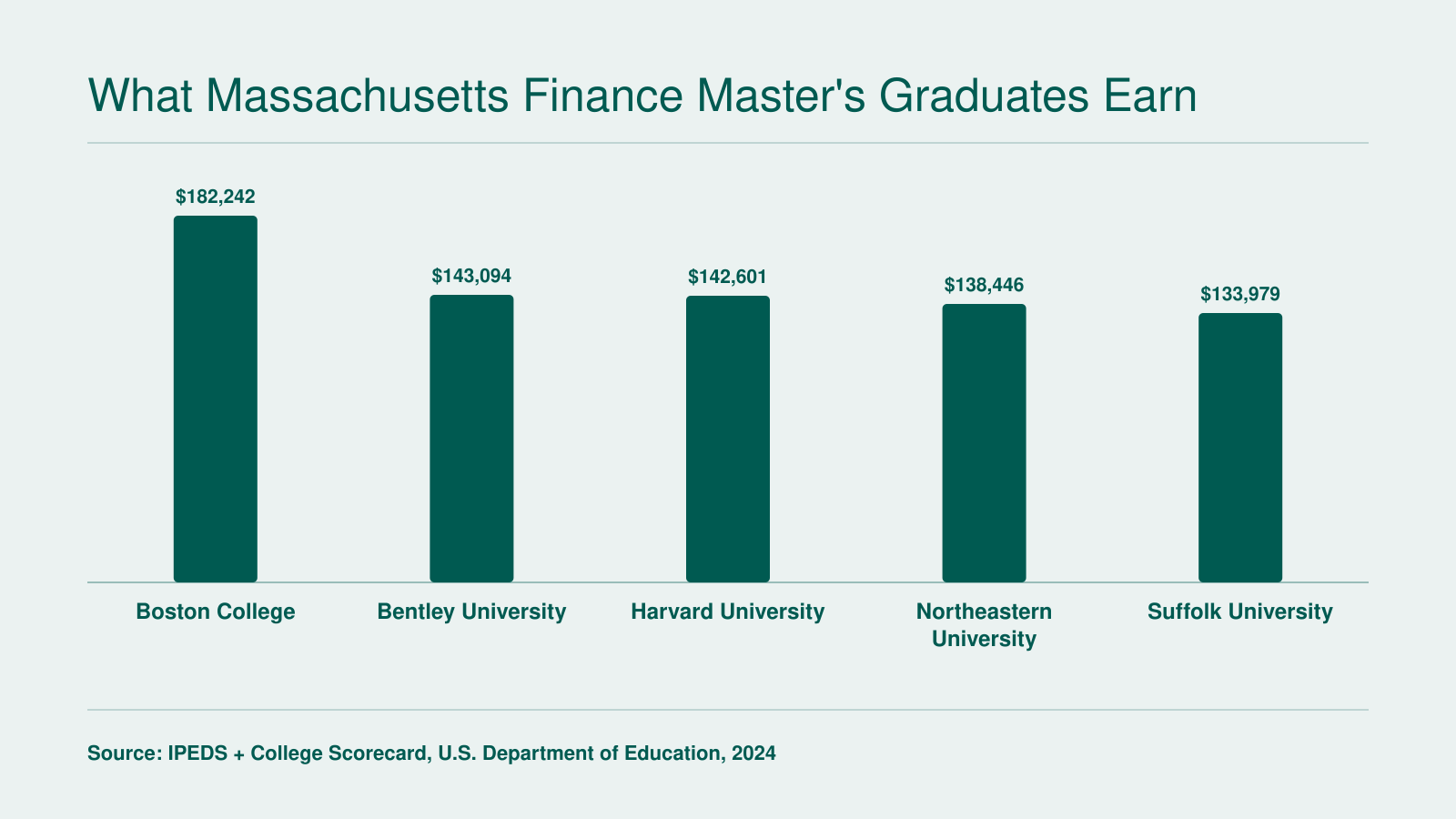
Each bar shows median program-level earnings five years after completion. Paired with median program debt, Boston College graduates earn $182,242 against $41,000 in debt. Bentley University pairs $143,094 with $20,500, the lightest debt load of the group. Harvard University shows $142,601 against $28,268, and Northeastern University $138,446 against $36,150.
Admissions Checklist for Massachusetts Master's in Finance Programs
Requirements vary by school, so confirm every detail on the program's own admissions page before you apply. Test policy is covered in the GRE/GMAT section above.
- Bachelor's degreeBoston College asks for a four-year bachelor's degree. Boston University accepts a bachelor's degree or equivalent.
- Quantitative prerequisitesBentley decides on foundation courses case by case, based on your prior education and experience. Check each school's list of expected coursework in economics, accounting, statistics, or calculus.
- TranscriptsBoston College wants transcripts from every institution you attended. Northeastern and Brandeis also require transcripts. Admitted international students may need official translations and degree verification.
- Resume and essayNortheastern and Brandeis require a resume. Boston College and Northeastern cap their essays or personal statements at 500 words.
- Recommendations and interviewNortheastern asks for two recommendation letters. Brandeis requires an interview. Northeastern may also invite applicants to a video interview, so check which format applies to your track.
- English proficiencyNortheastern requires an English test if applicable. Boston University lists a 90 TOEFL iBT score, though its pages treat scores as recommended. Boston College's published pages state no minimum.
- Fall deadlinesEarly rounds for fall 2026 or 2027 starts have run from mid-October to early November. Boston College lists October 13, 2026, Boston University October 20, 2026, and Northeastern November 1, 2026. Brandeis announces fall admission decisions in mid-April, but its pages publish no current deadline schedule. Boston University's pages disagree on whether a sixth round exists, so check for later rounds.
Compare Finance programs on the data that matters
Explore more Business & Management specializations or browse every graduate field.
All Business & Management programs