Master's Programs in Pennsylvania
Every master's program reported by a school in Pennsylvania: 2,050+ programs at 100+ graduate schools, with the online options, costs and outcomes behind each one.

Pennsylvania's Master's Programs split into three tiers: the state-owned PASSHE universities, the state-related schools (Penn State, Pitt, Temple, and Lincoln), and a deep private sector that includes Penn, Drexel, Villanova, and Carnegie Mellon. Each tier prices, admits, and funds students differently.
The practical questions are consistent. What will it cost? Can it be done fully online? What do admissions require, and how will it be paid for? Does the degree lead to a Pennsylvania license, and does it raise your salary enough to justify the debt?
A bigger name rarely settles those questions. Program-level outcomes data often shows a modest public program outperforming a pricier private one on earnings relative to debt.
Key Points
- Pennsylvania graduate tuition splits into three price tiers, from PASSHE up to private universities.
- Check each program's handbook for on-campus residency before assuming an online master's is fully remote.
- Judge degrees by College Scorecard earnings and debt for that specific program, not school reputation.
Popular degrees in Pennsylvania
Master's programs in Pennsylvania by field
Business & Management
- Management68 programs
- Healthcare Administration59 programs
- Analytics58 programs
- Accounting58 programs
- Finance52 programs
- General Business47 programs
- Healthcare Management45 programs
- Marketing42 programs
Education & Teaching
- Special Education77 programs
- Educational Leadership46 programs
- Secondary Education40 programs
- Curriculum & Instruction38 programs
- Reading & Literacy34 programs
- Teaching29 programs
- Early Childhood Education21 programs
- Elementary Education21 programs
Nursing
- Family Nurse Practitioner (FNP)31 programs
- Nursing Education or Nurse Educator30 programs
- Nurse Administrator19 programs
- Adult Gerontology Acute Care Nurse Practitioner14 programs
- Psychiatric Mental Health Nurse Practitioner13 programs
- Adult Gerontology Primary Care Nurse Practitioner12 programs
- MSN/MBA11 programs
- RN to MSN10 programs
Healthcare
- Health Administration33 programs
- Speech Pathology33 programs
- Public Health26 programs
- Health Informatics21 programs
- Health Education12 programs
- Nutrition9 programs
- Exercise Science7 programs
- Clinical Research Management3 programs
Communications & Media
- Speech Pathology33 programs
- Communication30 programs
- Communication Disorders24 programs
- Strategic Communication8 programs
- Media Communication7 programs
- Journalism6 programs
- Public Relations4 programs
- Communication Management4 programs
Counseling
- Clinical Mental Health Counseling48 programs
- School Counseling31 programs
- Marriage and Family Therapy or Marriage and Family Counseling10 programs
- Addiction Counseling3 programs
- Christian Counseling3 programs
Psychology
- Applied Behavior Analysis18 programs
- Counseling Psychology18 programs
- Educational Psychology or School Psychology12 programs
- General Psychology9 programs
- Clinical Psychology8 programs
- School Psychology4 programs
- Forensic Psychology3 programs
- Industrial Organizational Psychology3 programs
Social Work & Social Sciences
- Social Work28 programs
- Social Work Advanced Standing21 programs
- Sociology10 programs
- Political Science, Government7 programs
- Human Services2 programs
Computers & IT
- Data Analytics25 programs
- Cybersecurity20 programs
- Information Security & Assurance13 programs
- Machine Learning9 programs
Arts & Design
- Creative Writing42 programs
- Fine Arts5 programs
- Interior Design1 program
Religion & Theology
- Theology17 programs
- Divinity15 programs
- Christian Ministry9 programs
- Christian Leadership2 programs
- Youth and Family Ministry2 programs
Criminal Justice & Law
- Public Policy17 programs
- Master of Laws8 programs
- Homeland Security7 programs
- Legal Studies4 programs
- Business Law4 programs
- Cybercrime3 programs
Science & Engineering
- Sustainability or Environmental Management24 programs
- Environmental Science11 programs
- Geography3 programs
How Much Do Master's Programs Cost in Pennsylvania?
Graduate tuition in Pennsylvania sorts into three rough price tiers, and the gap between the bottom and the top is wide enough to change which degrees make financial sense.
The Three Tiers
- PASSHE universities: The state system's 2026-2027 systemwide graduate base rate is $557 per credit1, though individual universities and specific programs may charge more. Each PASSHE campus sets its own tuition and mandatory fees, so there is no single statewide price.
- State-related universities: Penn State, Pitt and Temple publish rates by campus, school, program and residency rather than one institutionwide figure. Temple's Graduate Cost and Aid page shows 2026-2027 graduate tuition of roughly $1,165 to $1,872 per credit depending on the program and residency status.
- Private universities: Penn, Drexel, Villanova and Carnegie Mellon sit at the top, and their published rates generally do not vary by residency at all.
One point trips up a lot of applicants: "in-state" at a state-related school is not the same as a public-system discount. Temple's resident rates still land well above PASSHE per-credit pricing. Many online programs, meanwhile, charge one flat rate no matter your state of residence, which can work in your favor if you are out of state and against you if you are a Pennsylvania resident.
Estimating Your Total
Multiply the per-credit rate by the credits required (most master's degrees run 30 to 36), then add mandatory fees, which are billed separately and are easy to overlook.
A worked comparison drawn from Kutztown University Graduate Tuition and Fees: Kutztown charges Pennsylvania residents $684 per credit in 2026-2027, with tuition, technology and instructional fees bundled in, plus a possible $50 first-semester records charge. At 30 to 36 credits that is roughly $20,520 to $24,624. Temple's lowest published graduate rate of $1,165 per credit produces about $34,950 to $41,940 over the same credit range, before its per-term university services fee (up to $549 in fall and spring) is added.
The Cheapest Option
PASSHE per-credit tuition is the practical floor for a master's degree in Pennsylvania. The $557 systemwide base rate is the benchmark for everything else; individual campuses layer on their own fees, with annual mandatory fees reported in a $2,058 to $4,118 range across the system.1
Graduate Tuition at Penn State, Pitt, Temple, PASSHE and Private Universities
What does a graduate credit actually cost at Penn State, Pitt, Temple, or Drexel this year? The honest answer is that no single number exists, because rates shift by program, campus, residency, and credit load, and they change every academic year. The fastest route to an accurate figure is to pull it from each school's own tuition page.
Step 1: Find the Official Rate
For each school you are considering, search "[school name] graduate tuition and fees 2026-27" and open the bursar or student accounts page. Cover Penn State (University Park and World Campus), Pitt, Temple, a PASSHE university such as West Chester or IUP, Drexel, and Villanova. Then filter or scroll to the graduate level, choose Pennsylvania resident or non-resident, and record the per-credit rate rather than the per-semester total.
What we could confirm: Penn State says University Park graduate tuition varies by residency, campus, program college, and sometimes major, and it points students to its Tuition Calculator. The university also approved a 2% increase for in-state graduate students at University Park for 2026-27.2 World Campus lists the same rate to every student regardless of residency. For 2026-27, that is $1,048 per credit for most programs, or $12,572 per semester at 12 or more credits. Business and MBA programs run $1,286 per credit, engineering programs $1,166, and Business Analytics and finance programs run $1,089.1
Step 2: Cross-Check With Neutral Sources
- IPEDS College Navigator: Compare published graduate tuition across schools in one place.
- Graduate financial aid offices: They publish cost-of-attendance budgets that include fees and living costs.
- BLS.gov: The Occupational Outlook Handbook gives salary context for judging whether a price is worth paying.
- Professional associations: Check them for licensure, exam, and certification costs that sit outside tuition.
Step 3: Ask Admissions What the Rate Leaves Out
Published per-credit rates rarely tell the whole story, especially for online, out-of-state, and private programs. Email graduate admissions or the program coordinator and ask:
- What is the per-credit rate for my specific program and start term?
- Which mandatory, technology, and program fees apply on top of tuition?
- How are in-state residency rules applied to graduate students?
- Is the rate flat above a certain credit load, as with World Campus's per-semester pricing?
- Does the rate change after the first year?
Write down the date you received each answer. Tuition is reset annually, so a figure from an older page or a forum post can be wrong by the time you enroll. Confirm every number for the current academic year before you compare programs on cost.
Online, Hybrid, and Flexible Formats in Pennsylvania
Online means different things in graduate marketing. A program you can finish from another state is not the same as one that quietly expects you in Pennsylvania three times a year, and that difference is the gap between a workable plan and a scheduling crisis.
Three formats, three very different commitments
- Fully online, no campus visits: Every course, exam and advising meeting happens remotely. Penn State World Campus lists its Master of Applied Statistics this way: 30 credits at roughly $1,048 per credit, with no residency requirement attached.
- Online with residencies: Coursework is remote, but the program builds in short on-campus immersions, orientations or intensives. These are usually a few days at a time and are non-negotiable for graduation.
- Hybrid: Deliberately split between remote and in-person instruction on a recurring basis, often evening or weekend sessions at a regional campus.
Before you commit, ask the program directly whether any component requires physical attendance, and get the answer in writing. Catalog pages are not always current.
Why some fields can't go fully remote
Clinical and licensure-bound degrees nearly always carry an in-person element, even when the didactic portion is delivered online. Counseling programs require supervised practicum and internship hours with real clients. MSN programs require clinical placements under a preceptor. Teacher preparation, including M.Ed. programs, requires student teaching in a school setting. The coursework can travel; the supervised practice cannot, because state boards and accreditors require documented hours observed by a licensed professional. Expect the school to either place you locally or require you to secure a site yourself, which is worth confirming early.
Accelerated and one-year options
Several Pennsylvania routes compress the timeline. Neumann University's M.S. in Education is an accelerated online degree of 36 credits aimed at already-certified teachers and advertised as completable in 12 months. Penn LPS markets its Global Master of Public Administration as an online MPA program earnable in a year from anywhere. Gwynedd Mercy offers accelerated online education degrees, though completion time varies by student. Other pathways start earlier rather than finishing faster: Penn GSE's accelerated bachelor's-to-master's option is open to Penn and Tri-College undergraduates, and Penn Engineering's Online Accelerated Master's lets eligible undergrads apply up to three residential graduate courses toward a master's, then finish seven more online, typically within three years.
Check state authorization first
If you live outside Pennsylvania, confirm the school is authorized to operate in your state and that its licensure track meets your home state's requirements. Authorization status can change, and it governs whether your degree actually credentials you where you plan to work.
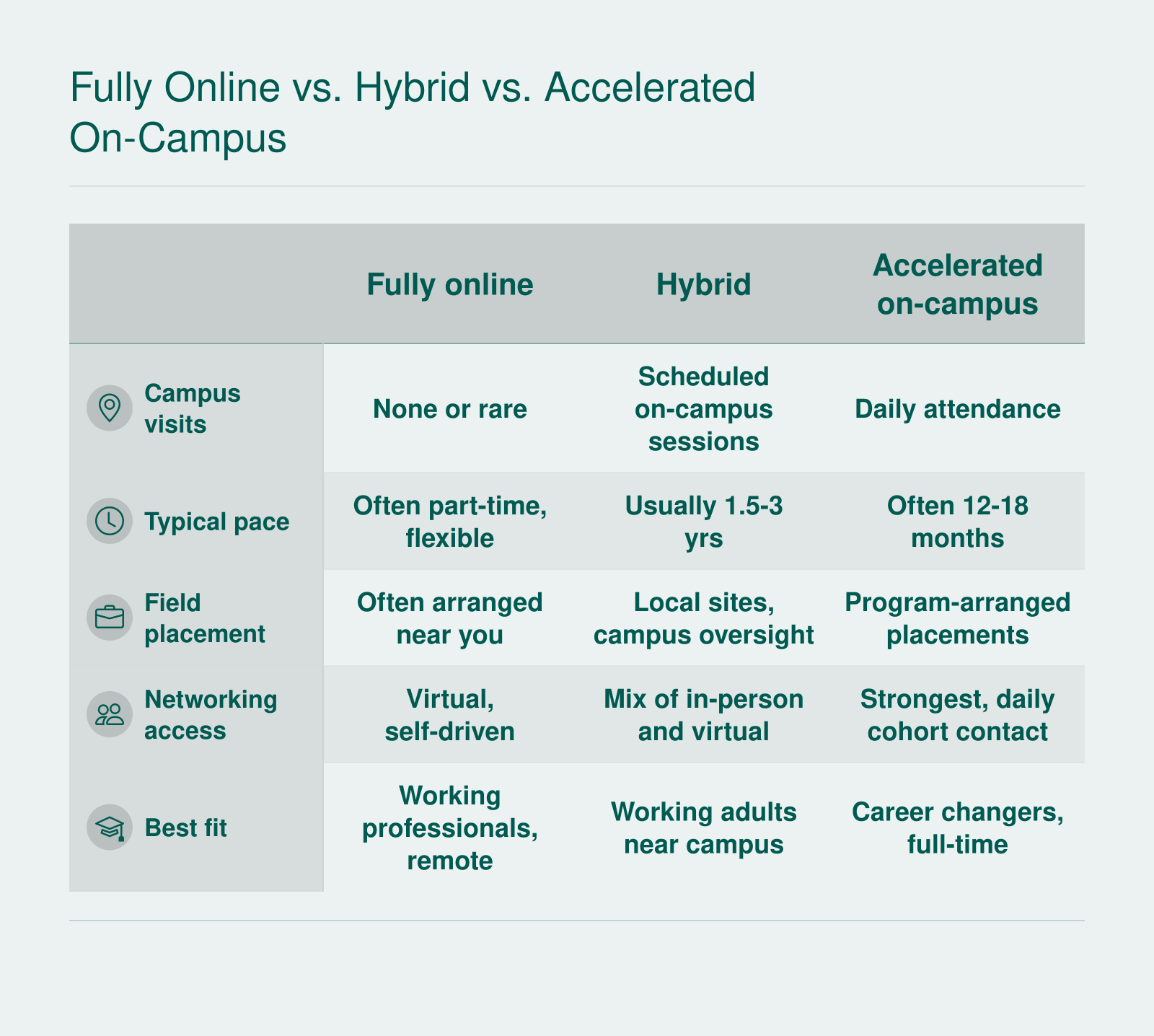
Fully Online vs. Hybrid vs. Accelerated On-Campus
The format you choose changes how often you travel, how fast you finish, and how you build a professional network. Compare the three common options below. Before you commit, confirm the residency requirement in the program handbook, not the marketing page.
Admissions Requirements at Pennsylvania Graduate Schools
Pennsylvania master's admissions are set program by program, not school-wide, so check the page for your specific degree before you apply.
- Bachelor's degree and GPAAn accredited bachelor's degree is the baseline. A 3.0 is the common benchmark: Penn State Engineering and Agricultural and Extension Education, Temple's Fox MBA, Media Studies and Journalism, and Computational Data Science, and Drexel's College of Computing & Informatics all list it. Penn State American Studies lists 2.75. Some programs consider lower GPAs through conditional or provisional admission.
- GRE and GMATPolicies differ widely. Penn State Engineering and College of Education do not require the GRE, and Penn State American Studies recommends it. Temple Media Studies and Journalism makes it optional. Pitt English and Drexel Computing & Informatics do not require it. Temple's Fox MBA requires the GMAT or GRE, and Computational Data Science requires one if your GPA is below 3.0. Work experience and a strong undergraduate GPA are the usual grounds for waivers.
- Application materialsExpect a resume, a statement of purpose, letters of recommendation, and transcripts. Some programs also require prerequisite coursework or a writing sample, so confirm the list on the program page.
- DeadlinesDates are program-specific. Temple's Fox MBA lists December 15, and Temple Computational Data Science and Pitt list January 15. Penn State American Studies and Temple Media Studies and Journalism list February 15. Drexel's Computing & Informatics program listed July 15 for fall 2026. Penn State advises international applicants to apply at least four months ahead.
- International applicantsEnglish minimums vary by program. Drexel Computing & Informatics lists TOEFL 90, IELTS 6.5, or Duolingo 115. Temple Computational Data Science lists TOEFL 85 or IELTS 7.0. Penn State lists IELTS 6.5, and its TOEFL minimum changed for tests taken on or after January 21, 2026. Lower scores may bring provisional admission with required English coursework. Some degrees from English-speaking countries qualify for an exemption, so check both the Graduate School and the program page.
Financial Aid, Assistantships, and Employer Benefits
Can a Pennsylvania master's pay for itself through teaching, research, or employer tuition benefits? The answer often depends on the format. Research and thesis-based programs are far more likely to offer assistantships, while professional and fully online No-GRE master's programs lean on loans, employer benefits, and private scholarships.
Graduate Assistantships
At Penn State, graduate assistantships are competitively awarded and generally require degree-seeking status with at least 9 credits in fall and spring.1 Appointments span quarter-time, half-time, and three-quarter-time, roughly 10 to 30 hours per week.2 Penn State covers tuition fully for teaching, research, and administrative assistants rather than issuing a separate waiver, and adds a monthly stipend plus often a health subsidy.2 The University of Pittsburgh lists a minimum graduate student assistant stipend of $10,557.50 per term, but the work load and any tuition remission vary by school or program.3 Temple's assistantship terms are not uniform enough to summarize as a single university-wide package; students should check the specific program. Because these awards are competitive, apply early and ask each program for its written appointment terms, including summer support and enrollment requirements. If you are considering an online professional master's, do not assume assistantship funding exists at all.
Federal and State Aid
Most master's students start with a federal Direct Unsubsidized Loan, which does not require demonstrated financial need. Grad PLUS loans can fill the gap up to the cost of attendance, but they carry a credit check, higher interest rates, and higher origination fees. PHEAA's main State Grant is directed at undergraduates, so Pennsylvania graduate students should not build a budget around state grant aid. PHEAA does highlight federal Teacher Loan Forgiveness for qualifying full-time teachers in low-income schools, but the available research did not confirm a separate, broadly available Pennsylvania graduate grant or health-care loan repayment fund.4 Nurse practitioners and health workers may find repayment help through employers or federal programs rather than a Pennsylvania-specific graduate fund.
Employer Tuition Reimbursement
Large Pennsylvania employers, including health systems and state government agencies, often provide tuition reimbursement. Under IRS Section 127, up to $5,250 per year in employer education assistance is excluded from taxable income, which can cover a meaningful share of an in-state online master's. Benefits typically require supervisor approval, a passing grade, and sometimes a service commitment after the final course, so confirm the terms before enrolling.
Which Pennsylvania Master's Degrees Lead to Licensure?
In Pennsylvania, most clinical and health-related master's degrees lead to a license issued by a board under the Department of State's Bureau of Professional and Occupational Affairs. Career changers should confirm that a program meets Pennsylvania board requirements before enrolling, because a degree that falls short can delay licensure or force extra coursework. If you might move after graduating, also check whether the next state will accept the program's accreditation and your supervised hours. Educator certification runs through the Pennsylvania Department of Education and is covered in the next section.
| Field | PA Licensing Board | Programmatic Accreditation | Supervised Hours | Required Exam |
|---|---|---|---|---|
| Licensed Professional Counselor (LPC) | Pennsylvania State Board of Social Workers, Marriage and Family Therapists, and Professional Counselors | CACREP, or an equivalent program | 3,000 hours | National Counselor Examination (NCE) or National Clinical Mental Health Counseling Examination (NCMHCE), among accepted examinations |
| Licensed Clinical Social Worker (LCSW) | Pennsylvania State Board of Social Workers, Marriage and Family Therapists, and Professional Counselors | CSWE | 3,000 hours | ASWB clinical examination |
| Marriage and Family Therapist (MFT) | Pennsylvania State Board of Social Workers, Marriage and Family Therapists, and Professional Counselors | COAMFTE | 3,000 hours | National Marriage and Family Therapy Examination (AMFTRB) |
| Speech-Language Pathologist | Pennsylvania State Board of Examiners in Speech-Language Pathology and Audiology | An accrediting agency approved by the board (ASHA CAA is the standard accreditor) | 1,260 hours | Praxis examination in speech-language pathology |
| Nurse Practitioner (CRNP) | Pennsylvania State Board of Nursing | CCNE or ACEN | N/A | National certification as a nurse practitioner (confirm the accepted certifying body with the board) |
Pennsylvania Educator Certification
Return on Investment: Earnings vs. Debt for Pennsylvania Graduates
Federal program-level data now lets you judge a master's degree by what its own graduates earn and owe, not by the school's reputation.
Reading Scorecard Field-of-Study Data
The College Scorecard reports outcomes for one credential in one field at one school. That means you can look up a specific MSN or MBA instead of relying on a campus-wide average. Compare two numbers:
- Median earnings: usually measured about a year after completion.
- Median debt: the typical amount borrowed for that program.
Know the limits. Debt figures cover federal borrowers only. Small programs are often suppressed for privacy, which means the data is missing, not that debt is zero.
Where Pennsylvania Programs Land
Business looks strong. A 2026 compilation of outcomes for Pennsylvania general MBA programs, drawn from the June Scorecard release, puts statewide median first-year earnings near $100,020 against median debt of about $41,000. Three schools report earnings well above that statewide debt figure:
- Temple Fox: $129,690
- Penn State Smeal: $106,923
- Drexel LeBow: $94,936
These figures reflect only graduates who received federal aid. School-specific debt isn't reported for them.
Nursing tends to do even better. Urban Institute benchmarks built from national program data show nursing master's graduates earning about 1.91 times what they borrow, compared with roughly 1.66 for business.1
Education and the helping professions are tighter. Penn's education master's (159 graduates) shows median debt of $69,500 against median earnings of $77,285 in the 2025-26 field-of-study data.23 That works out to about 1.11 times debt.3 Another release lists $87,086, so check which year you're reading.2 Nationally, graduates of MSW programs average more debt ($50,917) than reported earnings ($46,815).1 Counseling and mental health programs also commonly show high debt relative to pay.1
A Simple Rule of Thumb
Keep total borrowing at or below the salary you can realistically expect in your first year. If a program's median debt exceeds its graduates' median earnings, you need a concrete offset before enrolling, such as an assistantship, employer tuition benefits, or a cheaper public option.
Licensure Fields Pay Off Later
First-year numbers understate counseling, social work, and similar licensed fields. Graduates often work at associate or provisional levels while completing the supervised hours Pennsylvania requires for independent licensure. Pay typically rises once you're fully licensed. Judge these programs over a longer horizon, but budget for the leaner early years too.
Nurse Practitioners Lead Master's-Level Pay in Pennsylvania
How to Choose a Pennsylvania Master's Program
Choosing a Pennsylvania master's program means matching one specific degree at one specific school to the job you want, the credential that job requires, and the money and time you can realistically commit. Run every option through the same filters, in the same order, and your shortlist narrows quickly.
Filter in This Order
- Credential: If your target job requires a license or certification (counseling, nursing, social work, teaching), confirm the program leads to that credential in Pennsylvania and in any other state where you might work. If it doesn't, nothing else matters.
- Accreditation: Verify institutional accreditation, then programmatic accreditation where your field has one. Employers and licensing boards check both.
- Format fit: Decide whether you need fully online, hybrid, or on-campus study. Ask whether an "online" program requires on-campus residencies, intensives, or in-person clinical placements.
- Total cost: Compare the total cost of a master's degree after assistantships, tuition waivers, and employer tuition benefits, not the per-credit sticker price.
- Outcomes: Check program-level graduate earnings and debt where they are published. Where they are not yet available, ask the department for job placement and licensure exam results.
Judge Fields, Not Brands
A familiar name does not guarantee the best value in your field. Pennsylvania's best-known universities have different strengths. Penn State runs a large online operation through World Campus alongside its campus programs, giving working adults many online master's degrees, though pricing varies by campus and format. Temple, a state-related university in Philadelphia, charges Pennsylvania residents less than nonresidents, which can make it a strong in-state value in the fields where it is strong. Drexel is a private university on a quarter calendar with an established online presence, appealing to students who want to move through coursework quickly. As a private school, it offers no in-state price break, so funding and employer aid weigh more heavily there.
Your Next Steps
- Request the program's full cost sheet, including fees and any travel for residencies or placements.
- Ask admissions whether the GRE or GMAT is required or can be waived, and what in-person requirements apply.
- Look up the specific program, not just the university, on College Scorecard to compare graduate earnings against typical debt.
Graduate schools in Pennsylvania with the most master's programs
| School | City | Type | Master's programs | Online | Grad tuition / yr |
|---|---|---|---|---|---|
| Drexel University | Philadelphia | Private nonprofit | 97 | 64 | $39,261 |
| University of Pittsburgh-Pittsburgh | Pittsburgh | Public | 91 | 22 | $27,580 |
| Temple University | Philadelphia | Public | 76 | 31 | $22,818 |
| Pennsylvania State University | University Park | Public | 65 | 23 | $26,034 |
| University of Pennsylvania | Philadelphia | Private nonprofit | 61 | 13 | $47,844 |
| Pennsylvania State University | University Park | Public | 57 | 37 | $24,650 |
| West Chester University of Pennsylvania | West Chester | Public | 51 | 25 | $12,652 |
| Duquesne University | Pittsburgh | Private nonprofit | 50 | 32 | $27,612 |
| Lehigh University | Bethlehem | Private nonprofit | 49 | 16 | $28,840 |
| Carlow University | Pittsburgh | Private nonprofit | 46 | 40 | $24,816 |
| Slippery Rock University of Pennsylvania | Slippery Rock | Public | 45 | 42 | $12,720 |
| Pennsylvania Western University | California | Public | 45 | 41 | $11,261 |
| Widener University | Chester | Private nonprofit | 41 | 28 | $28,004 |
| Saint Joseph's University - Philadelphia | Philadelphia | Private nonprofit | 40 | 33 | $20,048 |
| Eastern University | Saint Davids | Private nonprofit | 38 | 34 | $14,534 |
Program counts are the verified master's listings in our directory; tuition is the school-wide average for a full-time graduate student (IPEDS).
Pennsylvania Master's Programs: Quick Answers
These answers condense the cost, format, and licensure points covered above. Tuition rates, reimbursement terms, and state authorization rules change, so confirm current details with each program before you apply.
What is the cheapest way to earn a master's degree in Pennsylvania?
Can I finish a Pennsylvania master's program in one year?
Can I enroll in a Pennsylvania online master's program if I live in another state?
Will a Pennsylvania counseling or social work license transfer to another state?
Compare programs nationwide
Many Pennsylvania residents study online. Every ranked list above has an online lens, or browse every field.
Online master's programs Browse all fields