Best Master's in Clinical Psychology Programs in Pennsylvania
Compare 8 accredited Clinical Psychology programs in Pennsylvania, with graduate earnings, cost, debt, and completion data from IPEDS and the U.S. College Scorecard.

In Pennsylvania, the psychologist title is reserved for doctoral graduates, so a clinical psychology master's leads to LPC or LMFT licensure instead.
The programs ranked here are mostly campus-based, with Waynesburg delivering its counseling master's fully online over 20 months. One caveat worth catching early: Immaculata's M.A. is open only to students already in its Psy.D., while Millersville, Chestnut Hill, Marywood and both Penn State campuses admit master's applicants directly.
Match the coursework to the license you actually want, checking counseling psychology licensure requirements by state. Credit gaps discovered after graduation are slow and expensive to fix.
Key Points
- A master's alone does not make you a licensed psychologist in Pennsylvania.
- Waynesburg delivers its counseling master's fully online across 20 months.
- Immaculata's M.A. is open only to enrolled Psy.D. students, not direct applicants.
Best Clinical Psychology Master's Schools in Pennsylvania for 2027
Not every Pennsylvania clinical psychology master's accepts direct applicants. Millersville, Chestnut Hill, Marywood and both Penn State campuses admit master's students directly, while Immaculata's M.A. is open only to enrolled Psy.D. students. Cards below note which path each school offers and whether the program is built around LPC licensure or doctoral preparation.
Millersville University of Pennsylvania
#1Millersville, PA · $12,000 – $17,000/yr (est.)
Best for: In-state residents minimizing tuition costs
Millersville admits master's applicants directly into its M.S. in Clinical Psychology, which pairs coursework with supervised work in the department's training clinic and internships at local agencies and hospitals. Students choose a 42-credit route aimed at doctoral study or a 60-credit route that meets Pennsylvania's educational requirements for LPC licensure. Applicants need a bachelor's degree, not necessarily in psychology, plus at least 18 undergraduate psychology credits. In-state tuition is the lowest on this list.
- Direct-admit master's, not embedded in a doctoral program
- Two tracks: 42 credits (doctoral prep) or 60 credits (LPC)
- 60-credit route recommended for Pennsylvania licensure
- Requires 18 undergraduate psychology credits
- Department training clinic provides supervised experience
- Internships at local mental health agencies and hospitals
- Emphasis on assessment and psychotherapy skills
Chestnut Hill College
#2Philadelphia, PA · $15,000 – $20,000/yr (est.)
Best for: Working adults needing evening classes
Chestnut Hill offers a direct-admit M.S. in Clinical and Counseling Psychology, so the formal title is broader than clinical psychology alone. The 60-credit degree runs two to three years with mostly evening classes in Philadelphia and Center Valley, and it is designed to meet Pennsylvania LPC and LMFT requirements. Program-level Scorecard data shows median earnings of about $49,800 one year after finishing. It is separate from the college's Psy.D., though the program notes preparation for doctoral study.
- Direct-admit master's, separate from the Psy.D.
- 60 credits, typically two to three years
- Seven concentrations, including Trauma Studies and Generalist
- Prepares for Pennsylvania LPC and LMFT licensure
- 100-hour practicum plus 600-hour internship
- Fall, spring and summer start dates
- Two recommendation letters, goals essay and interview
- MPCAC accreditation noted in program materials
Pennsylvania State University-Penn State Erie-Behrend College
#3Erie, PA · ~$25,000/yr (est.)
Best for: Aspiring counselors wanting extensive supervised fieldwork
Penn State Behrend in Erie offers a direct-admit M.A. in Clinical Psychology that is built around Pennsylvania professional-counselor licensure training. Students complete 100 practicum hours, a 600-hour supervised internship and a master's research paper over 60 credits, full-time in about two years or part-time at their own pace. Admission is fall only with an April 30 deadline, and wage-assistant positions are typically available to incoming students.
- Direct-admit master's, not described as en route to a doctorate
- 60 credits, full-time or part-time
- About two years full-time with year-round study
- 100-hour practicum and 600-hour supervised internship
- Master's research paper required
- Fall admission, April 30 application deadline
- Priority access to on-campus research and outreach labs
- Wage-assistant positions typically available
Pennsylvania State University-Penn State Harrisburg
#4Middletown, PA · ~$25,000/yr (est.)
Penn State Harrisburg, in Middletown, runs a 60-credit M.A. in Clinical Psychology that moved to its current structure in Fall 2024. The scientist-practitioner curriculum includes three semesters of fieldwork (100 practicum hours and 600 internship hours) and a thesis-style master's research paper. It admits master's applicants directly and suits both doctoral-bound students and those heading into entry-level clinical roles. The GRE is not required, but omitting it makes applicants ineligible for most assistantships and scholarships.
- Direct-admit master's, 60 credits since Fall 2024
- Scientist-practitioner training model
- Three semesters of fieldwork, 700 total clinical hours
- Master's research paper under faculty mentorship
- Online trauma psychology elective through Penn State Behrend
- Needs 18 undergraduate psychology credits and a 3.0 recent GPA
- Interview and APA-style writing sample required
- Fall admission, April 30 deadline
Marywood University
#5Scranton, PA · $10,000 – $15,000/yr (est.)
Marywood's 48-credit M.A. in Psychology, Clinical Services, in Scranton is a direct-admit master's with an on-campus training clinic. It combines 21 core credits with a clinical services concentration, and students finish with a practicum and a thesis, project or approved internship. The department offers LPC and State Board licensure guidance, and up to two Clinical Services master's students per year move into the Psy.D. Program-level Scorecard data shows median earnings of about $45,900 one year after finishing.
- Direct-admit master's, 48 credits
- Requires a 3.25 GPA overall and in psychology
- Needs 12 undergraduate psychology credits and a statistics course
- Thesis, professional project or advisor-approved internship
- Comprehensive exam after seven core courses
- On-campus clinic and training facility
- Up to two students enter the Psy.D. each year
- LPC and State Board licensure guidance
Waynesburg University
#6Waynesburg, PA · ~$17,000/yr (est.)
Waynesburg's entry is a Master of Arts in Counseling rather than a clinical psychology degree, delivered fully online. It is a direct-admit program with Clinical Mental Health Counseling and Addictions Counseling concentrations, both aimed at Pennsylvania LPC licensure. Program materials describe CACREP accreditation and a 20-month full-time schedule. It is the only fully online option on this list.
- Fully online, direct-admit master's
- Concentrations in Clinical Mental Health and Addictions Counseling
- 20 months full-time, two start dates per year
- Meets Pennsylvania LPC educational requirements
- Addictions graduates eligible for CAADC certification
- State grant may provide up to $32,000 in stipends and tuition support
- Virtual admission interview required
- CACREP accreditation noted in program materials
Immaculata University
#7Immaculata, PA · ~$13,000/yr (est.)
Immaculata's M.A. in Clinical Psychology is embedded in its Psy.D. curriculum and open only to doctoral students, so it is not a route for direct master's applicants. It builds competency in six core areas, with courses in psychopathology, assessment and several therapy approaches, plus two practicum seminars. Students must pass a comprehensive exam before earning the degree. It is relevant mainly to those already planning a Psy.D., not to applicants seeking a standalone licensure-focused master's.
- Embedded in the Psy.D., not a standalone master's
- Open only to admitted Psy.D. students
- Six core competency areas
- Two supervised practicum seminars
- Comprehensive exam required before the master's is awarded
- Counseling skills and theories prerequisites
Cost & outcomes by school
Federal data for the highest-earning Clinical Psychology programs, independent of the ranking above. Earnings are this field's master's graduates four years after completing, where the Scorecard reports them.
| School | Earnings | Tuition / yr | Debt | Grads/yr | Format |
|---|---|---|---|---|---|
| Immaculata University PA | $61,059 | $12,780 | $61,600 | 31 | Campus |
| Marywood University PA | $60,829 | $12,951 | $66,179 | 36 | Campus |
| Chestnut Hill College PA | $59,588 | $19,447 | $51,375 | 73 | Campus |
| Pennsylvania State University-Penn State Harrisburg PA | $56,114 | $25,356 | $44,250 | 16 | Campus |
| Pennsylvania State University-Penn State Erie-Behrend College PA | $56,114 | $25,356 | $44,250 | 8 | Campus |
| Waynesburg University PA | $55,846 | $16,920 | $40,813 | — | Online |
| Lancaster Bible College PA | — | $11,160 | — | — | Hybrid |
| Millersville University of Pennsylvania PA | — | $12,479 | — | 15 | Campus |
Sources: U.S. Department of Education. Tuition and graduates: IPEDS. Earnings and debt: College Scorecard, this field's master's graduates; a dash means no figure is reported.
Cost, debt & payoff
Median earnings of this field's master's graduates (4 yrs after completing) vs. their median federal loan debt · U.S. College Scorecard
Across these programs the median graduate earns about $57,851 and finishes with roughly $47,813 in debt — a ratio that clears a common rule of thumb (keep debt below first-year salary). Tuition and debt vary widely school to school, so check the per-school figures in the table above before you shortlist.
What Earned a Pennsylvania Program a Spot on This List
The clinical psychology master's programs on this list are among the Master's Programs in Pennsylvania that actually pay off for students, not merely because they exist. The programs below stand out on the numbers that shape your budget and your first years of practice:
- Cost: published graduate tuition for in-state and out-of-state students, plus the average net price after grants and scholarships.
- Completion: each school's graduation rate.
- Format: whether the program runs on campus or online.
- Outcomes: program-level graduate earnings and median debt, where those figures are reported.
Graduation rates cover the whole institution, not the master's in clinical psychology program alone. Net price is an average across aided students, so your own bill could land higher or lower.
Licensure fit, meaning whether coursework and practicum hours line up with Pennsylvania LPC or LMFT requirements, gets its own section further down. Read it before you commit.
Online and Hybrid Master's in Clinical Psychology Options in Pennsylvania
Flexibility and clinical training pull in opposite directions here, and the programs below reflect that. Waynesburg University is the fully online option, delivering its counseling master's across 20 months with clinical mental health and addictions concentrations built toward Pennsylvania LPC requirements. Chestnut Hill College uses a hybrid structure, with Saturday classes and optional five-day accelerated courses easing the commute. The rest, including Immaculata, Marywood, Millersville, Penn State Behrend and Penn State Harrisburg, run on campus.
Programs publish little about synchronous versus asynchronous scheduling and required residencies, so confirm both with admissions before committing. Placement practice varies by school: Chestnut Hill arranges its 100-hour practicum and field placements at hospital, outpatient and residential sites across Philadelphia and the Lehigh Valley, while Waynesburg includes supervised field training for distance students.
One caution: coursework can be remote, but supervised hours cannot. Every path to LPC licensure, including counseling psychology master's programs in Pennsylvania, runs through in-person work at an approved site.
Related Articles
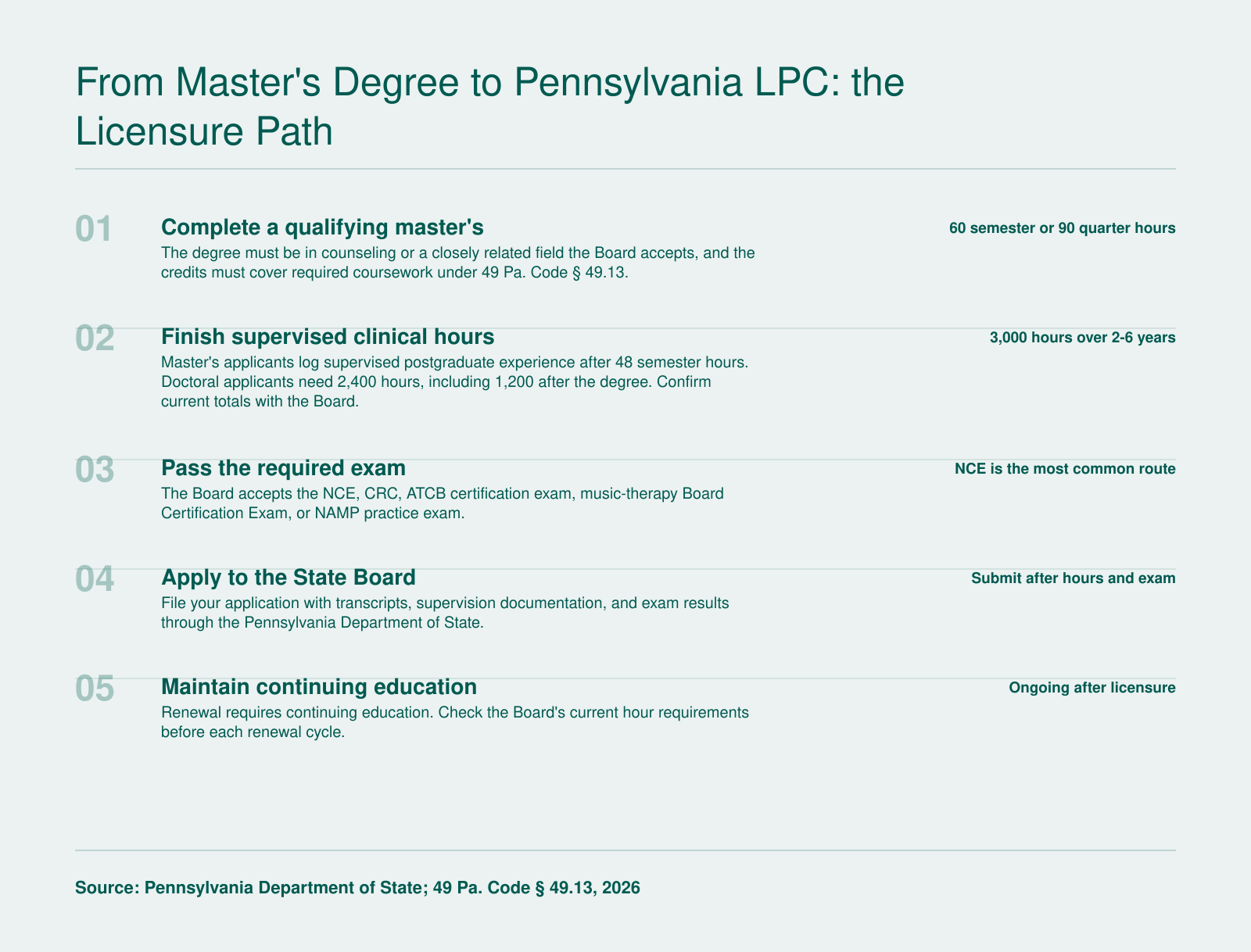
From Master's Degree to Pennsylvania LPC: the Licensure Path
Pennsylvania licenses professional counselors through the State Board of Social Workers, Marriage and Family Therapists and Professional Counselors. Master's graduates with fewer than 60 credits should check whether they need extra coursework before counting hours. The LMFT variant requires a marriage and family therapy or related degree, a practicum with 300 supervised direct client-contact hours, the AMFTRB national exam, and 3 hours of child-abuse recognition and reporting training.
Admissions Requirements for Pennsylvania Clinical Psychology Master's Programs
Requirements vary by school, so confirm each program's current admissions page before applying. The details below reflect what the programs publish.
- Bachelor's degreePenn State and Chestnut Hill College require a bachelor's degree. Penn State and Penn State Behrend also expect at least 18 undergraduate psychology credits, so a psychology major is not the only route in, but substantial coursework is needed.
- Prerequisite coursesPenn State and Penn State Behrend require statistics and psychology research methods, each completed with a B or higher. Abnormal and developmental psychology are not listed as stated prerequisites in the sources reviewed, so check with each program.
- GPA, letters, and interviewPenn State and Penn State Behrend look for a 3.0 GPA in the last 60 credits, and Millersville also cites a 3.0. Penn State asks for three letters, and Chestnut Hill asks for two. Penn State, Behrend, and Chestnut Hill (2026-2027) all include an interview. Penn State does not require the GRE, but applicants who skip it may be ineligible for most assistantships and scholarships.
- Clearances for clinical placementPennsylvania placements commonly involve Act 34 and Act 151 clearances and FBI fingerprinting. The sources reviewed do not confirm requirements for each program, so ask the admissions office what is needed and when.
- DeadlinesPenn State admits for fall only. Its bulletin lists April 30, while the psychology FAQ says December 1, so confirm the date directly. Fall 2027 deadlines for the other schools were not confirmed, so check each program's admissions page and apply early.
Quick Answers for Pennsylvania Clinical Psychology Master's Applicants
These answers cover the questions applicants ask most often about licensure, degree types, prerequisites, and doctoral pathways in Pennsylvania. Confirm details with each program and the relevant state board before you apply.
Can a master's degree lead to clinical licensure in Pennsylvania?
Is a clinical psychology master's the same as a clinical mental health counseling degree?
What undergraduate coursework do Pennsylvania clinical psychology master's programs expect?
Does a clinical psychology master's help with admission to PsyD programs in PA?
Compare Clinical Psychology programs on the data that matters
Explore more Psychology specializations or browse every graduate field.
All Psychology programs