Best Master's in Clinical Psychology Programs
Compare 150+ accredited Clinical Psychology programs at 130+ schools, with graduate earnings, cost, debt, and completion data from IPEDS and the U.S. College Scorecard.

In most states, a master's in clinical psychology satisfies coursework for Licensed Professional Counselor or Marriage and Family Therapist licensure, but it does not confer the title psychologist. The best master's in clinical psychology programs earn that label through graduate earnings, debt, and net price, not reputation.
The 10 programs ranked here include public options charging under $12,000 in annual net price and private options above $27,000, with completion times that cluster around two to three years. Accreditation and state licensure rules do more to shape your clinical options than the school's prestige. Check those requirements before comparing online placements or assuming a two-year timeline.
Key Points
- Out-of-state students pay $19,785 more at UCF than in-state peers.
- Only 61 master's programs nationwide hold MPCAC accreditation, a short list to check first.
- Most states route master's graduates to counseling licenses, so verify your state board before enrolling.
10 Clinical Psychology Master's Programs Ranked by Graduate Outcomes
Each school earned its spot by what graduates walk away with: earnings, manageable debt, and a realistic price tag. The programs below are paired with the specific formats, concentrations, and clinical placements that make that value real.
San Jose State University
#1San Jose, CA · ~$10,000/yr (est.)
Best for: California MFT licensure-focused clinical trainees
San Jose State's 60-unit MS in Clinical Psychology blends evidence-based practice, community mental health emphasis, and scientist-practitioner training to prepare students for California MFT licensure. Fall applicants apply by January 1, do not submit GRE scores, and must meet a 3.0 GPA threshold along with at least 100 hours of applied clinical experience.
- 60 total credit hours
- Prepares for MFT licensure in California
- Evidence-based practice focus
- Community mental health emphasis
- Internship opportunities with community agencies
- Scientist-practitioner model
University of Delaware
#2Newark, DE · $20,000 – $25,000/yr (est.)
Best for: Research-minded applicants seeking clinical science training
Delaware's MS in Clinical Psychological Science uses a three-year, 60-credit path with research training, a thesis, and a third-year internship. The clinical science concentration is accredited through both the Psychological Clinical Science Accreditation System and APA, and Delaware's Institute for Community Mental Health connects students to applied community experience.
- 60 total credit hours
- Three-year program with fall start
- Thesis required
- Hands-on research in advanced labs
- Focus on empirically supported treatments
- Includes a third-year internship
- Pathway to licensure as mental health professional
University of Missouri
#3Columbia, MO · ~$14,000/yr (est.)
Best for: Doctoral-bound psychology researchers needing clinical science
Missouri's MA in Psychology with an emphasis in clinical psychology is a research-intensive, 30-credit program designed for students pursuing doctoral study. Students complete a thesis and oral exam, and the clinical science curriculum carries APA and PCSAS accreditation.
- 30 total credit hours
- Thesis required
- Clinical science model of training
- Prepares for doctoral study
- Faculty research on addictions, anxiety, and mood disorders
- APA and PCSAS accredited
University of Central Florida
#4Orlando, FL · ~$9,000/yr (est.)
UCF offers two campus MA tracks in clinical psychology. The applied pre-licensure path runs 61 credits with a 700-hour internship and leads toward Florida LMHC licensure, while the shorter research/thesis track emphasizes faculty mentorship and doctoral preparation in a small cohort.
- 61 total credit hours
- 700 clinical hours
- Prepares for LMHC licensure in Florida
- Terminal master's program
- Small cohorts of 10-14 students
- Internship at community agencies
- 38 total credit hours
- Thesis required
- Prepares for doctoral study
- Optional clinical practicum
- Small cohort of 4-6 students
- No LMHC license eligibility
Towson University
#5Towson, MD · ~$13,000/yr (est.)
Towson's Psychology MA clinical concentration prepares students for LCPC licensure or doctoral study through a 48-credit evidence-based curriculum. A required 425-475 hour community internship adds diagnostic assessment and treatment training with adults and children.
- 48 total credit hours
- 425-475 hour clinical or research internship
- Evidence-based practice model
- Prepares for LCPC licensure
- Training in diagnostic assessment
- Work with adults and children
Wheaton College
#6Wheaton, IL · ~$20,000/yr (est.)
Wheaton's MA in Clinical Psychology is embedded within the Psy.D. program and requires 48 credits plus biblical and theological studies. Practicum training begins in the second year, and admission requires a 3.0 GPA, the GRE, and prerequisite psychology coursework.
- 48 total credit hours
- Prepares for applied clinical careers
- Practicum begins in second year
- Includes biblical and theological studies
- M.A. granted within Psy.D. program
- Entrance exam required; GRE
- 3.0 GPA minimum
- APA accredited
Immaculata University
#7Immaculata, PA · ~$13,000/yr (est.)
Immaculata's MA in Clinical Psychology is open only to Psy.D. students and builds competency in research, ethics, diversity, assessment, intervention, and scientific foundations. The program includes two practicum seminars and a comprehensive examination before the master's is awarded.
- Embedded within Psy.D. program
- Open only to Psy.D. students
- Six core competency areas
- Includes two practicum seminars
- Comprehensive examination required
- Prerequisite courses required
San Francisco State University
#8San Francisco, CA · $5,000 – $10,000/yr (est.)
San Francisco State's MS in Psychology clinical concentration is a two-year, 60-credit full-time program aligned with California MFT licensure. It combines 24 units of practicum with prerequisite coursework and helping experience, admitting only for fall by February 1.
- 60 total credit hours
- 24 units of practicum
- Eligibility for MFT licensure
- Comprehensive exam or thesis option
- Prerequisite coursework and helping experience required
- Fall admission only, February 1 deadline
Montclair State University
#9Montclair, NJ · ~$16,000/yr (est.)
Montclair State's MA in Clinical Psychology offers Child/Adolescent Psychology and Forensic Psychology tracks, both following a scientist-practitioner model. The child track centers developmental psychopathology and family-school contexts, while the forensic track adds an admissions interview and writing sample.
- STEM designated program
- Small cohorts and close mentorship
- Active research lab opportunities
- Prepares for supervised clinical roles
- Focus on child and adolescent mental health
- Rolling admissions
- Priority deadline March 15
- Admissions interview and writing sample required
- Scientist-practitioner training model
DePaul University
#10Chicago, IL · ~$23,000/yr (est.)
DePaul's clinical psychology MA/PhD program offers Clinical-Child and Clinical-Community tracks focused on underserved youth and families in urban settings. Students train at an in-house clinic and Chicago-area hospitals while following a scientist-practitioner model.
- APA accredited
- 20 total courses
- Thesis required
- In-house clinic training
- Chicago area clinical placements
- Faculty research on youth depression
- Apply by December 1
- Partnerships with Chicago hospitals
- Act and Adapt coping skills program
- Alumni network of over 201,000
- Received three APA awards
- Recognized for diversity training
Cost & outcomes by school
Federal data for the highest-earning Clinical Psychology programs, independent of the ranking above. Earnings are this field's master's graduates four years after completing, where the Scorecard reports them.
| School | Earnings | Tuition / yr | Debt | Grads/yr | Format |
|---|---|---|---|---|---|
| San Francisco State University CA | $96,854 | $9,370 | — | 6 | Campus |
| Teachers College at Columbia University NY | $91,522 | $37,918 | $81,639 | 237 | Campus |
| Alliant International University-San Diego CA | $86,459 | $19,690 | $61,500 | 121 | Hybrid |
| Notre Dame de Namur University CA | $85,048 | $15,300 | $81,798 | 20 | Online or campus |
| California State University-Northridge CA | $83,681 | $8,982 | $41,000 | 22 | Campus |
| University of Georgia GA | $83,010 | $11,002 | $41,000 | 81 | Campus |
| Montclair State University NJ | $81,192 | $16,056 | $36,500 | 19 | Campus |
| California State University-Fullerton CA | $76,598 | $8,994 | $37,058 | — | Campus |
| Vanguard University of Southern California CA | $75,686 | $16,853 | — | 37 | Hybrid |
| University of Houston-Clear Lake TX | $72,708 | $9,762 | $41,000 | 51 | Campus |
| The University of Texas Rio Grande Valley TX | $72,427 | $8,589 | $29,158 | 19 | Campus |
| Western Michigan University MI | $72,299 | $20,103 | $49,498 | 42 | Campus |
Sources: U.S. Department of Education. Tuition and graduates: IPEDS. Earnings and debt: College Scorecard, this field's master's graduates; a dash means no figure is reported.
Cost, debt & payoff
Median earnings of this field's master's graduates (4 yrs after completing) vs. their median federal loan debt · U.S. College Scorecard
Across these programs the median graduate earns about $66,014 and finishes with roughly $47,793 in debt — a ratio that clears a common rule of thumb (keep debt below first-year salary). Tuition and debt vary widely school to school, so check the per-school figures in the table above before you shortlist.
Why Outcomes, Not Prestige, Drive This List
Does a prestigious clinical psychology program still pay off if its graduates leave with high debt and earnings that don't cover the monthly payment?
This list starts with outcomes that matter for clinical psychology and counseling psychology master's programs, where most graduates enter licensed practice rather than academia. We look at program-level earnings after completion, median federal debt and the monthly payment it implies, approximate net price, and completion volume, using federal College Scorecard data. A well-known university does not fix low earnings or high debt.
Why this beats reputation-based lists
For a clinical psychology master's, the payoff is usually a counseling or assessment role under supervision, not a tenure-track job; that practice-oriented path also appears in clinical mental health counseling programs. A brand-name department may matter less than whether a program's graduates can manage loan payments on a master's-level salary. Focusing on verified outcomes keeps the comparison relevant to the license you will actually hold.
What the ranking cannot yet show
Net price is institution-wide and approximate, graduation rates are school-wide rather than program-specific, and some clinical psychology programs do not yet publish program-level earnings. Use this list as a starting filter, then pair it with the licensure rules covered later, for the state where you plan to practice. A program that looks strong nationally can still be the wrong fit if it does not lead to eligibility where you plan to practice.
Jobs a Clinical Psychology Master's Unlocks, Plus the Doctoral Route
A master's in clinical psychology, one of the psychology master's programs, is a two-year graduate degree that prepares you to assess and support people with mental health conditions, and what you can do with it depends on whether you hold a license. The degree alone qualifies you for a few roles. Others stay closed until you finish supervised practice and pass a state exam.
Roles Open Right After Graduation
- Psychometrist: Administers and scores cognitive and neuropsychological tests under a psychologist's direction.
- Behavioral health case manager: Coordinates care, services, and follow-up for clients in community agencies or hospitals, a role also associated with MSW programs.
- Research coordinator: Runs studies, recruits participants, and manages data in university or hospital labs, duties central to clinical research master's programs.
Roles That Require Licensure First
Licensed counselor or therapist positions come only after post-degree supervised hours, which commonly take about two years, plus a board exam. Some states also credential a psychological associate at the master's level, but the title and scope vary widely, so check your state board before you enroll.
The Doctoral Route
Many students use the master's as a stepping stone to a PhD or PsyD. It builds research experience and strengthens an application. Transfer credit is inconsistent, though. Some doctoral programs accept a portion of master's coursework, and others make you start from the beginning, so ask each program directly.
If your goal is doing therapy, choose a licensure-track program. A research-track MA rarely satisfies the coursework and practicum rules that licensing boards set.
Clinical Psychology Master's vs. Clinical Mental Health Counseling: Which Leads Where
A clinical psychology master's is built around the science of psychology, while a clinical mental health counseling (CMHC) degree is built around a license to practice counseling. The titles sound close, but they often lead to different places.
Side-by-side differences
- Focus: Clinical psychology tends to be broader and more research-oriented, and some programs are primarily academic. CMHC centers on counselor training and supervised practice.
- Accreditation: MPCAC typically applies to clinical psychology programs, CACREP to CMHC. They are not interchangeable.
- Credits: Both commonly run about 60, though requirements vary by program and state.
- Field hours: MPCAC calls for at least 600 supervised hours, including 240 of direct client contact. CACREP calls for 100 practicum hours plus 600 internship hours, 700 combined.
- Licenses: CMHC graduates usually pursue LPC, LMHC, or LPCC, then complete roughly 2,000 to 3,000 post-degree supervised hours and pass the NCE or NCMHCE. Clinical psychology graduates may look at LMFT (which needs MFT-specific coursework) or state psychological associate credentials.
- Doctoral fit: A thesis, strong statistics, and faculty research make a clinical psychology master's the stronger launchpad for a PhD. Either degree can work for a PsyD.
The pitfall to check first
Some states require a CACREP-accredited degree for LPC licensure. A clinical psychology MA graduate can be blocked even with 60 credits and 600 field hours. MPCAC accreditation also does not equal psychologist licensure, which requires a doctorate. Confirm your state board's rules before you apply.
Rule of thumb: choose clinical psychology if a doctorate or research is the goal, and choose CMHC if you want the most direct route to counselor licensure.
Related Articles
State Licensure Paths for Master's-Level Graduates
Only a minority of states license master's-level psychological associates or psychologists, while most route graduates through counseling licenses such as the LPC or LPCC. The table below shows a representative mix, and details change, so treat it as a starting point rather than legal guidance. Before enrolling, confirm coursework, practicum, and program accreditation requirements directly with the state board, since a degree that fits one state may not meet another's rules. Oregon is left out because its master's-level clinical psychology pathway was not specified in our sources.
| State | Master's-Level License | Post-Degree Supervised Hours | Independent Practice? | Licensing Board |
|---|---|---|---|---|
| California | Licensed Professional Clinical Counselor (LPCC) | 3,000 total supervised hours over at least 104 weeks | Yes, once fully licensed | California Board of Behavioral Sciences |
| Texas | Licensed Psychological Associate (LPA) | 3,000 postgraduate supervised hours for independent-practice authority | Yes, after completing the hours | Texas State Board of Examiners of Psychologists |
| Minnesota | Licensed Professional Counselor (LPC) | 2,000 hours of supervised post-degree practice | Yes, once fully licensed | Minnesota Board of Behavioral Health and Therapy |
| Kansas | Master's-level psychologist license (LMLP or LCP pathways) | 3,000 hours over at least 24 months, including 1,500 direct client contact hours and 100 supervision hours | Confirm with board | Kansas Behavioral Sciences Regulatory Board |
| Mississippi | Licensed Professional Counselor (LPC), after provisional LPC status | 3,000 post-master's hours over at least 18 months | Yes, once fully licensed | Mississippi State Board of Examiners for Licensed Professional Counselors |
| Kentucky | Licensed Psychological Associate | At least 9,000 hours for practitioner licensure | Confirm with board | Kentucky Board of Examiners of Psychology |
| North Carolina | Licensed Psychological Associate | At least 500 hours of supervised graduate training (additional post-degree requirements not confirmed) | Confirm with board | North Carolina Psychology Board |
| Alaska | Psychological Associate | Two years of supervised experience | Confirm with board | Alaska Department of Commerce, Community, and Economic Development |
| West Virginia | Licensed Psychologist (master's level) | Supervised experience required; exact hours not confirmed | Confirm with board | West Virginia Board of Examiners of Psychologists |
| Vermont | Licensed Psychologist, Master's | Supervised experience required; exact hours not confirmed | Confirm with board | Vermont Office of Professional Regulation |
| Georgia | Master's in counseling or applied psychology may qualify; license title varies | At least 300 hours of supervised practicum or internship within the degree | Confirm with board | Georgia Composite Board of Professional Counselors, Social Workers and Marriage and Family Therapists |
U.S. institutions conferred 31,818 master's degrees in psychology in 2021-22, according to the NCES Digest of Education Statistics. That volume matters when you apply: licensure-track practicum and internship slots are limited by the number of supervising clinicians in a given metro area, not by how many students enroll.
Only 61 master's programs nationwide carry MPCAC accreditation, per the council's official directory. Set against the hundreds of master's programs in psychology offered across the country, that makes accredited clinical psychology options a surprisingly short list, worth checking before you apply anywhere.
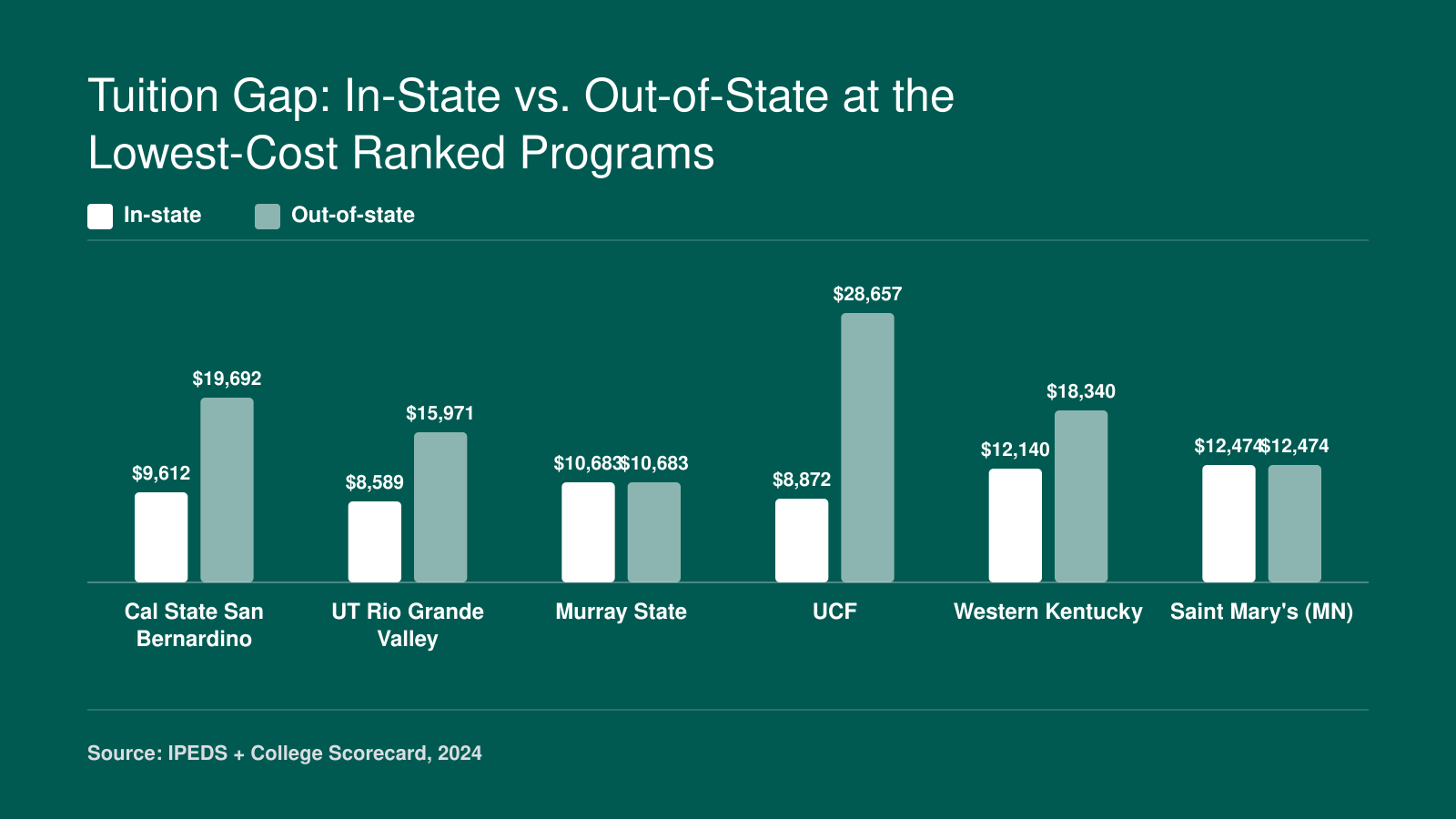
Tuition Gap: In-State vs. Out-of-State at the Lowest-Cost Ranked Programs
Residency can change the bill sharply at public schools. Out-of-state students pay $19,785 more at UCF, $10,080 more at Cal State San Bernardino, $7,382 more at UT Rio Grande Valley, and $6,200 more at Western Kentucky. Murray State charges one rate to everyone, and Saint Mary's is private with a single price. These figures cover tuition and fees only and exclude clinical training costs such as supervision, liability insurance, and practicum travel.
Clinical Psychology programs by state
Questions Applicants Ask First
These two questions come up before almost any others: what the degree legally allows, and whether international students can enroll. A third covers a related check to make before you commit. State boards and individual master's programs set the final rules, so confirm specifics with both.
Does a clinical psychology master's let you practice independently without a doctorate?
Can international students enroll in a U.S. clinical psychology master's program?
Will a program make me licensure-eligible in my state?
Compare Clinical Psychology programs on the data that matters
Explore more Psychology specializations or browse every graduate field.
All Psychology programs