Best Master's in Applied Behavior Analysis Programs
Compare 230+ accredited Applied Behavior Analysis programs at 200+ schools, with graduate earnings, cost, debt, and completion data from IPEDS and the U.S. College Scorecard.

Which ABA master's programs actually qualify you to sit for the BCBA exam, and how much debt does that eligibility cost? Two questions decide it: whether the coursework meets current Behavior Analyst Certification Board requirements, and what you pay after grants.
Price spreads are wide. Among the top-ranked programs, average net price runs from about $3,000 at CUNY Hunter College to nearly $33,000 at Penn State. The list mixes campus, hybrid, and fully online formats, and the bigger name is rarely the cheaper one.
Eligibility is only the first hurdle. The national first-time BCBA pass rate fell to 51% in 2025, so program quality shows up on exam day.
10 ABA Master's Programs for 2027, Ranked
The ABA master's decision usually comes down to format, price, and how well a program fits your working life. These ten schools range from dual certification and cohort models to fully online paths, with enough price and format variety to reward a close look.
Columbia University in the City of New York
#1New York, NY · ~$58,000/yr (est.)
Best for: Aspiring special educators needing dual certification
Columbia's Teachers College path is built for students who want a teaching credential and behavior-analytic training at once, with a dual-certification design spanning general and special education from birth through grade 6. The small cohort model, paid internships in ABA-based schools, and evening classes make it a distinctive fit for aspiring special educators in New York who need a licensure-linked route alongside BCBA preparation. A thesis is required.
- 47 credit hours over two years
- Dual certification in general and special education, birth to grade 6
- Paid internships in ABA-based schools and classrooms
- Evening classes with a small cohort of 15 to 25 students
- Integrative thesis requirement
- Prepares for BCBA and New York State LBA licensure
- $75 application fee and fall start
University of Washington-Seattle Campus
#2Seattle, WA · ~$19,000/yr (est.) · BCBA pass rate 81.6% (3-yr weighted avg)
Best for: Working professionals needing flexible scheduling
Washington offers both a cohort-based campus M.Ed. and a fee-based online Applied Behavior Analysis master's, so format is the first big fork for prospective students. For the on-campus version, the school reports median earnings of $58,061 one year after finishing and median debt of $35,261, while the online format uses a flat per-credit rate. The campus program is paused for the upcoming admissions cycle, with an update expected by spring 2027.
- 67 total credit hours over two years
- Cohort-based classes held Tuesday through Thursday
- Fieldwork partnerships with local agencies and UW-affiliated centers
- Capstone project using single-case research
- Shared supervision model meets BACB requirements
- $589 per credit for residents and nonresidents
- Synchronous online classes with evening start times
- Median graduation in 1.7 years
- Fieldwork scholarships up to $6,000
- General scholarships up to $8,000
- Optional supervision package for fieldwork
Vanderbilt University
#3Nashville, TN · ~$58,000/yr (est.) · BCBA pass rate 65.1% (3-yr weighted avg)
Best for: Early interventionists concentrating on young children
Vanderbilt's M.Ed. in Applied Behavior Analysis sits inside a highly regarded special education department and lets students choose among concentrations that include early childhood special education, high incidence disabilities, and severe disabilities. The full-time, in-person program pairs BCBA-focused coursework with two semester-long internships in school, clinic, and home settings.
- Concentration in early childhood special education
- Two semester-long internships in school, clinic, and home settings
- Rolling admissions and fall start
- Housed in a top-ranked special education department
- Concentration in high incidence disabilities
- Four concentration options available
- ABAI-verified course sequence
- Collaborate on faculty research projects
- Concentration in severe disabilities
- Full-time, in-person format
- Fieldwork in school, clinic, and home settings
- BCBA demand grew 190% from 2018 to 2021
- Faculty are Board Certified Behavior Analysts
Ohio State University
#4Columbus, OH · ~$14,000/yr (est.) · BCBA pass rate 41.9% (2-yr weighted avg)
Ohio State's Applied Behavior Analysis specialization is delivered fully online and can be completed part time, which makes it a practical option for working educators and behavior technicians. Students can finish in about two years full time or stretch to three to four years, with a thesis or project capstone and the option to use their own classroom for field experience.
- 34 total credit hours
- Full-time and part-time pacing options
- Asynchronous online classes
- Thesis or capstone option
- Field experience in your own classroom
- Prepares for BCBA coursework requirements
- Scholarships and graduate associateships available
Florida International University
#5Miami, FL · ~$11,000/yr (est.) · BCBA pass rate 50.7% (3-yr weighted avg)
Florida International's master's is a hybrid, cohort-based psychology program that moves quickly: 45 credit hours over 16 months. The lockstep curriculum includes experiential learning with local behavior-analysis organizations and is taught by faculty who are practicing BCBAs.
- 45 credit hours over 16 months
- Cohort-based, lockstep curriculum
- Fall and spring start dates
- Experiential learning with local ABA organizations
- Faculty are practicing BCBAs
University of Georgia
#6Athens, GA · ~$11,000/yr (est.) · BCBA pass rate 85.4% (3-yr weighted avg)
Georgia's on-campus MS is a two-year, cohort-based program with all applied experience hours available at the university's Center for Autism and Behavior Education Research clinics. The program reports median earnings of $64,962 one year after finishing and median debt of $41,000. No GRE is required.
- Two-year cohort model
- No GRE required
- All applied experience hours available on campus at CABER clinics
- Active SABA student organization
- Financial aid and scholarships available
- Focus on behavioral assessment and single-case research
Northeastern University
#7Boston, MA · ~$29,000/yr (est.) · BCBA pass rate 74.1% (3-yr weighted avg)
Northeastern's MS in Applied Behavior Analysis leans on more than 45 years of ABA instruction and keeps classes small, with a flexible online core and a hybrid option in Charlotte. The program reports median earnings of $59,352 one year after finishing and median debt of $41,000. A professional portfolio, rather than a thesis, serves as the capstone.
- 30 total credit hours over 10 courses
- Optional synchronous sessions with small classes up to 19
- No GRE required
- Professional portfolio capstone
- Hybrid option in Charlotte, NC
- Over 45 years of ABA instruction
- Opportunity to transfer up to nine credits
Purdue University
#8West Lafayette, IN · ~$10,000/yr (est.) · BCBA pass rate 70.6% (3-yr weighted avg)
Purdue offers two Applied Behavior Analysis routes: a 33-credit online master's and an accelerated 39-credit on-campus option for students who want to compress their path. Both are built around BCBA exam preparation, though the online format is designed for working professionals and the accelerated track is more structured.
- 33-credit online master's program
- Synchronous and asynchronous class options
- Cohort learning model
- ABAI approved course sequence
- Prepares for BCBA exam
- 39 total credit hours
- 3.3 GPA minimum and 3 letters of recommendation
- Capstone required
- Test preparation modules for BCBA exam
- Campus-based residential format
Pennsylvania State University
#9University Park, PA · ~$26,000/yr (est.) · BCBA pass rate 55% (3-yr weighted avg)
Penn State Harrisburg's in-person ABA master's is designed around evening classes and a small cohort of roughly 15 students each year. The program includes at least 1,000 hours of supervised fieldwork and reports median earnings of $42,161 one year after finishing and median debt of $44,250.
- Complete in about two years
- Full-time and part-time options
- At least 1,000 hours of supervised fieldwork
- Evening classes stacked on two evenings
- Small cohort of about 15 students
- Prepares for BCBA under Pathway 1
- Eligible for Pennsylvania behavior specialist licensure
CUNY Hunter College
#10New York, NY · ~$11,000/yr (est.) · BCBA pass rate 68.4% (3-yr weighted avg)
CUNY Hunter's master's focuses on behavior-analytic intervention across the lifespan, with particular strength in autism spectrum disorder and other DSM diagnoses. The hybrid program also emphasizes supervisory and administrative skills, and it positions graduates for New York State behavior analysis licensure.
- Prepares for BCBA exam
- Focus on autism spectrum disorder and other DSM diagnoses
- Covers all ages from infancy to old age
- Settings include schools, homes, day programs, and residential care
- Eligible for New York State behavior analyst licensure
- Also trains supervisors and administrators
Cost & outcomes by school
Federal data for the highest-earning Applied Behavior Analysis programs, independent of the ranking above. Earnings are this field's master's graduates four years after completing, where the Scorecard reports them.
| School | Earnings | Tuition / yr | Debt | Grads/yr | Format |
|---|---|---|---|---|---|
| Hofstra University NY | $90,301 | $31,120 | $48,162 | 58 | Online |
| Alliant International University-San Diego CA | $86,459 | $19,690 | $61,500 | 121 | Online |
| Touro University NY | $86,288 | $14,979 | $37,615 | 45 | Hybrid |
| CUNY Queens College NY | $86,240 | $11,612 | $33,941 | 57 | Campus |
| Cambridge College MA | $85,569 | $11,763 | $26,500 | 49 | Hybrid |
| California State University-Northridge CA | $83,681 | $8,982 | $41,000 | 22 | Campus |
| University of Georgia GA | $83,010 | $11,002 | $41,000 | 81 | Campus |
| University of Utah UT | $80,164 | $8,724 | $26,100 | 71 | Campus |
| National University CA | $78,497 | $16,416 | $28,854 | 1,098 | Online |
| Florida Institute of Technology FL | $77,258 | $24,320 | $20,500 | 851 | Campus |
| Rider University NJ | $76,780 | $20,220 | $41,000 | 25 | Hybrid |
| Wayne State University MI | $76,420 | $17,960 | $40,245 | 46 | Online |
Sources: U.S. Department of Education. Tuition and graduates: IPEDS. Earnings and debt: College Scorecard, this field's master's graduates; a dash means no figure is reported.
Cost, debt & payoff
Median earnings of this field's master's graduates (4 yrs after completing) vs. their median federal loan debt · U.S. College Scorecard
Across these programs the median graduate earns about $68,704 and finishes with roughly $41,000 in debt — a ratio that clears a common rule of thumb (keep debt below first-year salary). Tuition and debt vary widely school to school, so check the per-school figures in the table above before you shortlist.
ABAI Accreditation, Verified Course Sequences, and Your BCBA Eligibility
The phrase that once reassured ABA applicants most, "verified course sequence," no longer means what it did. The rules changed on January 1, 2026, so it pays to know exactly what each label covers.
Two Different Designations
ABAI accreditation is a program-level peer review. Reviewers examine the whole program: coursework, faculty, curriculum, experiential learning, and outcome measures. A Verified Course Sequence (VCS) was narrower. It confirmed only that a set of courses covered the BACB's required content areas and hours. It said nothing about teaching quality or how graduates fare, and ABAI never treated it as a quality seal.
What the BACB Accepts in 2026
The VCS system ended on December 31, 2025, and the old course-by-course review no longer applies to new applications. Students enrolling now meet BCBA degree and coursework requirements through one of two routes:
- Pathway 1: Graduate from an ABAI- or APBA-accredited program. This satisfies both the degree and coursework requirements at once.
- Pathway 2: Complete a program whose coursework the institution attests meets BACB requirements.
Pathway 1 is the cleaner route. Pathway 2 works, but you are relying on the program's own attestation, so ask admissions how they handle it and what documentation you will receive.
Checking the Programs on This List
Several ranked programs describe themselves as ABAI accredited in their program materials, including Columbia University (Teachers College), the University of Washington-Seattle, Ohio State, Florida International University, and Penn State Harrisburg. Some program pages still advertise a "verified" or "approved" course sequence, language that predates the 2026 change. Treat that as a prompt to ask which pathway the program supports now. Whatever a school's marketing says, confirm its current status in the ABAI accredited program directory before you apply. Status can change, and the directory is the authoritative record.
A Costly Mistake to Avoid
A master's in psychology, education, or counseling psychology is not automatically a BCBA-ready degree. If a program is neither ABAI-accredited nor APBA-accredited nor able to attest that its coursework meets BACB requirements, you may finish your degree and still need extra courses before you can sit for the exam. That means more tuition and a delayed credential. Verify first, then enroll.
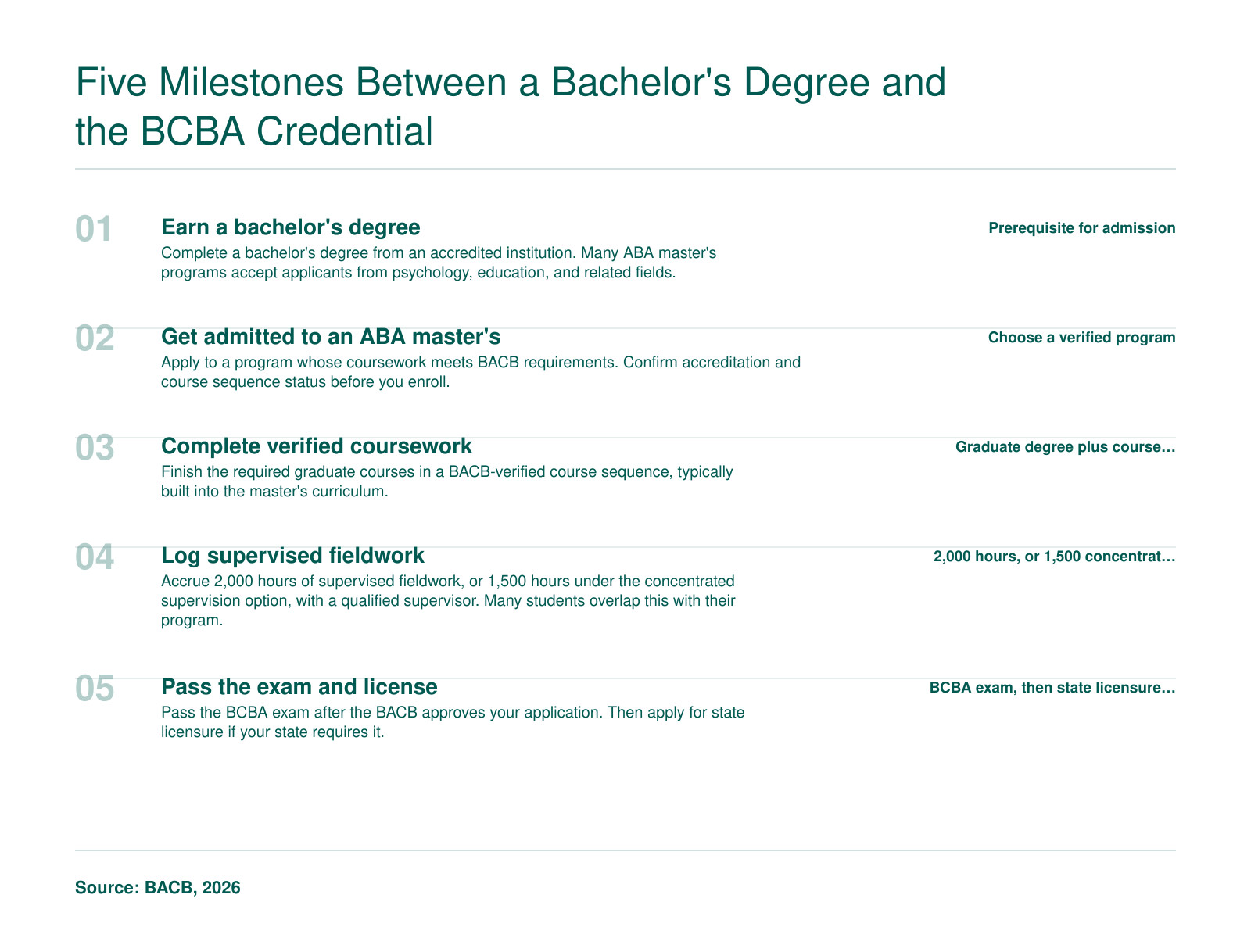
Five Milestones Between a Bachelor's Degree and the BCBA Credential
Order matters on the way to the BCBA credential, because each milestone unlocks the next. Note that some states license behavior analysts separately from BACB certification, so certification alone may not be enough to practice where you live.
Reading BCBA Pass Rates by ABA Master's Program
Pass rates are one of the few ABA education outcomes with a published benchmark, and that benchmark has been sliding. The national first-time BCBA exam pass rate was 51% in 2025, down from 54% in 2024 and 56% in 2023. In 2020 it was 66%. Retake candidates fare worse, at 23% in 2025 and 25% in 2024.
What the BACB Publishes
The BACB reports university examination pass rates annually for first-time BCBA candidates who completed a Verified Course Sequence (VCS). Programs appear only when they meet a minimum candidate threshold, and first-time rates are listed separately from overall rates that include retakes. The first-time figure is the cleaner comparison, since retakes pull an overall rate downward or upward depending on a program's history.
We could not confirm program-by-program figures for the schools on this list from the sources available to us, so we are not quoting individual rates here. Check the BACB's current university pass-rate table directly, and note the reporting year beside every number you copy down.
How to Interpret What You Find
- Start with the 51% benchmark: A program well above it is a positive signal. One well below it deserves a direct question to the admissions office.
- Weigh cohort size: A rate based on 8 test-takers can swing 12 points on a single candidate. A rate from 80 test-takers is far steadier.
- Look for multiple years: Two or three consecutive years at a similar level tell you more than one strong result.
- Compare like with like: Use first-time rates against first-time rates, and keep the reporting year consistent.
Questions Worth Asking Programs
Pass rates reflect who enrolls as much as how they are taught. Ask how many students sit for the exam each year, when graduates typically test relative to finishing fieldwork, and whether the program offers exam prep. A school that answers plainly, and shares its own cohort data, is usually more trustworthy than one that only advertises a headline percentage.
ABA Master's Program Tuition Comparison: In-State, Out-of-State, and Net Price
Net price is an institution-wide average after grant and scholarship aid, so it is a planning figure, not a quote for any one student. The table below shows each school's published in-state and out-of-state tuition alongside that net price and its delivery format. For context on what these totals often miss, the University of South Florida charges $600 per credit across 42 credits for a $25,200 total, while Drexel University lists $1,132 per credit plus a $125 fee. Several online programs, such as Walden University and Simmons University, charge one per-credit rate for all students, which removes the out-of-state premium.
| School | In-State Tuition | Out-of-State Tuition | Net Price | Format |
|---|---|---|---|---|
| CUNY Hunter College | $11,398 | $20,828 | $2,984 | Hybrid |
| CUNY Queens College | $11,612 | $21,042 | $4,195 | Campus |
| California State University-Stanislaus | $9,766 | $19,846 | $6,067 | Campus |
| Florida Atlantic University | $6,693 | $18,482 | $8,752 | Online |
| Florida International University | $11,334 | $24,439 | $9,288 | Hybrid |
| University of Georgia | $11,002 | $29,774 | $13,936 | Campus |
| University of Washington-Seattle Campus | $18,792 | $32,811 | $14,091 | Campus |
| University of Houston | $10,051 | $19,231 | $14,276 | Hybrid |
| Purdue University | $9,992 | $28,794 | $14,600 | Online |
| Arizona State University | $13,587 | $27,521 | $14,967 | Campus |
Related Articles
According to the Behavior Analyst Certification Board, the U.S. had 88,013 BCBAs as of October 1, 2026, a striking scale for a specialized credential. That workforce still must supply the fieldwork supervision hours candidates need, so supervisor availability often decides how quickly a master's student can sit for the BCBA exam.
Application Checklist for Applied Behavior Analysis Master's Programs
Requirements differ by program, so confirm each school's current criteria before you apply. These are the items published most often.
- Bachelor's degree and majorsAn accredited bachelor's degree is the baseline. Majors are usually broad, though some programs prefer psychology, education, special education, or behavior analysis. Nebraska Omaha requires 15 undergraduate semester hours of psychology, including statistics and an upper-level lab.
- Minimum GPAA 3.0 is the most common published floor, at Johns Hopkins, Texas Tech, Drexel, Liberty, and Alabama in Huntsville. Texas A&M–San Antonio lists 2.6 overall and Capella 2.3. Memphis has no formal cutoff, but a GPA below 3.0 may get extra review.
- GRE policyTexas A&M–San Antonio states the GRE is not required. The other programs reviewed did not list a GRE requirement, but check each application page to be sure.
- Letters, statement, and resumeMost programs ask for two letters (Johns Hopkins, Memphis, Texas Tech). Nebraska Omaha and Alabama in Huntsville ask for three. Nebraska Omaha also requires a statement, writing sample, and vitae.
- RBT or related experienceTexas A&M–San Antonio prefers a BCaBA or RBT credential, or undergraduate ABA coursework. Ohio State recommends at least one year working with individuals with disabilities, and Alabama in Huntsville prefers field experience.
- Deadlines and start termsJohns Hopkins listed July 15, 2026. Texas Tech lists August 1 for fall and December 1 for spring. Memphis admits for fall only. Oregon opened Fall 2026 applications September 15, 2026, so many fall 2026 windows have closed and you should plan for 2027.
Applied Behavior Analysis programs by state
Quick Answers for Future BCBAs Weighing an ABA Master's
These are the questions prospective students ask most often before committing to an ABA master's. Rules change, so confirm every detail against the current BACB handbook before you enroll.
Does an online master's in applied behavior analysis qualify you to sit for the BCBA exam?
Do you need a psychology bachelor's degree to get into an ABA master's program?
How many supervised fieldwork hours does the BACB require, and do master's programs build them in?
What changes if a program is ABAI-accredited rather than offering only a Verified Course Sequence?
Compare Applied Behavior Analysis programs on the data that matters
Explore more Psychology specializations or browse every graduate field.
All Psychology programs