Best Master's in Health Informatics Programs
Compare 230+ accredited Health Informatics programs at 200+ schools, with graduate earnings, cost, debt, and completion data from IPEDS and the U.S. College Scorecard.

Georgetown University reports median earnings of $103,494 for graduates a decade after entry, the highest among the schools ranked here. Salaries vary widely across the field, so a program's value depends on net cost after aid, delivery format, and whether it holds CAHIIM accreditation.
The programs ranked here include fully online, hybrid, and campus tracks, several built for working professionals who need 32 to 36 credits while keeping a full-time job. Boston University and UNC-Chapel Hill, for example, run online options with no GRE/GMAT and multiple start dates. Accreditation and employer acceptance of online formats have narrowed the delivery trade-off, while net price and debt gaps remain wide.
Key Points
- Ten ranked programs draw on IPEDS and College Scorecard data, several fully online.
- In-state residents save about $11,566 at the cheapest ranked programs.
- In one 2025 survey, 86% of tech employers viewed online and on-campus credentials equally.
The 10 Best Master's in Health Informatics Programs for 2027
These 10 programs stand out for combining rigorous health informatics training with practical career outcomes. We flag fully online options clearly so readers searching for a master's in health informatics online can find flexible paths, and we note where tuition is highest and lowest. Use this list to compare format, concentration, and early-career earnings side by side.
University of North Carolina at Chapel Hill
#1Chapel Hill, NC · ~$13,000/yr (est.)
Best for: Budget-conscious North Carolina residents online
UNC-Chapel Hill is the leading fully online option on this year's list, offering a Master of Professional Science in Biomedical and Health Informatics with Clinical Informatics or Public Health Informatics tracks. Graduate tuition is $8,994 for North Carolina residents and $41,203 for nonresidents. The 35-credit program includes a 400-hour mentored internship, no GRE, and rolling spring, summer, and fall starts.
- Clinical Informatics concentration
- No entrance exam required
- 35 total credit hours
- 400-hour mentored clinical internship
- Rolling admissions with spring, summer, fall starts
- 100% online courses
- Full-time and part-time options
- Fast track in one year
- Public Health Informatics concentration
- Interdisciplinary faculty from multiple departments
- Ties to NC Research Triangle Park companies
- Hands-on analytics and machine learning experience
- Three completion pace options
- Also available as a residential program
- Prepares for analyst, manager, researcher roles
Vanderbilt University
#2Nashville, TN · ~$58,000/yr (est.)
Best for: Working clinicians needing executive informatics training
Vanderbilt's online Master of Science in Applied Clinical Informatics is designed for physicians, nurses, and other health professionals who want to work full-time while studying. The 21-month, 36-credit program includes a capstone and 240 hours of hands-on interdisciplinary experience. Graduate tuition is $67,498 for both in-state and out-of-state students.
- 21-month program
- Complete 36 credits of clinical informatics coursework
- 240 clinical hours
- Capstone required
- Work full-time while earning degree
- Designed for healthcare professionals
- International students eligible
- World-renowned faculty
Dartmouth College
#3Hanover, NH · $65,000 – $70,000/yr (est.)
Best for: Career changers wanting an on-campus year
Dartmouth's on-campus Master of Science in Medical Informatics is a 12-month program open to students from all academic backgrounds. The curriculum blends database management, health data security, decision analysis, and hands-on electronic health record training. Graduate tuition is $68,268 for both in-state and out-of-state students, and the university graduates about 96% of students institution-wide.
- 12-month program
- Capstone required
- Designed for all academic backgrounds
- Foundational training built in
- Hands-on electronic health record training
- Careers in government, healthcare, and research
Georgetown University
#4Washington, DC · $60,000 – $65,000/yr (est.)
Georgetown's campus-based Master's in Health Informatics & Data Science is an accelerated one-year program in Washington, D.C., with full-time and part-time options. It focuses on health data science, predictive analytics, AI, and machine learning, and includes a real-world capstone. Graduate tuition is $68,017 for both in-state and out-of-state students.
- 1-year program
- Full-time and part-time options
- Real-world capstone projects
- Located in Washington, D.C.
- Application deadline: July 1
- Careers: health data analyst, business analyst
Johns Hopkins University
#5Baltimore, MD · ~$65,000/yr (est.)
Johns Hopkins offers a 24-month, full-time on-campus research master's in health sciences informatics that connects students with all Hopkins health sciences schools. The program includes research rotations, a thesis, and training in clinical decision support, telemedicine, and precision medicine analytics. Graduate tuition is $65,230 for both in-state and out-of-state students.
- 24-month program
- 3 letters of recommendation required
- Thesis required
- Research rotations in year one
- Thesis research in year two
- Partners with all health sciences schools
- Prepares for scholarly publication
- Programming language proficiency preferred
University of California-Davis
#6Davis, CA · $15,000 – $20,000/yr (est.)
UC Davis's Master of Science in Health Informatics emphasizes public health applications, including surveillance, prevention, and health promotion. The campus-based program pairs students with a research professor mentor and an academic advisor. Graduate tuition is $16,774 for California residents and $50,974 for nonresidents. Note: the university is not accepting applications for the 2026-27 academic year while it strengthens the program.
- Mentorship from a research professor
- Academic advisor guidance
- Focus on public health informatics
- Interdisciplinary team science
- Leader in translational research
- Data-driven health research
University of Washington-Seattle Campus
#7Seattle, WA · ~$19,000/yr (est.)
The University of Washington's hybrid online Master of Health Informatics and Health Information Management is designed for working professionals seeking leadership roles in health IT. It covers electronic health records, data management, and enterprise system implementation. Graduate tuition is $12,973 for Washington residents and $43,209 for nonresidents.
- Hybrid online format
- Designed for working professionals
- Leadership roles in health IT
- Enterprise health information systems
- Bachelor's degree required
Northeastern University
#8Boston, MA · ~$29,000/yr (est.)
Northeastern's Master of Science in Health Informatics is a STEM-certified, interdisciplinary campus program combining health sciences and computer science. Students can add up to 12 months of co-op experience, and recent graduates show strong early-career earnings: $67,211 one year after entry and $104,317 four years after entry. Graduate tuition is $66,162 for both in-state and out-of-state students.
- No concentration track
- STEM-certified interdisciplinary program
- Up to 12 months of co-op experience
- Alumni work at Mass General Brigham and Boston Children's Hospital
- Joint program with Khoury College
- 2 letters of recommendation required
- 3.0 GPA minimum
- Rolling admissions
- Personal Health Informatics concentration
- Thesis or capstone option
- Courses in medical knowledge and human-computer interaction
- Study data management and analysis
- Apply technical and business knowledge
- Health Informatics Analytics concentration
- Vancouver campus option for Canadian students
- Career path: Population Health Analyst
- Offered jointly by Bouvé and Khoury Colleges
- Capstone required
Rutgers University
#9New Brunswick, NJ · ~$23,000/yr (est.)
Full-time students can finish in 18 months, and recent program graduates had median earnings of $81,932 one year after entry. Graduate tuition is $17,929 for New Jersey residents and $37,441 for nonresidents.
- 18-month program
- 36 total credit hours
- Full-time and part-time options
- 3.0 GPA minimum
- No entrance exam required
- Online format for working professionals
- STEM-designated on-campus for international students
Boston University
#10Boston, MA · $65,000 – $70,000/yr (est.)
Boston University's Master of Science in Health Informatics is CAHIIM-accredited and offered fully online or on campus, with full-time and part-time study. The 32-unit program can be completed in 8 to 16 months, with concentrations in Applied Data Analytics and Health Information Management. Graduate tuition is $68,102 for both in-state and out-of-state students.
- CAHIIM accredited
- Complete in 8 to 16 months
- 32 total credit hours
- No GRE required
- STEM designated program
- 24:1 average class ratio
- Access to Health Informatics Research Lab
- Merit scholarships automatically considered
- Health Information Management concentration
- Complete in 12 to 20 months
- 40 total credit hours
- Eligible for CPHI and CHDA certification exams
- Certificate-to-degree pathway
- Common job titles: CMIO, clinical app developer, EHR specialist
- Applied Data Analytics concentration
- Top-ranked online program, #12 nationally
- Online and on-campus options
- Flexible start dates: fall, spring, summer
Cost & outcomes by school
Federal data for the highest-earning Health Informatics programs, independent of the ranking above. Earnings are this field's master's graduates four years after completing, where the Scorecard reports them.
| School | Earnings | Tuition / yr | Debt | Grads/yr | Format |
|---|---|---|---|---|---|
| Duke University NC | $163,348 | $66,523 | $45,810 | 33 | Hybrid |
| The University of Texas Health Science Center at Houston TX | $105,837 | $11,367 | $20,500 | 80 | Online |
| Columbia Southern University AL | — | $3,936 | — | — | Online |
| Georgia Southwestern State University GA | — | $4,626 | — | — | Online |
| Middle Georgia State University GA | — | $4,534 | — | — | Online |
| Northeastern State University OK | — | $5,771 | — | — | Online or campus |
| University of the Potomac-Washington DC Campus DC | — | $5,850 | — | — | Campus |
| Clayton State University GA | — | $6,493 | — | — | Campus |
| Georgia Southern University GA | — | $6,646 | — | — | Online |
| Fayetteville State University NC | — | $6,791 | — | — | Online |
| The University of Findlay OH | — | $18,706 | — | 104 | Hybrid |
| Arkansas Tech University AR | — | $7,670 | — | — | Online |
Sources: U.S. Department of Education. Tuition and graduates: IPEDS. Earnings and debt: College Scorecard, this field's master's graduates; a dash means no figure is reported.
Cost, debt & payoff
Median earnings of this field's master's graduates (4 yrs after completing) vs. their median federal loan debt · U.S. College Scorecard
Across these programs the median graduate earns about $104,317 and finishes with roughly $41,000 in debt — a ratio that clears a common rule of thumb (keep debt below first-year salary). Tuition and debt vary widely school to school, so check the per-school figures in the table above before you shortlist.
How We Rank Health Informatics Master's Programs
How do you tell which health informatics master's is worth the money? We start with what can be measured. Each program is compared on published graduate tuition, the average net price at the institution, the institution's graduation rate, and, where reported, College Scorecard program-level earnings and federal debt for graduates.
Federal data, not reputation
Many competing lists lean on reputation surveys or paid placements, which reward name recognition and advertising budgets. Ours is built from federal data instead. A famous school does not move up because it is famous, and a lower-profile program with solid earnings and manageable debt is not penalized for being quiet. We weigh the factors qualitatively rather than publishing fixed percentages, because the goal is to compare cost against outcomes, not to chase a formula.
What the numbers can't tell you
Every dataset has limits, and you should know them before relying on any ranking.
- Graduation rate: It covers the whole institution, not the health informatics program itself.
- Net price: It is an institutional average, so your own cost depends on aid, residency, and transfer credits.
- Earnings and debt: Some programs haven't yet published Scorecard earnings, so those schools are judged on the cost and completion measures available.
Treat the ranking as a well-grounded starting point, then confirm current tuition, curriculum, and accreditation directly with each program before you apply.
How Much Does a Health Informatics Master's Cost?
Sticker price and total cost rarely match in health informatics, and the gap matters most if you live outside the state of the school you want.
Annual Tuition Across Ranked Programs
Among the 10 ranked programs, in-state graduate tuition runs from about $8,037 a year at UNC Charlotte to $22,017 at the University of Minnesota-Twin Cities. Out-of-state rates at public universities range from $10,352 at Charter Oak State College, which charges everyone the same, to $33,249 at Minnesota. Vanderbilt, the only private school on the list, charges $57,868 regardless of residency, well above any public option.
Estimating Total Program Cost
Annual figures hide how long you'll pay. Multiply the per-credit rate by required credits instead:
- Texas State University: $502 per credit for 30 credits, roughly $15,060 total.1
- Northern Kentucky University: $619 per credit for 33 credits. The school lists $20,955 including all fees.2
- UMass Lowell: $610 per credit (Fall 2026) for 36 credits, about $21,960 before term registration fees, with increases expected.3
- George Mason University: $800 per credit for 36 credits, or as few as 30 if prior education or work lets you waive two intro courses.4
Online Rates and Residency
Uniform online pricing offers the biggest savings for out-of-state learners, as it does in online MPH programs. Northern Kentucky and UMass Lowell charge online students the same rate whether they live in-state or out-of-state, and UMass Lowell extends that rate to students outside the U.S. Kent State still differentiates, though modestly: an estimated $829 per credit for Ohio residents versus $839 for others, about $29,800 versus $30,200 overall.5 Many schools don't publish a clear online-versus-campus comparison, so confirm with admissions before assuming a discount.
Read Net Price Carefully
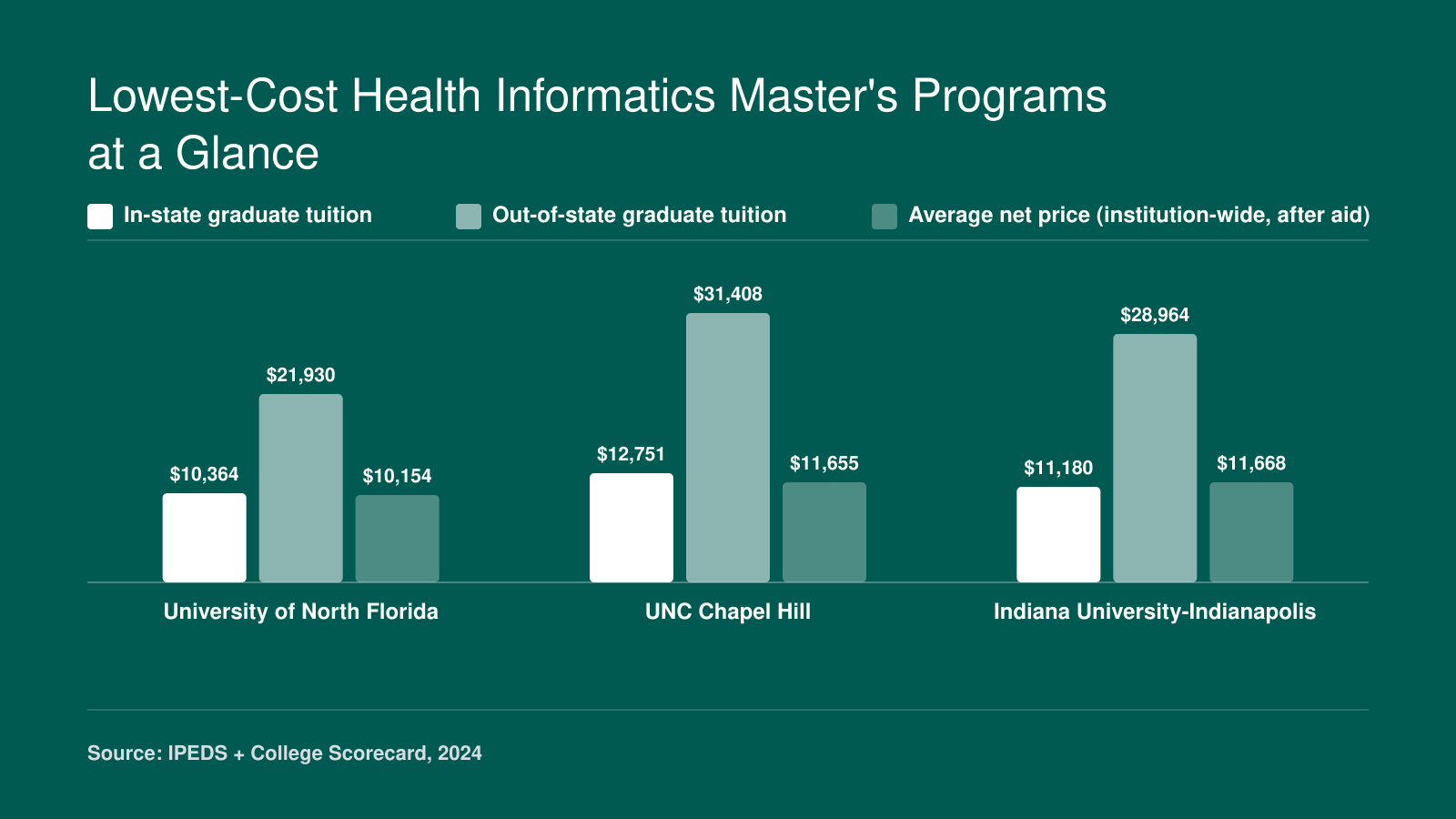
Net price among ranked schools ranges from about $10,154 at the University of North Florida to $18,784 at Stony Brook. These are institution-wide averages after grant aid, not a quote for this degree, and graduate aid packages can look very different.
Lowest-Cost Health Informatics Master's Programs at a Glance
These are the three least expensive ranked programs on tuition. Net price is an institution-wide average after grant aid, not a figure specific to the health informatics program, so treat it as a general cost benchmark. Residents save about $11,566 at the University of North Florida, and about $17,800 to $18,700 at Indiana University-Indianapolis and UNC Chapel Hill, compared with non-residents.
Related Articles
Online vs. Campus: Choosing Your Learning Format
Many ranked programs offer both formats, so you can often choose delivery without switching schools. Employers appear to treat the two credentials similarly: in one 2025 survey, 86% of employers in technology roles viewed online and on-campus credentials equally, and 2023 postgraduate employment rates were 79% for online graduates and 78% for on-campus graduates. The real differences are in schedule, access, and visa eligibility.
| Factor | Online | On Campus |
|---|---|---|
| Schedule flexibility | Highest. Most coursework can be completed around a full-time job, often asynchronously. | Fixed class times and a set location. Evening cohorts exist but require commuting. |
| Live (synchronous) sessions | Varies by program. Some require weekly live evening sessions, others are mostly self-paced. Confirm before applying. | Attendance is generally expected for in-person class meetings. |
| Typical completion time, full-time | About 12 to 24 months, depending on credit load and program design. | About 12 to 24 months, often following a structured cohort sequence. |
| Typical completion time, part-time | Often 2 to 4 years, with the easiest pacing adjustments for working professionals. | Often 2 to 4 years, with fewer course options per term. |
| Networking and practicum access | Relies on virtual cohorts and alumni networks. Practicums may be arranged near your home or current employer. | Easier in-person contact with faculty, classmates, and nearby hospital or health system partners. |
| Tuition structure | Often priced per credit, and some programs charge one rate regardless of residency. Confirm whether technology or program fees apply. | Per-credit or per-term pricing, usually with higher rates for out-of-state students at public universities, plus campus fees and living costs. |
| International student eligibility | Fully online programs generally do not qualify for F-1 student visas. | Usually required for F-1 visa eligibility. Confirm with the school's international office. |
Admissions Requirements and Prerequisites
Requirements vary by program, so confirm current terms with each school before you apply.
- Degree and GPAA bachelor's degree is standard. Most programs set the GPA floor at 3.0, but Denver allows 2.5 for 2026–27 and Cincinnati may admit conditionally below 3.0. Minnesota's published sources conflict (3.0 vs. 3.3), so verify with the program.
- GRE policyPolicies are split. Georgetown makes it optional, and UC Davis and San Diego don't require it. Temple and Loma Linda ask for scores only if your GPA is below 3.0. Minnesota and FIU require it, though Minnesota has exemptions. UC Davis admissions are suspended for 2026–27.
- BackgroundMinnesota requires 6 semester credits in life or health sciences. Temple expects a related bachelor's. Many other programs are flexible, so check for clinical, IT, or statistics prerequisites.
- Application materialsExpect a resume, statement of purpose, and letters of recommendation at most programs.
- International applicantsRutgers lists TOEFL above 79 or IELTS above 6.5, and Georgetown sets an 80 minimum on the original TOEFL scale. The TOEFL iBT scoring scale changed on January 21, 2026, so confirm which version a school uses. Many programs also require a credential evaluation, such as from WES.
- Deadlines and start termsFall deadlines run from February 15 (Minnesota, international) through August 1 (FIU, Northeastern domestic). Georgetown's final deadline is July 1, and ASU uses a July 15 priority date. Some programs also offer spring starts, though Minnesota accepts only domestic applicants for spring.
Health Informatics programs by state
Frequently Asked Questions About Health Informatics Master's Programs
These answers draw on the program, cost, and earnings comparisons earlier in this guide, plus federal STEM designation lists. Policies change, so confirm details with each school and your international student office before you apply.
Is a master's in health informatics worth it?
Which master's in health informatics programs are best for international students?
Can I get into a health informatics master's without a clinical or IT background?
How long does an online master's in health informatics take part-time?
Compare Health Informatics programs on the data that matters
Explore more Healthcare specializations or browse every graduate field.
All Healthcare programs