Best Master's in Health Informatics Programs in Indiana
Compare 6 accredited Health Informatics programs in Indiana at 5 schools, with graduate earnings, cost, debt, and completion data from IPEDS and the U.S. College Scorecard.

A standalone Master of Science in Health Informatics and an informatics concentration inside a broader degree can look interchangeable in a program search. They are not. Indiana University-Indianapolis offers the state's only standalone M.S., a 36-credit, CAHIIM-accredited program in hybrid format.
University of Southern Indiana folds informatics into its online Master of Health Administration, while Purdue University Global's fully online Master's in Health Informatics Programs runs 48 to 56 credits with a required capstone.
That spread matters more than format. Credit load drives total tuition, and the Most Affordable Master's in Health Informatics Programs can help you compare that cost; accreditation shapes which national credentials graduates can pursue, since Indiana does not license the field.
Key Points
- Indiana has one standalone M.S. in Health Informatics, at IU Indianapolis.
- IU Indianapolis lists the GRE as optional for both of its graduate entry routes.
- IU Indianapolis charges $430.50 per credit for Indiana residents in 2026-27.
Indiana's Best Master's in Health Informatics Programs, Ranked
Indiana has only one standalone Master of Science in Health Informatics. The other two listings below are informatics concentrations inside broader degrees, so check the degree title, credit load, and accreditation status before you compare costs.
Indiana University-Indianapolis
#1Indianapolis, IN · $11,000 – $29,000/yr (est.)
Best for: Students seeking a standalone informatics degree
Indiana University Indianapolis offers the state's only standalone Master of Science in Health Informatics, combining healthcare, IT, and data science with a professional or thesis pathway. Students work on real projects through The Polis Center and an internship option with the State of Indiana. The school's institution-wide graduation rate is about 54 percent, and its net price is an institution-wide average after aid, not a program figure. The program reports median earnings of about $82,700 one year after graduation. IU states that its CAHIIM accreditation runs through 2030, but CAHIIM's directory currently lists the award as "Initial," so confirm the status with the school before applying.
- Standalone MS in Health Informatics, not a concentration inside another degree
- 36 credit hours across 12 courses
- Professional or thesis pathway
- No entrance exam required; GRE is test optional
- 3.0 GPA minimum
- Fall and spring start dates
- Indiana Partner tuition rate for eligible residents of ten states and Puerto Rico
- Offered on campus and online
University of Southern Indiana
#2Evansville, IN · ~$12,000/yr (est.)
Best for: Aspiring healthcare managers adding data skills
The University of Southern Indiana in Evansville delivers health informatics as a concentration inside its online Master of Health Administration, not as a standalone MS. The curriculum emphasizes health data analysis, informatics leadership, and technology implementation for bachelor's-prepared working professionals. Its institution-wide graduation rate is about 48 percent, and its net price is an institution-wide average after aid. CAHIIM accreditation for this concentration was not confirmed in the research, so ask the school directly if it matters for your goals.
- Informatics concentration within an MHA, not a standalone MS
- Fully online format
- Focus on health information systems and informatics leadership
- Evidence-based practice curriculum with community research partners
- Next start date January 11, 2027
- Application deadline December 25, 2026
Purdue University Global
#3West Lafayette, IN · $10,000 – $15,000/yr (est.)
Best for: Working adults needing fully online study
Purdue University Global is a fully online option, listed in West Lafayette, with two Master of Health Informatics listings that differ in credit load and concentration. Both include a required capstone and a pathway to a CAHIIM Digital Health Leader certificate and a digital health leader micro-credential. That certificate is separate from CAHIIM accreditation of the master's itself, which was not confirmed. Its institution-wide graduation rate is about 50 percent, and its net price is an institution-wide average after aid.
- 56 total credit hours
- Concentration covers compliance, revenue cycle management, and health information protection
- Capstone project required
- Fully online delivery
- Eligible for the CAHIIM Digital Health Leader certificate
- 48 total credit hours, fewer than the concentration version
- Optional Health Information Management concentration
- Capstone project required
- Fully online delivery
- Interprofessional curriculum with data analytics and project management skills
Cost & outcomes by school
Federal data for the highest-earning Health Informatics programs, independent of the ranking above. Earnings are this field's master's graduates four years after completing, where the Scorecard reports them.
| School | Earnings | Tuition / yr | Debt | Grads/yr | Format |
|---|---|---|---|---|---|
| Indiana University-Indianapolis IN | $103,089 | $11,180 | — | 146 | Hybrid |
| Purdue University Global IN | — | $10,211 | — | — | Online |
| Indiana Wesleyan University IN | — | $10,620 | — | — | Hybrid |
| Indiana Wesleyan University IN | — | $10,926 | — | — | Hybrid |
| University of Southern Indiana IN | — | $11,667 | — | — | Online |
Sources: U.S. Department of Education. Tuition and graduates: IPEDS. Earnings and debt: College Scorecard, this field's master's graduates; a dash means no figure is reported.
Online and Hybrid Master's in Health Informatics Options in Indiana
Online delivery is now standard for health informatics graduate study, so the differences that matter most are scheduling and applied-work requirements. IU Indianapolis offers its Master of Science in Health Informatics both on campus and online. University of Southern Indiana (a master's in healthcare administration in Indiana with a health informatics concentration) and Purdue University Global run online.
Live Sessions vs. Self-Paced Work
Purdue Global's courses are asynchronous, so you work through material on your own schedule. Each course also adds a weekly live seminar, so plan for one fixed time slot each week. IU Indianapolis and USI do not spell out the live versus self-paced split for these degrees. Ask admissions how often you would need to log in at set times, especially if you work shifts.
Capstones, Practicums, and Residencies
- Purdue Global: Fully online with no campus visits. The 48 to 56 credits end in HI595, a 4-credit capstone built around a practice-focused project. No internship is required.
- IU Indianapolis: The 36-credit degree lists a 3-credit practicum and a 1 to 6 credit professional internship, and it ends in a thesis or project. The program's materials do not describe a campus residency. If you study online from outside Indianapolis, ask whether you can complete a practicum or internship near home.
Check State Authorization First
If you live outside Indiana, confirm the school is authorized to enroll online students in your state before you apply.
Which Indiana Health Informatics Master's Programs Waive the GRE?
Indiana University Indianapolis lists the GRE as optional for both of its graduate entry routes. Purdue Global and the accelerated bachelor's-to-master's pathway show no published GRE or GMAT policy, so confirm with admissions before you apply. Where a cell reads "No published policy," the school's current admissions page does not state one. IU Indianapolis expects proficiency in programming, databases, medical terminology, or human anatomy and physiology, or equivalent experience, and it prefers backgrounds such as nursing, health information management, statistics, or computer science. Applicants without these can prepare with introductory coursework in programming, databases, and anatomy and physiology, or with hands-on clinical or data work. Purdue Global lists only a bachelor's degree, so it is the lighter prerequisite load of the programs here.
| School | GRE/GMAT Policy | Other Admission Requirements | Program Length | Start Terms & Deadlines |
|---|---|---|---|---|
| Indiana University Indianapolis, M.S. Health Informatics | GRE optional; GMAT: No published policy | Bachelor's degree; 3.0 GPA on a 4.0 scale; proficiency in programming, databases, medical terminology, or human anatomy and physiology (or equivalent experience); strong background in a field such as nursing, health information management, computer science, or statistics preferred | N/A | Fall: January 15 early action, April 1 international, July 31 domestic. Spring: August 15 international, November 1 domestic |
| Indiana University Indianapolis, M.S. Informatics, Health Informatics specialization | GRE optional; GMAT: No published policy | Bachelor's degree with demonstrated technical skills; 3.0 GPA on a 4.0 scale; coursework or equivalent in programming, databases, medical terminology, and human anatomy and physiology | N/A | Spring and fall (specific deadlines not listed) |
| Purdue Global, Master of Health Informatics | No published policy | Bachelor's degree from an accredited institution with official transcript; no specific GPA requirement identified | N/A | Start date December 4, 2026; application deadline November 20, 2026 |
| Indiana University Indianapolis, accelerated B.S. Health Sciences + M.S. Health Informatics | No published policy | Current IU Indianapolis health sciences undergraduate; 3.25 cumulative GPA; apply in the sixth semester or after completing five semesters and 75 credit hours | N/A | Fall: April 1. Spring: October 1 |
Related Articles
What a Master's in Health Informatics Costs in Indiana
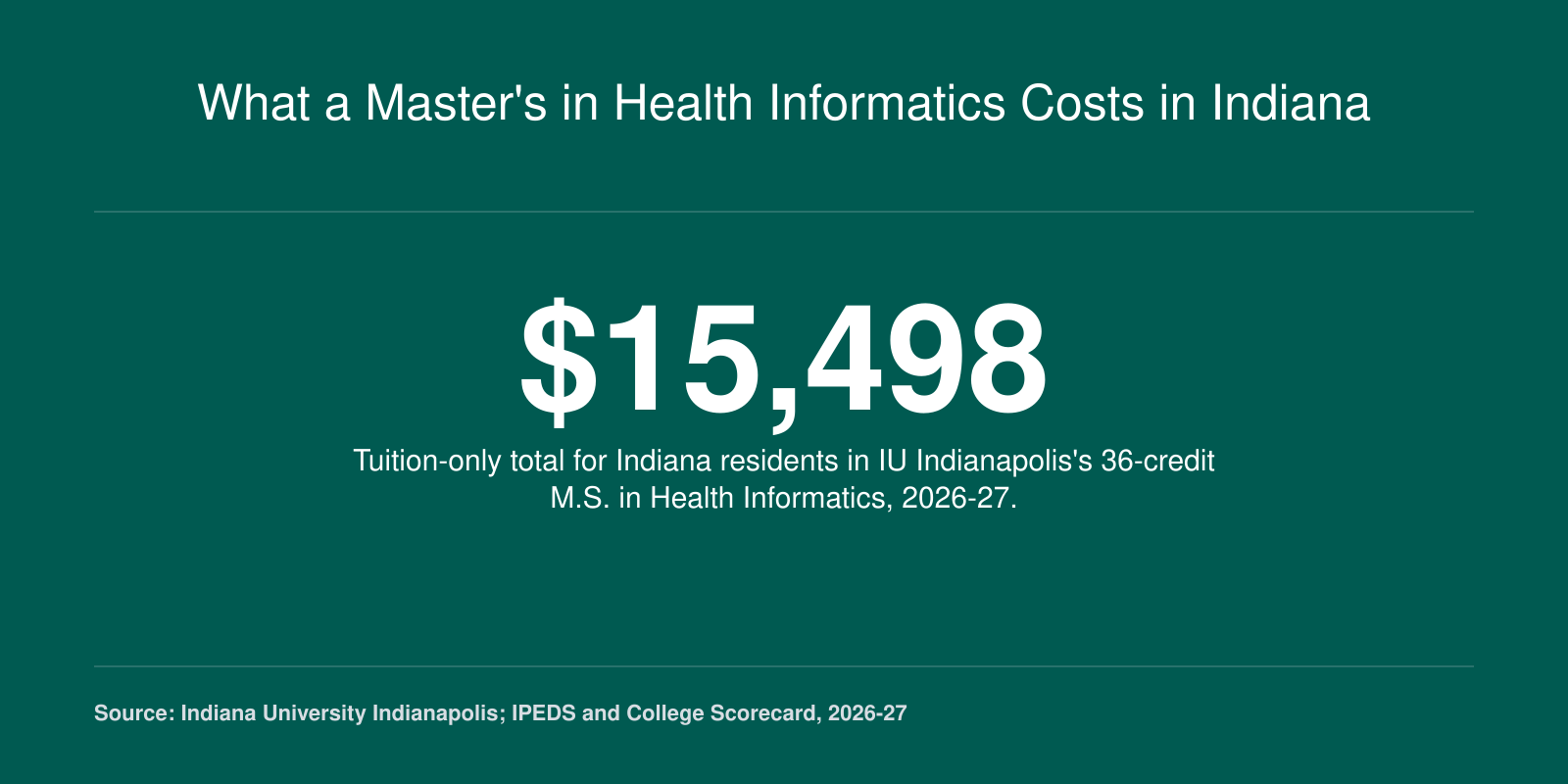
IU Indianapolis publishes the clearest 2026-27 pricing for its 36-credit M.S. in Health Informatics: $430.50 per credit for Indiana residents, $645.75 for Indiana Partners and $1,201.50 out of state. That works out to roughly $15,498, $23,247 and $43,254 in tuition alone, and it is unclear whether program or other fees are added. Annual tuition and fees run $11,180 in-state and $28,964 out-of-state at IU Indianapolis, $11,667 and $21,948 at the University of Southern Indiana, and $10,211 and $11,241 at Purdue University Global, where the 56-credit online program means one year understates the full price. For residents, IU Indianapolis is the cheapest option with a published program total, while only Purdue Global shows a narrow residency gap, and no school here publishes a flat online rate. Net price is an institution-wide average after aid, not specific to this program: $7,770 at Purdue Global, $11,668 at IU Indianapolis and $12,923 at the University of Southern Indiana.
Indiana Licensure and Certification for Health Informatics
Career and Salary Outcomes for Indiana Health Informatics Graduates
Health data work in Indiana now spans clinical care, insurance, public health and drug research, not just hospital IT departments.
What Graduates Earn
Indiana University-Indianapolis offers the clearest program-level picture. One year after finishing, graduates of its Master of Science in Health Informatics earned a median of $82,722; four years after finishing, the median was $103,089. That four-year figure lands close to the Indiana median wage for medical and health services managers, which was $50.07 an hour as of May 2025 (roughly $104,000 a year). Managers usually reach that level only after years of leadership experience. For a degree that costs far less than many private alternatives, that is a strong earnings return within a few years of graduating.
Where Graduates Work
The main employer categories are hospitals, insurance companies, government agencies and health IT software companies. In Indiana, that includes IU Health, Eskenazi Health, Eli Lilly, HealthNet and the Indiana Health Information Exchange. Common job titles fall into two groups:
- Clinical side: clinical analyst, health informatics specialist, nurse informaticist (often via a Nursing Informatics MSN), pharmacy informaticist
- Data side: clinical data analyst, healthcare analyst, data scientist, biostatistician
Informatics vs. Health Administration
The real difference is the kind of job each degree leads to. Informatics trains you to build, manage and analyze clinical data systems. A Master's in Healthcare Management in Indiana prepares you to run operations, budgets and staff. The University of Southern Indiana sits between the two: its Master of Health Administration carries a health informatics concentration, which suits students aiming for management roles that require data fluency. If you want to stay hands-on with systems and analytics, a dedicated informatics master's is the more direct path.
Compare Health Informatics programs on the data that matters
Explore more Healthcare specializations or browse every graduate field.
All Healthcare programs