Best Nursing Informatics MSN Programs
Compare 70+ accredited Health/Nursing Informatics programs at 60+ schools, with graduate earnings, cost, debt, and completion data from IPEDS and the U.S. College Scorecard.

EHR optimization, clinical decision support, and quality-reporting work now depend on nurses who can read a workflow and a database schema in the same shift. Hospitals need clinicians who understand both the bedside and the back end, and that gap is what a nursing informatics MSN is built to close.
We ranked the programs below using net price, completion, and program-level graduate earnings. Graduate tuition across the ranked schools spans widely: in-state figures start around $7,153 at Texas Tech University Health Sciences Center, while private programs like Duke University run near $66,500.
For a working RN, the tension is rarely interest in the field. It is reconciling residency-based tuition gaps, practicum hours, and ANCC certification eligibility with a license to maintain and a schedule that does not pause.
Key Points
- Georgia Southwestern State University has the lowest in-state graduate tuition here at $4,626.
- About 8 in 10 nurse informaticists work remotely, per the 2022 HIMSS survey.
- Residency, attendance format, and RN license rules matter more than school name in 2027.
10 Nursing Informatics MSN Programs for 2027
Nursing informatics master's programs combine clinical nursing knowledge with data systems, analytics, and technology leadership. The 10 programs below stand out for their delivery formats, practicum structures, and certification preparation, with some reporting strong program-level earnings and others offering lower published tuition or net price. Use this list to compare programs that fit working nurses, career changers, and RN-to-MSN pathways.
Duke University
#1Durham, NC · ~$67,000/yr (est.)
Best for: Nurses wanting academic medical center depth
Duke's MSN in Health Informatics pairs online courses with two required campus visits and a 224-hour practicum, and students benefit from a longstanding Duke Health partnership for applied training and system lectures. The curriculum emphasizes database design, clinical data analytics, and systems development for nursing informatics roles. This hybrid offering suits nurses who want the resources and clinical depth of a major academic medical center.
- Hybrid program with online courses and two campus visits
- 224-hour clinical practicum included
- Covers database design and clinical data analytics
- Prepares for nursing informatics specialist roles
- Duke Health partnership provides applied training
- Program director is Debbie Travers
- Median earnings one year after finishing: $124,486
- Median earnings four years after finishing: $163,348
Vanderbilt University
#2Nashville, TN · ~$58,000/yr (est.)
Best for: Working nurses needing part-time online coursework
Vanderbilt's Nursing Informatics MSN is delivered online and part-time across six semesters, allowing full-time employment while completing the 24-month program. Students can tailor practicum experiences and qualify to sit for ANCC certification, with graduates finding roles in health systems, universities, government, nonprofits, and industry. The program is a strong fit for working RNs who need a flexible online path and broad career options.
- Online part-time format across six semesters
- 24-month program length
- Allows full-time employment while studying
- Tailored practicum experiences
- ANCC certification eligible
- Applications open for 2026 and 2027 entry cycles
- Employment settings include health systems, government, nonprofits, industry
Texas Tech University Health Sciences Center
#3Lubbock, TX · ~$7,000/yr (est.)
Best for: Texas RNs needing affordable hybrid pathway
Texas Tech University Health Sciences Center offers the first nursing informatics MSN in Texas, a hybrid program with 39 credit hours. It prepares nurses for ANCC and CPHIMS certification and requires a BSN, RN license, 3.0 GPA, and two years of clinical experience. The curriculum covers data management, analytics, clinical decision support, and project management, making it a practical choice for Texas RNs who want a hybrid public option.
- First nursing informatics MSN in Texas
- Hybrid program format
- 39 semester credit hours
- Prepares for ANCC and CPHIMS certification
- Requires BSN, RN license, 3.0 GPA
- Two years clinical experience required
- Computer literacy test required
- State restrictions may apply for online students
University of Utah
#4Salt Lake City, UT · $9,000 – $28,000/yr (est.)
The University of Utah's online MS in Nursing Informatics can be completed in three semesters through asynchronous coursework, with clinical experiences arranged locally. The program focuses on user-centered system design, data analytics, health information systems, and ethical leadership, and incorporates AI applications. Published program earnings show a median of $82,917 one year after finishing and $137,424 four years after finishing. It is a strong option for nurses who want a fast, fully online pathway with strong early-career earnings.
- Online program format
- Three semesters completion
- Asynchronous coursework available
- Clinical experiences arranged locally
- Focus on patient-centric systems and data analytics
- Incorporates AI applications
- Median earnings one year after finishing: $82,917
- Median earnings four years after finishing: $137,424
University of South Carolina
#5Columbia, SC · ~$14,000/yr (est.)
The University of South Carolina's online MSN in Nursing Informatics requires 36 credits and can be completed full-time in four semesters or part-time in seven, with a 225-hour practicum often done at the workplace. Admission requires a BSN, 3.0 GPA, RN license, and three references, with no GRE. The RN to MSN track offers a bridge path for associate-degree nurses, with 100% online didactic coursework and regional practicum placement. This school is a flexible choice for both BSN-prepared and RN-to-MSN students seeking online education.
- 36 credit hours required
- Full-time in four semesters
- Part-time in seven semesters
- Includes 225-hour practicum
- Prepares for ANCC certification
- BSN, 3.0 GPA, RN license required
- Three professional references
- No GRE required
- Bridge pathway for associate-degree RNs
- Three concentration options
- 4-semester program
- 36 total credit hours
- Rolling admissions
- Full-time and part-time options
- Fall and summer start dates
- 225 clinical hours
University of Maryland, Baltimore
#6Baltimore, MD · ~$18,000/yr (est.)
The University of Maryland, Baltimore offers an online MSN in Nursing Informatics that can be completed in as little as two years, with 500 practicum hours and competency-based education. In-state tuition is $926 per credit hour, out-of-state $1,643, and eligible students in some states may qualify for in-state rates through the Academic Common Market. The program includes free ANCC exam preparation workshops and prepares graduates for nurse informatics specialist roles with potential salaries over $100,000.
- 36 credit hours required
- Online format
- In-state tuition: $926 per credit hour
- Out-of-state tuition: $1,643 per credit hour
- As little as 2 years to complete
- 500 practicum hours required
- BSN, 3.0 GPA, RN license required
- Free ANCC exam preparation workshops
CUNY Graduate School and University Center
#7New York, NY · $10,000 – $24,000/yr (est.)
CUNY Graduate School and University Center's online Master of Science in Nursing Informatics includes a six-credit practicum and is accredited by CCNE. Admission requires a BSN, 3.0 GPA, unencumbered nursing license, and specific undergraduate coursework. The program reports strong completion and job placement rates, with a focus on data management, compliance, and staff education for informatics roles.
- Online program format
- Six-credit practicum included
- Accredited by CCNE
- 3.0 GPA requirement
- Unencumbered nursing license needed
- BSN degree required
- High job placement rates
- Strong completion rates
SUNY Polytechnic Institute
#8Utica, NY · ~$13,000/yr (est.)
SUNY Polytechnic Institute's online Health Informatics master's blends health information science with technology and social science, covering EHR optimization, AI-enabled decision support, and health data analytics. The program accepts applicants with any bachelor's degree, requires an undergraduate statistics prerequisite with a C or better, and can be completed full-time in four semesters or part-time in six.
- 33 total credit hours
- Rolling admissions
- Full-time completion in four semesters
- Part-time completion in six semesters
- New Fall 2026 tracks in clinical, public health, data analytics
- Requires undergraduate statistics with C or better
- Open to any bachelor's degree holder
- 100% job placement rate reported
University of Alabama at Birmingham
#9Birmingham, AL · ~$9,000/yr (est.)
The University of Alabama at Birmingham's Nursing Informatics specialty is a 40-credit hybrid program with part-time, distance-accessible study, synchronous online classes, and on-campus intensives. It prepares advanced practice nurses for roles in health information systems, combining computer science, cognitive science, and nursing expertise. Admission requires a BSN, 3.0 GPA, and unencumbered nursing license.
- 40 credit hour program
- Hybrid distance-accessible format
- Part-time study option
- Synchronous online classes
- On-campus intensives included
- BSN, 3.0 GPA, unencumbered license required
- Prepares advanced practice nurses
- CCNE accredited
The University of Texas at Arlington
#10Arlington, TX · ~$11,000/yr (est.)
The University of Texas at Arlington's online MSN in Health Informatics combines data science, technology, and healthcare management for leadership roles. The curriculum supports certification preparation for Informatics Nursing (RN-BC), CPHIMS, and CAHIMS, and includes a practicum component. This flexible online format suits working professionals aiming for clinical informatics, data governance, or population health management.
- Online program format
- MSN in Health Informatics degree
- Supports RN-BC, CPHIMS, CAHIMS certification preparation
- Includes practicum component
- Taught by industry experts
- Career planning support included
- EHR optimization and data governance focus
- Population health and ethics emphasized
Cost & outcomes by school
Federal data for the highest-earning Health/Nursing Informatics programs, independent of the ranking above. Earnings are this field's master's graduates four years after completing, where the Scorecard reports them.
| School | Earnings | Tuition / yr | Debt | Grads/yr | Format |
|---|---|---|---|---|---|
| University of Utah UT | $137,424 | $8,724 | — | 30 | Online |
| Capella University MN | $100,105 | $15,092 | $33,064 | 208 | Online |
| Columbia Southern University AL | — | $3,936 | — | — | Online |
| Georgia Southwestern State University GA | — | $4,626 | — | — | Online |
| Albany State University GA | — | $5,008 | — | — | Online |
| Northeastern State University OK | — | $5,771 | — | — | Online |
| Aspen University AZ | — | $5,910 | — | — | Online |
| Rasmussen University-Minnesota MN | — | $6,627 | — | — | Online |
| University of South Dakota SD | — | $7,118 | — | — | Online |
| Post University CT | — | $7,955 | — | — | Online |
| Columbus State University GA | — | $8,268 | — | — | Online |
| University of Alabama at Birmingham AL | — | $8,640 | — | — | Hybrid |
Sources: U.S. Department of Education. Tuition and graduates: IPEDS. Earnings and debt: College Scorecard, this field's master's graduates; a dash means no figure is reported.
Cost, debt & payoff
Median earnings of this field's master's graduates (4 yrs after completing) vs. their median federal loan debt · U.S. College Scorecard
Across these programs the median graduate earns about $104,240 and finishes with roughly $41,000 in debt — a ratio that clears a common rule of thumb (keep debt below first-year salary). Tuition and debt vary widely school to school, so check the per-school figures in the table above before you shortlist.
How We Rank the Best Nursing Informatics MSN Schools
A nursing informatics MSN, one of the health informatics master's programs, should leave you with a manageable loan balance and a measurably bigger paycheck, so those are the outcomes we scored.
What Goes Into the Score
We start with degree-aware graduate tuition, meaning the price master's students pay rather than the undergraduate sticker rate. Next come average net price after grants and scholarships and each institution's overall graduation rate. Where College Scorecard publishes program-level earnings and debt, those figures count too. For many informatics programs they are not yet available, so the picture is sometimes thinner than we'd like.
Caveats Worth Knowing
Graduation rates and net price are institution-wide figures, not informatics program outcomes, so treat them as context rather than a promise. Net price is also an average across students who received aid, not a personal quote. Your own cost depends on residency, transfer credits, employer tuition benefits, and how quickly you finish. Confirm the numbers with the school's financial aid office before you commit.
Format Is Listed for Every School
Each entry notes whether the program is online, on campus, or a hybrid of both. We include every delivery format so working nurses and campus learners can compare side by side on the same measures.
Nursing Informatics MSN Program Cost and Return on Investment
The real question isn't just what a program charges, but what you'll owe when you graduate and what you can earn to pay it back. Sticker price and actual cost rarely match, and the gap matters more here than almost anywhere else.
What the Degree Actually Costs
Published graduate tuition across the schools ranked here spans a wide band. Public programs such as Western Governors University and Thomas Edison State University sit near $8,600 to $12,150 a year, while CUNY City College charges roughly $7,340 in-state against $15,290 out-of-state. At the high end, Duke and Vanderbilt list annual tuition near $67,000 to $68,000. For public schools, the in-state versus out-of-state spread is the single biggest swing in nursing informatics MSN program cost, so residency and online in-state eligibility are worth confirming before you apply.
Net Price vs. Published Tuition
Average net price, the aid-adjusted amount students pay, usually runs below sticker tuition. At private schools the gap is dramatic: Duke's net price averages near $29,600 against nearly $69,000 published. One caution: net price averages across the entire institution and all degree levels, not this MSN specifically. Treat it as a directional signal, not a quote.
Debt, Payments, and Earnings
Program-level borrowing, the typical 10-year monthly payment, and program-specific msn nursing informatics salary figures are the numbers that would let you judge ROI directly. For the nursing informatics programs here, those program-level earnings and median debt are not yet published in the federal outcomes data, so a clean earnings-to-debt comparison between individual schools isn't available.
What you can lean on: the lower-cost public and competency-based options (WGU, Thomas Edison, CUNY in-state) keep likely borrowing modest, which strengthens their return no matter where informatics salaries land for your role and region.
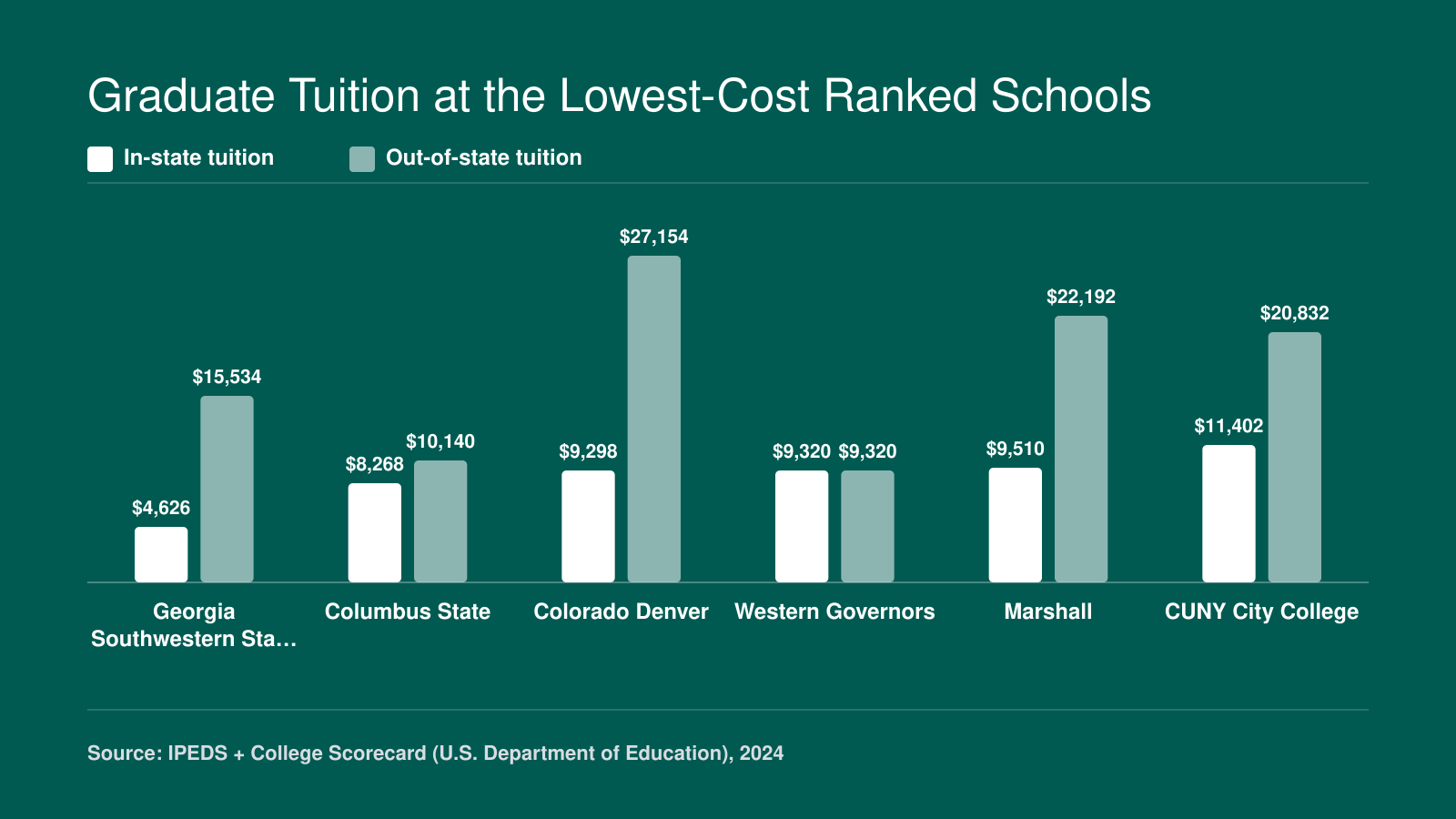
Graduate Tuition at the Lowest-Cost Ranked Schools
If you are searching for the cheapest online nursing informatics programs, residency can matter more than the school's name. Georgia Southwestern State University has the lowest in-state rate at $4,626, but out-of-state students pay $15,534. At the University of Colorado Denver, the out-of-state rate of $27,154 is nearly three times the in-state $9,298, even though the program is online. Western Governors University charges one flat rate of $9,320 for everyone, and Columbus State University shows only a small gap ($8,268 vs. $10,140). Confirm the exact rate for your state with each school before you budget.
Related Articles
Online, Hybrid or Campus: Attendance Rules That Matter to Working Nurses
For working nurses, including those in online nurse practitioner programs, the real scheduling question is not whether a program says it is online, but whether courses follow your clock or a professor's. Synchronous online classes meet live at set times, while asynchronous courses let you complete readings, discussions, and assignments on your own schedule. That distinction matters as much as the practicum.
Synchronous vs. asynchronous
Rutgers delivers its MSN coursework fully online and asynchronously, though students still complete 500 clinical hours and need an active, unencumbered U.S. RN license. Utah also offers asynchronous coursework, with clinical experiences arranged near the student. UAB uses the opposite model: synchronous online classes plus on-campus intensives.
Campus and clinical requirements
Most nursing informatics MSN programs still require in-person clinical or practicum hours. Maryland's program is online except the 500-hour practicum, which students arrange at a mutually agreeable location. Chamberlain is 100% online plus practicum; Herzing's practicum load differs by pathway (135 hours for the main MSN, 180 for the accelerated RN to MSN). Duke requires clinical hours and two campus intensives, adding travel and schedule burden. WGU arranges field experiences near the student and requires an active, unencumbered RN license in the state of residence or employment.
State authorization
Online enrollment is not available everywhere. Some programs cannot enroll residents of certain states because of state authorization rules. Rutgers participates in SARA, covering 49 states, D.C., Puerto Rico, and the U.S. Virgin Islands, but notes that enrollment still depends on state of residence, faculty licensure, and Board of Nursing approval. Check each school's state authorization page before applying, especially if you hold a compact license or plan to move during the program.
About 8 in 10 nurse informaticists work remotely, according to the 2022 HIMSS Nursing Informatics Workforce Survey. The same survey found that 63% hold a master's degree. For nurses weighing an MSN, that suggests the credential is common in this field and that location flexibility is a realistic expectation.
What You Need to Apply: RN License, GPA and Prerequisites
Requirements differ by school, so confirm each program's current rules before you start an application. These are the patterns across the schools ranked here.
- Active RN licenseEvery program here that reports a license rule requires a current, unencumbered RN license. Which state counts varies: some schools want your practicum state, some your state of residence, and Tampa specifies Florida.
- Nursing degreeA BSN is the standard entry point, as at Rutgers and UAB. Some schools take ADN or diploma nurses through a bridge: South Carolina accepts ADN or BSN holders, Methodist requires at least 54 undergraduate credits plus an 18-credit bridge, and WGU's RN-to-MSN path accepts up to 80 transfer credits.
- GPA3.0 is typical at UAB, Duke and Tampa. Rutgers prefers 3.2 or higher rather than setting it as a hard minimum. Some schools measure your last 60 credits instead of your overall GPA, and a lower GPA may trigger extra requirements.
- Statistics prerequisiteAn undergraduate statistics course is common. UAB requires Descriptive Statistics (MA-180), and Tampa asks for statistics, nursing research and nursing leadership. Recency limits of roughly 5 to 10 years are common but not universal, so ask whether an older course will count.
- GRE and experienceRutgers and Methodist do not require the GRE. UAB asks for a GRE (minimum 297) or GMAT (minimum 480) only when GPA is below 3.2, and Tampa makes it optional. Tampa expects one year of RN experience; WGU requires none.
- Transfer creditLimits vary widely. Tampa accepts up to 9 graduate credits and excludes courses older than 7 years. Competency-based RN-to-MSN routes such as WGU's allow far larger undergraduate transfers. Ask each school about references and the statement of purpose, since those requirements differ.
The American Nurses Association recognized nursing informatics as a specialty in 1993, though some sources say 1992. That recognition set the foundation for ANA's Nursing Informatics: Scope and Standards of Practice, now in its 3rd edition (2022), which defines the role and expectations for informatics nurses today.
Health/Nursing Informatics programs by state
Nursing Informatics MSN Questions, Answered
How many months does a nursing informatics MSN usually take?
Does a nursing informatics MSN pay off compared with staying in a staff RN role?
How is nursing informatics different from health informatics?
Compare Health/Nursing Informatics programs on the data that matters
Explore more Nursing specializations or browse every graduate field.
All Nursing programs