Best Nursing Informatics MSN Programs in Texas
Compare 5 accredited Health/Nursing Informatics programs in Texas at 4 schools, with graduate earnings, cost, debt, and completion data from IPEDS and the U.S. College Scorecard.

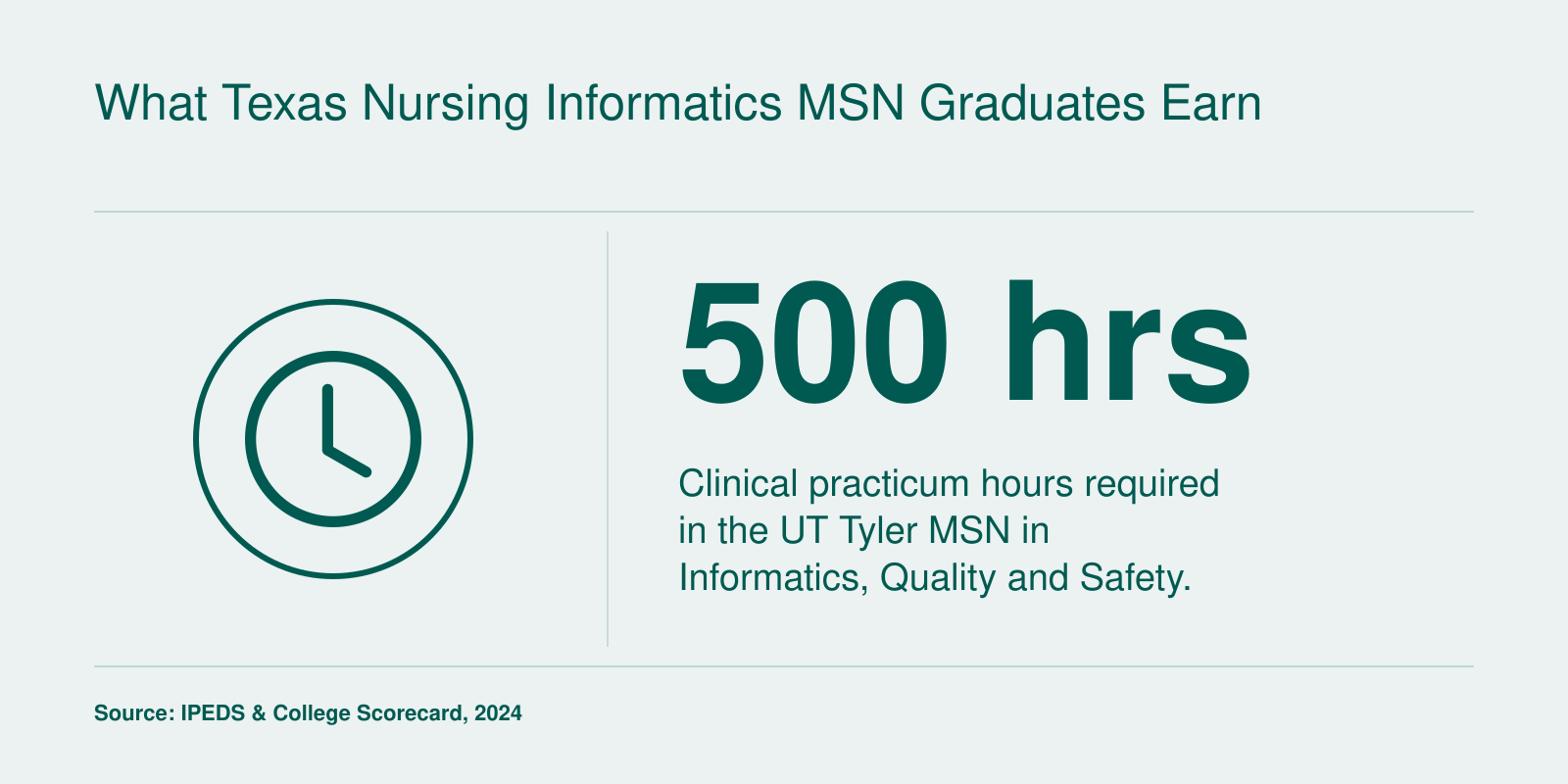
A Texas RN moving into EHR optimization, clinical systems analysis, or health data work faces a practical fork: some informatics MSN programs require a BSN, an active RN license, and two years of clinical experience before you apply, and others add a 500-hour practicum. UT Tyler, for instance, requires 500 clinical hours and preps graduates for the ANCC Informatics Nursing board exam.
The programs below, campus and online alike, are drawn from Texas schools in our data. Tuition and delivery vary widely, and informatics remains a non-APRN specialty, so the MSN sharpens a skill set rather than adding a license.
Key Points
- Texas Tech Health Sciences Center ranks first with hybrid and fully online CCNE-accredited tracks.
- UT Austin states plainly that its admissions materials do not require the GRE.
- An MSN adds no license: graduates practice on an active Texas RN license.
Best Nursing Informatics MSN Programs in Texas, Ranked
Texas Tech University Health Sciences Center takes the #1 spot because it pairs a CCNE-accredited nursing informatics MSN with both a hybrid and a fully online track, and it was the state's first program of its kind. The four programs behind it cover a wider range of formats, from an MS in health informatics that does not require an RN license to a fully online RN-to-MSN track. Graduation rates below are institution-wide, and net price is an approximate average after aid, not a quote.
Texas Tech University Health Sciences Center
#1Lubbock, TX · ~$7,000/yr (est.)
Best for: Working RNs wanting hybrid flexibility
Texas Tech University Health Sciences Center in Lubbock runs the state's first nursing informatics MSN, and the program is CCNE accredited. It offers a hybrid track and a separate fully online track in Nursing Informatics and Intelligent Systems, with practicum work in the online track completed virtually. Coursework covers data analytics, clinical decision support, EHR evaluation, and project management, and graduates are prepared for ANCC certification. An institution-wide graduation rate and average net price are not reported for this health sciences center. Out-of-state applicants should confirm with admissions that their state is currently eligible.
- Hybrid format, CCNE accredited
- Prepares for ANCC and CPHIMS certification exams
- Requires BSN, RN license, 3.0 GPA, two years of clinical experience
- Computer literacy test and three references required
- Covers EHR evaluation, public health informatics, systems development lifecycle
- Post-master's certificate option available
- Credit total has changed across versions, so confirm it with admissions
- Fully online option, coursework completed from any state
- Starts each spring, one start date per year
- Faculty-guided practicum builds an ePortfolio in a virtual environment
- Class size of about 15 students
- Prepares for ANCC board certification
- 3.0 GPA, three recommendation letters, and work experience required
- BSN must come from a CCNE or ACEN accredited program
- Military benefits accepted
University of North Texas
#2Denton, TX · $9,000 – $16,000/yr (est.)
Best for: Analytics-focused clinicians wanting stackable certificates
The University of North Texas in Denton offers an MS in Health Informatics rather than an MSN, so it suits clinicians and health data professionals who want roles beyond bedside nursing. The 36-credit degree can be taken face-to-face, hybrid, or completely online. Guided electives cover health data analytics, population health informatics, and artificial intelligence in healthcare. The university graduates about 61% of students overall, and its average net price after aid is roughly $15,600.
- 36 credit hours across 12 courses
- At least 21 credit hours in HINF courses
- Face-to-face, online, and hybrid formats; fully online option
- Guided electives include legal and ethical issues and AI in healthcare
- Stack a Health Data Science or Health Information Archives certificate
- Capstone required
- Fall 2026 and later starters follow a revised curriculum
The University of Texas at Tyler
#3Tyler, TX · ~$8,000/yr (est.)
Best for: Nurses focused on quality and patient safety
The University of Texas at Tyler delivers its Informatics, Quality and Safety MSN fully online with rolling admissions, which suits nurses who need to start on their own timeline. The program lists CCNE accreditation and prepares students for the ANCC Informatics Nursing exam. It stands out for pairing informatics with quality improvement and patient safety. The university graduates about 54% of students overall, and its average net price after aid is roughly $13,300.
- 36 credits: 12 core, 18 specialization, 9 elective
- 500 practice hours required
- Prepares for the ANCC Informatics Nursing exam
- Requires BSN, current RN license, statistics course, 3.0 GPA
- Rolling admissions with year-round starts
- Transfer up to nine credits
- $50 application fee for domestic students
The University of Texas at Arlington
#4Arlington, TX · ~$11,000/yr (est.)
The University of Texas at Arlington offers an online MSN in Health Informatics through its College of Nursing and Health Innovation. The program emphasizes EHR documentation, data governance, and population health, and it includes a practicum. It supports preparation for Informatics Nursing (RN-BC), CPHIMS, and CAHIMS certification. The university graduates about 54% of students overall, and its average net price after aid is roughly $14,000.
- Online format, ACEN accredited
- Practicum component included
- Supports RN-BC, CPHIMS, and CAHIMS certification prep
- Focus on EHR optimization and clinical decision support
- Data governance and population health emphasis
- Career planning support and academic advising
Lamar University
#5Beaumont, TX · ~$9,000/yr (est.)
Lamar University in Beaumont offers an online RN-to-MSN with a Health Informatics and Information Systems concentration, built for working nurses moving into leadership. It includes a dedicated health information systems course and covers interoperability, data standards, privacy, and emerging tools like telehealth and AI. It has the lowest average net price in this list at roughly $9,400, though the university graduates about 37% of students overall, the lowest rate here.
- Fully online, ACEN accredited
- Starts each fall
- Covers EHRs, data standards, and interoperability
- Dedicated Health Information Systems course
- Privacy, security, and ethics in health IT
- $25 application fee
Cost & outcomes by school
Federal data for the highest-earning Health/Nursing Informatics programs, independent of the ranking above. Earnings are this field's master's graduates four years after completing, where the Scorecard reports them.
| School | Earnings | Tuition / yr | Debt | Grads/yr | Format |
|---|---|---|---|---|---|
| Lamar University TX | — | $8,642 | — | — | Online |
| The University of Texas at Tyler TX | — | $8,480 | — | 27 | Online |
| Texas Tech University Health Sciences Center TX | — | $7,153 | — | 13 | Hybrid |
| The University of Texas at Arlington TX | — | $11,249 | — | — | Online |
Sources: U.S. Department of Education. Tuition and graduates: IPEDS. Earnings and debt: College Scorecard, this field's master's graduates; a dash means no figure is reported.
How We Ranked Texas Nursing Informatics Master's Programs
Prestige and price rarely line up, so these rankings lean on federal data rather than reputation. We drew on IPEDS and College Scorecard figures: graduate tuition, average net price, graduation rate, and program-level earnings and debt wherever those are published.
One caveat matters. Graduation rate and net price describe the whole institution, not the informatics program alone. Earnings and debt come from the program level when the federal government reports them; where those figures are unavailable, the rankings say so instead of estimating.
Only Texas schools offering a nursing informatics MSN, a nursing informatics concentration, or a health informatics master's were eligible. Campus, hybrid, and online programs were ranked together, so format did not earn or cost any school a position.
Tuition and deadlines change, so confirm current figures directly with each school before you apply.
Online and Hybrid Nursing Informatics MSN Options in Texas
Which Texas nursing informatics MSN programs can be completed online, and which require campus attendance? Texas Tech University Health Sciences Center and The University of Texas at Tyler take different delivery approaches among online master's programs in Texas.
Texas Tech's MSN in Nursing Informatics is hybrid, combining on-campus classes and simulated clinical experiences with web-based technologies. The catalog lists face-to-face, online, hybrid, and interactive video conferencing formats but does not specify how often campus visits occur or which activities are synchronous versus asynchronous. The program cannot accept online students from Arizona, Arkansas, California, Colorado, the District of Columbia, Louisiana, New York, North Carolina, Oregon, Pennsylvania, South Dakota, or Washington.
UT Tyler's MSN in Informatics, Quality and Safety is 100% online, with part-time and full-time pacing. UT Tyler lists no required on-campus visits or synchronous/asynchronous breakdown, and it publishes no state authorization restrictions for out-of-state online students.
Neither campus is in Houston. Texas Tech is in Lubbock, and UT Tyler is in Tyler, so Houston-area nurses should confirm clinical placement logistics or plan for travel to Lubbock if choosing the hybrid option.
Tuition can differ sharply among the Texas nursing informatics master's programs ranked here, and the pricier name is not always the better value when graduate earnings and debt are part of the math.
Which Texas Nursing Informatics Master's Programs Waive the GRE?
The GRE is a general graduate entrance exam, and for informatics applicants in Texas it is largely a non-issue. UT Austin is the one Texas program in this comparison whose admissions materials state plainly that it does not require the GRE. TTUHSC and UT Tyler publish no GRE requirement, optional policy, or waiver at all, which is not the same as a confirmed waiver. Ask the graduate nursing office directly before you assume.
- TTUHSC: BSN, valid unencumbered RN license, 3.0 GPA, undergraduate research and statistics passed with a C or better, and at least two years of clinical experience. The fall cycle opens November 1 and closes February 15.
- UT Tyler: Accredited BSN, 3.0 across the last 60 undergraduate credits, statistics with a C or better, and RN licensure in the state where practicum hours occur. Rolling admission with multiple start terms.
- UT Austin: BSN or an ADN plus a non-nursing bachelor's, 3.0 upper-division GPA, Texas or compact RN licensure on admission, no stated experience minimum. Deadline November 1.
Related Articles
Cost, Financial Aid, and Texas Licensure for Informatics Nurses
The MSN does not create a new license: graduates practice on an active Texas RN license from the Texas Board of Nursing, and informatics is a non-APRN specialty. APRN approval is a separate authorization that requires a current RN license first. The Board does not name informatics specifically, but program materials list only an active RN license. Texas Tech University Health Sciences Center publishes 2026-27 rates of $288.29 per credit for residents and $716.29 for nonresidents across 36 credits, which works out to roughly $10,400 and $25,800 in tuition before fees. Its separate distance-learning rate of $589 per credit for out-of-state students is not reconciled with the nonresident figure, so confirm which applies to you. Mandatory fees add materially (about $25 per credit for information technology alone), and several schools here do not publish a full program total. Employer tuition reimbursement and general graduate aid can offset these costs, so ask your hospital's education benefits office and each school's financial aid office. The table below uses federal program-level tuition and net price figures.
| School | Format | Graduate In-State Tuition | Graduate Out-of-State Tuition | Average Net Price |
|---|---|---|---|---|
| Lamar University | Online | $8,642 | $16,022 | $9,366 |
| The University of Texas at Tyler | Online | $8,480 | $17,264 | $13,323 |
| The University of Texas at Arlington | Online | $11,249 | $26,073 | $13,951 |
| University of North Texas | Hybrid | $9,091 | $16,471 | $15,649 |
What Texas Nursing Informatics MSN Graduates Earn
College Scorecard has not published program-level median earnings for any of the nursing informatics master's programs ranked here, so we have no earnings chart. We will not substitute institution-wide earnings, because those blend every field at a school and would mislead you. Public materials do document the roles graduates move into, including clinical informatics specialist, nurse informaticist, and EHR analyst. They do not establish named employer partnerships or placement rates for these programs. The clearest concrete signal is the hands-on practicum that builds employer-facing experience.
Practicum Hours, Placements, and ANCC Certification Prep
The real tradeoff in a practicum is between a program that hands you a placement and one that expects you to find your own, and the published details are thin on both counts.
Practicum and Accreditation
UT Tyler's MSN lists 500 clinical hours and CCNE accreditation. Texas Tech Health Sciences Center also lists CCNE accreditation. Its practicum is a 4-credit course in a 1:9 format delivered virtually with faculty guidance, but total hours are not stated. UT Arlington notes a practicum component without a published hour count. Lamar does not publish hours in the material reviewed. UNT's health informatics degree is not a nursing program and ends in a capstone. None of these pages clearly says whether the school secures preceptors or the student does, so ask each admissions office directly. Confirm CCNE or ACEN status for UT Arlington and Lamar the same way.
ANCC Informatics Certification
The RN-BC credential requires an active RN license, a bachelor's degree or higher in nursing, two years of full-time RN practice, and 30 informatics continuing education hours within three years.1 You also need one pathway: 2,000 informatics practice hours; 1,000 hours plus 12 graduate informatics semester hours; or a graduate informatics program with at least 200 faculty-supervised practicum hours.1
Before applying, ask each school for its placement support and whether its practicum meets that 200-hour threshold.
Compare Health/Nursing Informatics programs on the data that matters
Explore more Nursing specializations or browse every graduate field.
All Nursing programs