Best Public Health Nursing MSN Programs
Compare 100+ accredited Public Health programs at 60+ schools, with graduate earnings, cost, debt, and completion data from IPEDS and the U.S. College Scorecard.

An active RN who wants to move from bedside care to community health, epidemiology, and health policy usually needs an RN to MSN program, not just enthusiasm. The public health nursing MSN programs below are ranked on federal graduate earnings, net price, and debt outcomes rather than name recognition. Net price ranges from about $3,000 at CUNY Hunter College to nearly $39,000 at Drexel University, a gap that can decide whether the degree pays for itself.
Per-credit cost, online or campus delivery, clinical hours near home, CCNE accreditation, time to degree, and early-career salaries all affect that return. A local practicum and a flexible format often matter more than the university's name, because they determine whether a working RN can finish at all.
Key Points
- An active RN license is required for the MSN, while an MPH needs none.
- Most BSN-prepared nurses finish in roughly 2 to 3 years full-time.
- Practicums often run in the low hundreds of hours, well below NP tracks.
Best Public Health Nursing MSN Programs for 2027: The Top 10
These 10 public health nursing MSN programs stood out in 2026 for their mix of flexible delivery, clinical preparation, and published graduate outcomes. The list below is ordered by our ranking model, with the strongest overall balance at the top.
Yale University
#1New Haven, CT · ~$50,000/yr (est.)
Best for: Nurses pursuing joint MSN/MPH policy roles
Yale University pairs advanced nursing practice with public health training through its joint MSN/MPH program. Students can specialize in Chronic Disease Epidemiology, Health Policy, or Social and Behavioral Sciences and complete an applied practice experience. The joint degree typically takes three to four years, and recent graduates reported median earnings of $72,627 one year after finishing.
- Joint MSN and MPH degree
- Three to four year program
- Campus-based learning
- Specializations in Chronic Disease Epidemiology, Health Policy, or Social and Behavioral Sciences
- Applied practice experience required
- Open to GEPN and RN students
- Tuition paid to the school where enrolled each term
- CCNE and CEPH accredited
University of Massachusetts-Amherst
#2Amherst, MA · $15,000 – $20,000/yr (est.)
Best for: Working RNs needing fully online study
UMass Amherst's public health nursing MSN is delivered fully online through the Elaine Marieb College of Nursing. The curriculum emphasizes community health, population health needs, and health equity, with leadership preparation for roles in public health departments, home care, and community organizations. Admission requires a BSN and current RN licensure, and the fall deadline is December 15 with rolling admissions after. Recent graduates reported median earnings of $61,185 one year after finishing.
- Fully online delivery
- Public Health Nursing concentration
- Prepares for leadership in community health organizations, public health departments, and home care
- Fall admission deadline December 15
- Rolling admissions available
- Requires BSN and current RN licensure
- Competitive tuition rates and financial aid available
- CCNE and CEPH accredited
University of Maryland, Baltimore
#3Baltimore, MD · ~$18,000/yr (est.)
Best for: Maryland nurses wanting lower in-state tuition
The University of Maryland, Baltimore offers a hybrid MSN in Community/Public Health Nursing that blends online coursework with face-to-face learning. The program requires 38 credits and 315 practicum hours, with full-time completion in as little as two years. In-state students pay $926 per credit hour and out-of-state students pay $1,643, with recent graduates reporting median earnings of $60,071 one year after finishing.
- Hybrid format blending online and face-to-face learning
- 38 credits and 315 practicum hours
- Full-time completion in as little as two years
- In-state tuition $926 per credit; out-of-state $1,643 per credit
- Admission requires BSN, 3.0 GPA, and current RN license
- Optional dual MSN/MPH degree available
- Graduate certificates available
- CEPH accredited
CUNY Hunter College
#4New York, NY · ~$11,000/yr (est.)
Hunter College offers both a standalone Community/Public Health Nursing MS and dual MS/MPH options with concentrations in Community Health Education or Environmental and Occupational Health. The 42-credit MS includes 501 clinical hours, with online didactic courses and in-person practicums. The dual degrees require 57 credits and can be completed full-time in five semesters, with late afternoon and evening courses.
- 42 credits total
- 501 clinical hours
- Online didactic courses with in-person practicums
- Core nursing and public health courses
- CEPH accredited
- 57 credits dual MSN/MPH degree
- Community Health Education concentration
- Full-time in five semesters
- Late afternoon and evening courses
- Requires BSN with 3.0 GPA
- New York State nursing license required
- CCNE accredited
- 57 credits dual degree
- Environmental and Occupational Health concentration
- Full-time in five semesters
- Late afternoon and evening courses
- CCNE accredited
- Prepares for Advanced Public Health Nurse certification
Drexel University
#5Philadelphia, PA · ~$39,000/yr (est.)
Drexel University's online MSN in Public Health Nursing blends nursing education with public health coursework from the College of Nursing and Health Professions and the Dornsife School of Public Health. The 45-credit program is fully online and includes a capstone project, with two to four years typical completion. For 2026-27, Drexel is not accepting applications; check back in summer 2027. Recent graduates reported median earnings of $61,046 one year after finishing.
- 45 quarter credits
- 100% online format
- CCNE and CEPH accredited
- Two to four years completion
- Three-year tuition lock
- Capstone project required
- Requires BSN with 3.0 GPA and unrestricted RN license
- Not accepting applications for 2026-27; check back summer 2027
University of Tulsa
#6Tulsa, OK · ~$28,000/yr (est.)
The University of Tulsa offers an online MSN with a Public Health Global Vision concentration. The 30-credit program includes core courses in advanced nursing theory, research, pharmacology, and health promotion, plus a capstone. Admission requires a BSN and an unencumbered RN license, with a recommended 3.0 GPA, and rolling admission supports working professionals.
- Online program format
- Public Health Global Vision concentration
- 30 credit hours
- 18 core course hours, 9 specialization track hours, 3 capstone hours
- Requires BSN and unencumbered RN license
- Recommended 3.0 GPA
- Rolling admission
- ACEN accredited
California State University-San Bernardino
#7San Bernardino, CA · ~$10,000/yr (est.)
Cal State San Bernardino's MSN with an Advanced Community/Public Health Nursing concentration uses a hybrid format, combining online coursework with limited in-person sessions. Full-time students typically finish in two to two-and-a-half years, and clinical practicums are arranged near students' residences when possible. Recent graduates reported median earnings of $51,772 one year after finishing.
- Hybrid online with limited in-person sessions
- Advanced Community/Public Health Nursing concentration
- Full-time completion in 2 to 2.5 years
- Part-time progression available
- Clinical practicums arranged near students' residences
- Requires BSN and current RN licensure
- CCNE accredited
- Population health assessment and program evaluation focus
University of North Carolina at Charlotte
#8Charlotte, NC · $5,000 – $10,000/yr (est.)
UNC Charlotte's online MSN in Community/Public Health Nursing prepares nurses for leadership in public health departments, community organizations, and school systems. The 38-credit program offers spring, summer, and fall admission, with tuition starting at $309.59 per credit for North Carolina residents. The curriculum includes 360 clinical hours, and recent graduates reported median earnings of $57,197 one year after finishing.
- 38 credit hours
- 100% online delivery
- Spring, summer, and fall admission
- NC resident tuition $309.59 per credit; nonresident $1,186.59 per credit
- Requires RN licensure, bachelor's degree, and 3.0 GPA
- Statistics course prerequisite
- 360 clinical hours required
- CCNE accredited
University of Kansas
#9Lawrence, KS · $12,000 – $27,000/yr (est.)
The University of Kansas offers a hybrid Master of Science in Nursing with a Public Health Nursing specialty. The minimum 39-credit program emphasizes leadership, research, epidemiology, and environmental health, with application deadlines of April 1 for fall and September 1 for spring. Admission requires a BSN, current RN licensure, and a 3.0 GPA, and recent graduates reported median earnings of $62,420 one year after finishing.
- Minimum 39 credit hours
- Hybrid online and campus learning
- Public Health Nursing specialty
- Requires BSN, current RN license, and 3.0 GPA
- One year clinical experience recommended
- Graduate-level statistics prerequisite
- Application deadlines April 1 for fall, September 1 for spring
- Core courses in leadership, research, epidemiology, and environmental health
Atlantis University
#10Miami, FL · ~$14,000/yr (est.)
Atlantis University's MSN with a Public Health Nursing concentration uses a hybrid online and campus format. The 36-credit program can be completed in about 1.2 years and emphasizes evidence-based, culturally appropriate services for high-risk populations. Scholarships are available, and admission requires a nursing background and relevant experience.
- Hybrid online and campus format
- 36 total credits required
- About 1.2 years to complete
- Public Health Nursing concentration
- Scholarships available
- Requires nursing background and relevant experience
- Capstone project completion
Cost & outcomes by school
Federal data for the highest-earning Public Health programs, independent of the ranking above. Earnings are this field's master's graduates four years after completing, where the Scorecard reports them.
| School | Earnings | Tuition / yr | Debt | Grads/yr | Format |
|---|---|---|---|---|---|
| California State University-Fullerton CA | $182,816 | $8,994 | $41,000 | 20 | Campus |
| San Diego State University CA | $165,564 | $10,252 | — | 31 | Campus |
| California State University-San Marcos CA | $148,800 | $9,606 | $60,000 | 31 | Hybrid |
| California State University-Fresno CA | $147,082 | $8,865 | — | 7 | Online |
| CUNY Hunter College NY | $142,731 | $11,398 | $20,500 | 143 | Campus |
| Rhode Island College RI | $138,536 | $10,112 | $41,000 | 25 | Hybrid |
| Wayne State University MI | $137,480 | $17,960 | $50,500 | 51 | Campus |
| University of Kansas KS | $136,168 | $11,971 | — | 13 | Hybrid |
| The University of Tennessee-Chattanooga TN | $131,034 | $11,110 | $61,063 | 24 | Campus |
| Commonwealth University of Pennsylvania PA | $129,202 | $12,140 | $50,714 | 22 | Online |
| Florida International University FL | $125,543 | $11,334 | $42,812 | 94 | Hybrid |
| University of North Carolina at Charlotte NC | $125,281 | $8,037 | $41,000 | 48 | Online |
Sources: U.S. Department of Education. Tuition and graduates: IPEDS. Earnings and debt: College Scorecard, this field's master's graduates; a dash means no figure is reported.
Cost, debt & payoff
Median earnings of this field's master's graduates (4 yrs after completing) vs. their median federal loan debt · U.S. College Scorecard
Across these programs the median graduate earns about $121,198 and finishes with roughly $40,934 in debt — a ratio that clears a common rule of thumb (keep debt below first-year salary). Tuition and debt vary widely school to school, so check the per-school figures in the table above before you shortlist.
What Moves a School up This List
What actually separates the program sitting at the top of the best MSN programs list from one three spots down? Not the sticker price on a tuition page, and not the name recognition of the university attached to it. A nurse weighing public health MSN programs against the best MPH programs needs to know what she will pay after aid and what graduates earn once they are working, so the order here leans on figures schools are required to report to the federal government rather than on reputation.
The numbers behind the order
- Cost: Published graduate tuition and fees, plus the average net price students actually pay at the institution after grants and scholarships are applied.
- Earnings and debt: Where the federal government has published figures for a specific master's program, median earnings and typical borrowing for its graduates carry real weight.
- Completion: The institution's graduation rate, which signals whether students who enroll tend to finish.
- Format: Whether the degree runs online, hybrid, or on campus, since that determines who can realistically enroll.
What these numbers cannot tell you
Graduation rate and net price describe the entire institution, not the nursing school inside it. A university with a modest overall completion rate may still run a tightly supported MSN cohort. Earnings figures are also missing for some smaller public health nursing programs, which means a good program can look thin on paper simply because too few graduates were counted.
No school pays for a position here. Advertising, sponsorship, and paid placement play no part in the order.
Public Health Nursing MSN, Community Health MSN, or MPH?
An active RN license is the entry ticket for a public health nursing MSN, while an MPH asks for no nursing license at all. That difference shapes almost everything else about the three credentials.
The Three Credentials Compared
- Public Health Nursing MSN: Requires RN licensure. The focus is advanced public-health nursing, including community-health leadership, care coordination, MSN Nurse Educator skills, and supervision. Expect a supervised practicum, with hours set by each program. Best fit: nurses aiming at health department, school, or community nursing leadership.
- Community Health MSN: Usually requires RN licensure too. The name is not standardized and may describe a concentration, a track, or a population-health program. It centers on care for groups and neighborhoods, with practicum requirements that vary by school. Best fit: nurses working in clinics, outreach, and community partnerships.
- MPH: Open to nurses and non-nurses. The core is epidemiology, biostatistics, health policy, program management, and administration, with an applied practice experience in most programs. It carries no Nurse Practitioner-level advanced nursing practice content. Best fit: program management, policy, epidemiology, and agency administration.
Where They Overlap
Public health and community health nursing MSNs often share much of their curriculum, so compare course lists and practicum details rather than relying on the title. No national dataset separates earnings or hiring outcomes by these degrees, and the 5% projected growth for registered nurses is an occupation-level figure, not a degree-level one. Licensure, certification, and prior clinical experience still decide eligibility for many roles. A joint MSN/MPH exists for people who want both skill sets, though its pay advantage is not documented.
Rule of thumb: choose the MSN if you want to keep climbing the nursing ladder toward MSN Nurse Executive Leadership, and the MPH if you want to move into broader public health administration.
Public Health Nursing MSN Program Cost: Tuition, Per-Credit Rates, and Net Price
Sticker price is only part of the picture. Hunter College, Cal State San Bernardino, and Purdue Global are the most affordable options in this cost comparison when looking at net price after aid. Those net price figures are institution-wide averages, not personal quotes, so use them to compare affordability rather than plan your exact bill. For a fuller estimate, look at per-credit rates and required credits. At the University of Maryland, Baltimore, the Community/Public Health Nursing MSN requires 38 credits. In-state students pay $926 per credit plus a $75 campus center infrastructure fee and $10 technology fee per credit, about $38,418 before books and living costs ((926 + 75 + 10) × 38). Out-of-state students pay $1,643 per credit plus the same fees, about $65,664 before other expenses ((1,643 + 75 + 10) × 38). The published UMB totals are $45,151.25 in state and $73,461.25 out of state. Fees that often sit outside the per-credit listing, such as clinical, technology, and graduation fees, can add thousands. Many online programs use one flat per-credit rate regardless of residency. Before borrowing, ask your employer about tuition reimbursement and check HRSA nurse workforce programs for loan repayment and scholarship options.
| School | In-state tuition | Out-of-state tuition | Net price after aid |
|---|---|---|---|
| CUNY Hunter College | $11,398 | $20,828 | $2,984 |
| California State University, San Bernardino | $9,612 | $19,692 | $4,564 |
| Purdue University Global | $10,211 | $11,241 | $7,770 |
Related Articles
Online, Hybrid, or Campus: Matching the Format to Your Schedule
Wayne State's MSN in Advanced Public Health Nursing runs entirely through live online classes, while American Public University's community and public health MSN runs asynchronously, with deadlines but no set meeting times. Both are called "online." They demand completely different things from your week.
Synchronous vs. Asynchronous
Synchronous coursework means logging in at a fixed hour for a live class. Asynchronous means deadlines, not appointments: you watch recorded lectures and post to discussion boards whenever you can. For a nurse working rotating twelve-hour shifts, that distinction decides whether a program is feasible at all. A Tuesday 6 p.m. seminar is impossible if your schedule rotates every three weeks. Liberty University's community health MSN runs in eight-week terms with no set login times, though the university cautions that individual courses may still carry scheduled meetings or travel requirements, so verify course by course rather than trusting the program page alone.
Formats on This List
The programs ranked here span all three delivery models. Drexel, UMass Amherst, and UNC Charlotte run fully online. Maryland, Cal State San Bernardino, Kansas, and Atlantis use hybrid structures. Maryland's blended design is explicit: five online courses, five face-to-face courses, and two practicum courses totaling 315 hours. Yale and Hunter College are campus-based. Even fully online programs route you into local clinical work. American Public University requires 160 community practicum hours, split across two components, completed where you live.
Before You Apply
Confirm two things with an admissions advisor: whether a part-time track exists and when cohorts start. UNC Charlotte admits in spring, summer, and fall. Kansas admits twice a year. UMass Amherst sets a December 15 fall deadline with rolling review. Those calendars determine your start date more than anything else.
Clinical Hours and Practicum Placement Near Home
Hour totals vary by focus
Public health nursing MSN practicums commonly sit in the low hundreds rather than the 700 to 900 hour direct patient care loads tied to nurse practitioner tracks. American Public University's MSN in Community and Public Health Nursing requires 160 clinical hours, while the University of Maryland's MSN in Community/Public Health Nursing requires 315 hours. If a school quotes 750, 765, or 840 hours, confirm whether that figure belongs to an NP concentration such as Family Nurse Practitioner (FNP) or Psychiatric Mental Health NP rather than the public health practicum itself.12
Online students usually complete hours locally
Several programs allow or expect the practicum to be done in the student's own community. American Public University describes the practicum as the only in-person requirement and places it in the student's community. Arkansas State University also uses rotations in the home community, but notes hours must occur in a state where the university holds operating authority. That restriction connects to state authorization: a program may accept you for online coursework but not have the approvals needed for a clinical placement in your state.
Placement responsibility and paperwork
Some programs have faculty or coordinators help identify preceptors and sites; others expect students to contact sites first and then have a coordinator approve the match. Texas State University does not assign preceptors because of geography, so students reach out to sites and the coordinator facilitates approval. Schools often keep affiliation agreements with local agencies; Texas State reports more than 1,000 agreements and a preceptor database.1 Before starting hours, expect immunization records, background checks, and possibly a signed affiliation agreement between the school and the site. Walsh University's online MSN coordinator secures the site and handles clearance deadlines, but preceptors generally need relevant licensure or certification and at least one year of experience, and cannot be a supervisor, friend, or family member.3
Confirmed public health nursing hour data is limited, and much of the placement detail above comes from adjacent NP tracks, so treat the process as program-specific rather than universal.
How Long Does a Public Health Nursing MSN Take?
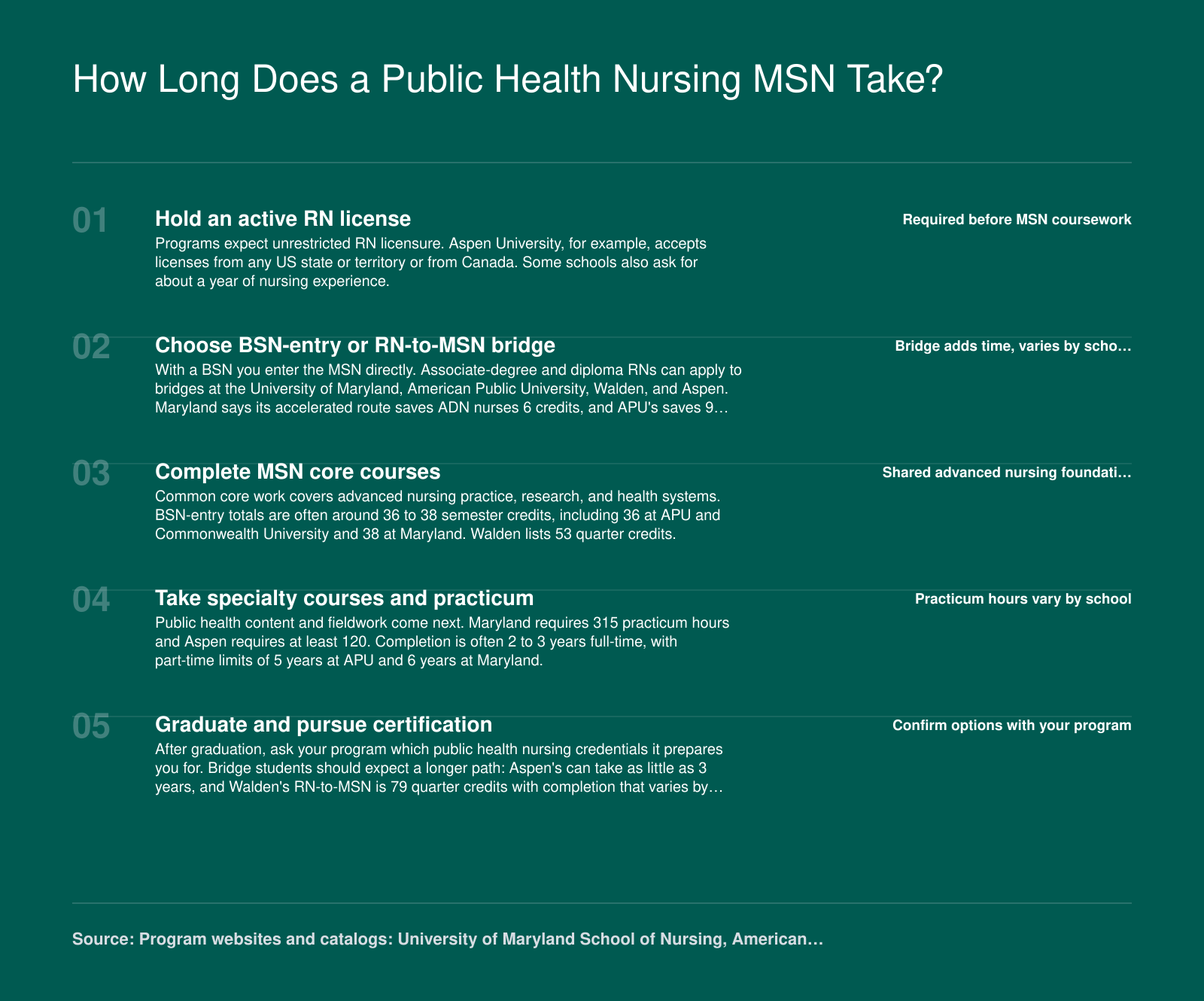
Most BSN-prepared nurses can finish a public health nursing MSN in roughly 2 to 3 years full-time, while part-time students usually have 5 to 6 years at the schools that publish a limit. Timelines vary by school, and credit totals are not directly comparable because some programs use quarter credits and others use semesters.
Getting in: Prerequisites, Nursing Experience, and Deadlines
Requirements vary by school, so confirm details with each admissions office before you apply.
- Unencumbered RN licenseEvery program here expects an active RN license. North Alabama disqualifies applicants with restrictions or reprimands, and National University requires a license in your state of employment or residence. Minnesota State Mankato accepts a license from any state.
- BSN or ADNMaryland, Drexel, Kentucky, North Alabama, and Mankato list a BSN. National University accepts a diploma, ADN, or BSN.
- Minimum GPAA 3.0 is the common threshold. Drexel reviews lower GPAs individually. Kentucky and Eastern may admit provisionally below 3.0.
- Nursing experienceMaryland and North Alabama prefer experience but don't require it. Drexel doesn't require it. Pacific Lutheran lists one year.
- Prerequisite coursesPacific Lutheran requires college-level statistics. Prerequisite lists for most other schools weren't confirmed, so check each one.
- Application materialsMaryland asks for two to three recommendation letters and Drexel asks for two. Expect a personal statement and resume as well.
- DeadlinesMaryland's scholarship deadline is December 15, 2026, and its final deadline is January 5, 2027. After December 15, admission is space-available with no merit scholarships. Drexel isn't accepting 2026–2027 applications. Deadlines for several other schools weren't confirmed.
Public Health programs by state
Compare Public Health programs on the data that matters
Explore more Nursing specializations or browse every graduate field.
All Nursing programs