Best Public Health Nursing MSN Programs in Texas
Compare 2 accredited Public Health programs in Texas, with graduate earnings, cost, debt, and completion data from IPEDS and the U.S. College Scorecard.

Search "public health nursing MSN in Texas" and most results are something else: general MSN tracks, such as an MSN in Nursing Administration, standalone MPH degrees, or DNP programs. Few are dedicated public health nursing master's at all.
A public health nursing master's centers on population health, epidemiology, health policy, and community-level care, not individual bedside practice. That focus changes where graduates work and what the degree is worth.
In Texas, most of these credentials come through public health master's programs rather than nursing-specific tracks like Psychiatric Mental Health Nurse Practitioner (PMHNP) MSN programs in Texas, so confirming accreditation and any nursing pathway with each school matters before you apply.
Key Points
- Texas State University offers an online MSN in Public Health/Community Health Nurse Practitioner.
- In-state graduate tuition at Texas public universities here runs roughly $7,166 to $11,950 per year.
- Texas RNs earned a median wage of $90,225 in 2024, so confirm each school's GRE policy.
The 10 Best Public Health Nursing Master's Programs in Texas
Most of the programs below are Master of Public Health degrees or related public health master's programs, not dedicated public health nursing MSN tracks, so nurses should confirm any nursing-specific track, entry pathway, and accreditation directly with each school. Where a nursing college hosts the program or runs a separate nursing MSN, we say so. Tuition figures are listed graduate tuition before fees, and graduation rates describe the whole institution, not the program.
The University of Texas at Austin
#1Austin, TX · ~$12,000/yr (est.)
Best for: Global policy dual-degree seekers
UT Austin is the highest-profile name on this list, with a graduation rate of about 89% across the institution. Listed graduate tuition is about $12,006 in-state and $22,954 out-of-state. The public health option here is a dual degree that pairs a global policy master's with an MPH from UTHealth Houston, not a nursing MSN. It suits students who want a policy lens on population health and can manage two separate applications.
- Three-year dual degree with UTHealth Houston
- 49 total credit hours across both institutions
- Apply and be admitted to both programs separately
- Each institution confers its own degree
- MPH portion is completed at UTHealth Houston School of Public Health
- On-campus format
Texas A&M University-College Station
#2College Station, TX · ~$12,000/yr (est.)
Best for: On-campus students choosing a specialty
Texas A&M's school graduation rate is about 84%, and listed graduate tuition is roughly $6,885 in-state and $19,642 out-of-state. Its on-campus MPH offers five concentrations, which gives nurses with a specific interest, such as environmental or occupational health, room to specialize. The degree is a public health master's rather than an MSN, and the school is on-campus only.
- On-campus only, no online option
- Five concentrations: Environmental Health, Occupational Safety and Health, Epidemiology, Health Policy and Management, Health Behavior
- Fall and spring start dates
- Epidemiology requires a 3.0 GPA; Health Behavior requires 2.75
- Guaranteed Admissions Program available
- Scholarships available
Texas Tech University Health Sciences Center
#3Lubbock, TX · ~$7,000/yr (est.)
Best for: Online learners balancing full-time work
Texas Tech University Health Sciences Center offers the lowest listed graduate tuition among the ranked schools with a national-level health sciences focus: about $4,904 in-state and $12,283 out-of-state. The school's graduation rate is not reported in the data we use. Its online MPH is a population health degree, not a public health nursing MSN, and the school's separate nursing MSN options (such as nursing education and leadership) are not dedicated public health tracks. Nurses who need a fully online format with flexible start terms will find it practical.
- 45 credit hours, generalist or epidemiology concentration
- Fully online option; most finish in 15 to 24 months
- Three start dates per year
- Applied Practice Experience with a community partner
- Capstone, public health project, or thesis finish
- About $17,335 total program tuition
- Applications through SOPHAS with two recommendation letters
The University of Texas at Arlington
#4Arlington, TX · ~$11,000/yr (est.)
UT Arlington houses its MPH in the College of Nursing and Health Innovation, a natural fit for nurses exploring population health. The school's graduation rate is about 54%, and listed graduate tuition is roughly $9,189 in-state and $24,013 out-of-state. The degree is an MPH, not a nursing MSN, and UTA's separate online MSN offerings should not be confused with it.
- 42 credit hours on the main campus
- Two concentrations: Urban Health and Epidemiology
- Urban Health covers community assessment, program evaluation, and advocacy
- Described by UTA as the only urban health MPH in Texas
- Housed in the College of Nursing and Health Innovation
- Financial aid and departmental scholarships available
The University of Texas at San Antonio
#5San Antonio, TX · $10,000 – $29,000/yr (est.)
UT San Antonio's school graduation rate is about 53%, with listed graduate tuition near $7,641 in-state and $26,245 out-of-state. Its MPH comes from the Kate Marmion School of Public Health and can be paired with an MBA. It is a public health master's, not a nursing MSN, and the dual route may appeal to nurses heading toward health administration.
- 45 credit hours through the Kate Marmion School of Public Health
- Dual MBA/MPH option with up to 9 shared credits
- Dual degree can be completed in as little as three years
- Separate applications to each program
- Dual admission asks for a 3.0 GPA and two recommendation letters
- Assistantships and scholarships available
Baylor University
#6Waco, TX · ~$44,000/yr (est.)
Baylor is a private university, so its listed graduate tuition is about $43,578 for both in-state and out-of-state students, far above the public options here. The school's graduation rate is about 80%. Its on-campus MPH is a public health degree, not a nursing MSN, and scholarships and assistantships can offset some of the cost for competitive applicants.
- On-campus, two-year program of 42 to 43 credit hours
- Concentrations: Bioethics, Community Health Science, Epidemiology, Environmental Health Science
- Practicum and capstone project required
- GRE scores and a 3.0 GPA listed for admission
- Scholarships up to 50% of tuition for competitive applicants
- Graduate assistantships with a monthly stipend
The University of Texas at Tyler
#7Tyler, TX · ~$8,000/yr (est.)
UT Tyler's graduation rate is about 54%, and listed graduate tuition is roughly $6,534 in-state and $15,318 out-of-state. Its online MPH focuses on rural population health, which is relevant for nurses serving East Texas communities. The school also markets a separate online RN-to-MSN pathway, but that is a nursing degree distinct from this MPH and not a public health track.
- 42 credit hours, fully online
- Two-year track or as little as 15 months on the fast track
- Applied Practice Experience and capstone required
- Rural-focused outcomes such as community health profiles
- Electives in epidemiology and biostatistics
The University of Texas at El Paso
#8El Paso, TX · $5,000 – $10,000/yr (est.)
UTEP's school graduation rate is about 50%, and listed graduate tuition is roughly $5,865 in-state and $15,320 out-of-state, among the lowest here. Its MPH concentrates on Hispanic and Border Health and makes GRE and MCAT scores optional. It is a public health master's, not a nursing MSN, and suits nurses committed to border communities.
- 42 credit hours, on campus, cohort-based
- Concentration in Hispanic and Border Health
- GRE and MCAT scores optional
- Fall start only; applications due March 15
- Six practicum credit hours plus thesis or graduate project
- Needs a 3.0 GPA, three recommendation letters, and an interview
University of Houston-Clear Lake
#9Houston, TX · $5,000 – $10,000/yr (est.)
University of Houston-Clear Lake has a school graduation rate of about 52% and listed graduate tuition near $8,190 in-state and $17,622 out-of-state. The public health offering is a concentration within a Master of Science in Exercise and Health Sciences, not an MPH or a nursing MSN, so it fits a narrower audience. Evening classes make it workable for people with day jobs.
- Hybrid mix of web-enhanced, online, and in-class instruction
- In-class courses held in the evenings
- Public health concentration covers epidemiology, biostatistics, and policy
- Prepares for NSCA and ACSM certification exams
- Internships and Human Performance Laboratory work available
Texas State University
#10San Marcos, TX · ~$9,000/yr (est.)
Texas State's graduation rate is about 55%, with listed graduate tuition of roughly $6,432 in-state and $13,812 out-of-state. Its online MPH offers two concentrations in an accelerated format and prepares graduates for the CHES exam. It is a public health master's, not a nursing MSN, and the school's nursing MSN programs are separate degrees.
- 42 hours of graduate coursework, fully online option
- Concentrations: Community Health & Behavior or Health Policy & Management
- Accelerated online concentration format
- 6-credit internship in a public health setting
- Comprehensive exam in the final semester
- Graduates can sit for the CHES exam
Cost & outcomes by school
Federal data for the highest-earning Public Health programs, independent of the ranking above. Earnings are this field's master's graduates four years after completing, where the Scorecard reports them.
| School | Earnings | Tuition / yr | Debt | Grads/yr | Format |
|---|---|---|---|---|---|
| Texas State University TX | $111,334 | $8,997 | $35,780 | 21 | Online |
| Parker University TX | — | $14,898 | — | — | Online |
Sources: U.S. Department of Education. Tuition and graduates: IPEDS. Earnings and debt: College Scorecard, this field's master's graduates; a dash means no figure is reported.
Online and Hybrid Public Health Nursing Master's Options in Texas
Online graduate nursing keeps expanding, but state authorization rules still decide who can actually enroll in public health nursing MSN programs. The clearest online option among master's programs in Texas is Texas State University's MSN in Public Health/Community Health Nurse Practitioner (PHMNP), which is delivered online.
Fully Online vs. Hybrid
Texas State's published materials do not identify a required campus immersion for the PHMNP. We could not confirm a hybrid program with mandatory on-site intensives elsewhere among the ranked schools. Before you apply, ask each admissions office whether campus visits are required and how often they occur, so you can plan time off from work.
How Practicum Hours Work
The PHMNP requires 840 practicum hours, split into 750 direct and 90 indirect. Indirect hours are faculty-led virtual simulation and case-study work. Direct hours must be completed in person with a qualified preceptor in an approved setting. For a public health track, that could mean a local or state health department or a community clinic. The program requires a preceptor, but the sources we reviewed do not say whether students find their own or receive placement help. Ask about this early, because lining up a site can take months.
Out-of-State Students
Texas State's online programs were approved only for Texas as of 2025. If you live outside Texas, confirm in writing that the school is currently authorized to enroll residents of your state before you apply.
Texas registered nurses earned a median annual wage of $90,225 in 2024, according to the Texas Workforce Commission's 2025 Report on Texas Growth Occupations. The agency's statewide career and technical education labor market file counts 261,050 RNs employed in Texas in 2024, with an average of 16,904 job openings a year.
Which Ranked Texas Public Health Nursing Master's Programs Waive or Skip the GRE
Test policies change often, and several schools here publish none at all. Treat this as a starting point for Nursing Master's Programs and confirm with admissions before booking an exam.
No GRE Required
- UTEP: The program lists no entrance exam requirement, describes itself as test optional, and sets a 3.0 minimum GPA.
- Texas State University: Graduate admissions material says the GRE is not required, placing it among No-GRE master's programs, with GPA minimums of 2.75 to 2.8 depending on the page.
Conditional Path
- UT Arlington: A 3.0 GPA on your last 60 hours earns unconditional admission, while 2.8 to 2.99 may mean probationary admission where GRE minimums can apply.
GRE Required
- UT Austin: The 2026 MSN FAQ requires a GRE taken within five years, offers no waiver, and recommends a combined 300, though a later version says the exam is not required.
- Baylor University: The program lists the GRE as required alongside a 3.0 minimum GPA.
No Published Policy
- Texas Tech University Health Sciences Center: The GRE appears among accepted exams, but no requirement or waiver is stated.
- Texas A&M University: No test policy is published, so ask admissions.
- UT San Antonio: No test policy is published, so ask admissions.
- UT Tyler: No test policy is published, so ask admissions.
- University of Houston-Clear Lake: No test policy is published, so ask admissions.
Related Articles
Cost, Accreditation, and Certification for a Texas Public Health Nursing Master's
Cost depends on credit load, residency, and fees more than a school's public profile. For Texas public universities on this list, in-state graduate tuition runs from roughly $7,166 to $11,950 per year, while out-of-state rates range from about $15,900 to $29,582. Net price is an institution-wide average after aid, not a program quote. The UT Arlington RN-to-MSN offers a concrete example: 71 credits for Nurse Administrator and 69 for MSN Nurse Educator, with a published total of $19,500 after listed reductions, but it does not publish a per-credit rate or mandatory-fee total.
Accreditation and Certification
CCNE or ACEN accreditation signals that a nursing program meets national standards and is usually required for certification exams and employer acceptance. For public health nursing specifically, the ANCC Advanced Public Health Nursing (APHN-BC) credential's current eligibility is not clearly established in public sources, so confirm directly before applying. The NBPHE Certified in Public Health (CPH) exam is a separate alternative for graduates of CEPH-accredited public health programs; the regular exam fee is $385. CPH eligibility includes students enrolled in CEPH-accredited schools and alumni of CEPH-accredited master's or doctoral programs, with additional work-experience pathways. Because CCNE accreditation is established for UT Arlington's RN-to-MSN but not for a public-health nursing specialization, check program-level accreditation before committing.
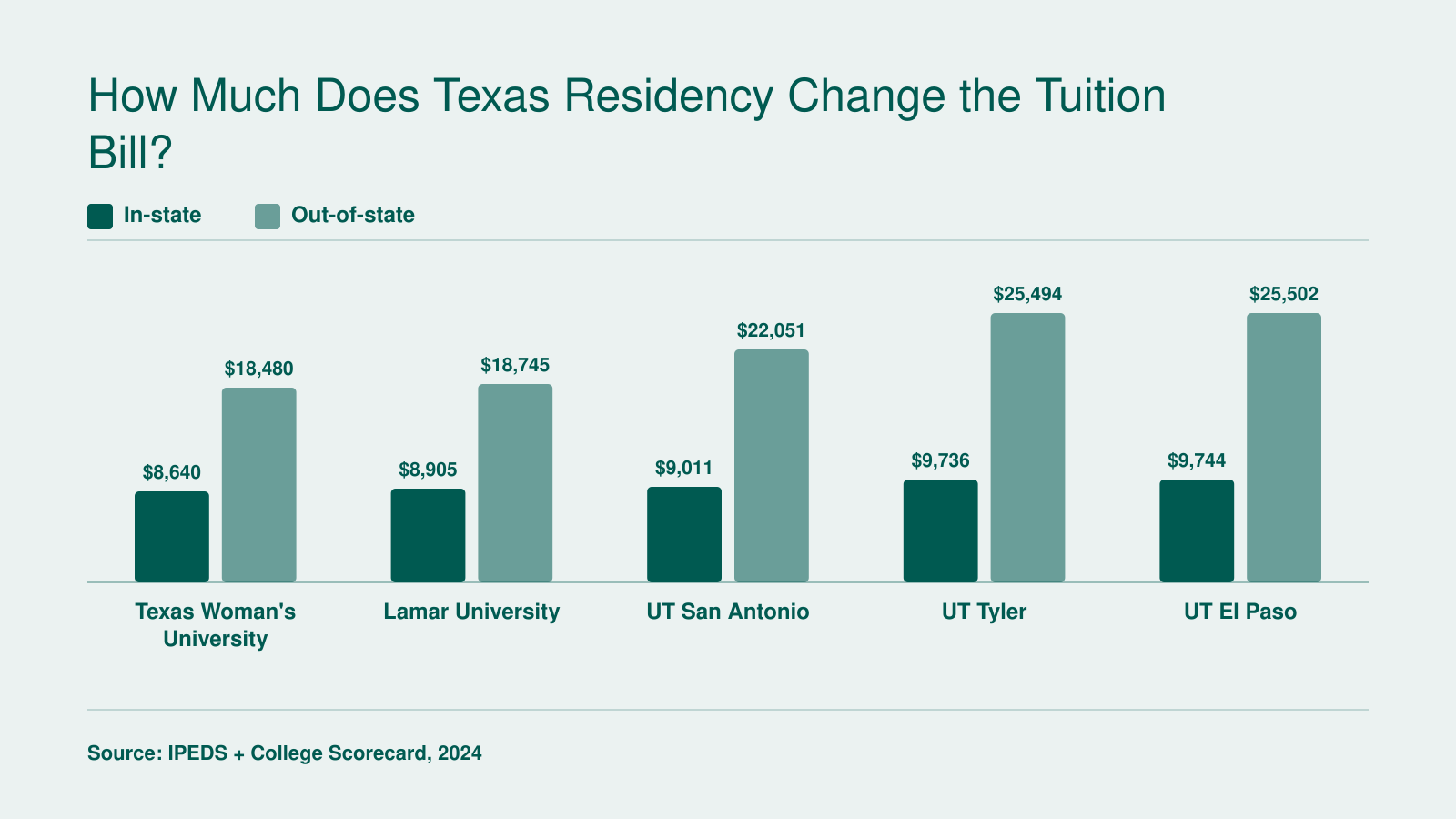
How Much Does Texas Residency Change the Tuition Bill?
Every school in this comparison is a public university, so residency status drives the price. The chart shows published annual tuition and fees for in-state and out-of-state students at the lowest-cost schools ranked here. Check each program's bursar page for current per-credit rates before you budget.
Texas Nursing Licensure for Public Health MSN Graduates
Admission Requirements for Public Health Nursing Master's Programs in Texas
Requirements vary by school and track, so confirm details on each admissions page before applying.
- DegreeA BSN is the usual requirement; UT Austin also accepts an ADN or diploma plus a bachelor's in another field.
- RN licenseAn active, unencumbered Texas RN license is typical; Texas State accepts a multistate license.
- Minimum GPA3.0 at UT Austin, Texas Tech Health Sciences, and Midwestern State; 2.75 at Texas State.
- Statistics prerequisiteTexas Tech requires research and statistics with a C or better; UT Austin also lists statistics.
- References and statementExpect references and a personal statement; confirm the exact number with each school.
- DeadlinesUT Austin: Sept. 1-Nov. 1. Texas Tech fall: Feb. 15. Midwestern State: Jan. 1-April 15.
- Direct entryUT Austin is the ranked school here with a path for non-nursing bachelor's holders.
Compare Public Health programs on the data that matters
Explore more Nursing specializations or browse every graduate field.
All Nursing programs