Master's Programs in North Carolina
Every master's program reported by a school in North Carolina: 990+ programs at 50+ graduate schools, with the online options, costs and outcomes behind each one.

Which North Carolina master's program actually gives you the best return for the money? The state has dozens of graduate schools, from the 16-campus UNC System to private institutions like Duke and Wake Forest, yet tuition, format, and outcome data sit on separate university pages that rarely use the same terms.
That gap matters because the spread is wide. A flagship name can cost far more than a regional public offering a comparable degree, and residency status, enrollment load, and fees change the final bill. UNC-Chapel Hill, NC State, UNC Charlotte, and Duke draw most searches, but regional campuses often undercut them on price.
In a state with this many credible options, the program-level numbers are what separate a sound investment from an expensive one.
Key Points
- Twelve months of NC domicile, decided by the RDS, sets in-state tuition eligibility.
- UNC-Chapel Hill lists 15 fully online master's programs, and pricing varies by program.
- Counseling licensure requires a 60-hour, CACREP-accredited master's for applications after July 1, 2022.
Popular degrees in North Carolina
Master's programs in North Carolina by field
Business & Management
- Management33 programs
- Analytics30 programs
- Accounting28 programs
- Healthcare Administration28 programs
- Finance24 programs
- General Business23 programs
- Public Administration20 programs
- Marketing20 programs
Education & Teaching
- Teaching41 programs
- Special Education16 programs
- STEM Education or Science Education or Mathematics Education16 programs
- Curriculum & Instruction15 programs
- Elementary Education15 programs
- Educational Leadership14 programs
- Library Science or Library and Information Science or Library Media13 programs
- Reading & Literacy11 programs
Healthcare
- Nutrition18 programs
- Health Administration15 programs
- Public Health11 programs
- Health Informatics10 programs
- Exercise Science9 programs
- Health Education8 programs
- Speech Pathology7 programs
- Clinical Research Management3 programs
Social Work & Social Sciences
- Social Work28 programs
- Social Work Advanced Standing14 programs
- Sociology13 programs
- Political Science, Government4 programs
- Human Services2 programs
Nursing
- Nursing Education or Nurse Educator11 programs
- Nurse Administrator8 programs
- Family Nurse Practitioner (FNP)6 programs
- Direct Entry MSN (MENP) or (DEMSN)5 programs
- Psychiatric Mental Health Nurse Practitioner4 programs
- RN to MSN4 programs
- Adult Gerontology Primary Care Nurse Practitioner3 programs
- Public Health3 programs
Counseling
- Clinical Mental Health Counseling28 programs
- School Counseling15 programs
- Marriage and Family Therapy or Marriage and Family Counseling5 programs
- Addiction Counseling3 programs
- Christian Counseling1 program
Psychology
- Counseling Psychology10 programs
- General Psychology7 programs
- Industrial Organizational Psychology4 programs
- School Psychology4 programs
- Sports Psychology4 programs
- Educational Psychology or School Psychology4 programs
- Clinical Psychology3 programs
- Applied Behavior Analysis2 programs
Communications & Media
- Communication11 programs
- Speech Pathology8 programs
- Communication Disorders6 programs
- Journalism3 programs
- Media Communication3 programs
- Strategic Communication3 programs
- Technical Communication2 programs
- Public Relations1 program
Religion & Theology
- Divinity12 programs
- Theology12 programs
- Christian Ministry8 programs
- Christian Leadership2 programs
- Urban Ministry2 programs
Science & Engineering
- Environmental Science14 programs
- Sustainability or Environmental Management14 programs
- Geography5 programs
Arts & Design
- Creative Writing26 programs
- Fine Arts5 programs
Computers & IT
- Cybersecurity12 programs
- Data Analytics12 programs
- Information Security & Assurance3 programs
- Machine Learning2 programs
Criminal Justice & Law
- Public Policy4 programs
- Master of Laws3 programs
- Legal Studies1 program
- Business Law1 program
- Fire Science or Fire Administration or Fire Leadership1 program
How Much Does a Master's Degree Cost in North Carolina?
The real cost question for a North Carolina master's degree is not which campus has the lowest sticker price. It is what your specific program will charge, given your residency, your enrollment load, and the fees layered on top of tuition. Those variables can move your bill as much as the choice between schools, which is why we don't list a single tuition figure for UNC-Chapel Hill, NC State, UNC Charlotte, East Carolina, Appalachian State, UNC Greensboro, Duke, or Wake Forest. Rates reset each academic year and often differ by program within the same university.
Why One Number Doesn't Work
UNC-Chapel Hill shows the problem clearly. For Fall 2026 through Spring 2027, graduate tuition is charged per credit hour and varies by program and residency. For most graduate programs, tuition is capped at full-time enrollment of 9 credit hours per semester.1 Mandatory student fees are billed separately: campus-based fees are generally flat per semester, while distance-education fees are charged per credit hour. Some programs and courses add their own fees, and the university notes that your actual rate appears on your bill.
NC State publishes both a per-credit-hour schedule of graduate tuition and required fees2 and a separate estimated cost of attendance page3. Read both: one shows what a credit costs, the other how that scales to a year.
A Four-Step Cost Plan
- Pick 2 to 3 target programs: Compare specific degrees, not universities in general, since rates can differ by program at the same school.
- Confirm your status: Determine whether you'll be classified in-state or out-of-state, and whether you'll enroll full-time or part-time. Part-time students paying per credit may never reach a full-time cap.
- Use official tools: Search "[university name] graduate tuition and fees" or "[university name] cashier tuition" to find the cashier or student services page, then run any tuition estimator or cost-of-attendance calculator the school offers to estimate annual tuition plus mandatory fees.
- Contact financial aid: Ask for a program-specific estimate that includes any program or course fees missing from the general schedule.
Budget Beyond Tuition
Mandatory fees, books, and housing can add substantially to your total, which is why cost of attendance figures include living expenses. Use them, not tuition alone, when comparing offers. Private universities like Duke and Wake Forest set their own rates, so check their pages directly rather than relying on UNC System schedules.
To judge whether a price is worth paying, pair it with outcomes. The U.S. Bureau of Labor Statistics (BLS.gov) publishes salary and job-outlook data by occupation, and professional associations in fields like counseling, nursing, or social work explain licensure and certification requirements a tuition page won't mention. A cheaper program that doesn't prepare you for licensure is not the better value.
Do Online Master's Students Qualify for In-State Tuition in North Carolina?
Twelve continuous months of bona fide North Carolina domicile is the baseline for in-state tuition,1 and that clock is run by one centralized body: the Residency Determination Service (RDS).2 Individual universities in the UNC system do not decide your classification. RDS does, and its decision follows you across schools. Graduate and master's applicants must complete a residency determination through RDS2 unless they qualify under a specific statutory exception.
What the 12-Month Domicile Rule Actually Requires
Domicile is not just living somewhere for a year. RDS looks at the totality of your ties to North Carolina: where you reside, where you work, where your vehicle and voter registration sit, whether you file NC income taxes, whether you own or lease property here, and your financial independence.3 No single factor settles it. Critically, moving to North Carolina primarily to attend school does not establish domicile, even after 12 months.4 You have to show you intend to make the state your permanent home, not that you are here temporarily to earn a degree.
Online Enrollment Alone Does Not Create Residency
Here is the direct answer: enrolling online in a North Carolina program does not make you a resident.5 If you live outside the state and study remotely, you ordinarily fail the 12-month domicile test and are classified out-of-state. Some institutions also apply their own distance-education pricing, though that varies by program, so confirm the exact rate with the school. The flip side holds too: a student who genuinely establishes and maintains NC domicile for 12 continuous months may qualify through the ordinary process even while studying online.5
Military and Veteran Exceptions
Active-duty service members stationed in North Carolina, and certain dependents sharing their home, may receive in-state tuition without meeting the 12-month rule.2 Being on active duty outside the state does not automatically qualify you.6 Veterans using covered federal benefits (Chapter 30, 31, or 33, or the Fry Scholarship) may receive an out-of-state tuition waiver if they live in North Carolina and enroll within three years of the service member's discharge or retirement.3 Military or veteran status by itself is not the same as residency.6
Practical Tip
Complete your RDS residency determination before you apply, and gather documentation early: a current lease, NC driver's license, voter registration, and recent NC tax filings all strengthen your case.
Online and Hybrid Master's Programs in North Carolina
NC State: Broad Online Catalog, Program-Specific Pricing
NC State runs one of the deepest online graduate catalogs in the UNC System. Fully online master's options include the MS in Foundations of Data Science, the Master of Computer Science, the Master of Engineering, the MS in Electrical Engineering, and a Teaching, Learning, and Curriculum degree, a master's in curriculum and instruction for educators.1
Pricing depends on the program. Most distance students pay a standard graduate distance rate split by North Carolina residency, and NC State says this matches what on-campus students pay under the same rate structure.2 Graduate Engineering Online and the MBA are billed higher. For example, the online data science master's lists 2026-2027 resident tuition of $585.39 per credit hour, plus a $311.11 tuition increment and $28.50 in required fees, for $925 per credit hour.3 Those rates were published before the state budget was final, so treat them as provisional. Graduate credit-hour charges are capped at a nine-credit full-time load each semester.
UNC Charlotte: Same Tuition, Lighter Fees
UNC Charlotte markets online master's degrees to working professionals, including an Online MBA that is fully online.4 Its policy is straightforward: tuition is the same regardless of modality, and it follows the campus designation of your primary program rather than how individual courses are coded.5 The savings show up in fees. Charlotte Online students pay a reduced set of mandatory fees set by the UNC Board of Governors, which can trim the total bill compared with a campus student in the same degree.
ECU, UNCG, App State, UNCW, and UNC-Chapel Hill
East Carolina, UNC Greensboro, Appalachian State, UNC Wilmington, and UNC-Chapel Hill all deliver graduate coursework online6, but we could not verify a current list of their fully online versus hybrid master's degrees or confirm whether each charges a separate distance-education rate. ECU has long been one of the system's larger distance-education providers. Confirm format and pricing directly with each graduate school before applying, because "online" sometimes includes required campus visits or synchronous sessions.
Where to Start Your Search
The UNC System's online catalog, UNC Online, is the best master directory for public options.6 Use it to identify which campuses offer your field, then go to each program's own page for current tuition and delivery details.
On timing, many part-time online master's students finish in roughly two to three years, though pacing depends on credit load and program design. Rely on each program's published plan of study, not a general estimate, when budgeting your time and tuition.
Which North Carolina Master's Programs Have the Best Career Outcomes?
Program-level outcome data has quietly become the most useful tool prospective graduate students have, and almost nobody uses it. The federal College Scorecard now publishes median earnings and median cumulative debt broken out by individual field of study, not just by institution, which means you can compare MSN programs at East Carolina and UNC Charlotte rather than comparing two university brands. The catch is that coverage is uneven, and North Carolina is no exception.
What the data actually shows, and what it doesn't
For several North Carolina programs, the published figures are either suppressed or built on tiny graduate cohorts. One third-party compilation of College Scorecard data for a UNC-Chapel Hill master's in business administration and management reports median earnings around $203,447 against median debt of roughly $90,800, but that figure rests on just four graduates in the reporting cohort1. A sample that small tells you almost nothing about what a typical graduate earns. Treat it as a reminder to check the graduate count before trusting any single number, not as evidence that a Chapel Hill MBA pays a fifth of a million dollars.
Comparable field-level figures for NC State, Duke, UNC Charlotte, and East Carolina in computer science, engineering, nursing, and social work were not verifiable at the time of writing. We would rather say that plainly than publish a tidy table built on guesswork.
Judge earnings against debt, not against prestige
The useful question is not which school has the better name. It is what ratio of earnings four years after completion to borrowed principal a program produces. A regional public like UNC Charlotte or East Carolina charging in-state rates can deliver a stronger ratio than a flagship or a private research university, because the numerator in engineering, computer science, and nursing is driven largely by the regional labor market rather than by the degree's letterhead. Run that comparison yourself on the programs you are actually considering.
Also set expectations by field. Counseling, school administration, and classroom teaching master's degrees are licensure gateways first and earnings boosters second. Graduates in those fields routinely earn less than peers from MBA programs or computer science while carrying similar debt, which is a reason to borrow conservatively, not a reason to avoid the degree.
How to look it up
Search any North Carolina institution on the Department of Education's College Scorecard site and open its field-of-study view, then filter to master's credentials. Two limits matter: the figures cover only students who received federal financial aid, and the published pooled cohorts span award years from roughly 2014-15 through 2019-202, with earnings measured several years after completion3.
Admission Requirements for North Carolina Master's Programs
Requirements vary by program, so treat the figures below as general baselines and confirm details with each department. Duke and UNC Charlotte do not publish one university-wide standard that we could verify for 2026.
- Bachelor's degree and GPAYou need a bachelor's degree from an accredited institution. UNC-Chapel Hill and NC State both cite a 3.0 (B average) as the general Graduate School baseline, though programs may set higher bars. UNC Charlotte lists no single minimum GPA, and its early-entry option for current undergraduates asks for a 3.2 GPA and 75 credit hours.
- GRE/GMATNeither UNC-Chapel Hill nor NC State has a universal test rule. UNC's Master of Applied Professional Studies does not require the GRE, and NC State's Master of Engineering Management has waived it, though applicants may still submit scores. Check your target program's page, since some departments still require scores.
- Statement, resume, and recommendationsExpect a statement of purpose and a resume or CV. Letter counts are set by program: NC State's general application lists three, and UNC's Applied Professional Studies program also asks for three. Some programs add essays or portfolios.
- Program-specific prerequisitesMany programs expect background coursework or credentials, such as prerequisite courses for computer science or psychology, or an RN license for a nursing MSN. Confirm these early so you have time to complete them.
- English proficiency and feesNC State's general minimums for non-citizens are a TOEFL iBT total of 80 with at least 18 per section, or IELTS 6.5 overall and in each section, with possible exemptions. Its current fee is $85 domestic and $95 international, but older materials list lower amounts. Verify the amounts on each school's site.
Application Deadlines and Competitiveness at UNC, NC State, Duke, and UNC Charlotte
UNC-Chapel Hill's Graduate School asks for applications by December 15, 2026 for full consideration for Graduate School fellowships, but that date is not an admission deadline for every program. Final deadlines vary by department, and some programs set earlier dates. For example, MPA programs at UNC-Chapel Hill list January 1, 2027 for Fall 20271, Carolina Planning uses December 15, 20262, the Master of Science in Information Science and Master of Science in Library Science programs both list February 9, 20273, and the Master of Science in Data Science lists March 9, 20273. The residential MPH at Gillings sets a December 1, 2026 deadline4.
Funding priority matters
Meeting the priority deadline is the single most important step for students who want assistantships or fellowships. At UNC-Chapel Hill, departments often use deadlines like December 1 or December 15 to make funding decisions. An application that arrives after those dates may still be reviewed for admission, but it can miss the fellowship and assistantship cycle. For funded master's programs, plan to submit before the December or January priority date unless the department states otherwise. At UNC Charlotte, most graduate programs use rolling decisions with a general fall schedule of priority March 1 and final August 1, but individual programs may close earlier if cohorts fill.
Competitiveness is not one number
None of these universities publishes a single campus-wide graduate acceptance rate. Some professional schools at Duke and UNC may report admit rates, but many academic master's programs do not report a separate rate, so students should assess fit through prerequisites, statement quality, and research alignment rather than a missing statistic. If a program does not post an admit rate, that is not a red flag; it simply means the department has not aggregated graduate admissions data.
Verify each program page
Because deadlines sit inside departments, a university calendar is only a starting point. NC State and Duke, for example, do not publish a single central master's deadline; dates are set by individual colleges and departments. Always check the program page and confirm whether a funding deadline applies earlier than the final admission date.
UNC-Chapel Hill offers 15 fully online master's degree programs in 2026, according to UNC Online's master's program listing. That figure covers Chapel Hill only, not every UNC System campus, so check each university's own online catalog for additional remote options across the state.
Accreditation and Licensure for North Carolina Master's Degrees
Accreditation has shifted from a routine check to a gatekeeping checkpoint for North Carolina master's students, especially in licensed health, education, and social service fields. Before comparing tuition or rankings, confirm both the university's institutional accreditation and the specific program's specialized approval.
Start with institutional accreditation
North Carolina's public universities and the state's large private research universities are regionally accredited by the Southern Association of Colleges and Schools Commission on Colleges (SACSCOC). You can verify any school through the SACSCOC member directory or the U.S. Department of Education's accreditation database. Regional accreditation matters for federal aid eligibility, transfer credit, and employer recognition, but it does not by itself qualify you for a state license.
Programmatic accreditation is the licensure filter
Licensure is program-specific. For nursing advanced practice, North Carolina recognizes national accreditation from CCNE or ACEN. Many NC universities with nursing master's programs hold CCNE accreditation, while Gardner-Webb's program is ACEN-accredited; check your intended specialty because accreditation can vary by track. For clinical mental health counseling programs, CACREP is the key marker to look for, and some licensure pathways expect or require CACREP alignment, so verify current board rules rather than assuming any counseling master's qualifies. Social work is clearer: North Carolina requires an MSW, DSW, or PhD from a CSWE-accredited school. CSWE-accredited MSW programs in the state include Appalachian State, East Carolina, Fayetteville State, Johnson C. Smith, the NC A&T/UNC Greensboro collaborative, NC Central, NC State, UNC Chapel Hill, UNC Charlotte, UNC Pembroke, UNC Wilmington, and Western Carolina.
For education, the practical gatekeeper is NC DPI approval of the specific educator preparation program. A CAEP-accredited master's in teaching is not automatically NC DPI-approved, so confirm the program's state approval before enrolling. AACSB accreditation remains a quality signal for business master's programs, but it is not a licensure requirement.
Online students need state authorization checks
If you study online from another state, an unaccredited program can block licensure in your home state or in North Carolina. Look for the program's state authorization and professional licensure disclosure page, which should list the states where the curriculum meets educational requirements. Contact the licensing board directly if the disclosure is unclear.
Licensure Spotlight: Counseling in North Carolina
Financial Aid, Assistantships, and Scholarships for NC Master's Students
Sticker price is only the starting point. Funding varies widely by program type, so it pays to look at what each department offers before you compare costs.
Graduate Assistantships
At UNC System schools and Duke, assistantships are the most valuable form of master's funding. A teaching or research assistantship typically pays a stipend in exchange for part-time work. Many also come with tuition remission, and some include access to subsidized health insurance. Stipend amounts and benefits differ by department and school, so ask each program for current figures in writing.
These positions are more common in research-focused, thesis-track master's programs, such as sociology master's programs with assistantships, than in professional or course-based degrees. If a program is built mainly for working adults, such as many online msw programs or evening programs, assistantships may be scarce or unavailable.
At UNC System campuses, assistants may also qualify for tuition remission or an out-of-state tuition award that reduces what they pay. Policies are set by each institution and can change, so confirm the details with the graduate school before you count on them.
Federal Loans and Recent Changes
Federal Direct Unsubsidized Loans are open to most eligible graduate students. Grad PLUS loans have long covered remaining costs, but recent federal legislation ended Grad PLUS for new borrowers starting in July 2026 and introduced new annual and lifetime borrowing limits for graduate students. Because the rules include transition provisions for students already borrowing, check the current limits at studentaid.gov and with each school's financial aid office. If your program costs more than the federal cap allows, you will need to plan for savings, scholarships, employer help, or private options.
State, Employer, and Field-Specific Options
- Employer tuition assistance: Many hospitals, school districts, and private employers help pay for job-related graduate study. Ask about annual limits and any work-commitment requirement.
- Teaching and nursing incentives: North Carolina has offered service-based and forgivable loan programs for educators, including special education teachers, and nurses. Eligibility for graduate study varies, so check current terms with the state agency that administers them.
- Departmental scholarships: Many programs award merit or need-based funding. You usually must apply by the program's priority deadline, which can be earlier than the general application deadline.
When comparing offers, subtract all grants, remission, and stipends from the full cost of attendance. A pricier program with funding can cost less than a cheaper one without it.
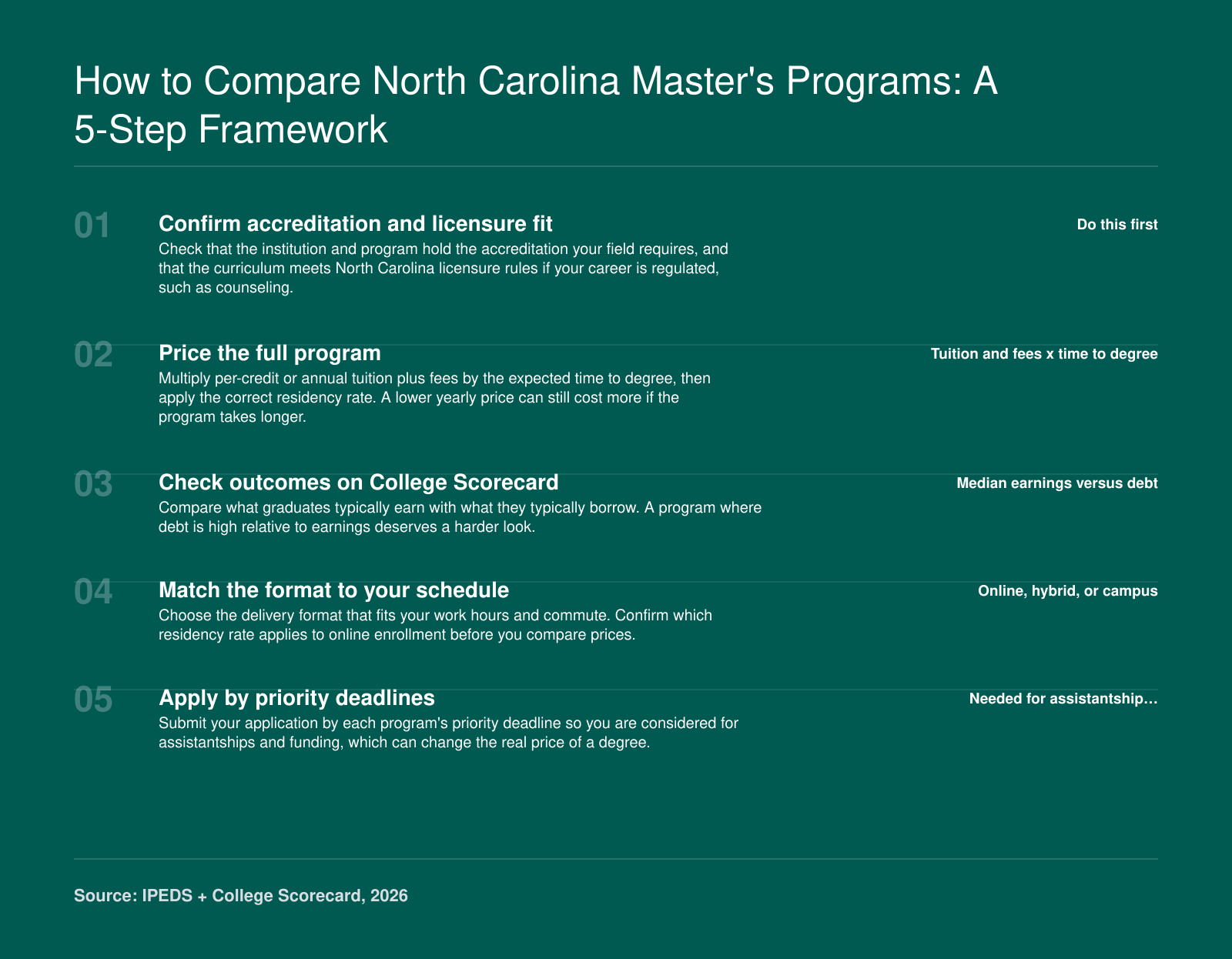
How to Compare North Carolina Master's Programs: A 5-Step Framework
North Carolina offers programs at public flagships, private research universities, and regional campuses, so name recognition alone is a poor guide. Work through these five steps in order to narrow your list on cost, outcomes, and fit.
Graduate schools in North Carolina with the most master's programs
| School | City | Type | Master's programs | Online | Grad tuition / yr |
|---|---|---|---|---|---|
| University of North Carolina at Greensboro | Greensboro | Public | 79 | 39 | $8,614 |
| University of North Carolina at Chapel Hill | Chapel Hill | Public | 65 | 19 | $12,751 |
| University of North Carolina at Charlotte | Charlotte | Public | 60 | 20 | $8,037 |
| North Carolina State University at Raleigh | Raleigh | Public | 56 | 28 | $12,101 |
| University of North Carolina Wilmington | Wilmington | Public | 56 | 34 | $8,112 |
| East Carolina University | Greenville | Public | 56 | 37 | $7,658 |
| University of North Carolina at Pembroke | Pembroke | Public | 40 | 38 | $6,928 |
| Duke University | Durham | Private nonprofit | 39 | 17 | $66,523 |
| North Carolina Central University | Durham | Public | 38 | 21 | $7,638 |
| Appalachian State University | Boone | Public | 36 | 12 | $8,570 |
| Fayetteville State University | Fayetteville | Public | 35 | 11 | $6,791 |
| Wake Forest University | Winston-Salem | Private nonprofit | 32 | 14 | $39,141 |
| North Carolina A & T State University | Greensboro | Public | 32 | 16 | $8,368 |
| Western Carolina University | Cullowhee | Public | 29 | 14 | $7,876 |
| Campbell University | Buies Creek | Private nonprofit | 26 | 11 | $16,347 |
Program counts are the verified master's listings in our directory; tuition is the school-wide average for a full-time graduate student (IPEDS).
Frequently Asked Questions About Master's Programs in North Carolina
These answers summarize the main points from this guide. Program formats, prices, and licensure rules change, so confirm details with each program and the North Carolina Psychology Board before you apply.
Which North Carolina universities offer fully online master's programs?
Is a master's degree at UNC Charlotte cheaper than at UNC-Chapel Hill or NC State?
What psychology master's programs are available in North Carolina, and do they lead to licensure as a Licensed Psychological Associate (LPA)?
Can I keep a full-time job while earning a master's at Duke or NC State?
Compare programs nationwide
Many North Carolina residents study online. Every ranked list above has an online lens, or browse every field.
Online master's programs Browse all fields