Best Master's in Health Education Programs in North Carolina
Compare 8 accredited Health Education programs in North Carolina, with graduate earnings, cost, debt, and completion data from IPEDS and the U.S. College Scorecard.

A teacher licensure track in health and physical education and a CEPH-accredited MPH both sit under the health education umbrella, but they lead to different desks: K-12 classrooms on one side, county health departments and community nonprofits on the other.
In-state graduate tuition across the programs ranked here runs from roughly $6,600 to about $32,240, close to a fivefold spread, with campus and online options sitting side by side in that range. For community and public health roles, the CHES credential, not the degree title, is what most North Carolina employers screen on.
Key Points
- North Carolina A&T is the only ranked school that states no GRE is required.
- CHES and MCHES credentials come from NCHEC, a national body, not the state.
- Confirm CEPH accreditation and CHES exam eligibility before applying, whatever the sticker price.
Top 10 Master's in Health Education Schools in North Carolina
North Carolina offers master's in health education options ranging from CEPH-accredited MPH programs to online health education degrees and teacher-licensure tracks. Graduation rates below are institution-wide figures, and net price is an approximate institution-wide average after aid, not a program quote. Each card includes a plain note on CEPH accreditation status, and where a school does not state one, we say so.
University of North Carolina at Greensboro
#1Greensboro, NC · ~$9,000/yr (est.)
Best for: Working adults needing evening classes
UNC Greensboro delivers its Master of Public Health in Community Health Education on campus, with required courses held in the evening and meeting once weekly. The program includes a six-credit community-based internship or practicum, and students can finish in about two years full time or about three years part time. The school has an institution-wide graduation rate of about 56%, and its approximate average net price after aid is about $10,965. CEPH note: the MPH is a standalone CEPH-accredited program, with accreditation running through December 31, 2027.
- Campus-based MPH with evening classes meeting once weekly
- Six-credit community-based internship or practicum
- About two years full time, about three part time
- Community health and population-based health promotion focus
- CEPH-accredited standalone program through 12/31/2027
Wingate University
#2Wingate, NC · $10,000 – $15,000/yr (est.)
Best for: Remote students arranging home-area practicum sites
Wingate University offers a fully online MPH with a Health Education and Promotion concentration, built around applied practice experiences and eligibility for the CHES exam. Students who live outside North Carolina may arrange their practice site in their home area. The school has an institution-wide graduation rate of about 46%, and its approximate average net price after aid is about $20,748. Published 2026-27 tuition is $820 per credit hour. CEPH note: the Health Education and Promotion concentration is reported as fully CEPH-accredited.
- 42 credit hours, fully online with no on-campus requirements
- Can be completed in as little as two years
- Concentration reported as CEPH-accredited
- Eligible to sit for the CHES exam
- Applied practice experience, site may be arranged near home
- Fall and spring entry points
- 2026-27 tuition listed at $820 per credit hour
East Carolina University
#3Greenville, NC · ~$8,000/yr (est.)
Best for: Aspiring health promotion professionals
East Carolina University's Master of Arts in Health Education is delivered entirely online and aimed at working professionals building careers in health promotion. Admission asks for a bachelor's degree, a preferred 3.0 GPA, three recommendation letters, and a statement of purpose. The school has an institution-wide graduation rate of about 63%, and its approximate average net price after aid is about $15,739. CEPH note: this is not an MPH, and we did not find a stated CEPH accreditation status for the program.
- Fully online Master of Arts in Health Education
- Preferred 3.0 GPA for admission
- Three recommendation letters required
- Statement of purpose outlining career goals
- Bachelor's degree from an accredited institution required
Western Carolina University
#4Cullowhee, NC · ~$8,000/yr (est.)
Western Carolina University's Master of Health Sciences with a Health Education concentration is a 100% online program that prepares students for CHES certification. Core coursework covers epidemiology, healthcare policy, statistics, and research methods. WCU appears to bill online students under a separate distance-learning tuition schedule, so check current rates. The school has an institution-wide graduation rate of about 60%, and its approximate average net price after aid is about $13,315. CEPH note: WCU does not state a CEPH accreditation status for this degree.
- 100% online, 33 credit hours
- Full-time (about 18 months) or part-time (2.5 to 3 years) pacing
- 3.0 GPA and three recommendation letters for admission
- Capstone project or thesis
- Prepares for CHES certification
- Core courses in epidemiology, policy, statistics, and research methods
- Up to 6 transfer credits accepted
North Carolina State University at Raleigh
#5Raleigh, NC · $12,000 – $33,000/yr (est.)
NC State's Master of Education with a Health Professions Education concentration sits within its adult and community college education offerings. It suits clinicians and health professionals who want to teach and train others rather than pursue community-based health promotion. Delivery is hybrid or fully online. The school has an institution-wide graduation rate of about 85%, and its approximate average net price after aid is about $17,303. CEPH note: this is an education degree, and no CEPH accreditation status is stated for it.
- 36 credit hours, hybrid or fully online
- Covers adult learning theory, instructional strategies, and program evaluation
- 3.0 GPA, personal statement, resume, three recommendation letters
- Rolling admissions with fall or summer starts
- Capstone research project
- Interprofessional learning environment
Campbell University
#6Buies Creek, NC · ~$16,000/yr (est.)
Campbell University offers two campus-based options: a Master of Education in Health and Physical Education for experienced, licensed teachers, and a Master of Health Professions Education with a teaching and leadership focus that addresses rural healthcare needs. Both lean toward educator development more than community health programming. The school has an institution-wide graduation rate of about 61%, and its approximate average net price after aid is about $24,516. CEPH note: no CEPH accreditation status is stated for either program.
- 34 semester hours, campus-based
- Leads to advanced licensure for experienced educators
- Requires a current teaching license and 3.0 GPA
- Action research project
- Includes curriculum development and human diversity coursework
- Campus-based professional development degree
- Prepares healthcare professionals to teach and lead
- Addresses rural healthcare needs
North Carolina A & T State University
#7Greensboro, NC · ~$8,000/yr (est.)
North Carolina A&T State University's online Master of Arts in Teaching in Health and Physical Education targets career changers and recent graduates seeking North Carolina K-12 teaching licensure. It is a teacher-preparation degree rather than a public health credential. The school has an institution-wide graduation rate of about 57%, and its approximate average net price after aid is about $10,846. CEPH note: no CEPH accreditation status is stated for this program.
- Online, 30 credit hours
- Leads to North Carolina K-12 teaching licensure
- Praxis II exam and clinical practice required
- 2.80 minimum GPA, 24 content credit hours, three recommendations
- No GRE required
- edTPA portfolio assessment included
Salem College
#8Winston-Salem, NC · ~$7,000/yr (est.)
Salem College offers an online Master of Health Administration with synchronous, evening courses and a leadership emphasis. It is a management degree rather than a health education program, so it fits readers who want to lead health organizations. The school has an institution-wide graduation rate of about 57%, and its approximate average net price after aid is about $18,277. CEPH note: no CEPH accreditation status is stated for this program.
- Online with synchronous evening courses
- 3.0 GPA, resume, statement of purpose, three recommendations
- Capstone project, internship available
- Covers data analytics, ethics, and cultural proficiency
- Statistics and accounting prerequisites
- Rolling admissions
University of North Carolina at Pembroke
#9Pembroke, NC · ~$7,000/yr (est.)
UNC Pembroke offers a campus-based Master of Arts in Teaching with a Health and Physical Education specialization. It is open to anyone with a four-year degree seeking North Carolina health or physical education teacher licensure. The university lists estimated tuition and fees of roughly $8,500 for part-time completion. The school has an institution-wide graduation rate of about 44%, and its approximate average net price after aid is about $10,260. CEPH note: no CEPH accreditation status is stated for this program.
- 30 semester hours, campus-based
- Required internship in a public school setting
- Leads to North Carolina teaching licensure
- Open to bachelor's holders beyond related majors
- Estimated part-time tuition and fees of about $8,500
Cabarrus College of Health Sciences
#10Concord, NC · $30,000 – $35,000/yr (est.)
Cabarrus College of Health Sciences offers an online Master of Science in Health Sciences with an Education and Training concentration, taught asynchronously in seven-week blocks and completable in as little as one year. It is oriented toward educating future healthcare professionals. The college is exploring a combination with Carolinas College of Health Sciences, pending approvals, so applicants should confirm current details. The school has an institution-wide graduation rate of about 71%, and its approximate average net price after aid is about $17,618. CEPH note: no CEPH accreditation status is stated for this program.
- Online, asynchronous, seven-week course blocks
- Completable in as little as one year
- Bachelor's degree required, healthcare experience preferred
- Hands-on practicum experiences
- Institution is SACSCOC accredited
- Financial aid available
Cost & outcomes by school
Federal data for the highest-earning Health Education programs, independent of the ranking above. Earnings are this field's master's graduates four years after completing, where the Scorecard reports them.
| School | Earnings | Tuition / yr | Debt | Grads/yr | Format |
|---|---|---|---|---|---|
| Campbell University NC | $84,266 | $16,347 | $78,500 | 27 | Campus |
| East Carolina University NC | $76,699 | $7,658 | $39,484 | 60 | Online |
| University of North Carolina at Greensboro NC | $63,897 | $8,614 | $32,676 | 14 | Campus |
| University of North Carolina at Pembroke NC | — | $6,928 | — | — | Campus |
| North Carolina A & T State University NC | — | $8,368 | — | — | Online |
| North Carolina State University at Raleigh NC | — | $12,101 | — | — | Online |
| Cabarrus College of Health Sciences NC | — | $32,240 | — | — | Online |
| Wingate University NC | — | $11,864 | — | 5 | Online |
Sources: U.S. Department of Education. Tuition and graduates: IPEDS. Earnings and debt: College Scorecard, this field's master's graduates; a dash means no figure is reported.
Cost, debt & payoff
Median earnings of this field's master's graduates (4 yrs after completing) vs. their median federal loan debt · U.S. College Scorecard
Across these programs the median graduate earns about $76,699 and finishes with roughly $39,484 in debt — a ratio that clears a common rule of thumb (keep debt below first-year salary). Tuition and debt vary widely school to school, so check the per-school figures in the table above before you shortlist.
Online and Hybrid Master's in Health Education Options in North Carolina
Distance delivery has become the default rather than the alternative for accredited health education master's programs in North Carolina, and most of the programs ranked here are built for students who never set foot on campus, a pattern common across online master's programs in North Carolina.
- Fully online: East Carolina University, Western Carolina University (33 credits, carrying a distance-learning designation), North Carolina A&T State University, Salem College, Wingate University, and Cabarrus College of Health Sciences.
- Hybrid: NC State's Master of Education is offered in either hybrid or fully online form, giving working professionals a choice of how much live contact they want.
Delivery schedules vary more than the labels suggest. Cabarrus runs asynchronous courses in seven-week blocks. Salem schedules synchronous evening classes. Wingate teaches through Canvas and Zoom and states plainly that there are no on-campus requirements. East Carolina, Western Carolina, and NC A&T do not publish a clear synchronous-versus-asynchronous breakdown, so ask admissions directly before you assume flexibility.
Field experience is handled differently at each school. Wingate places students in applied practice experiences through community partnerships, Cabarrus builds in hands-on practicum work, NC A&T requires supervised clinical practice and an edTPA portfolio, and Salem offers an internship option alongside its capstone.
Which North Carolina Master's in Health Education Programs Waive or Make the GRE Optional?
Only one program on this list states its testing policy outright. North Carolina A&T State University's online Master of Arts in Teaching in Health and Physical Education states plainly: no GRE required. Applicants need a bachelor's degree, a minimum 2.80 GPA, three recommendations, and Praxis II results, with a 3.0 GPA to be maintained in the program.
The other schools here publish GPA expectations but no GRE policy that we could verify. Treat that silence as a question for an admissions officer, not an assumption that a score is required.
- 3.0 GPA programs: NC State, Western Carolina, Campbell, and Salem College each set a 3.0 minimum; East Carolina lists 3.0 as preferred.
- Extra prerequisites: Salem expects prior statistics and accounting coursework, though professional expertise may be accepted. Campbell requires a current teaching license, and UNC Pembroke looks for a related bachelor's degree. Cabarrus College prefers healthcare experience.
- Deadlines: NC State admits on a rolling basis, and Wingate offers both fall and spring entry. Confirm current cycle dates directly with each program.
Related Articles
Cost, Licensure, and Certification for North Carolina Master's in Health Education Graduates
Cost and credentialing vary more by program format and residency than by reputation; North Carolina's key health education credentials are national, not state-issued.
Cost Ranges
Among the programs here, 2026-27 tuition runs from about $6,600 at Salem College to $32,240 at Cabarrus College of Health Sciences for in-state students. The widest in-state to out-of-state gap is at NC State: about $12,101 in-state versus $32,874 out-of-state. UNC's online MPH publishes $1,735 per credit for 2026-27, making the 42-credit program roughly $72,870 before fees.1 A UNC cost-of-attendance page lists $10,315 tuition and $1,067 fees for one 9-hour semester, so total cost depends on enrollment intensity.2 UNC's tuition and financial aid page notes aid eligibility, but specific assistantship amounts are not itemized.1
Credentials and Teaching
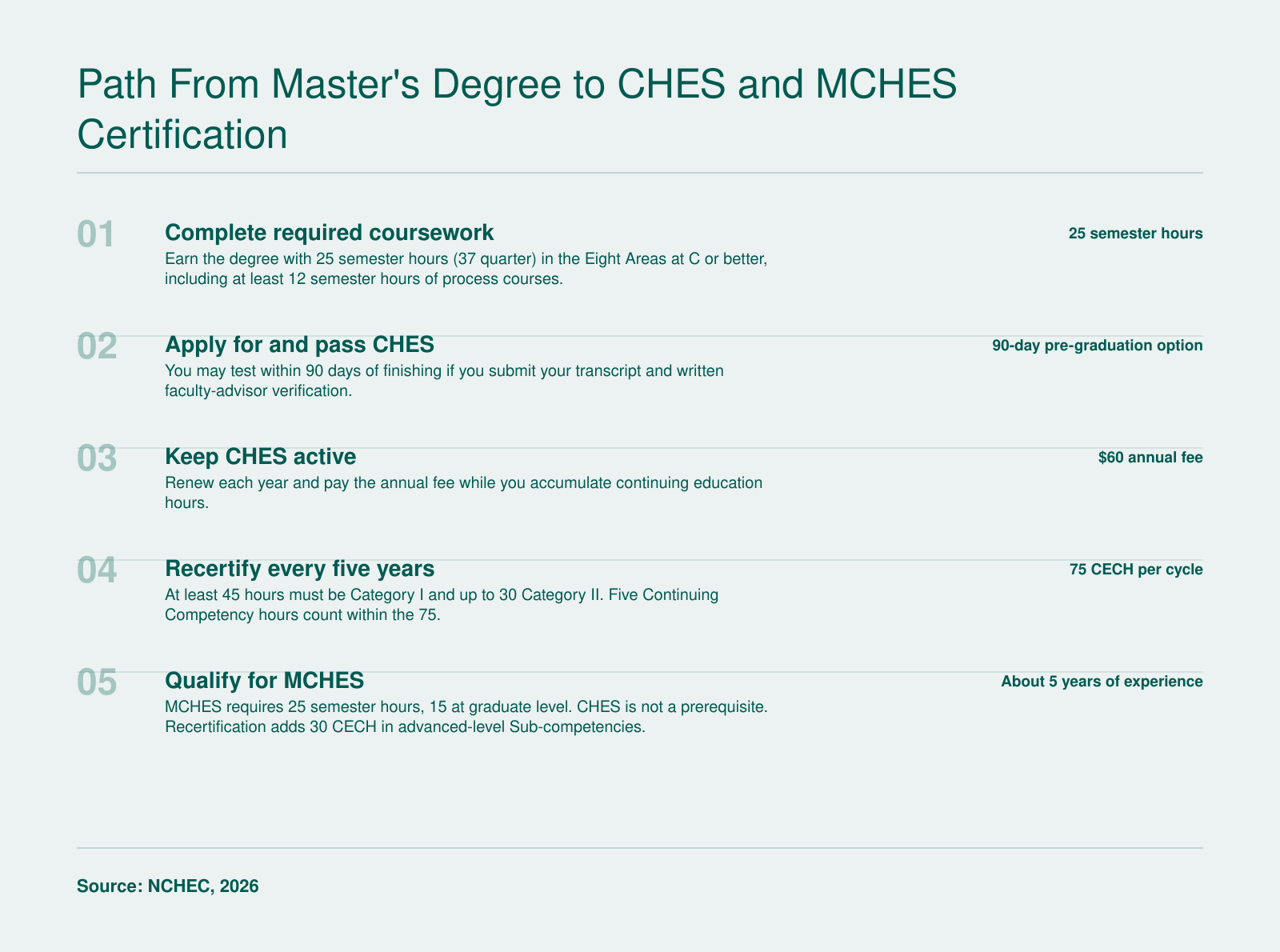
North Carolina does not license health educators. The main national credentials are CHES and MCHES from NCHEC. CHES eligibility requires a bachelor's or higher plus 25 semester credits of health education coursework with grades of C or better.3 MCHES requires a master's, five years of experience, and two verification forms; prior CHES is not required if you independently meet the coursework threshold.4 To teach health in NC public schools, you need a separate NC DPI educator license in health or health and physical education. A master's alone does not authorize public school teaching.
Path From Master's Degree to CHES and MCHES Certification
NCHEC sets the national credentials for health educators, and the steps run in a fixed order. Here is the route from a master's program to CHES and then MCHES.
Master's in Health Education vs. MPH: Which Degree Is Right for You?
The two degrees overlap, but they are built for different jobs. In North Carolina, the MPH programs on this list at UNC Chapel Hill, UNC Asheville, and North Carolina Wesleyan University each require 42 credit hours. Master's in health education programs typically run shorter, so confirm the exact requirements with each school. Choose health education if you want to teach or run programs in schools and communities. Choose the MPH if you want broader public health practice and leadership.
| Factor | Master's in Health Education | MPH |
|---|---|---|
| Focus | Behavior change, health teaching, program planning and delivery for schools and communities | Population health across epidemiology, policy, biostatistics, environmental health, and health management |
| Typical credit hours | Often about 30 to 36 credits, varying by program | 42 credits at UNC Chapel Hill, UNC Asheville, and North Carolina Wesleyan |
| Practicum or field hours | Usually one internship or field placement; hours vary by school | UNC Chapel Hill: 200 minimum supervised hours. UNC Asheville: noncredit practicum, hours not specified. North Carolina Wesleyan: 7 experiential learning credits, hours not specified |
| Thesis vs. capstone | Varies: thesis, project, or comprehensive exam depending on the school | No thesis required at the programs listed above. UNC Chapel Hill requires a 3-credit culminating experience, UNC Asheville a capstone (PBH 992), and North Carolina Wesleyan a comprehensive exam |
| Accreditation body | Program-level approval or teacher-preparation accreditation, depending on the track | CEPH, which requires an applied practice experience and an integrative learning experience |
| Career paths | School health educator, community health educator, worksite wellness, nonprofit program staff | Epidemiologist, health policy analyst, program manager, public health agency leader |
Frequently Asked Questions About Master's in Health Education Programs in North Carolina
What is the average tuition for a master's in health education in North Carolina?
Which North Carolina schools offer CEPH-accredited health education programs?
Can I take the CHES exam before I finish my master's?
Do I need a teaching license to teach health in North Carolina public schools after earning this degree?
Compare Health Education programs on the data that matters
Explore more Healthcare specializations or browse every graduate field.
All Healthcare programs